Raising a Labrador puppy rests on five habits: early socialization, scheduled house training, recall by 5 months, steady training through adolescence, and measured meals. Socialize widely in the first three months, and keep teaching through the 6–10 month adolescent stretch. Feed large-breed puppy food, and keep forced exercise short.
Most first-time owners get caught off guard by adolescence. The Lab that learned reliably at 5 months seems to forget everything at 8 months. That’s normal development, not a training failure, and this guide shows what raising a Labrador puppy looks like in each phase.
The Four Phases of a Lab’s First Year
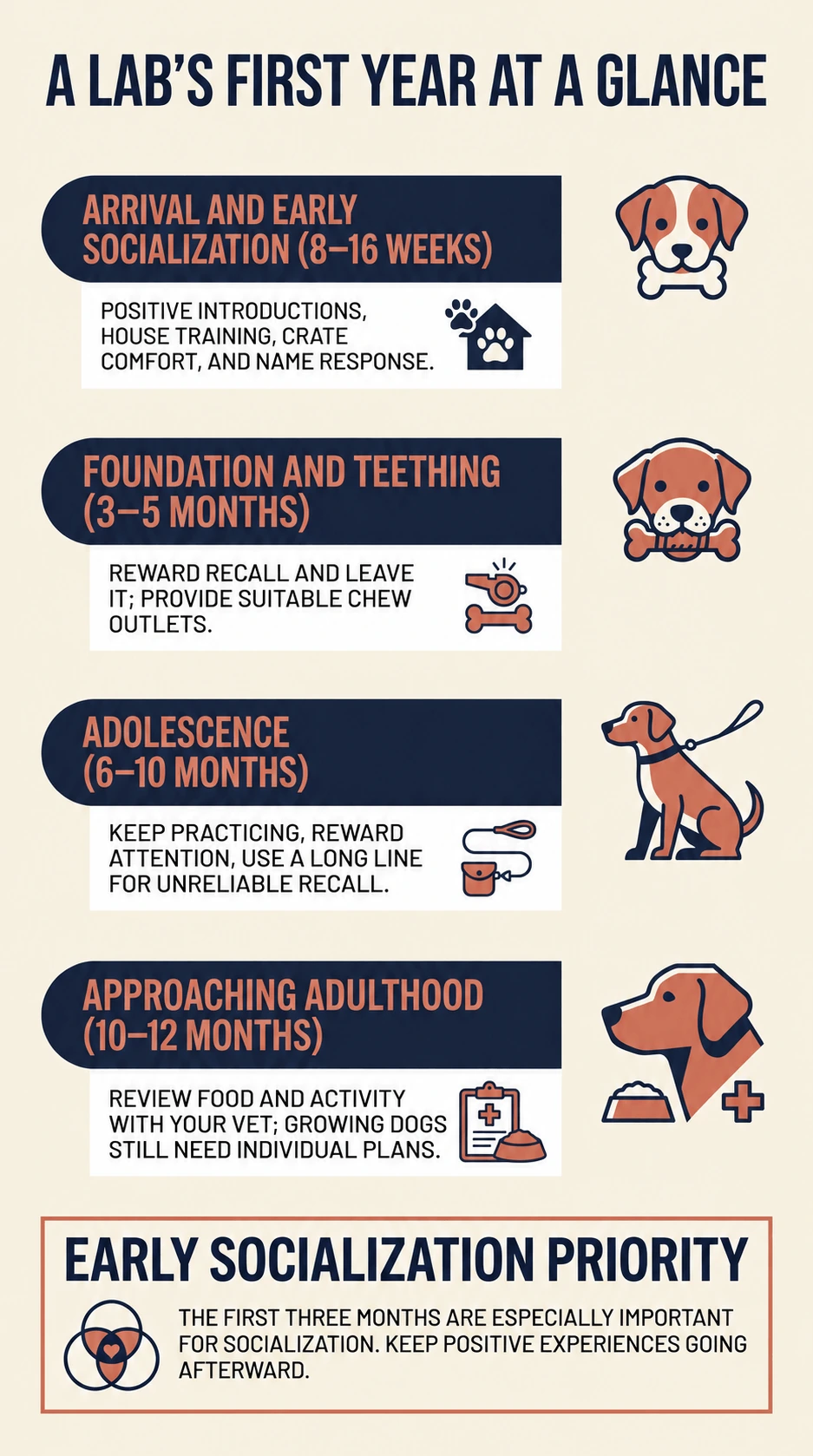
A Lab’s first year breaks into four phases. Each one brings a real physical and behavioral shift, so the challenges arrive on a fairly predictable schedule.
Knowing which phase you’re in is the most useful tool you have. It tells you which problems are temporary and which habits need work right now.
Phase 1 runs from arrival at about 8 weeks to 16 weeks. The first three months of life are the most important time for socialization, so the weeks right after pickup count heavily. House training, the crate, and name recognition start here too.
Phase 2 covers months 3 through 5. Adult teeth start pushing through at about 3.5 months, so chewing and mouthing peak. This is when sit becomes reliable, leave it takes shape, and recall gets its foundation.
Phase 3 is adolescence, roughly months 6 through 10. Hormonal changes shift the dog’s attention away from you and toward the world. Recall slips, leash pulling grows, and counter-surfing begins.
None of that is defiance. It’s a developmental stage, and it passes faster when training continues through it.
Phase 4 runs from about 10 to 12 months. Behavior starts improving in a steady way, the switch to adult food comes due, and graduated running becomes possible.
Weight climbs fast across all four phases. A male Lab often goes from 10–15 lb at 2 months to 65–80 lb at 12 months. Track your dog against the weight checkpoints on our growth chart rather than one target number.
Before Your Puppy Comes Home and the First Week
Raising a Labrador puppy starts before pickup day. A puppy at 8 weeks puts everything in its mouth, so puppy-proof at floor level first.
Secure or hide electrical cords. Move toxic houseplants out of reach, and clear socks, hair ties, coins, and small toys off the floor. Set up baby gates or an exercise pen so the puppy has one safe zone instead of the whole house.
Put the crate in its permanent spot before the puppy arrives. Stock two or three durable rubber chew toys, because a teething Lab will pick its own chew toys if you don’t.
Ask the breeder or shelter for the exact food brand and formula, and buy that same food. An abrupt food change on top of a new home often means an upset stomach in week one. If you plan to switch, do it gradually once the puppy settles.
Plan the ride home too. Bring a towel, a small crate or a second person to hold the puppy, and paper towels. Stop at the yard potty spot before you go inside, so the first thing the puppy learns is where to go.
Book the first vet visit within 48 to 72 hours of pickup. The puppy needs a baseline exam and a deworming plan. Bring the breeder’s or shelter’s records of every vaccine and dewormer so far.
Buy pet insurance before that visit. Anything found at the first exam can become a pre-existing condition, and most policies exclude those.
Budget for more than the purchase price. Our year-one budget and breeder checklist puts the first year at about $2,800 to $6,500 with the puppy included. That covers vet care, food, setup, training, and insurance.
A Simple First-Week Plan
Keep day one quiet. Let the puppy explore one room and the yard potty spot, then offer a meal and a nap in the crate. Save the visitors for later in the week.
Put the crate next to your bed for the first nights. Whining at night is a normal settling phase, since the puppy is sleeping without littermates for the first time. In our experience, it usually eases within the first week.
Hearing you breathe nearby is often enough to calm a puppy. Answering every whine with play tends to stretch the whining phase out. Night potty trips stay quiet and boring: out, potty, praise, and back to the crate.
Spend the rest of the week on short handling sessions, regular potty trips, and plenty of sleep. Touch paws, ears, and the mouth for a few seconds at a time, and pair each touch with a treat.
Keep the household rules consistent from day one. Decide now whether the puppy is allowed on the couch, and ask for a sit before meals and before the door opens. Changing the rules later is much harder than starting with them.
For a day-by-day version, read about the first night and first week at 8 weeks, including night one, feeding, and potty reality.
A Daily Routine That Changes With Age
A puppy’s day is built from five blocks: meals, potty trips, sleep, short training, and play. What changes with age is the size of each block, not the structure.
A predictable day does more for house training and sleep than any single trick. Puppies learn faster when meals, naps, and potty trips happen at roughly the same times.
Here is how the day shifts across the first year. Meal counts come from our puppy food guide, potty trips from our potty training guide, and sleep from AKC guidance cited in our 8-week guide.
| Daily block | 8–12 weeks | 3–5 months | 6–12 months |
|---|---|---|---|
| Meals | 3–4 a day | 3 a day | 2 a day |
| Potty trips | 8–10 a day: every 1–2 hours awake, plus after waking, meals, and play | About 7–8 at 3 months, 5–6 by 5 months | 5–6, easing toward the adult 3–4 by age one |
| Sleep | 18–20 hours a day (AKC) | Still most of the day, in long naps | Less, but still more than an adult |
| Training | 3–5 minutes, several times a day | Short sessions, several times a day | 5–10 minutes per session |
| Structured walk | About 10 minutes (5-minute rule) | About 15–25 minutes | About 30 minutes at 6 months, growing slowly |
| Alone time | Short practice absences only | Build up gradually | Longer if calm; a midday break still helps |
Sleep deserves protection. An 8-week puppy that crashes after play is recovering, not sick. Overtired puppies tend to get bitier, not calmer, so treat the crash periods as crate time.
Alone time is a skill you build, not a switch you flip. Start with a few minutes while the puppy naps in the crate, then stretch it slowly. An 8-week puppy should never spend a full workday alone in a crate.
Practice departures when nothing is at stake. Leave a stuffed chew toy in the crate, step out for a few minutes, and come back calmly with no big greeting. The steps for building alone time without panic include the warning signs that mean you should slow down.
If you work away from home, plan the first months around the puppy. A midday visit from a family member, neighbor, or dog walker covers a meal, a potty trip, and some play. An exercise pen with the open crate inside gives more room than a crate alone for longer stretches.
A Sample Day at About 10 Weeks
This sample uses the numbers above. Your clock times will differ, but the order of events stays the same.
- Wake up and go straight outside to the potty spot.
- Breakfast, then outside again.
- Play and one short training session.
- Nap in the crate.
- Wake, potty, short play, and back to a nap; repeat through the day.
- Midday and afternoon meals, each followed by a potty trip.
- Evening quiet play, a last potty trip, and bed in the crate beside you.
- One or two quiet potty trips overnight on an alarm.
Night sleep improves as bladder control does. Our potty training guide’s rule is simple: before 4 months, set a 2–3 hour alarm for a quiet trip outside. Skip food within about two hours of bedtime when you can, since that reduces overnight accidents.
House Training and Crate Basics
House training is the first big project in raising a Labrador puppy. It works on timing, not willpower: you take the puppy out before it needs to go, so it rarely fails indoors.
Go out right after waking, within about 10 minutes of each meal, after every play session, and every 1–2 hours while the puppy is awake. That schedule comes from our full house-training schedule, which also covers the night routine.
Use one spot and one cue word. Stand still, say the cue once, and wait. Reward within a second or two of finishing, outside, not after you walk back in.
Learn the warning signs. Sniffing the floor, circling, or wandering off toward a corner usually means the puppy needs to go now. Pick it up or leash it and head straight outside.
A simple log helps for the first two weeks. Write down meal times, potty times, and accidents, and patterns appear fast. Most puppies need to go at roughly the same points each day.
Accidents will happen. Clean them with an enzyme cleaner, which breaks down the odor that draws a puppy back to the same spot. Never punish an accident, because it teaches the puppy to hide when it goes.
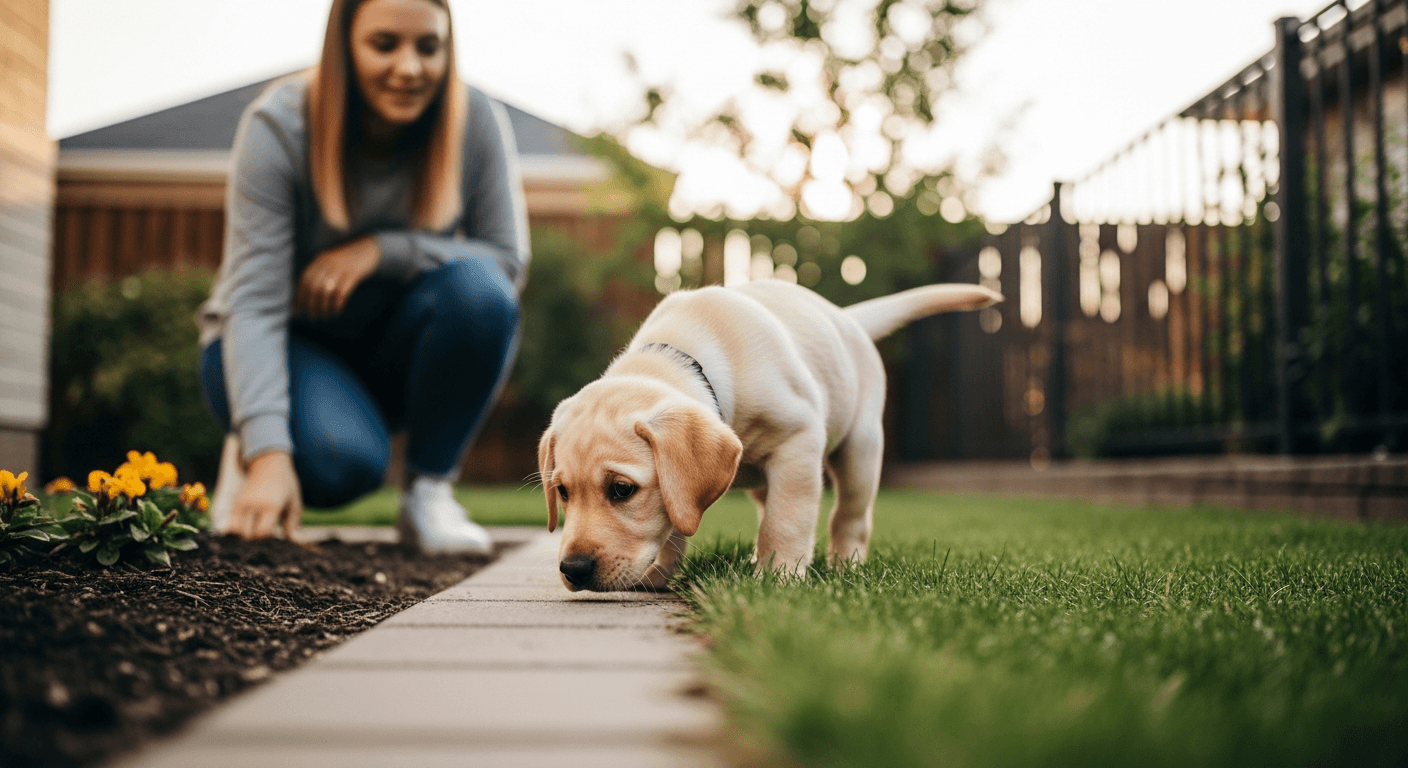
The crate is a bedroom, not a jail. A puppy that walks in on cue for a treat, naps there, and eats there learns to settle on its own.
Size matters. The puppy should be able to stand, turn, and lie flat, with no spare room for a bathroom corner. Many Lab owners buy an adult-size crate with a divider and move the divider as the puppy grows.
Never use the crate as punishment or for a full workday. For the first introduction, nighttime whining, and building duration, follow our crate training step by step.
Expect setbacks during teething and the first adolescent months. When accidents return, go back to the basic schedule for a week, and progress usually returns with it.
Socialization Before About 14 Weeks
Socialization is the part of raising a Labrador puppy with the tightest timeline. The AVSAB position statement on puppy socialization is clear on timing. “The primary and most important time for puppy socialization is the first three months of life.”
In practice, the weeks you control, from about 8 to 12–14 weeks, carry the most weight. Sensitivity then tapers gradually. AVSAB strongly encourages owners to keep socializing after that point, so the work doesn’t stop on a birthday.
Aim for many short, positive exposures, never forced ones. Introduce people of different ages, people in hats, glasses, uniforms, and beards, and people using canes or wheelchairs.
Add surfaces like grass, gravel, wood floors, metal grates, and stairs. Add sounds like traffic, children playing, the vacuum, and thunder recordings played quietly. Short car rides and calm, vaccinated adult dogs belong on the list too.
Watch the puppy’s body language. If it freezes, tucks its tail, or tries to hide, add distance and slow down. A frightening exposure teaches the opposite of what you want.
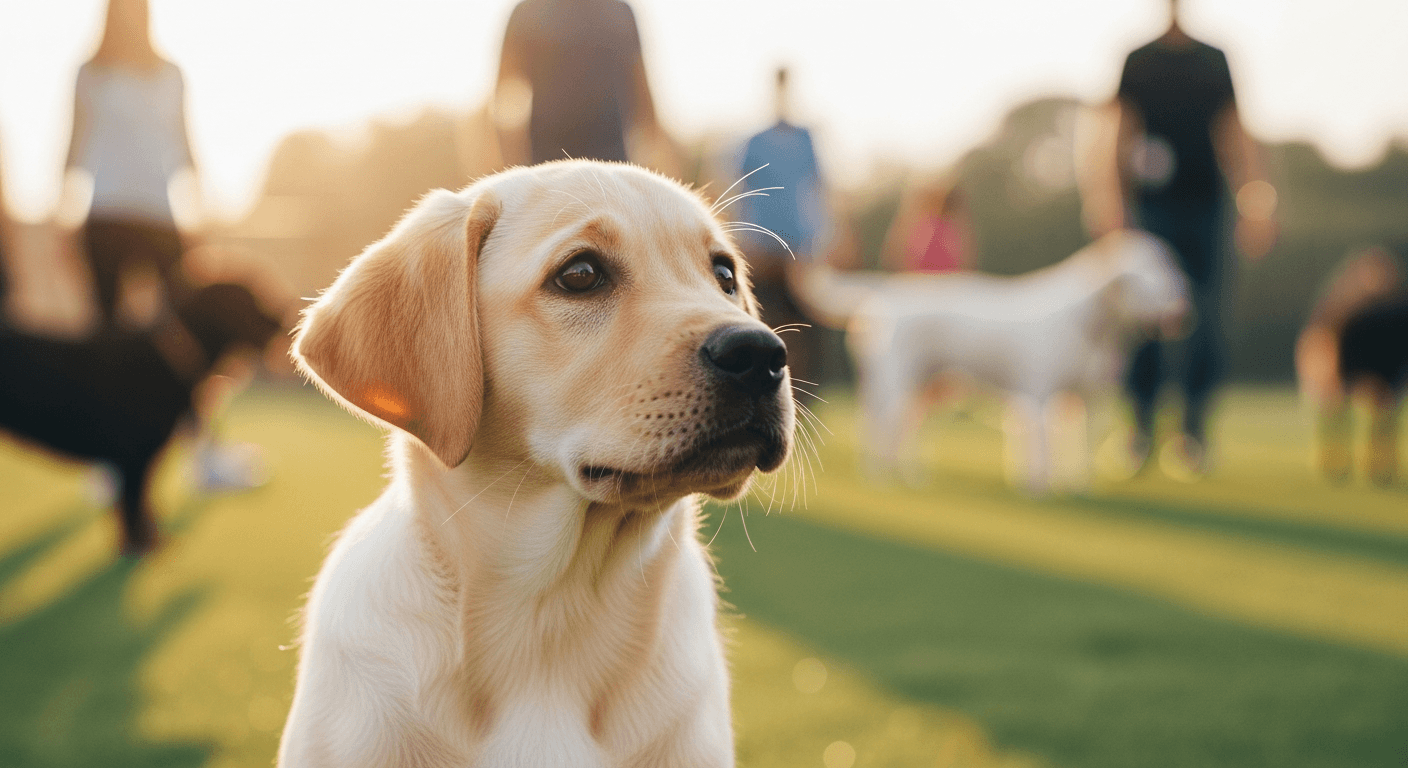
Watching dogs and people from a calm spot is useful exposure. Save off-leash dog park visits for later, once vaccines are complete and your puppy is confident.
Many owners wait for full vaccination before socializing. AVSAB says socialization before puppies are fully vaccinated should be the standard of care. It also notes that puppy classes can start as early as 7–8 weeks.
Good classes require up-to-date vaccines for every puppy. The core vaccine series runs to about 16 weeks, so plan exposure around the risk rather than waiting for the series to end.
When you visit a class, look for small groups, a clean floor, and short, supervised play between puppies of similar size. The trainer should use treats and praise, never leash jerks. A shy puppy should be allowed to watch first.
Handling at the vet is socialization too. Ask the staff to offer treats during the exam, and stop by for a quick weigh-in and a cookie when no shots are due.
Can you take a 9-week-old puppy outside? Yes, with care. Carry the puppy in busy areas, use clean private yards, and visit friends who have healthy, vaccinated dogs.
AVSAB advises avoiding dog parks and other places heavily used by dogs of unknown vaccination status. Our socialization checklist breaks exposures down by type and week.
By 12 weeks, most puppies are ready for busier, but still controlled, outings. Read up on what a 3-month-old Lab can handle before you plan them.
First Commands, Leave It, and Recall
Everything gets easier once a few cues work. Early lessons are short and few: name, sit, crate on cue, and the first steps of recall.
Name recognition comes first. Say the puppy’s name once in a happy tone, and reward every glance. Aim to have it solid by about 10 weeks.
Sit is the first formal command. Lure the nose up with a treat, mark the moment the rear touches the floor, and reward.
Crate on cue follows the same logic. Toss a treat inside, say the cue, and praise when the puppy walks in on its own.
Keep sessions to 3 to 5 minutes, several times a day. Stop while the puppy still wants more, and always end on a success. Pushing past the point where it checks out teaches it to check out.
Down comes next, usually once sit is reliable. Lure the nose from a sit straight down to the floor between the front paws, and reward the moment the elbows touch.
Start leash manners early, too. Clip on a light leash indoors, reward the puppy for walking beside you, and stop moving the instant the leash goes tight. A puppy that learns pulling gets it nowhere will be far easier to walk at 70 lb.
We use reward-based methods throughout. Markers, lures, and fading treats are all covered in our reward-based training methods.
Leave It: A Safety Cue for a Breed That Eats Anything
Labs eat grass, stones, socks, and anything dropped on a sidewalk. A solid leave it is a safety cue, not a party trick. It stops the grab before swallowing becomes an option.
Build it in steps. Start with a low-value object, then food on the floor, then food in your hand, then food dropped by accident.
Have it working before the puppy reaches counter height. Adolescence is much easier when leave it already exists.
Pair it with drop it for things already in the mouth. Offer a treat at the nose, say the cue as the item falls, and give the item back when it’s safe. Trading, not chasing, keeps a Lab from learning that grabbing starts a fun game.
Recall Before Adolescence
Recall deserves more practice in months 3 to 5 than any other cue. The recall a Lab has at 8 months is largely the recall you built before adolescence.
Aim for a dependable recall at 5 months in your yard and on a long line. Then add new places and mild distractions one at a time.
Use a long line, 15 to 20 feet, and high-value treats like real cooked chicken or cheese. Call once in a happy tone. If the puppy doesn’t respond within about 3 seconds, reel in gently or move away to draw it toward you.
Never call the puppy for something unpleasant, like a bath or the end of a fun walk. If coming to you always makes life better, the cue stays strong into adolescence.
For what to teach at each age, follow our age-by-age training schedule. For adult obedience and the bigger picture, see our complete Labrador training guide.
Teething, Biting, and Other Normal Puppy Behavior
Mouthing at 8 to 16 weeks is bite inhibition practice. The puppy learns how hard is too hard through feedback, so it isn’t aggression.
The teething peak hits between about 3.5 and 5 months as adult teeth push through. Gum discomfort drives harder chewing and biting, which is physical, not a behavior setback. Our tooth-by-tooth teething timeline shows which teeth come in when.
Give the mouth a job before you correct it. Frozen stuffed rubber toys put cold pressure on sore gums, and rubber chews made for strong chewers last longest. Supervise any edible chew, such as a bully stick.
When teeth touch skin, give a short, sharp yelp and withdraw play for 30 to 60 seconds. Skip muzzle holds and nose flicks. The goal is to show the puppy that hard bites end the fun.
The yelp works for many puppies, but some get more excited. If yours does, stand up, go quiet, and step away instead.
Children need their own rules during this stage. Kids should not run from or wrestle with a mouthy puppy, since both turn biting into a game. An adult supervises every session, and the puppy gets a chew toy or a crate break when it gets wound up.
Protect your belongings with management, not scolding. Keep shoes in closets, use bitter spray on chair legs if needed, and trade any stolen item for a treat. The fourth month is often the mouthiest, and the 4-month teething stretch has its own survival tips.
Normal Behaviors That Worry New Owners
Zoomies, sudden bursts of wild running, are a normal release after meals, baths, or crate time. Give the puppy a safe space and let the burst run its course.
Some puppies stiffen over the food bowl at 8 to 10 weeks. Approach while the puppy eats and drop in a better treat, so a person near the bowl means more food. This is far easier at 9 weeks than at 9 months.
Heavy sleep after play is normal too, as the routine table shows. For more examples on both sides of the line, see normal vs concerning puppy behavior.
When to Call the Vet or a Trainer
We call the vet for loose stool lasting more than 48 hours, or for a puppy that refuses food for more than 24 hours. Lethargy that doesn’t follow hard play or heat is also worth a call.
Any limp or reluctance to bear weight needs a vet check within 24 hours. Growth plate injuries in puppies can be subtle at first.
Growling at family members calls for a qualified trainer, not punishment. Punishing a growl removes the warning but not the discomfort behind it.
The Adolescent Months: 6 to 10
For most owners, the hardest months with a Lab are 7 to 9. Some sources stretch the difficult period from 6 to 18 months, and that’s fair. In our experience, 7 to 9 months is the peak inside it.
Adolescence in Labs is biological. Hormonal changes begin around 6 months, and the dog’s attention shifts from you to the environment. The start of that shift is laid out in how 6 months changes your Lab.
The effects are predictable. Recall gets patchy, so the dog hears its name and keeps sniffing. Leash pulling reaches near-adult strength.
Counter-surfing begins as the front paws reach table height. By 8 months, many males already weigh 50–65 lb on our growth chart, tall enough to reach most counters. Jumping on guests gets harder to interrupt because attention is such a strong reward.
Many trainers also describe a second fear phase during adolescence. A dog that greeted strangers happily at 5 months may hesitate at 9 months. Patient, positive exposure usually helps it pass.
Expect the 7-month peak to feel like a step backward. That feeling is normal, and it isn’t a sign that your earlier training failed.
By the eighth month, your Lab has close to adult strength and puppy judgment. Handling that combination safely is the focus of 8-month adolescence.
The Biggest Mistake: Stopping Training
The most common mistake in raising a Labrador puppy is stopping training because the dog seems to have forgotten everything. Every session during this phase, even an imperfect one, keeps the skill alive for the adult dog.
Upgrade the reward. A Lab that worked for kibble at 4 months often needs real chicken, cheese, or hot dog pieces at 8 months. The world got more interesting, so the payment has to match.
Keep sessions to 5 to 10 minutes and end on success. Practice recall on a long line in moderate distraction rather than abandoning it after one failure at a busy park.
Owners who keep training through adolescence usually see the payoff sooner. The dog doesn’t lose the skills; it needs more reasons to use them for a few months.
Give the brain work as well as the legs. Sniff walks, food puzzles, short retrieving games, and scatter-feeding part of a meal in the grass all tire a teenage Lab. Retrieving is what the breed was built for, so use it as a reward.
Manage the Environment
Management is the second lever. A counter-surf rehearsed dozens of times becomes a habit, but a dog that finds nothing on the counter has nothing to rehearse.
Jumping works the same way. Turn away before the paws land, and give attention the moment all four feet are on the floor. Repeated hundreds of times, four on the floor becomes the default.
Use baby gates, a clear counter, and a leash indoors when guests arrive. Management isn’t giving up on training; it keeps bad habits from hardening while training catches up.
If problems go beyond the normal adolescent slump, read through adolescent behavior problems, where chewing, barking, and pulling get a full plan each.
Most Labs show the first signs of settling at 9 months or soon after, provided training kept going. The first birthday is a turning point, not a finish line.
Feeding, Exercise, and Growth by Age
Meal frequency drops twice in the first year. These counts match our puppy food guide, which also lists cup amounts by age.
| Age | Meals per day | Why |
|---|---|---|
| 8–12 weeks | 3–4 | A small stomach handles small, frequent meals |
| 3–6 months | 3 | Stomach capacity grows |
| 6–12 months | 2 | Morning and evening, the adult rhythm |
We leave portions out of this guide on purpose, because they depend on the food’s calories per cup. See our portions by age and food picks for cups per day.
Large-Breed Puppy Food
Feed a large-breed puppy formula until the switch at 12 to 15 months. Vets recommend these formulas because they control calcium and calories, and too much of either during growth raises joint risk in big breeds.
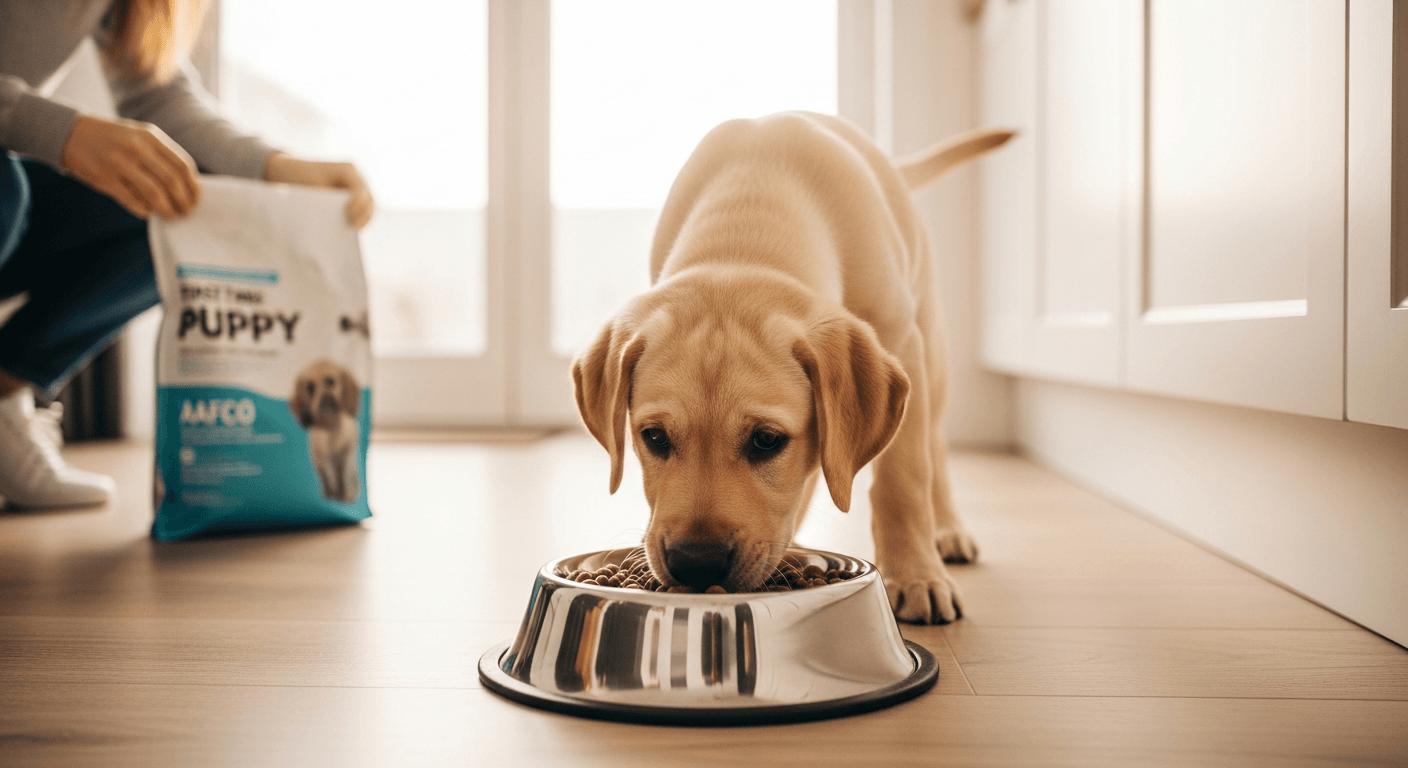
Check the bag for an AAFCO growth statement. Look for the phrase “growth of large size dogs (70 lb. or more as an adult).” If that wording is missing, the food wasn’t formulated for large-breed puppies.
Skip calcium supplements and meal toppers unless your vet prescribes them. A complete puppy food is already balanced, and extras throw that balance off.
Measure Every Meal
Food is where things go wrong most quietly, because extra pounds build slowly. Measure every meal with a real measuring cup.
Labs don’t self-regulate their intake. Free feeding produces an overweight Lab, and extra weight loads growing joints.
Part of the reason is genetic. A 2016 University of Cambridge study found a POMC gene variant in about 23% of the Labs tested, roughly 1 in 4. It blunts the feeling of fullness, so carriers act hungry all the time.
Judge portions by body condition, not appetite. You should feel the ribs under light pressure and see a waist from above.
If the puppy is getting round, trim the portion slightly and ask your vet. Treats count toward the daily total, so keep training treats pea-sized. After the first year, our adult feeding amounts take over.
Exercise by Age: The 5-Minute Rule
Puppy joints need activity, but not forced mileage. The AKC Lab milestone article quotes a breeder on this. She recommends “about five minutes of activity per month of age.”
Apply it to structured walks and on-leash outings, per session. Self-paced play in a safe yard doesn’t count against it, because the puppy stops when it’s tired.
| Age | Structured walk per session |
|---|---|
| 3 months | About 15 minutes |
| 4 months | About 20 minutes |
| 5 months | About 25 minutes |
| 6 months | About 30 minutes |
This is a breeder and vet rule of thumb, not the result of a controlled study. No formal data sets an exact number, so watch your puppy and stop when it lags, lies down, or limps.
The same AKC article notes that one breeder starts swimming lessons at about 3 months. Another holds off on stairs until about 4 months. Leash walks stay short until 6 months, then grow gradually, with no jogging yet.
Some puppy guides recommend 60 to 90 minutes of daily exercise for puppies. That’s adult-level volume, and it’s too much forced exercise for a growing Lab.
The target rises after the first year. Plan on at least an hour of real activity a day, and closer to two for a young Lab. In the largest owner study of Labs (Dogslife, 4,307 dogs), the typical dog got about 2 hours a day, mostly off-leash play and retrieving rather than leash walks.
Build toward that slowly through the second year, and read about adult exercise needs before you add running.
Growth Checks
Weight tells you whether food and growth line up. Use the checkpoints above as your guide. Per our growth chart, a male at 4 months is often 30–40 lb, and a female at 12 months is often 55–70 lb.
A puppy outside those ranges isn’t automatically a problem. Body condition and steady gain matter more than hitting an exact number.
Vet Care, Grooming, and Handling in Year One
Vet care is front-loaded into the first four months. Expect several visits before 16 weeks, then fewer once the core series is done.
Use the first visit to set the plan. Ask for the full vaccine and deworming calendar, a microchip if the puppy doesn’t have one, and the vet’s view on heartworm and flea products. Write down the next due dates before you leave.
The core DA2PP vaccine covers distemper, adenovirus, parvovirus, and parainfluenza. A common schedule gives it at 8, 12, and 16 weeks. Rabies follows local law, often at 12 to 16 weeks.
Bordetella, the kennel cough vaccine, is usually required before classes, boarding, or daycare. Leptospirosis and Lyme vaccines depend on where you live, so follow your vet’s regional advice. Our first-year vaccine and vet schedule lists what happens at each visit.
Parasite control runs alongside the shots. Most vets start monthly heartworm prevention at around 8 weeks and add flea and tick control suited to your region. Ask for a fecal test at puppy visits, since roundworms and hookworms are common and not always visible.
Ask for a body condition check at every visit. Catching extra weight at 4 months is far easier than fixing it at a year. Lean growth protects the joints covered in our guide to lifelong Labrador health.
Neuter Timing
Neuter timing matters more in Labs than in many breeds. A 2020 study by Hart and colleagues at UC Davis drew on records from 1,933 Labs.
Joint disorders occurred in 6% of intact males, rising to 13% in males neutered before 6 months. The paper’s guideline is to neuter males beyond 6 months and to spay females beyond 1 year.
The study found no clear rise in the tracked cancers with neutering in Labs, a breed-specific result. Females raise other factors, including heat cycles and pyometra risk, so the final decision belongs with your vet. Our guide to when to neuter a Lab walks through both sexes.
Grooming and Handling
A Lab coat is easy but not maintenance-free. Brush weekly, and once the adult coat comes in, plan on 2–3 sessions a week during the spring and fall coat blow.
Trim nails every 4–6 weeks. If you hear clicking on hard floors, they’re already too long. Brush teeth daily with dog toothpaste, and dry the ears after every swim.
Handle paws, ears, and mouth daily from 8 weeks, a few seconds at a time with a treat. A puppy that accepts handling becomes an adult that needs no restraint for nail trims or vet exams. Our grooming routine covers tools and technique.
Turning One: What Changes for a 1-Year-Old Lab
By the first birthday, the hardest work of raising a Labrador puppy is behind you. A 1-year-old Lab still isn’t a finished adult, though.
From about 9 to 12 months, most Labs show the first steady improvements. Recall gets more reliable, leash pulling eases with consistent handling, and the dog checks in with you on walks.
The month-by-month detail for 10 to 12 months shows what to expect at each step. Adolescent behavior often runs well into the second year.
No formal study pins down an exact age for maturity. Most Labs settle between 2 and 3 years, and some take until 3 or 4.
A typical week for a 1-year-old Lab looks different from the puppy months. Meals stay at two a day, training sessions can run longer, and off-leash play and retrieving become the core of daily exercise. Keep practicing recall and leave it in new places, because these skills still fade without use.
Your vet will also schedule the first adult boosters around the first birthday. It’s a good visit to review weight, body condition, and the neuter plan.
The Switch to Adult Food
The switch to adult food is due at 12 to 15 months. Choose a large-breed adult formula and blend it in over 7 days:
- Days 1–2: 75% puppy food, 25% adult food
- Days 3–4: half and half
- Days 5–6: 25% puppy food, 75% adult food
- Day 7: 100% adult food
Recheck portions after the switch, since activity often drops around this age. Signs of readiness and the first weeks on the new food are covered in switching to adult food.
Running and Growth Plates
Vets generally advise holding off on structured running until the growth plates mature. In large breeds, that often happens between 12 and 18 months, earlier in smaller females and later in big males.
From the first birthday, we start with 5-minute jog segments on grass or packed dirt. We add 5 minutes a week over 4 to 6 weeks and avoid high-volume sidewalk running until about 18 months.
Height usually settles by 9–12 months, but fill-out continues well after. The difference between height, weight, and maturity is explained in when growth plates close.
Frequently Asked Questions
Is raising a Labrador puppy hard?
It’s demanding at two points: the first weeks of house training and broken sleep, and the 7–9 month adolescent peak. Between those stretches, it’s steady, predictable work. Knowing the four phases helps, because you can see each hard stretch coming and know it will pass.
The breed itself makes some parts easier. Labs are food-motivated and people-focused, so reward-based training works well. The hard parts are energy, chewing, and appetite, which all respond to routine.
At what age do Lab puppies start to calm down?
Most Labs show steady improvement from about 10 to 12 months, provided training continued through adolescence. Real calm takes longer. No study sets an exact age, but most Labs settle in their third year, and a few need until 3 or 4.
Daily exercise and mental work speed things up more than waiting does. A Lab with too little to do stays bouncy for longer.
What age do Labs sleep through the night?
Most Labs can last the night without a potty trip by about 4 months, according to our potty training guide. That assumes a trip outside right before bed and another right after waking. Until then, a quiet alarm trip every 2–3 hours keeps the crate dry.
Keep those night trips dull: no lights, no play, and no talking beyond the cue word. Stretch the alarm gap gradually once the puppy wakes up dry.
How long can a Lab puppy be left alone?
Not long at first. At 8 to 12 weeks, stick to short practice absences, and never crate a puppy for a full workday. Build alone time gradually from there, and arrange a midday break during the first months if you work away from home.
Watch how your puppy handles each step up. Calm napping means you can stretch the time, while nonstop crying or chewing at the crate means you should go back a step.
What is the 5-minute rule for Labradors?
It’s a rule of thumb: about 5 minutes of structured exercise per month of age, per session. A 4-month-old Lab gets about 20 minutes of walking at a time, and self-paced yard play doesn’t count.
Breeders quoted by the AKC use it, but no study sets an exact number. Treat it as a ceiling for forced exercise, and cut a walk short if your puppy lags or lies down.
How long does the Labrador puppy phase last?
Physically, the puppy phase runs about 12 to 15 months and ends with the switch to adult food. Behaviorally, adolescence often runs well into the second year. You don’t get a calm adult at the first birthday; you get the beginning of one.
That gap is why training and management shouldn’t stop at 12 months. The habits you keep through year two decide how quickly the adult Lab shows up.
The one habit to protect in raising a Labrador puppy is to keep training when it feels like nothing is working. Early socialization, recall built before adolescence, and steady management through the 7–9 month peak shape the adult dog. When the first birthday arrives, start planning for life with an adult Lab.