Labrador seizures are most often caused by idiopathic epilepsy, a condition Labs are predisposed to, but toxins, low blood sugar, liver or kidney disease, and brain tumors can also trigger them. During a seizure, keep your hands away from the mouth, time the episode, and get to a vet immediately if it lasts more than five minutes.
Watching your dog seize is frightening. Most single seizures pass within a couple of minutes, and many Labs with epilepsy do well on medication. Knowing what you’re seeing, and what to do, makes the next one far less scary.
This guide to labrador seizures uses veterinary sources only: Cornell’s Riney Canine Health Center, VCA Animal Hospitals, the AKC, VIN’s Veterinary Partner, the University of Minnesota, and published studies of Labrador epilepsy. It isn’t a substitute for your vet, who needs to examine your dog.
What a Seizure Looks Like in a Lab
The seizure most people picture is a generalized one. Cornell’s Riney Canine Health Center describes a dog suddenly falling over with jerking, paddling legs, drooling, sometimes losing bladder or bowel control, and losing consciousness. VCA notes that a generalized seizure usually lasts one to two minutes.
Focal seizures are subtler and easier to miss. They start in one part of the brain, so you might see twitching of an eyelid, lip, or ear, repeated jaw clacking, or snapping at flies that aren’t there. Not all labrador seizures involve a fall, and the dog may stay aware during a focal one.
Cornell describes three phases:
- Before (pre-ictal): restlessness or anxiety that you may or may not notice.
- During (ictal): the seizure itself, usually lasting seconds to minutes.
- After (post-ictal): confusion, disorientation, and tiredness. Some dogs are very hungry.
Despite how violent they look, VCA says seizures are not painful, although your dog may feel confused and might panic. Many owners find that knowing this makes labrador seizures easier to watch calmly.
What Causes Seizures in Labradors
Cornell groups the causes of seizures into a few families, and your vet will work through them to find the one behind your dog’s episodes.
Reactive seizures come from a problem outside the brain, such as low blood sugar, low blood calcium, liver disease, or kidney disease. Some drugs can also lower the seizure threshold. When the underlying problem is fixed, these labrador seizures usually stop.
Toxins are the cause owners can most often prevent. Cornell lists dark chocolate, caffeine, the sugar substitute xylitol, antifreeze, rat poison, and liquor. Our list of foods Labs should never eat covers the kitchen risks, and if you suspect poisoning, call your vet or the ASPCA Animal Poison Control Center at (888) 426-4435.
Structural seizures come from a problem in the brain itself, such as a tumor, head trauma, inflammation, or infections like distemper. They’re one reason any first episode of labrador seizures needs a vet exam.
Idiopathic epilepsy is the most common cause of seizures in dogs, according to Cornell, and it’s the usual answer for labrador seizures too. It means repeated seizures with no cause that tests can find.
Age is one of the best clues. Cornell says idiopathic epilepsy usually starts between 6 months and 6 years of age. Puppies under a year are more likely to have a congenital problem, a toxin, or an infection like distemper.
A first seizure after age 6 points more often to a metabolic problem or a brain lesion such as a tumor or stroke. If your Lab is older, our guide to health changes in older Labs covers what else to watch for, and new labrador seizures in a senior always need a prompt vet visit.
Idiopathic Epilepsy: Why Labs Are Prone to It
Labs are on the lists of breeds predisposed to epilepsy. Cornell names Labrador Retrievers among the breeds with higher rates of seizure conditions. VIN’s Veterinary Partner says Labs and Golden Retrievers are predisposed but tend to start their seizures relatively late, closer to age five.
One study puts a number on labrador seizures from epilepsy. In a study of Danish Labrador Retrievers published in 2002, 3.1% of the dogs had epilepsy, compared with the 1% prevalence the authors cite for dogs in general. Epilepsy was about six times more likely in dogs over 4 than in younger ones.
That was one Danish study, not a US rate, but it fits with what vets describe. It found no significant difference in risk between males and females, while Cornell notes males may be more predisposed, so the evidence on sex is mixed.
Idiopathic epilepsy is a diagnosis of exclusion, so labrador seizures get this label only after other causes are ruled out. Cornell explains that vets rule out other causes with bloodwork and a urine test, and sometimes an MRI and a spinal fluid sample, often with help from a veterinary neurologist.
If those tests are normal in a dog that has had at least two seizures 24 hours apart, a tentative diagnosis of idiopathic epilepsy is made. Cornell says a genetic component is known in some breeds and suspected in others, but none of the sources we reviewed describe a DNA test for Lab epilepsy, so labrador seizures can’t be screened out the way some inherited conditions can.
Seizure, EIC, or Paroxysmal Dyskinesia?
Labs have two well-known look-alikes that can be confused with a seizure. Getting the label right matters, because the management is completely different.
Paroxysmal dyskinesia, also called atypical seizures, is an episodic movement disorder that mimics labrador seizures, and the University of Minnesota’s Canine Genetics Lab says is commonly recognized in Labrador Retrievers. Some dogs just stagger and look dazed for seconds or minutes. Others can’t stand for 2 to 5 minutes and try to crawl, yet stay conscious and can even recognize their owners.
Episodes often happen as the dog drifts off to sleep or wakes up, though exercise and excitement trigger them in some Labs. UMN notes that many affected dogs have far fewer episodes on anticonvulsant medication. In three published reviews of Labs with epilepsy, focal motor seizures were described in 10 to 70% of the dogs, so these subtle labrador seizures are not rare.
Exercise-induced collapse (EIC) is a genetic condition in which a Lab loses control of its back legs after 5 to 20 minutes of intense, exciting exercise. The dog stays alert and usually recovers within about 5 to 25 minutes, and a DNA test confirms it. Our guide shows what an EIC episode looks like.
Heart problems can also look like a seizure. Cornell says a cardiac collapse tends to be softer, more like fainting, and the dog usually recovers more quickly.
- Seizure: A generalized seizure often takes away awareness, can start at rest with no trigger, brings falling, paddling, and drooling, and usually lasts 1 to 2 minutes. Vets diagnose it by ruling out other causes.
- Paroxysmal dyskinesia: The dog stays conscious, often around sleep, waking, or excitement, and staggers, trembles, or tries to crawl for seconds up to 2 to 5 minutes. Other causes are ruled out first.
- EIC: The dog stays alert, collapses after 5 to 20 minutes of intense, exciting exercise with the back legs going first, and recovers in about 5 to 25 minutes. A DNA test confirms it.
Whatever you see, take a video if you safely can. Cornell says a video can be immensely helpful because your vet has to decide whether the event was a seizure at all, and that’s the hardest part of diagnosing labrador seizures.
What to Do During and After a Seizure
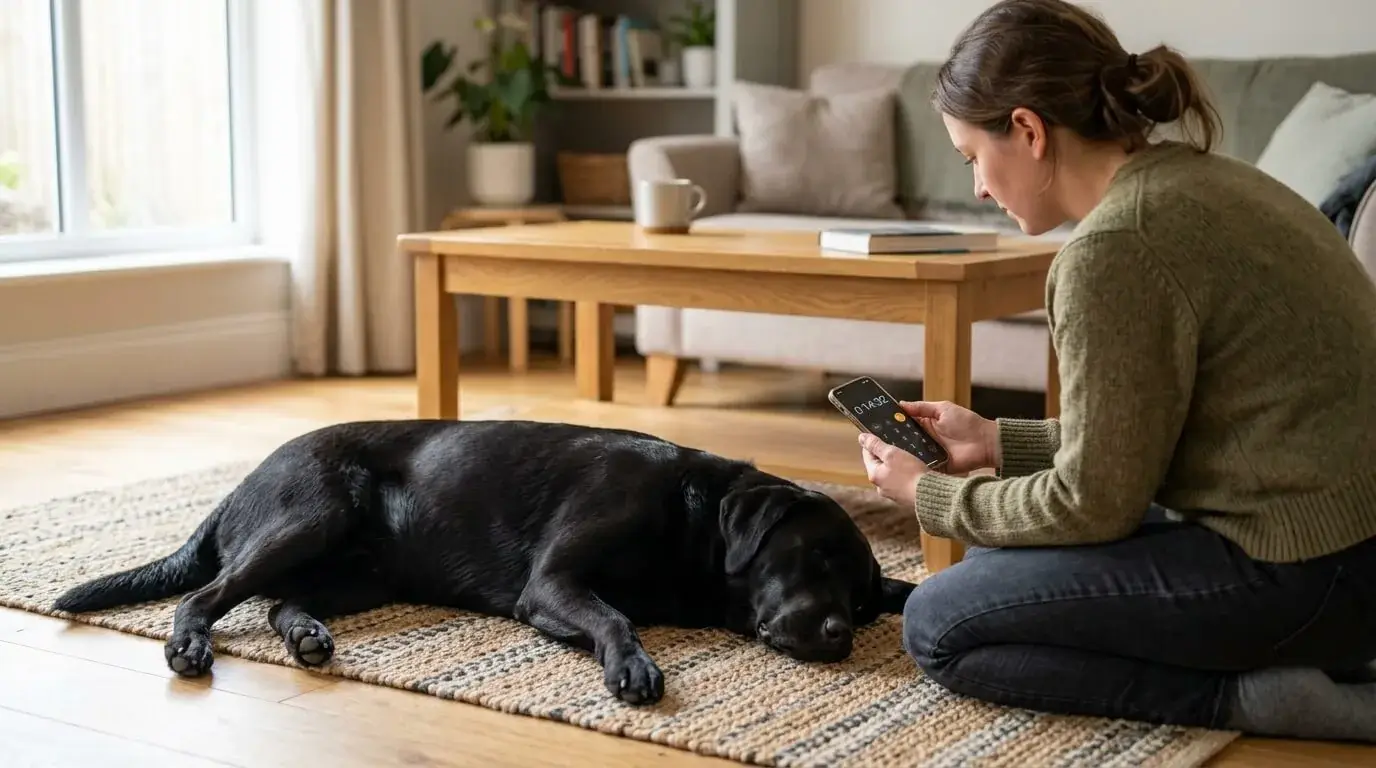
You can’t stop a seizure at home. Your job is to keep your Lab, and yourself, safe until it passes.
- Stay calm and clear the area. Move anything that could fall on your dog. If your Lab is near stairs, Cornell suggests staying below it on the steps if you safely can.
- Keep your hands away from the mouth. VCA and the AKC both say dogs don’t swallow their tongues during a seizure, and fingers or objects in the mouth risk a bad bite.
- Don’t hug or hold the head. Cornell notes that your dog isn’t aware of its surroundings or in control of its movements.
- Time it. Check the clock when it starts, because the five-minute mark decides whether it’s an emergency.
- Video it. A short clip helps your vet more than any description.
- Keep the room quiet and dim the lights if you can.
After the seizure, stay with your dog while it recovers. Cornell warns that in the minutes to hours afterward, a dog can stay disoriented or confused, and that confusion can sometimes show up as aggressive behavior. Give your Lab space and keep children away, as you would after any of its labrador seizures.
Once your dog is back to normal, call your vet. The AKC says to schedule an appointment even if a seizure lasted less than a minute and your dog seems fine afterward.
Write down the date, time, length, and what your dog was doing beforehand. A record like this is the most useful thing you can bring to a vet visit about labrador seizures.
When a Seizure Is an Emergency
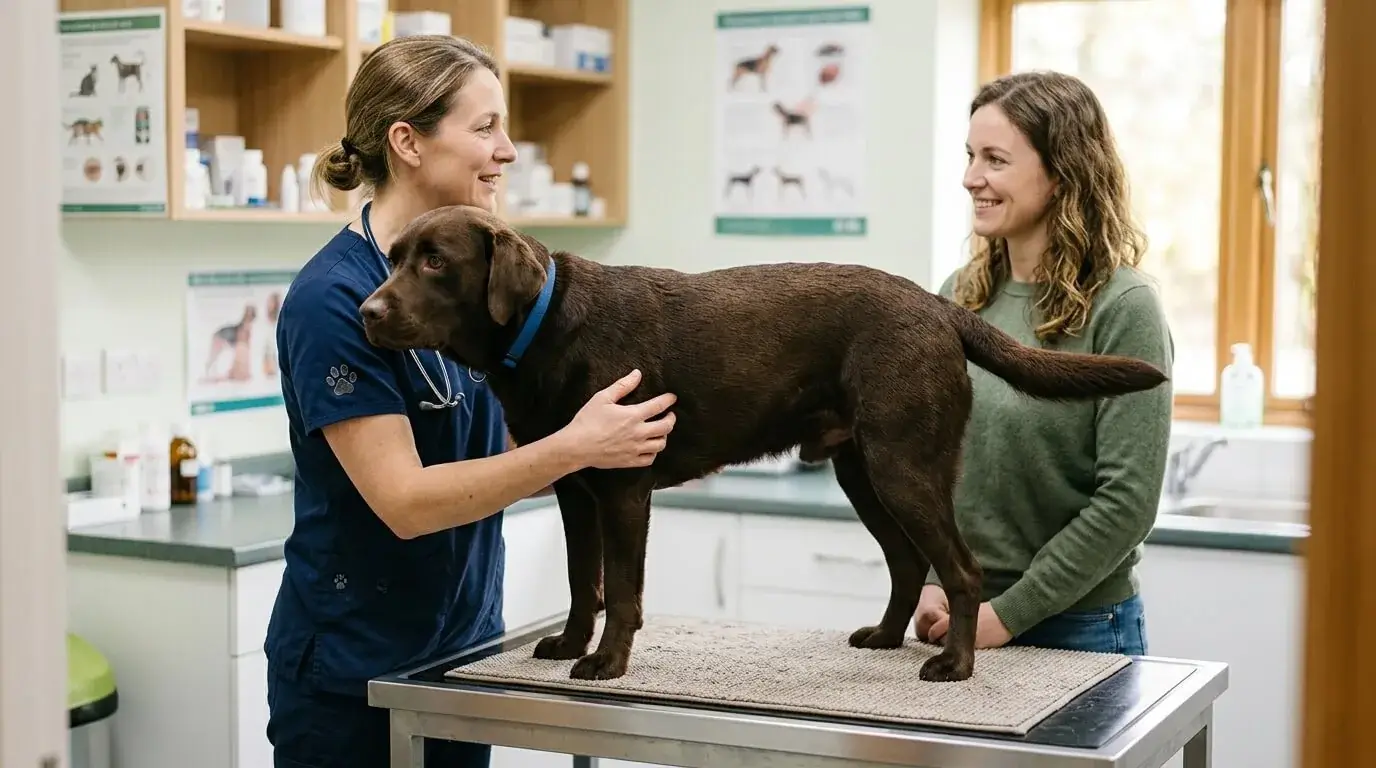
Most single seizures aren’t emergencies, but a few situations are. Go to the nearest emergency vet immediately if:
- The seizure lasts more than five minutes. Cornell and VCA call this status epilepticus, and it’s life-threatening.
- Your dog has more than one seizure in 24 hours. The AKC calls this a cluster and says to see a vet right away.
- Your dog doesn’t recover normally between seizures.
- You think your dog ate something toxic.
With long or repeated labrador seizures, the danger is heat as well as the seizure itself. VCA explains that with repeated or long seizures, body temperature begins to rise. The AKC notes that dogs with generalized seizures can reach 105°F or higher.
A first seizure isn’t usually an emergency once it’s over, but it still needs a vet visit. It’s on the short list of signs that need a same-day vet visit in our Lab health guide.
If labrador seizures stop on the way to the clinic and your dog stays quiet, Cornell says the status epilepticus emergency is over. Your vet still needs to see your dog.
Treatment and Living With an Epileptic Lab

Your vet may not start medication after a single seizure. Cornell explains that once anti-seizure drugs start, they’re usually needed for life, and some dogs never have a second seizure.
Medication is usually recommended sooner for cluster seizures, seizures lasting five minutes or more, or especially violent ones. Otherwise, the thresholds for treating labrador seizures vary: one Cornell page says more than two seizures in six months, while a Cornell neurologist’s general rule is more than one a month. Your vet will weigh how often and how badly your Lab is affected.
Common drugs include phenobarbital, levetiracetam, zonisamide, and potassium bromide. Cornell says treatment needs regular vet visits and blood work to keep the drug levels helpful without harmful side effects. About 20% of dogs have refractory epilepsy and need more than one medication.
Keep a seizure diary for life. Note the date, length, what happened before and after, and any missed doses, and add videos when you can. Over time, your notes on labrador seizures show your vet whether the treatment is working.
A 2019 study of 50 epileptic dogs of many breeds found that 74% had seizure-precipitating factors, most often stress, sleep deprivation, weather, and hormonal factors. It wasn’t a Lab-only study, but a diary may reveal triggers worth avoiding in your own dog.
The outlook for labrador seizures from epilepsy is often good. A long-term study of 54 Labs with idiopathic epilepsy found that dogs whose seizures started later, at a mean age of about four years, had an excellent outcome, even if treatment began late. Many dogs reach good seizure control, though Cornell notes that complete freedom from seizures is rare.
Well-controlled epilepsy still lets many Labs enjoy walks, swims, and family life. Our guide to the typical Labrador lifespan covers the bigger factors behind how long Labs live.
Labrador seizures are frightening, but they’re manageable. Stay calm, keep your hands clear, time the episode, and let your vet work out the cause.
Frequently Asked Questions
Is it common for Labradors to have seizures?
Labs are one of the breeds predisposed to epilepsy, according to Cornell and VIN. One Danish study found epilepsy in 3.1% of Labs, compared with about 1% in dogs generally.
Can a Lab live a normal life with epilepsy?
Many do. Dogs with labrador seizures that started later did especially well in one long-term study, though about 20% of epileptic dogs need more than one drug and complete seizure freedom is rare.
What should you not do during a dog seizure?
Don’t put your hands or anything else in your dog’s mouth, and don’t hug or hold its head. Move it away from danger only if you must, keep it clear of stairs and furniture, and time the seizure.
Can stress trigger seizures in Labs?
It can in some dogs, though the study we found wasn’t limited to labrador seizures. A study of 50 epileptic dogs of many breeds found stress, sleep deprivation, weather, and hormonal factors were the most common triggers. A diary helps you spot your own dog’s patterns.
Is a seizure the same as exercise-induced collapse?
No. A dog with EIC stays alert and collapses after intense exercise, while a generalized seizure usually causes a loss of consciousness and can happen at rest. A DNA test confirms EIC.