
How to train a labrador is one of the most common questions first-time Lab owners search — and the answer is simpler than most training guides make it seem. Labradors are among the most trainable breeds in the world. They are food-motivated, people-oriented, and genuinely eager to please. The challenge is not the breed — it is knowing the right method at the right stage.
This guide covers everything: how labrador puppy training works from 8 weeks onward, the obedience commands every Lab needs, how to survive adolescence without losing your mind, and how to fix the behavior problems most owners run into at 6 to 12 months. Use the sections below as a reference you come back to as your Lab grows.
Quick answer: Start labrador training on the day you bring your dog home. At 8 weeks old, a Lab’s brain is actively forming habits — every day you wait means habits form without your input. Use short, reward-based sessions (5 minutes at 8 to 10 weeks), mark the exact moment the behaviour happens with a clear “yes,” and give the treat immediately. That one-sentence method is the foundation of everything in this guide.
Are Labrador Retrievers Easy to Train?

Labrador retrievers are consistently ranked among the top 10 most trainable breeds in the world. Trainability is one of the defining traits in our Labrador Retriever breed guide. The AKC describes the Labrador as highly responsive to training — a reputation backed by decades of work as guide dogs, search and rescue dogs, and detection dogs in law enforcement.
Three breed traits make labrador training easier than most other dogs:
Food drive. Labs carry a variant of the POMC gene that affects the hormone signal telling them they are full. This same gene makes them highly responsive to treat-based training. A dog that never stops thinking about food will work hard and consistently for a small piece of cheese. Most other breeds require more effort to find a reward that motivates them to this degree.
People orientation. Labradors were bred to work alongside humans — not independently. Their default instinct is to watch you and respond to your signals. This is exactly what training requires. Compare this to a Husky or a Shiba Inu, both of which were bred for independent decision-making and are significantly harder to engage in structured training.
Resilience. Labs recover quickly from training mistakes. If you reward at the wrong moment, get the timing wrong, or end a session in frustration, the dog bounces back. This forgiveness makes labrador training unusually beginner-friendly.
The honest caveat: Labs are easy to train, but “easy” means the breed meets you halfway — not that you can skip the work. Labs are high energy and need physical and mental outlets to stay healthy — see our Labrador health guide. They are easily distracted, and go through an adolescent phase between roughly 6 and 18 months where compliance drops sharply. Owners who know what’s coming get through it. Owners who expect the puppy phase to continue without disruption often give up at exactly the wrong moment.
Labrador Training Principles: Timing, Rewards, and Consistency

Before you start labrador dog training, three principles apply at every age, every stage, and every behaviour. Get these right and the specific techniques throughout this guide will work. Miss them and the best training programme in the world will produce inconsistent results.
Timing is everything
A reward (treat, praise, toy) teaches the behaviour that immediately preceded it. Immediately means within 1 to 2 seconds — not after you’ve reached into your pocket, not after you’ve said “good girl” three times. The moment the behaviour happens, your marker word “yes” fires, and the treat follows.
This is why a marker word matters. “Yes” (or a clicker click) bridges the gap between the behaviour and the treat. When a sit occurs, you say “yes” at the exact instant the bottom touches the ground — then you take however long you need to deliver the treat. The marker word is the signal that the reward is confirmed and coming. Without it, your timing will be off on the vast majority of rewards.
Rewards before anything else
Positive reinforcement means a reward follows the desired behaviour, making it more likely to happen again. This is how dogs learn. Correction-based labrador training adds punishment to suppress unwanted behaviours — and studies published in veterinary behaviour journals consistently show that punishment-based methods increase anxiety and fear-based reactions without improving long-term compliance.
Labs respond exceptionally well to positive reinforcement. Use it as your primary tool.
Consistency beats technique
The most common failure in labrador dog training is inconsistency between household members. A Lab that learns jumping earns attention from one person but not another will jump on everyone — because the rule means nothing without universal enforcement. Decide your rules before training starts. Write them down if you need to. Apply them without exception, from every person, every time.
Puppies and adult Labs learn the same way — through repetition and consistent feedback. The difference is that puppies form new habits more quickly, while adult Labs often need more repetitions to change an ingrained pattern. The approach is identical; the timeline differs.
Labrador Puppy Training: The Foundation Phase
Labrador puppy training begins the moment your dog arrives home. The first 16 weeks are the critical socialisation window — what your puppy learns now shapes behaviour for life — our Labrador puppy first-year guide maps the full developmental timeline. Focus on house training, crate introduction, and three to four basic commands before adding anything more complex. For a complete overview, see our How to Train a Labrador Puppy: House Training, Crate Training & First Commands.
For a complete step-by-step guide, see How to Train a Labrador Puppy.
Training a Labrador Through Adolescence and Into Adulthood

Training a labrador through adolescence is where most owners lose confidence. Between roughly 6 and 18 months, a Lab’s compliance drops. Commands that were solid become inconsistent. Recall fails in the park. The dog appears to have forgotten everything it learned.
This is not a training failure. It is biology — and it is predictable.
What actually happens
Adolescence brings significant hormonal changes that temporarily compete with trained behaviours. The part of the brain responsible for impulse control continues developing until the dog is 2 to 3 years old. During adolescence, distractions compete more effectively with training cues. This is not stubbornness. It is an incomplete brain.
What the habit-reset looks like
When a behaviour breaks down during adolescence — recall becomes unreliable, jumping returns, the dog starts pulling again — apply the same cycle used for adult Labs learning a new behaviour:
- Manage first. Remove the opportunity for the unwanted behaviour until training catches up. Put the long line back on for recall. Use a front-clip harness for lead pulling. Put the crate back to work for destructive periods.
- Reward the opposite behaviour. Find the behaviour you want, reward it heavily. The unwanted behaviour disappears faster when the desired behaviour earns consistent rewards than when the unwanted behaviour earns punishment.
- Drop expectations temporarily, then rebuild. If sit was solid in the garden and now breaks in the park, go back to basics in the park — easy commands first, high-value treats, short sessions. Reliability in a new environment builds faster when you start from a position of success.
What not to do
Do not stop training during adolescence because it feels like it is not working. This is the most common mistake. Labs that are trained consistently through adolescence emerge at 18 to 24 months as reliable, well-behaved adults. Labs whose training pauses at 6 months and resumes at 2 years are effectively starting over.
Adult Labs — including those adopted at 1, 2, or 5 years old — learn with exactly the same method. The timeline is longer for deeply ingrained habits, but the approach is identical: manage first, reward the opposite, rebuild gradually.
Labrador Obedience Training: The 6 Commands Every Lab Needs
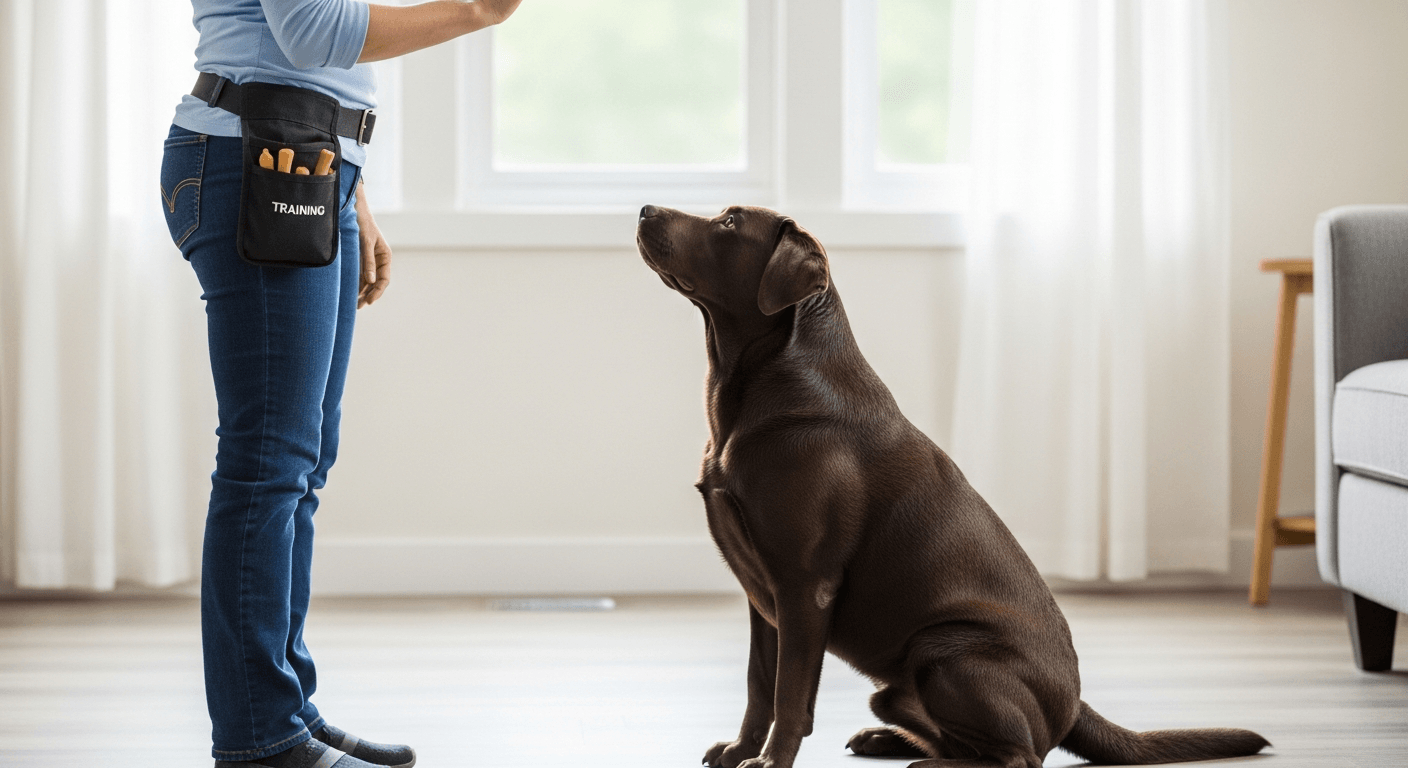
Every Labrador needs six foundation commands: sit, down, stay, come, heel, and leave it. These form the basis of all control, safety, and social behaviour. Teach them in short 5-minute sessions using reward-based methods — Labs respond poorly to repetition-heavy or punishment-based training.
For detailed training methods for each command, see Labrador Obedience Training.
Labrador Potty Training and Crate Training
House training and crate training are the two non-negotiable priorities in the first weeks. A consistent schedule and positive reinforcement resolve both within 4 to 8 weeks for most Labs. The crate is a tool for safety and calm — never punishment.
For full guides, see Labrador Potty Training and Crate Training a Labrador Puppy.
Labrador Leash Training: How to Stop Pulling

Labrador retriever training on the lead is one of the most common sources of frustration for owners. Labs pull because pulling has worked: moving forward is the reward for pulling. Every step taken while the lead is tight teaches the dog that tension equals progress.
The fix is straightforward but requires patience:
The stop-and-wait method
The moment the lead goes tight, stop walking. Stand completely still. Say nothing — no “no,” no “heel,” no corrections. Wait. The dog will eventually stop, turn, and create slack in the lead. The moment slack appears, walk forward. Repeat every time the lead tightens.
This method feels slow at first. Most Labs take 4 to 8 weeks of consistent application before they start walking with a reliably loose lead. The owners who succeed are the ones who apply the rule every single step, every single walk, from every person in the household. One person who continues walking when the lead is tight resets the training.
Starting in low-distraction environments
Begin loose-lead labrador training in the garden or a quiet street before attempting the park. A Lab surrounded by smells, dogs, and people has far more competing for its attention than one on a quiet pavement. Build the behaviour where distractions are minimal, then transfer to higher-distraction environments.
The front-clip harness
A front-clip harness (clip at the chest, not the back) reduces pulling mechanically while training is ongoing. When the dog pulls, the clip redirects them back toward you rather than allowing forward movement. This is not a substitute for training — it is a management tool that prevents the pulling behaviour from being rehearsed while you build the trained response.
Avoid retractable leads during loose-lead training. A retractable lead teaches the dog that tension is normal and that pulling earns more lead length — the opposite of what you’re trying to establish.
Begin labrador leash training early
Start in the house and garden from 10 to 12 weeks. A Lab that has never been taught to walk on a loose lead by 16 weeks will pull for its entire life unless specifically retrained. The time to establish this habit is early. The habit requires far less effort to install than to undo.
Common Labrador Training Problems: Causes and Fixes
The most common Labrador training problems are jumping, pulling on the lead, excessive barking, chewing, and recall failures. Most stem from under-stimulation or inconsistent handling — not wilful disobedience. Identifying the root cause is always the first step.
For causes and fixes for each problem, see Behavior Problems With Labrador Retrievers.
Mental Stimulation and Exercise: The Missing Half of Labrador Training

The most consistent predictor of good behaviour in a Labrador is adequate physical and mental exercise. Labs that are under-exercised are harder to train — not because the training method is wrong, but because a dog with unspent energy cannot concentrate.
Exercise by life stage
- Puppies (8–16 weeks): Short, low-impact play sessions. Avoid sustained running, jumping, or ball throwing — growth plates are open and vulnerable to injury. The AKC recommends a simple guideline: 5 minutes of exercise per month of age, up to twice daily. An 8-week puppy: 10 minutes per session. A 4-month puppy: 20 minutes.
- Adolescence (6–18 months): Increase duration as growth plates close — typically around 12 to 18 months. Until then, prioritise swimming, on-lead walking, and free play over repetitive ball throwing. Young adult Labs need 45 to 60 minutes of moderate activity daily.
- Adult Labs (18 months–7 years): 1 to 2 hours of combined activity daily — a mix of walking, off-lead running, swimming, and active play. Labs that receive adequate exercise are significantly easier to train and live with.
- Senior Labs (7+ years): Maintain consistent gentle exercise. Reduced intensity, same frequency. A senior Lab that stops moving entirely declines faster — joint mobility, weight management, and mental health all benefit from continued activity.
Mental stimulation
Physical exercise tires the body. Mental stimulation tires the brain. Labs that receive both are calmer, more focused, and easier to train. Include at least one of the following daily:
- A 10-minute training session (new behaviour or proofing an existing one)
- A puzzle feeder or stuffed Kong at mealtimes instead of a bowl
- A sniff walk — let the dog lead and sniff freely rather than maintaining pace
- A scatter feed in the garden (food hidden in grass for the dog to find)
A Lab that has worked its brain for 10 minutes is measurably calmer for the following 2 hours. This is one of the most practical and underused tools in labrador training.
Labrador Training Schedule: Plans for Puppies and Adults
A labrador puppy training schedule does not need to be elaborate. It needs to be consistent. The structure below covers the key windows; adapt it to your day.
Puppy schedule (8–16 weeks)
| Time | Activity |
|---|---|
| Morning | Potty trip immediately on waking → short play → breakfast (in the crate) → potty trip → 5-min training session |
| Mid-morning | Crate rest (30–60 min) → potty trip on waking |
| Midday | 10-min play session → potty trip → 5-min training session → crate rest |
| Afternoon | Potty trip → socialization outing (carry before full vaccination) |
| Evening | 5-min training session → dinner → potty trip → play → crate → night toilet break at 3–4am |
Puppy schedule (4–6 months)
Sessions extend to 8 minutes. Begin loose-lead work in the garden. Add stay. Begin proofing sit and come in the front garden. Enrol in a puppy class if you haven’t already — the socialization window is closing but still open until 16 weeks.
Adult Labrador schedule
| Time | Activity |
|---|---|
| Morning | 25–40-min walk → 8–10-min training session |
| Midday | Potty break → puzzle feeder or scatter feed |
| Evening | 30–45-min walk or off-lead run → 8–10-min training session → Kong or chew |
The most important element of any labrador training schedule is that it happens every day. Labs that are trained for 10 minutes daily for 6 months make consistently more progress than Labs trained intensively for one week, then inconsistently thereafter.
How to Train a Labrador Retriever for Reliable Off-Leash Recall
Teaching how to train a labrador retriever to come reliably off-leash is the single skill that most expands your Lab’s quality of life. A Lab with no recall is a Lab that must stay on-lead forever — which limits exercise, confidence, and the freedom the breed was built for.
Recall must always be rewarding
Every single recall must end in a reward for the first year of training. Not most of them. Every one. The moment you call your Lab to you and then clip on the lead to go home — ending the fun — you have begun training the recall to predict a negative outcome. The dog learns that coming might mean the park session ends, so coming becomes optional.
The fix: when it is time to leave the park, walk to your Lab and clip the lead. Do not call them to you. Reserve “come” exclusively for positive experiences.
The long line method
A 10 to 15-metre training lead is the most effective tool for building labrador recall during adolescence. It allows the dog to feel free while ensuring every recall is practised under controlled conditions. Use it in open spaces, call the dog, reward generously on arrival, release back to exploring. Twenty recalls per outing, repeated over 8 to 10 weeks, produces a dog that associates its name with running toward you at full speed.
Proofing recall step by step
Recall trained in the garden does not transfer automatically to the park. Proof in gradually increasing distraction: quiet garden → quiet park → park with one dog → park with multiple dogs. At each new level, drop to easy commands first, rebuild to recall, reward every response.
Most Labs reach reliable off-leash recall at 12 to 18 months with consistent daily practice.
Three Important Labrador Training Tips for Every Stage
These three labrador training principles apply at 8 weeks, 8 months, and 8 years. Get them right and every other technique in this guide becomes easier.
1. Train the behaviour you want, not against the one you don’t
When a Lab does something unwanted, the instinct is to react: push the dog, say “no,” shout. Every reaction gives attention to the unwanted behaviour, which often reinforces it. Instead: identify the behaviour you want, reward that behaviour consistently, and ignore or prevent the unwanted one. The desired behaviour grows. The unwanted behaviour fades.
Jumping disappears when greeting guests calmly earns attention. Pulling disappears when loose-lead walking earns forward movement. Counter surfing disappears when a mat in the kitchen earns rewards. The framework is the same in every case.
2. End before the dog is ready to stop
The best training session ends while the dog is still engaged and enthusiastic — not after they have checked out. A 4-minute session where the dog is motivated throughout builds more than an 8-minute session where attention drops in the final 3 minutes. End on a behaviour the dog performs confidently, reward generously, and stop. Labs motivated by sessions that end well come into the next session ready to work.
3. One rule, applied by everyone
Decide what the rules are before training starts. Write them down if necessary. Apply them without exception from every person in the household, every time. One person who lets the Lab jump up, steal food, or pull on the lead undoes the training every other person is doing. The breed is not the problem when behaviour is inconsistent — the household rules are.
When to Consider Professional Labrador Dog Training
Professional labrador dog training is worth considering in two situations: when you want a structured start, and when a specific behaviour is not improving with consistent home training.
Puppy classes
A quality puppy class — run by a certified trainer using positive reinforcement methods — provides structured labrador training, supervised dog socialisation, and expert feedback on your technique all at once. Most puppy classes run from 8 to 16 weeks, which aligns with the socialization window. The AKC recommends them as a priority for new owners.
Look for a trainer who uses reward-based methods and can explain the reasoning behind what they ask you to do. Avoid any class that uses physical corrections on puppies.
When to escalate
If a specific behaviour — aggression toward people or dogs, severe separation anxiety, persistent recall failure past 18 months — is not improving with consistent home training after 6 to 8 weeks, a certified professional is the right call. Look for a Certified Professional Dog Trainer (CPDT-KA). For clinical behaviour problems (phobias, severe aggression), a veterinary behaviourist is appropriate.
Do not wait years before seeking help. Problems reinforced for 2 years before anyone addresses them are significantly harder to resolve than problems addressed at 6 months.
Labrador Training FAQ
Are Labradors easy to train?
Yes. Labradors are among the most trainable breeds in the world. Their food drive, handler focus, and resilience to training mistakes make them well-suited for first-time owners.
When should I start training my Labrador?
Day one. A puppy brought home at 8 weeks is ready to begin. Start with name recognition, sit, recall, and labrador potty training in the first week. Do not wait for vaccinations or a settling-in period — habits form regardless of whether you’re directing them.
What is the best training method for Labradors?
Positive reinforcement — reward the behaviour you want, mark it precisely, and reward immediately. This method produces faster results and lower anxiety than correction-based approaches.
How long does it take to train a Labrador?
Basic obedience (sit, down, stay, come, loose-lead walking) is achievable in 6 to 8 weeks of consistent daily sessions. Reliable behaviour in all environments — with distractions, at distance, off-leash — takes 12 to 18 months. Emotional maturity in a Labrador arrives at 2 to 3 years.
Can I train an adult Labrador?
Yes. Labradors respond to training at any age. Ingrained habits take longer to change than new behaviours take to build, but the method is identical. Adult Labs often have better focus than puppies, which can make training faster in some respects.
How many training sessions per day?
For puppies 8 to 16 weeks: 2 to 3 sessions of 5 minutes each. For dogs 4 to 12 months: 2 sessions of 8 to 12 minutes. For adult Labs: 1 to 2 sessions of 10 to 15 minutes. Daily sessions build faster than weekly sessions — consistency matters more than duration.
My Lab knows commands at home but ignores me outside. What do I do?
This is a proofing gap, not a training failure. A behaviour trained in one environment is not trained — it is practised in one environment. Take training outdoors. Begin with easy commands (sit, down) in a low-distraction location. Reward generously. Build back to the harder commands. Repeat in each new environment. The behaviour will transfer.
How do I stop my Lab from pulling on the lead?
Stop every time the lead tightens. Say nothing. Wait for the dog to release tension, then walk forward. Apply this rule from every person, every walk, every step. Use a front-clip harness as a management tool while the trained response builds. Most Labs walk reliably on a loose lead within 6 to 8 weeks of consistent application.
Labrador training is not complicated — but it is consistent. The Labs that are a genuine pleasure to live with at 3 years old are the ones whose owners applied the same clear rules from day one, got through adolescence without stopping, and asked for specific behaviours rather than just reacting to unwanted ones.
The guides below go deeper on each area this post covers. Use them as your Lab progresses through each stage:
- Puppy foundation methods:Training Your Labrador Puppy — house training, crate training, and first commands in full detail
- Obedience step-by-step: Labrador Obedience Commands: Sit, Stay, Come & DownLabrador Obedience Commands: Sit, Stay, Come & Down
- Behaviour fixes: Labrador Behavior Problems: Jumping, Aggression & Destructive BehaviourLabrador Behavior Problems: Jumping, Aggression & Destructive Behaviour
- Barking: Why Do Labradors Bark?
- Separation anxiety: Labrador Separation Anxiety: Causes, Signs & TreatmentLabrador Separation Anxiety: Causes, Signs & Treatment
Post Code: P1 | Training Pillar | Rewrite: 2026-05-19
Images: 12 existing images — positions marked with [IMAGE x] throughout this draft
All image files and alt text remain unchanged — text only replacement