Behavior problems with labrador retrievers are the most common reason first-time Lab owners feel like they’re failing. You’re not. Labs have high energy, high intelligence, and high social needs — and when those needs go unmet, the behavior follows.
Some of what you’re seeing is normal adolescent Lab behavior that responds quickly to consistent training. Some is a genuine problem that won’t self-correct without targeted intervention. Knowing the difference is where the fix starts.
Labrador aggression is usually fear-based, resource-protective, or pain-related — not dominance-based. True aggression in a healthy, well-socialized Lab is uncommon. Before attempting any behavior modification, rule out pain first. Hip problems, dental disease, and ear infections can all present as aggression or sudden behavior changes.
Why Labradors Develop Behavior Problems

Labrador behavior problems almost always trace back to one of two sources: unmet needs or learned behavior. Understanding which applies to the individual dog determines everything about how to fix it.
Adult Labs typically need 60–80 minutes of vigorous exercise daily — significantly more than most companion breeds.
Labs were also bred as working gun dogs, selected to operate in close daily partnership with a handler across long field sessions. That working history creates a genuine social dependency and need for purposeful activity that distinguishes Labs from breeds selected for independent or low-drive temperaments.
When any of those needs go unmet consistently — not enough physical exercise, no mental stimulation, or leaving a Lab alone for more than 4–6 hours regularly — the dog finds its own outlets. Those outlets typically involve chewing, jumping, barking, or anxious behavior. The behavior is not bad temperament — it is a predictable response to a predictable deficit.
Adolescence compounds this. Between 6 and 18 months, a Lab has the physical size and energy of an adult but the impulse control of a puppy. This is the most common period for behavior problems to emerge — and the period where many owners first realize that early habits they let slide have calcified into reliable patterns.
The critical mistake owners make is addressing the symptom without the cause. Labs have a strong oral fixation rooted in their retriever heritage — chewing is a natural outlet for a dog bred to carry. Scolding a bored Lab for chewing furniture does not meet the need driving the behavior. The dog stops chewing the furniture while you’re watching and finds something else when you’re not.
Finally: any sudden behavioral change in an otherwise well-adjusted Lab — new growling, new fearfulness, new restlessness — should prompt a vet visit before any training response. Pain looks identical to behavior problems from the outside, and treating the medical cause often resolves the behavior entirely.
Labrador Aggression: Causes, Types & What to Do
True aggression in Labradors is genuinely uncommon — the breed’s temperament is specifically selected against it. Most behavior that owners describe as “aggression” is better categorized as fear response, resource guarding, or pain-induced reactivity. Labs’ well-documented food drive and lack of satiety signaling make food-bowl resource guarding particularly common in the breed — a point worth keeping in mind when the trigger is unclear. Each type requires a different approach, and correctly identifying which you are dealing with matters.
Fear aggression is among the most commonly identified forms of reactivity in Labs — and worth recognizing precisely because it is out of character for a breed selected for confidence and sociability. When a Lab shows these signs, something is wrong and it will not self-resolve. The dog growls, lunges, or snaps when startled, cornered, or approached in a way that feels threatening. Body language signals precede the behavior: whale eye (whites of the eyes visible), a lowered or stiffened posture, ears back, the dog trying to increase distance or back away before escalating. The dog wants space, not confrontation. Punishment makes it worse — it increases the anxiety that is already driving the behavior. The management approach is desensitisation and counter-conditioning. This means controlled, gradual exposure to the trigger at a distance where the dog can observe without reacting, paired with high-value rewards — typically across multiple short sessions of 5–10 minutes each, over several weeks.
Resource guarding appears around food bowls, high-value chews, resting spots, or sometimes a specific person. Labradors are one of the most food-motivated breeds — a trait that served them well as working retrievers but means food-bowl guarding can be more intense in Labs than in less food-driven breeds. The Lab growls or stiffens when approached near the valued resource. The instinct to punish this is understandable — and it is the wrong response. Punishing a guarding response increases the anxiety that drives it and makes the dog guard more intensely or more covertly. The productive approach is the trade-up protocol: approach the resource area calmly, offer a treat of higher value than what the dog is guarding, and build the association that approach equals something good rather than something threatening.
Pain-induced reactivity is easy to miss because the owner has no reason to expect pain. A Lab that growls when touched in a specific area, when picked up, or when asked to exercise or stand may be in genuine discomfort. Hip dysplasia, elbow problems, dental pain, and ear infections all present this way. According to VCA Animal Hospitals, pain is one of the most common and overlooked triggers for sudden aggression in otherwise well-tempered dogs. A vet examination before any training intervention is non-negotiable when this pattern appears.
When biting has occurred: any dog that has made contact and broken skin requires a veterinary behaviorist assessment — not just a training class. A certified veterinary behaviorist (Diplomate of the American College of Veterinary Behavior — DACVB) has both veterinary and behavioral qualifications. Do not self-manage bite history. The American Veterinary Medical Association outlines clear guidance on when professional intervention is required.
If the anxiety occurs specifically when your Lab is left alone, that is separation anxiety — a distinct condition with its own management protocol. See Labrador Separation Anxiety.
Labrador Jumping Up & Mouthing: Specific Training Solutions
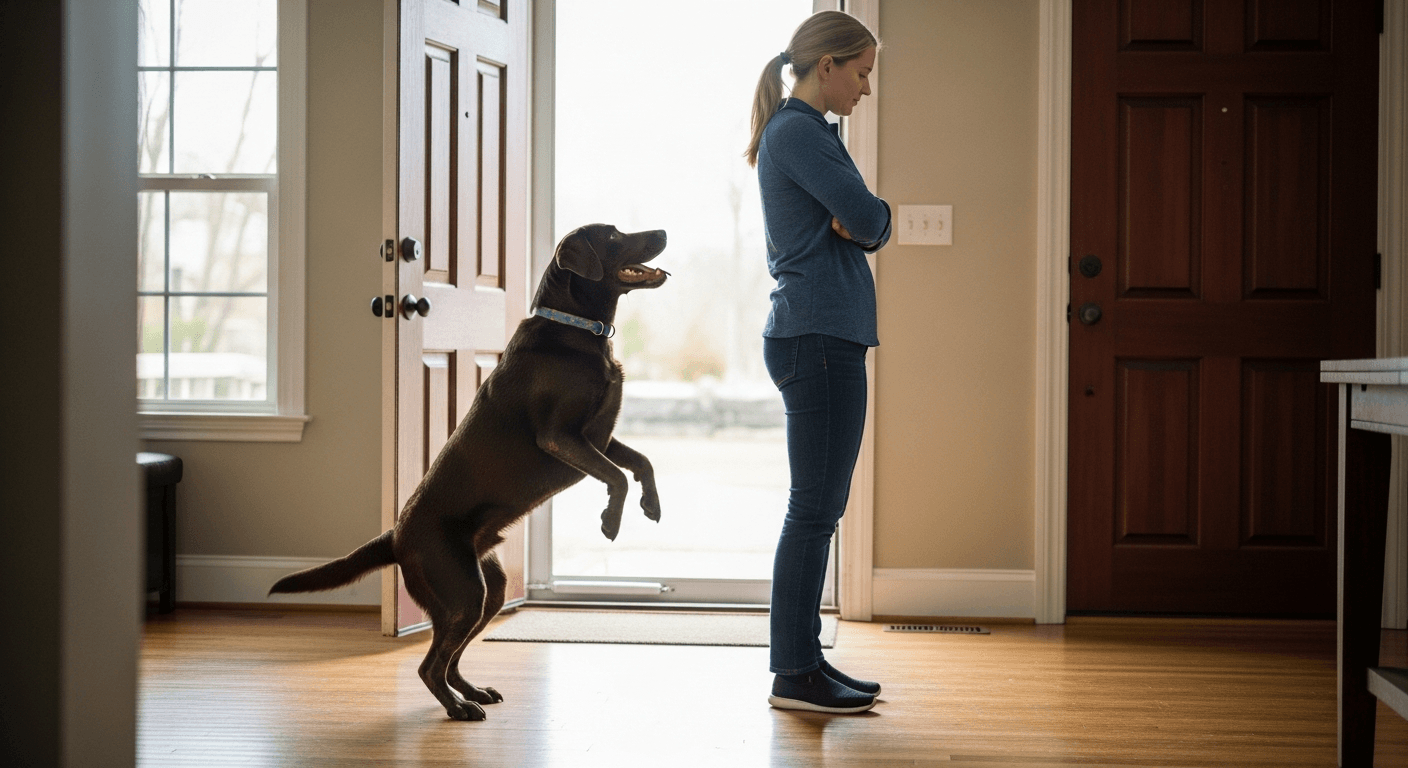
Jumping and mouthing are the most common behavior problems Labs are presented to trainers with. Both have the same underlying mechanism: they worked. The Lab jumped up, the owner said “no” or pushed the dog away, and the dog received attention and physical contact — which is exactly what it wanted. The behavior was reinforced.
The jumping protocol:
- The moment the Lab begins jumping — turn away completely. Arms crossed, no eye contact, no words. Not even “no.”
- Wait for four paws on the floor. Do not look until all four paws are on the ground.
- Mark the exact moment all four paws land — “yes” or a clicker.
- Immediately deliver your full attention, greeting, and reward.
The dog learns that jumping produces zero result and four paws on the floor produces everything it wanted. This works consistently — but it requires every person in the household and every visitor to apply the same response every time. One person’s “it’s okay just this once” resets the learning. Brief social norms coaching of guests before they enter the house saves enormous amounts of training time.
Mouthing and bite inhibition: Labrador puppies are mouthy — it’s breed-typical and part of how they learn jaw pressure control. The training goal is not to eliminate mouth contact but to teach the dog to control pressure. When teeth touch skin: a sharp “ouch,” immediate disengagement (stand up, stop play, no further interaction for 10 seconds), then re-engage calmly. If mouthing continues after three redirects in a session, end the play session entirely. Never shout, push the muzzle, or physically correct — these responses escalate the behavior.
For adult Labs still mouthing strangers or guests, add a “sit for greetings” protocol: the dog must be in a sit before any guest interaction begins. This gives the dog an incompatible alternative behavior — it cannot simultaneously sit and mouth a visitor. For puppies building these habits from the start, see Training Your Labrador Puppy.
Labrador Destructive Behavior: Boredom vs Anxiety

Destructive behavior — chewing furniture, shredding cushions, digging in the garden, destroying objects — is one of the most reported Labrador behavior problems. The most important question to answer before doing anything is: is this boredom or anxiety? The management approach is completely different for each.
Boredom destruction occurs when the dog is understimulated. It happens at any time of day, involves the most accessible interesting objects in the environment (shoes near the door, remote controls, cushions on the sofa), and the dog is typically bouncy and happy when the owner returns — no guilt, no distress, just energy that found an outlet.
Anxiety destruction looks different. It is focused near exit points — chewed door frames, scratched doors, damaged window sills. It may be accompanied by vocalisation (neighbours reporting barking while you’re out), pacing, or indoor toileting. When you return, the dog is activated and distressed rather than calm.
Three quick questions to distinguish them: (1) Does destruction happen only when you’re absent, or at any time? (2) Where is the damage concentrated — near exits, or anywhere accessible? (3) What is the dog’s state when you return — calm or clearly distressed?
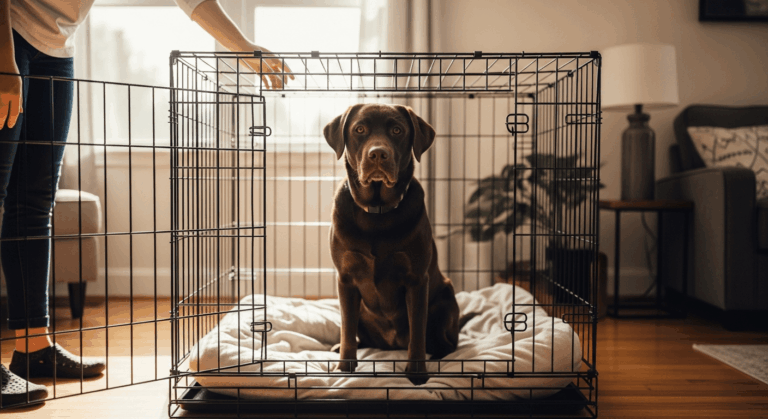
For boredom-driven destruction: increase daily exercise (a genuinely tired Lab does not have the surplus energy required for destructive behavior), add mental stimulation (training sessions, sniff work, food puzzles, filled frozen Kongs), and provide appropriate chew outlets — bully sticks, long-lasting filled Kongs, and appropriate nylons. Until the exercise and enrichment levels are sufficient, confine the dog to a crate or puppy-proofed space when unsupervised.
For anxiety-driven destruction: training alone does not solve it. The dog’s emotional state when alone is the problem. See Labrador Separation Anxiety for the desensitisation protocol that addresses the underlying cause. Do not punish anxiety-driven destruction — the dog was not making a choice to misbehave.
When to Consult a Professional Trainer or Behaviorist
Many Labrador behavior problems respond well to consistent owner-applied training over 4–6 weeks. But some situations require professional expertise, and knowing when to escalate saves time and reduces risk.
A certified professional dog trainer (CPDT-KA or member of APDT) is appropriate for jumping, pulling on leash, recall problems, general obedience resistance, and mild mouthing in adult dogs. Look specifically for force-free and reward-based trainers. Avoid trainers whose approach centers on “dominance,” alpha theory, or correction-based methods — these are not evidence-based and often worsen fear-based behaviors.
A veterinary behaviorist (DACVB — Diplomate of the American College of Veterinary Behavior) is a veterinarian with specialist behavior qualifications. Consult one when: any bite has broken skin, fear or aggression is severe enough to affect the dog’s daily quality of life, anxiety-based medication is being considered, or behavior problems are getting worse despite consistent training over 4+ weeks.
Clear escalation signals: bite history (any skin contact), unpredictable aggression with no identifiable trigger, self-directed anxiety behaviors (licking or chewing themselves compulsively), or any behavior problem that is worsening rather than improving with consistent effort.
Pet insurance policies vary on behavioral conditions — some cover veterinary behaviorist consultations under mental health, others exclude them. Check your policy terms before assuming coverage.
Frequently Asked Questions: Labrador Behavior Problems
Why has my Labrador suddenly become aggressive?
Sudden behavioral changes in an otherwise well-adjusted Lab — new growling, new reactivity, new reluctance to be touched — most commonly have a physical cause. Hip dysplasia, ear infections, dental pain, and other sources of discomfort cause Labs to become reactive to touch or movement in the affected area. A vet examination before any training response is the correct first step. If physical causes are ruled out, fear-based or resource-guarding behavior is the next most likely explanation.
Is it normal for Labradors to jump on people?
Yes — it is common, though not acceptable long-term. Labs jump because historically it produced the response they wanted (attention, physical contact). It is a learned behavior, not bad temperament. The fix is the four-step jumping protocol: turn away entirely when jumping occurs, wait for four paws on the floor, mark the moment of four-paw contact, then deliver full attention. Consistency from every household member and guest is what makes this work.
How do I stop my Labrador from chewing everything?
First, identify whether the chewing is boredom-driven or anxiety-driven — the management approach is different for each. Boredom chewing responds to increased exercise, mental stimulation (food puzzles, sniff work, training sessions), and appropriate chew outlets (filled frozen Kongs, bully sticks). Anxiety-driven chewing that occurs specifically when you’re absent is separation anxiety and requires a dedicated desensitisation protocol, not just more exercise.
My Labrador ignores my commands when there are distractions. Is this a behavior problem?
Not exactly — this is a training completion problem. A command trained only in the living room is not reliably trained. Dogs do not generalise learned behaviors automatically to new environments. The fix is proofing: re-teaching each command in progressively more distracting environments, starting easy, with higher-value rewards as distraction increases. If sit works in the kitchen but not in the park, the command needs park-specific training sessions.
When should I use a professional dog trainer for my Labrador?
If you have been consistently applying the correct training approach for 4+ weeks without meaningful improvement, a certified trainer (CPDT-KA) can identify what you’re missing. For any Lab with bite history, severe fear, or anxiety severe enough to cause self-harm, a veterinary behaviorist (DACVB) is the appropriate professional — not a general trainer.
Most Labrador behavior problems have a clear cause and a consistent fix. The hard part is applying that fix every single time, from every person in the household. If jumping, mouthing, or destructive behavior persists after four consistent weeks, a certified trainer can identify what is being missed and save you months of effort. For the full training framework, see our Complete Labrador Training Guide.