How to train a Labrador puppy starts on day one — the day they arrive home, typically at 8 weeks old. At this age, their brain is in the canine developmental sensitive period — the window when habits form fastest and stick longest. By 12 weeks, rehearsed behaviors like jumping and mouthing are already becoming default patterns that require active counter-conditioning to undo. The method is straightforward, and Labs are unusually well-suited to it. This post covers how to run a session, how to house train in the first two weeks, how to use a crate correctly, and which habits to lock in before the puppy hits 12 weeks. For the complete training roadmap, see our Complete Training Guide for Labrador Retrievers.
When to Start Training — and How to Do a Session
The answer is 8 weeks. Not “after they’ve settled in” — which tends to mean 12–16 weeks and costs you a significant training window. Not after full vaccination. The day they arrive.
Labs have high natural arousal — they’re excitable, mouthy, and easily distracted by scent and movement. Short, structured sessions work specifically well for the breed because their arousal level rises quickly in training environments. At 8–10 weeks, a Labrador’s attention span is measured in seconds, not minutes. Keep training sessions to 5 minutes maximum, two to three times per day. Beyond 5 minutes, arousal overrides focus and the puppy stops processing new information. Because Labs’ excitement levels spike faster than many breeds in stimulus-rich training environments, the 5-minute ceiling is especially critical for this breed. Most certified trainers recommend split sessions over a single extended session for exactly this reason.
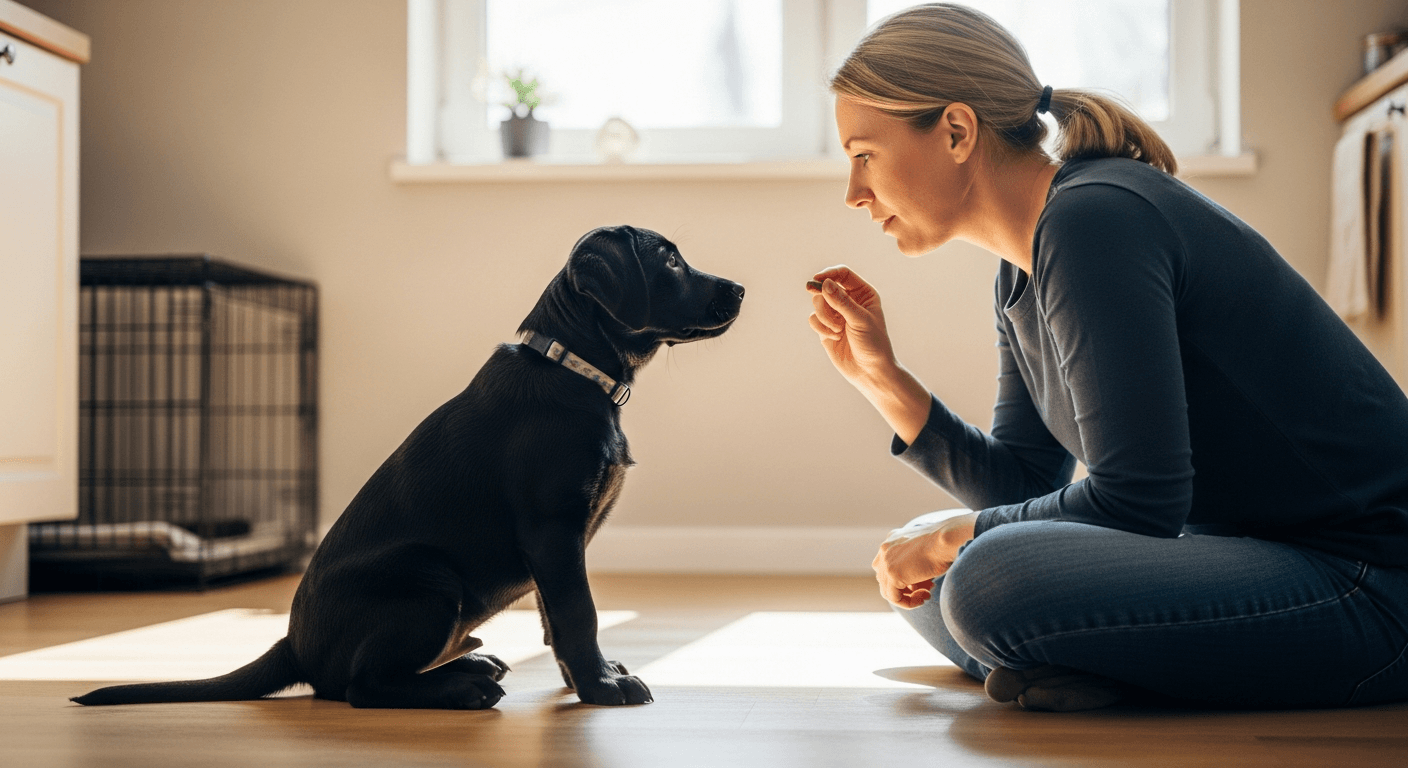
The method is lure and reward. Hold a small, soft, high-value treat at the puppy’s nose — something with strong smell like a pea-sized piece of cooked chicken, cheese, or a commercial training treat. Labs have exceptional scent sensitivity, and nose-targeting lures are particularly reliable for this breed — the treat immediately has their full attention.
Use it to physically guide the behavior you want: move the treat over the puppy’s head to guide them into a sit, for example. The instant the puppy’s bottom hits the ground, say “yes” clearly and give the treat. That “yes” is the marker word — the signal that the treat is coming and that the exact behavior that just happened is what earned it.
Reward timing is the most common training mistake. A treat given 3 seconds after the sit teaches the puppy to associate the reward with whatever they were doing 3 seconds after the sit — not the sit itself.
The marker word must happen at the precise moment the behavior occurs, then the treat follows. Precision matters more than enthusiasm.
Always end a session on something the puppy can do. If they’ve been struggling with “down,” go back to “sit” for the final repetition. Because Labs can show frustration through mouthiness or jumping when pushed past their threshold, ending on a known behavior also helps close the session calmly.
Labs are exceptionally food-motivated — more so than most breeds. A 2016 Cambridge University study found that roughly 25% of Labradors carry a POMC gene mutation that reduces the satiety signal from the brain, producing persistent hunger and a strong drive to work for food. In training, this works entirely in your favour. Small, soft training treats available on Chewy — Zuke’s Mini Naturals are a widely used option — work well because they’re consumed in under a second and the puppy is immediately ready for the next repetition.
Potty Training Your Labrador Puppy: The Step-by-Step Method
An 8-week-old Lab puppy can hold their bladder approximately one hour per month of age — roughly 2 hours maximum. After eating, drinking, waking from sleep, or playing, that window drops to minutes. Labs’ high activity level and fast metabolism make the post-play and post-meal windows especially short compared to calmer breeds — as little as 5–10 minutes in puppies under 10 weeks. Act immediately, not after the puppy settles. House training works by giving the puppy no opportunity to toilet inside — which means anticipating every trigger and acting before the accident happens.
Take the puppy outside immediately after each of these:
- Waking up from any sleep, including naps
- Finishing a meal
- Drinking water
- A bout of active play
- Any period of calm or lying still (the drop in activity often triggers the need to go)
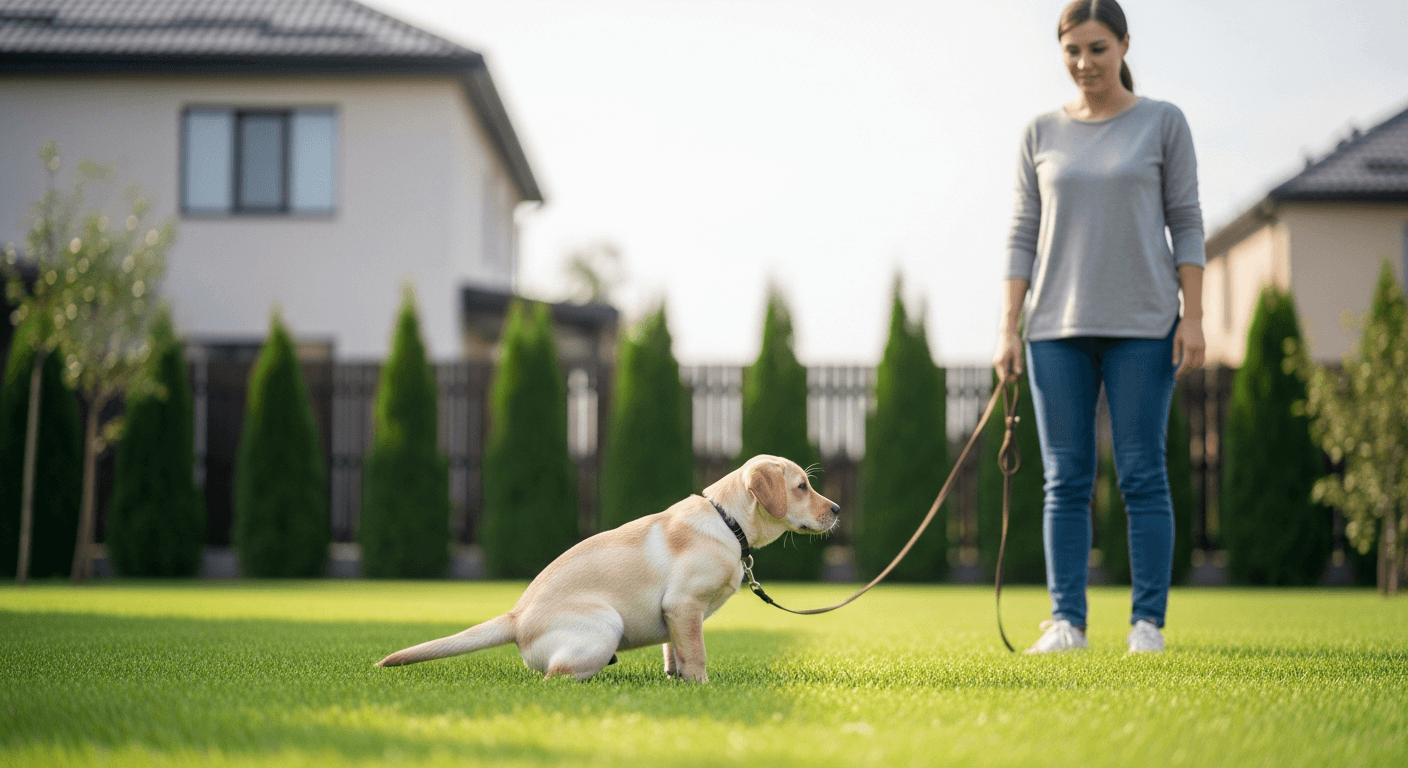
Choose one verbal cue — “go toilet,” “outside,” “go potty” — and use it every time you take them to the designated spot. Say it once as they’re sniffing around. Do not repeat it five times. One phrase, one meaning, consistent across everyone in the household.
The moment the puppy begins to toilet outside, say “yes” and give a treat immediately — not after you walk back inside. The timing rule from command training applies here too.
When there’s an accident inside: say nothing, do nothing, clean it up. Verbal correction, pushing away, or raising your voice does not teach the puppy where to go — it teaches them to hide when they need to toilet. The result is a puppy that sneaks behind the couch instead of signaling at the door, which makes house training slower. Clean accidents with an enzymatic cleaner rather than standard household products — enzymes break down the scent marker that draws dogs back to the same spot. VCA Animal Hospitals confirm this is the most common reason house training stalls: residual scent continues to signal “toilet here” even after the visible mess is cleaned.
For night-time: most Labs cannot sleep through the night without a toilet break until around 16 weeks. Set an alarm for 3–4 hours after bedtime. This is temporary.
One Lab-specific note: their strong scent drive means they often get absorbed in sniffing the yard instead of toileting. A puppy that sniffs for two minutes, comes back inside, and immediately has an accident is not being difficult — they were distracted from the task. Keep them focused on one area of the yard rather than letting them roam freely until toileting is established. For a dedicated walkthrough of the full house training method, see our Labrador potty training guide.
A note on training pads: they work as a temporary bridge, but they teach the puppy that toileting on soft surfaces inside is acceptable. If you use them, plan a deliberate transition to outdoor toileting by 12 weeks. Fixed meal times make the outdoor schedule significantly more predictable — for the feeding schedule at each age, see Labrador Puppy Food & Nutrition.
Socialization: The Window You Cannot Afford to Miss
Between 8 and 16 weeks, a Labrador puppy’s brain is in a sensitive period for forming associations with the world. The AKC’s complete guide to puppy socialization identifies this as the single most important window in a dog’s development. Positive experiences during this window become durable — they require far less reinforcement to hold than experiences introduced after 16 weeks. Fear responses formed during this window also tend to be more durable. This is the window that shapes temperament.
The complication is vaccination timing. Most vets recommend avoiding public parks and unvaccinated dogs until the full course is complete at 16 weeks — which is exactly when the socialization window closes. The practical solution is controlled exposure: carry the puppy in areas with foot traffic so they hear and see the world from a safe height. Invite vaccinated dogs you know to your home. Attend a reputable puppy class — the social benefit of controlled exposure to other puppies and people outweighs the very low disease risk in a vetted environment. Most veterinary behaviorists now recommend this approach.
Expose your puppy to before 16 weeks:
- People of different ages, sizes, and appearance: children, elderly people, men with beards or hats, people in uniforms
- Different surfaces: grass, gravel, metal grates, slippery tile, stairs
- Sounds played at low volume first: traffic noise, thunder, vacuum cleaners, door bells
- Car travel — short trips that don’t always end at the vet
- Other vaccinated, friendly adult dogs in your home
Watch the puppy’s body language throughout. A relaxed posture, tail up or relaxed, nose forward and sniffing = good. A crouching body, stiff legs, tail tucked, or a puppy that refuses to move = too much stimulation — end the session without forcing the approach. Never force a puppy toward something that frightens them.
If your puppy is already 14 weeks and hasn’t had significant socialization: start now. Later is not too late — it is more work, but the window doesn’t close like a switch at 16 weeks; it gradually narrows. Every positive exposure you give them now still matters. For a full week-by-week socialization plan, see Labrador Puppy Socialization.
Crate Training: How to Make the Crate a Safe Place
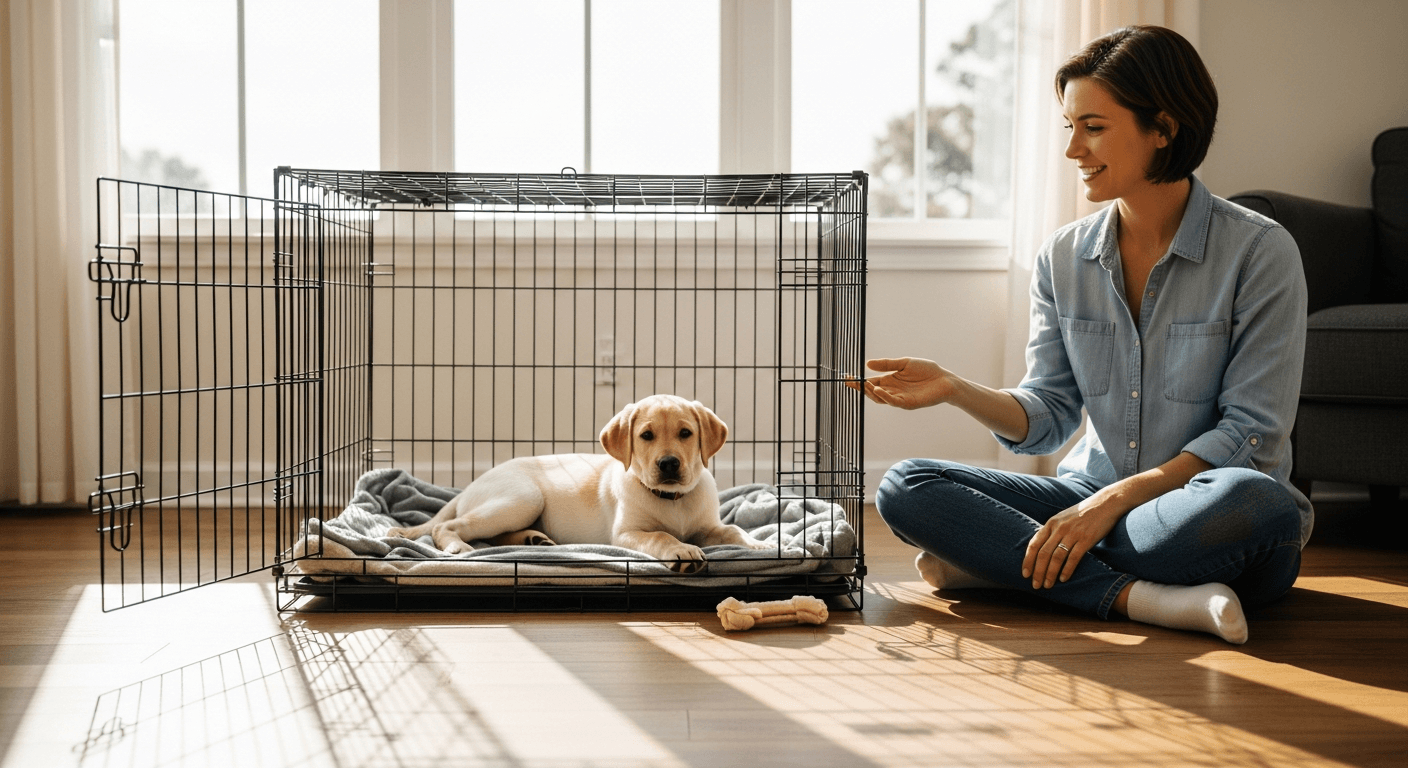
A crate is not a cage. Used correctly, most Labs choose to sleep in their crate voluntarily within two weeks of introduction. It gives the puppy a clear den signal, reduces destructive behavior when unsupervised, and supports house training. The key word is “correctly” — a puppy shoved into a crate and left to cry on day one will resist crate time for weeks.
On crate size: The crate should be large enough for the puppy to stand, turn around, and lie flat — no larger. A crate that’s too large allows the puppy to toilet at one end and sleep at the other, which breaks the house training benefit. Buy a 42-inch wire crate with a divider panel — it’s the size an adult Lab needs, and the panel lets you reduce the available space while the puppy is young. For a full step-by-step crate training method specific to Labs, see our Labrador crate training guide.
The introduction sequence:
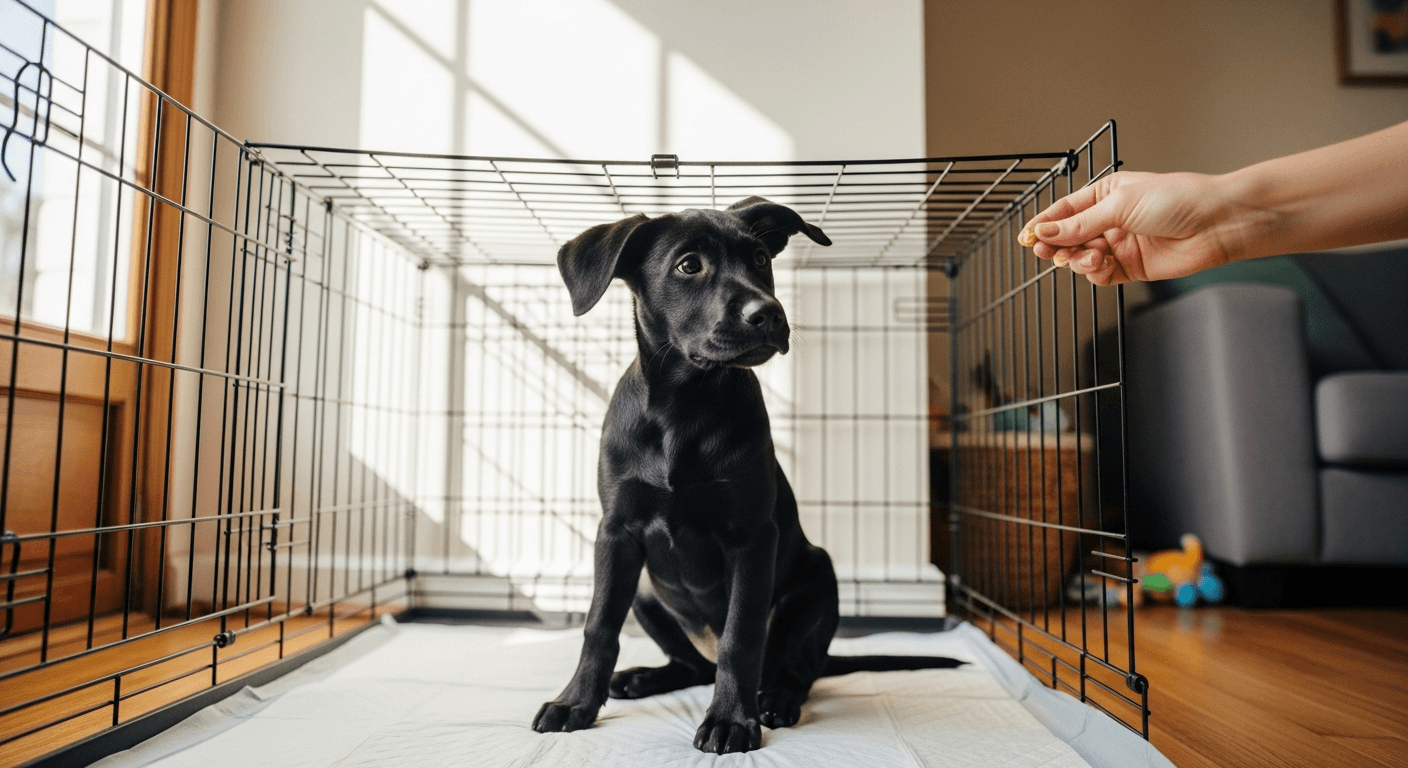
- Days 1–2: Leave the door open. Toss treats inside. Let the puppy explore voluntarily and come back out. Do not close the door.
- Days 3–4: Feed the puppy’s meals inside the crate with the door open. The crate becomes associated with food and calm.
- Days 5–7: Close the door for 30 seconds while the puppy is finishing a meal. Open before any distress. Over 2–3 days, extend gradually to 2–3 minutes.
- Week 2: The puppy can stay in the crate for 30–60 minutes with a stuffed Kong toy. Peanut butter or wet food frozen inside keeps most Lab puppies occupied and calm.
Never use the crate as punishment. A puppy sent to the crate after misbehaving learns to resist it. The crate must always mean calm, food, and rest.
On nighttime whining: Do not open the crate while the puppy is actively whining — this teaches them that whining is the release signal. Wait for a clear 5-second pause in whining, then calmly open the door. This distinction matters in the first week and saves weeks of nighttime difficulty later.
Maximum crate time at 8 weeks is approximately 3 hours, including overnight stretches with a toilet break. That increases by roughly 1 hour per month of age.
Building Good Habits in the First 30 Days
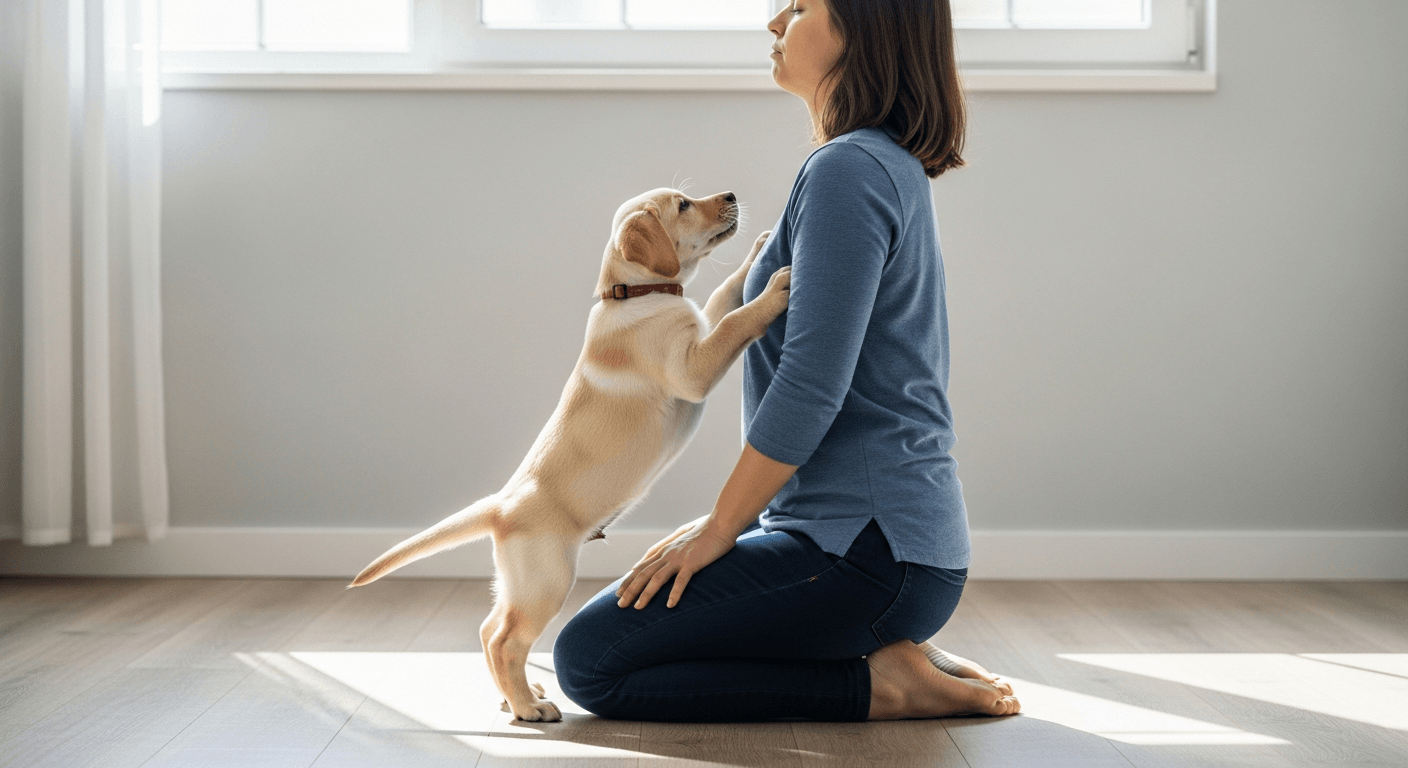
Labs are easy to shape at 8–12 weeks. They are significantly harder to reshape at 12 months. Every habit on this list is easier to install now than to correct later — and every one of them becomes a major quality-of-life issue if you wait.
1. No jumping — from day one. If a puppy jumps up and gets any response — being patted, being pushed away, being told “no” — they learn that jumping produces engagement. The rule: four paws on the floor gets your full attention; jumping gets complete disengagement — turn away, no eye contact, no words, wait for four paws, then greet. Apply this consistently from the first day in the house. A puppy that never learns to jump never becomes a 35 kg adult that flattens guests.
2. No biting skin. Puppy biting is normal and a key part of learning bite inhibition. The response that works: a sharp “ouch” the moment teeth touch skin, then immediate disengagement — stand up, stop the game entirely, wait 10 seconds, then re-engage calmly. Never shout, push the muzzle, or physically correct. Those responses escalate. For when biting continues beyond the normal mouthing phase, see Labrador Puppy Behavior.
3. Nothing from counters or the table. Decide this rule before the puppy arrives. Labs are lifelong opportunists around food — if counter-surfing works once, it becomes a permanent audition. The rule must be absolute from day one across everyone in the household.
4. Loose-lead walking starts at home. Begin walking with a loose lead in the house and yard at 10 weeks, before outdoor walks start. A Lab that hits 6 months without loose-lead experience is already pulling hard enough to be genuinely difficult. Starting on a loose lead in a low-distraction environment while the puppy is small costs nothing and saves enormous effort later.
5. Recall is a daily priority. Practice “come” in the yard every day from 8 weeks. It must always result in something positive — a treat, a brief game, enthusiastic praise. Never call the puppy to you for something unpleasant like a nail clip or a bath. If you need to end a play session or do something the puppy dislikes, go to the puppy instead of calling them. A recall associated with anything negative becomes unreliable, and an unreliable recall in an adult off-lead Lab is a safety problem.
Frequently Asked Questions: Training a Labrador Puppy
When should I start training my Labrador puppy?
Day one — which is typically 8 weeks old when the puppy comes home. Waiting until the puppy has “settled in” or until vaccinations are complete delays the most important learning window. At 8 weeks, a Lab’s brain is actively forming habits. Every day without structured guidance is a day where unguided habits form instead.
How long should a training session be for a Labrador puppy?
Five minutes maximum for 8–12 week old puppies. Run 2–3 sessions per day rather than one long session. A puppy’s attention span at this age is measured in seconds, not minutes — extending past 5 minutes produces frustration, not learning. As the puppy grows through 4–6 months, sessions can extend to 8–10 minutes, but short and frequent always outperforms long and occasional.
How do I house train a Labrador puppy?
Take the puppy outside immediately after every wake-up, every meal, every drink, every play session, and any period of calm. An 8-week Lab cannot hold its bladder for more than about 2 hours. Mark the moment of outdoor toileting with “yes” and a treat immediately — not after walking back inside. Clean indoor accidents with an enzymatic cleaner (not standard household products) to remove the scent marker that would otherwise draw the puppy back to the same spot.
At what age should a Labrador puppy be fully house trained?
Most Lab puppies become reliably house trained by 16–20 weeks with consistent management. Some are fully reliable by 12 weeks; others take until 6 months — both are within the normal range. Night-time accidents typically stop around 16 weeks as bladder capacity increases. Consistency across all household members is the single biggest factor in training speed.
How do I stop my Labrador puppy from biting?
The response that works: a sharp “ouch” the moment teeth touch skin, then immediate disengagement — stand up, stop all interaction for 10 seconds, then re-engage calmly. Do not shout, push the muzzle, or physically correct — these responses escalate rather than discourage. Consistency is essential: every person in the household must apply the same response every time teeth touch skin. Puppy biting typically reduces significantly by 16–20 weeks as bite inhibition is learned.
What Comes Next
With house training running, the crate established, and the five foundation habits in place, the next step is the four commands every Labrador needs to know reliably: sit, stay, come on command, and down. See Labrador Obedience Commands for the step-by-step method for each one. For your puppy’s vaccination schedule and first vet visits in the first year, see Labrador Puppy Health.