Crate training a Labrador puppy takes 1–2 weeks when you introduce the crate correctly. Lock the puppy in on day one and the crate becomes a source of panic. Introduce it gradually, with food and patience, and your Lab will walk in on its own within days.
Crate training a Labrador works because dogs have a natural preference for enclosed, den-like spaces when those spaces feel safe. Labs are especially quick to form the crate association — their high food drive means treat-based conditioning works faster here than with most other breeds.
You are not forcing something foreign on your dog. You are building an association between that space and calm, food, and rest — then formalizing it into a reliable habit.
This guide covers crate sizing, the step-by-step introduction process, night training, and fixes for the most common problems.
Crate training a Labrador puppy follows four stages: choose the right crate size, introduce it with the door open and treats inside, build up to short closed-door sessions, then extend duration over 7–14 days. Adult Labs need a 48-inch crate. Puppies need the same crate with a divider. Most Labs stop resisting the crate within one to two weeks when the introduction is done correctly.
Why Crate Training a Labrador Puppy Is Worth It
A crate is not a cage. It is a management tool and, once trained, a space your Lab will seek out on its own.
The practical case is straightforward: a crated Lab cannot chew through a couch cushion, eat a sock, or have a house training accident while you sleep. Labs have a well-documented oral fixation — they are among the breeds most commonly treated for foreign body ingestion — and unsupervised access during the puppy phase is a direct route to an emergency vet visit that a crate eliminates entirely.
The behavioral case is just as strong. According to the AKC’s crate training guide, dogs have a natural denning instinct — a preference for small, enclosed spaces where they feel secure. Labs that are crate trained often retreat to their crate voluntarily during thunderstorms, after high-energy play, or when the house gets busy.
Labrador crate training also pays off later in life. According to OFA data, hip dysplasia affects approximately 12% of Labradors — one of the highest rates among large breeds — and both hip and elbow surgeries typically require 8–12 weeks of strict crate rest during recovery. A Lab that is already comfortable in a crate is far easier to manage through that process than one encountering confinement for the first time post-surgery.
Choosing the Right Crate Size for a Labrador
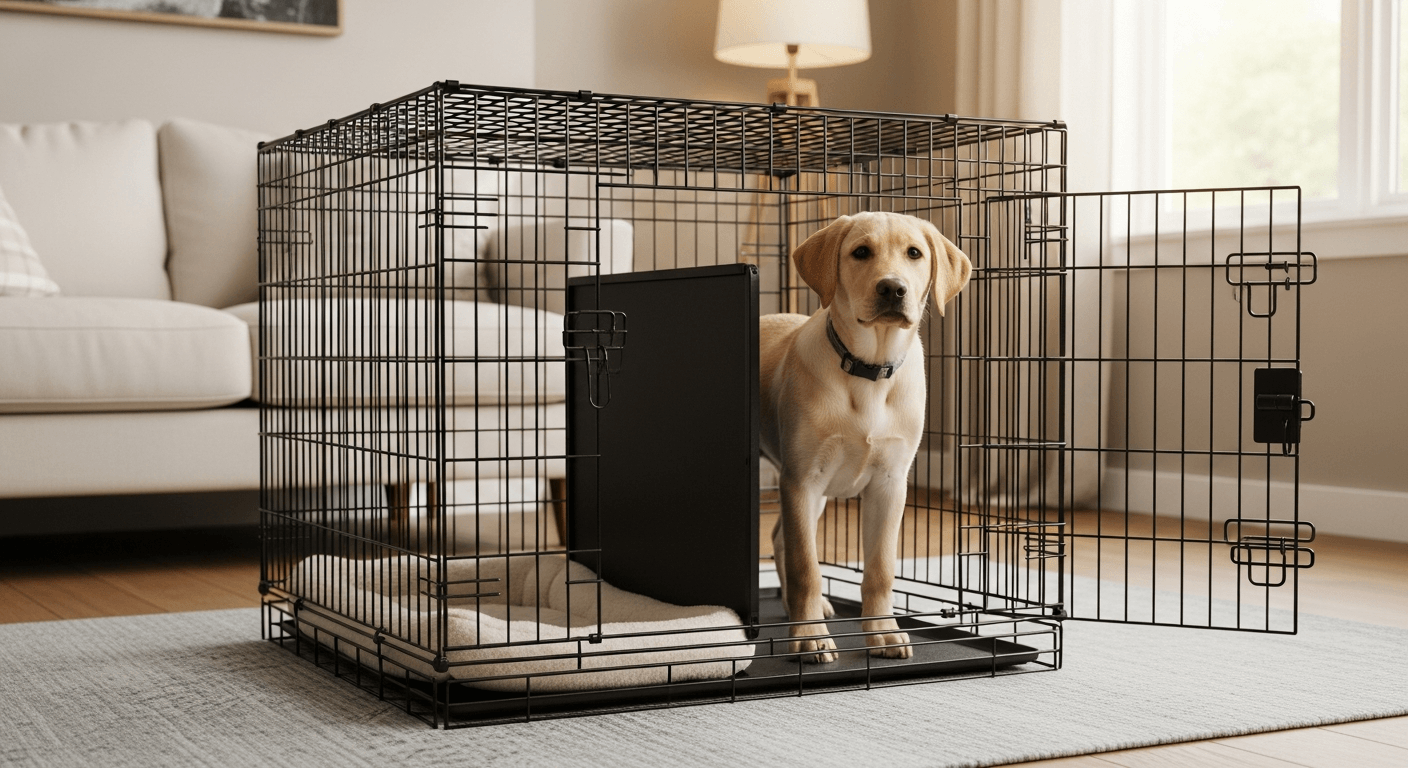
An adult Labrador needs a 48-inch (XX-Large) wire crate. Males typically weigh 65–80 lbs, females 55–70 lbs. The interior should be large enough for your Lab to stand upright, turn around, and lie down with its legs fully extended — but not so large that a corner becomes a bathroom.
For a puppy, buy the adult-size 48-inch crate immediately and use a divider panel to reduce the usable interior. Start with just enough space for the puppy to stand, turn, and lie down comfortably. Move the divider back in stages as your Lab grows.
Why not just buy a puppy-sized crate now? Because puppies with too much space will use one corner as a toilet and sleep in the other. The confined space is what discourages accidents. Labs are also notably slow to develop full bladder control — most are not reliably house trained until 4–6 months — making the divider especially critical during the early months. Buy the adult size, use the divider, and you only ever buy one crate.
| Lab Age | Divider Position | Approximate Interior |
|---|---|---|
| 8–12 weeks | Front third | ~24 inches |
| 3–5 months | Mid-point | ~30 inches |
| 6–9 months | Two-thirds back | ~36 inches |
| 10 months+ | Remove divider | Full 48 inches |
Wire crates are the best choice for Labs. They provide airflow, allow your Lab to see its surroundings, fold flat for storage, and accept divider panels. Plastic travel crates work for flights and transport but feel more enclosed and heat up faster — not ideal for a warm-coated, high-energy Lab at home.
IMAGE 1: crate size comparison infographic — four stages, one crate
How to Start Crate Training a Labrador Puppy (Week 1)
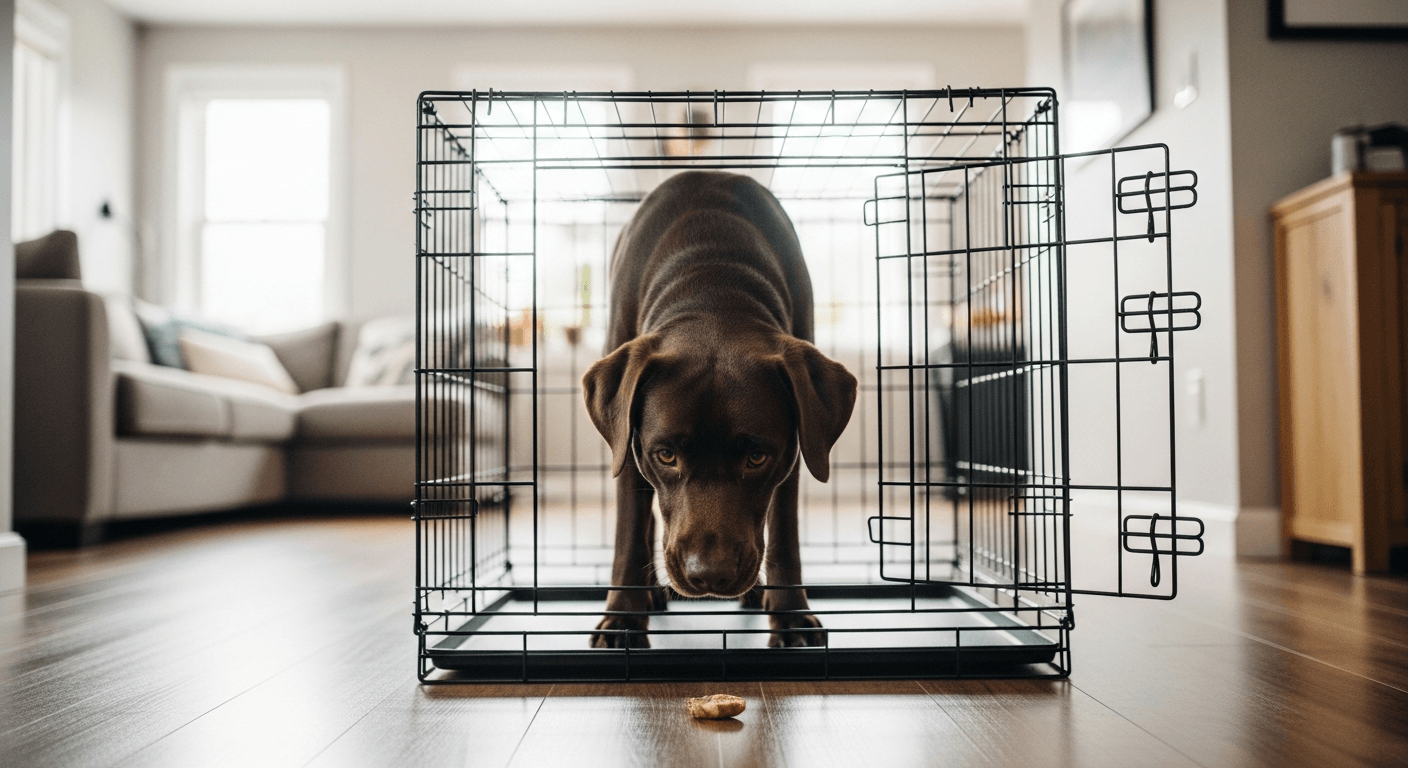
Do not skip this phase. A Lab introduced gradually accepts the crate in 7–14 days. A Lab locked in on day one may take significantly longer to build the same positive association — and some never fully settle in a crate that started as a source of stress.
Days 1–2: Open door, treat tossing
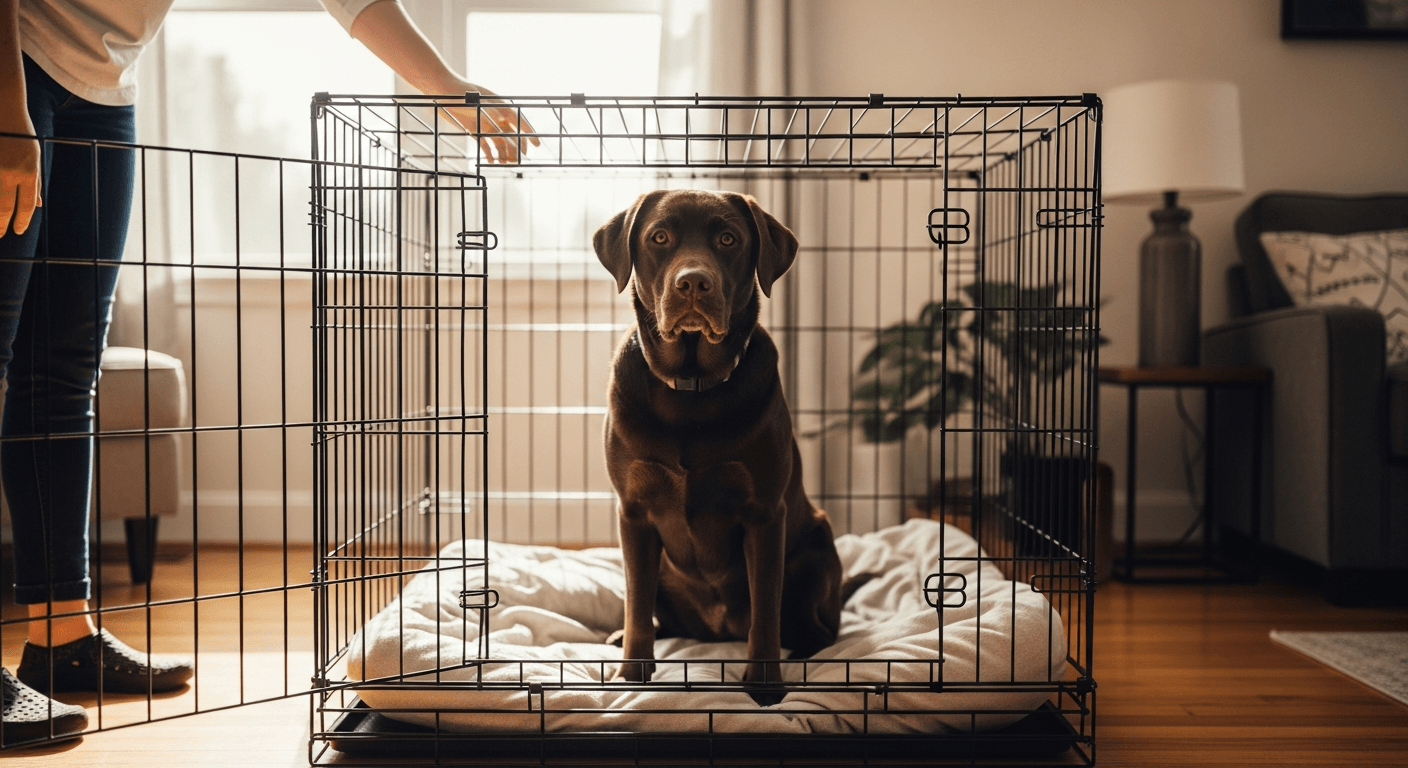
Place the crate in a main living area — somewhere your Lab already spends time. Leave the door completely open. Toss treats near the entrance, then just inside the threshold, then toward the back. Do not guide or lure your Lab inside physically. Let it investigate on its own terms. Some Labs walk straight in on the first toss. Others need two days before they cross the threshold. Both are normal.
Days 3–4: Meals inside the crate
Move your Lab’s meals to just inside the crate door, then to the middle, then to the back wall. Feed with the door open. After two or three meals, your Lab will walk in without hesitation — the crate now predicts food.
Days 5–7: Short closed-door sessions
Once your Lab enters the crate willingly for meals, close the door briefly while it eats. Open it as soon as the meal finishes. Do not leave the room. The first closed-door session should last no more than 60 seconds. Build up to 5 minutes, then 10, by the end of the week.
If your Lab shows signs of distress — panting, pawing, whining — before the door is even shut, you moved too fast. Go back one step.
IMAGE 2: Lab puppy lying calm inside open crate
Building Up Crate Time: The Step-by-Step Process
After week one, your Lab should enter willingly and stay calm with the door closed for 10–15 minutes. From there, build duration in 15-minute increments across the next week.
Maximum crate time by age: One hour per month of age, plus one. A 3-month-old Lab can manage 4 hours. A 5-month-old can manage 6 hours. An adult Lab should not be crated for more than 8 hours regularly — that is the upper limit, not the daily target.
When you leave, do not make it an event. Drop a treat in the crate, say your cue word (“crate,” “kennel,” or whatever you choose consistently), and walk out. Long farewells teach your Lab that departures are emotionally significant, which raises anxiety.
When you return, wait until your Lab is calm before opening the door. Opening to frantic jumping rewards the frantic jumping.
The best crate training tool: a frozen Kong stuffed with kibble and peanut butter. It occupies your Lab’s attention for 20–40 minutes without requiring your presence. Give the Kong only in the crate — never outside it. The crate becomes the only place that produces this specific reward, and Labs are highly motivated by food.
Crate training and potty training work together directly. A crated puppy cannot wander off and have an unsupervised accident. For the complete house training schedule, see our Labrador potty training guide.
Labrador Crate Training at Night
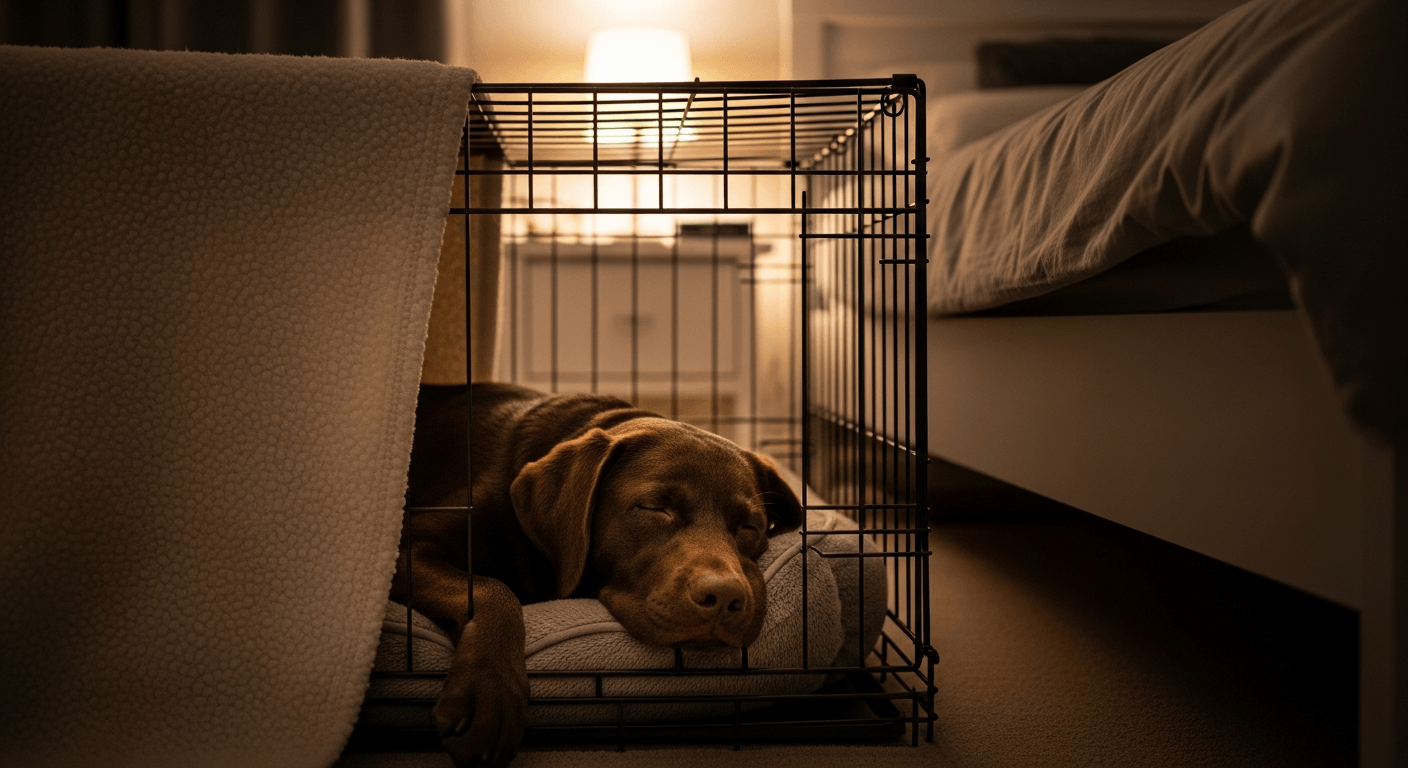
Puppies at 8 weeks cannot hold their bladder through the night. They need a 2–3 hour nighttime trip for the first 4–6 weeks. Set an alarm rather than waiting for whining — whining at 3 a.m. followed immediately by an open door teaches your Lab that whining is an effective strategy.
Place the crate in or beside your bedroom for the first few months. Labs are social dogs. A puppy that can hear and smell you will settle in significantly faster than one isolated in a separate room.
Cover three sides of the crate with a blanket or crate cover. This reduces visual stimulation and creates a den-like effect. Leave the front panel uncovered so airflow is maintained.
By 4 months of age, most Labs on a consistent daytime schedule — and with a final outdoor trip just before bed — can hold it through an 8-hour night.
IMAGE 3: Lab puppy sleeping in covered crate beside a bed
Common Labrador Crate Training Problems and Fixes
| Problem | Likely Cause | Fix |
|---|---|---|
| Whines or barks continuously inside | Moved too fast in the introduction | Go back to open-door phase; slow down by 3–5 days |
| Eliminates inside the crate | Crate too large, or left too long | Reposition the divider; shorten sessions |
| Refuses to enter the crate | Crate was used as punishment; or anxiety about enclosed spaces | Restart from day one; move crate location; never force entry |
| Settles briefly then escalates | Separation anxiety, not crate discomfort | Try crating with you in the room — if dog settles, isolation is the issue |
| Knocks over water bowl | Normal puppy behavior | Use a bolt-on crate bowl or remove water inside; offer water before and after crating |
The most common reason labrador crate training fails is rushing the introduction. If your Lab is still resisting after two weeks of consistent work, you almost certainly moved too fast through the first phase. Start over from day one — it takes less than a week to rebuild the association correctly, and the result lasts years.
Frequently Asked Questions
How long does crate training a Labrador puppy take?
Crate training a Labrador puppy typically takes 1–2 weeks when the introduction is done gradually. The first week builds a positive association with the crate open. The second week builds closed-door duration. Labs that were forced into the crate early can take 4–6 weeks to recover that trust.
Can you crate train an adult Labrador?
Yes. Adult Labs often crate train faster than puppies because they have better impulse control and are less reactive to new objects. Follow the same gradual introduction — open door, treats, short sessions — but expect it to take 5–10 days rather than 14. An adult Lab with no prior crate experience may be skeptical initially but adapts quickly once the crate consistently predicts food and rest.
How long can a Labrador stay in a crate?
Roughly one hour per month of age plus one for puppies: a 3-month-old Lab should not stay crated more than 4 hours. An adult Lab can handle 6–8 hours, but this should not be the daily norm. According to VCA Animal Hospitals, crating is a management tool — not a substitute for exercise and social time.
Should I put bedding inside the crate?
Yes. A crate pad or folded blanket that smells like your Lab makes the space more comfortable and encourages rest. Puppies that chew bedding should use a plain rubber mat until the chewing phase passes — typically by 6–8 months of age. For help managing teething alongside crate training, our teething guide covers what to expect week by week.
Is crate training a Labrador puppy cruel?
No — provided the crate is the right size, the dog has been introduced gradually, and crating duration matches the dog’s age. A properly crate-trained Lab will voluntarily retreat to its crate when given the choice. The discomfort comes from locking a dog in before it is ready, not from the crate itself.
Crate training a Labrador puppy is front-loaded work that pays off quickly. Two weeks of consistent effort produces a dog that sleeps through the night, does not destroy your home unsupervised, and has a calm space of its own for years. Start the introduction today — even 10 minutes of treat-tossing near the crate counts as day one. For the complete foundation in obedience, socialization, and behavior, see our complete Labrador training guide.