
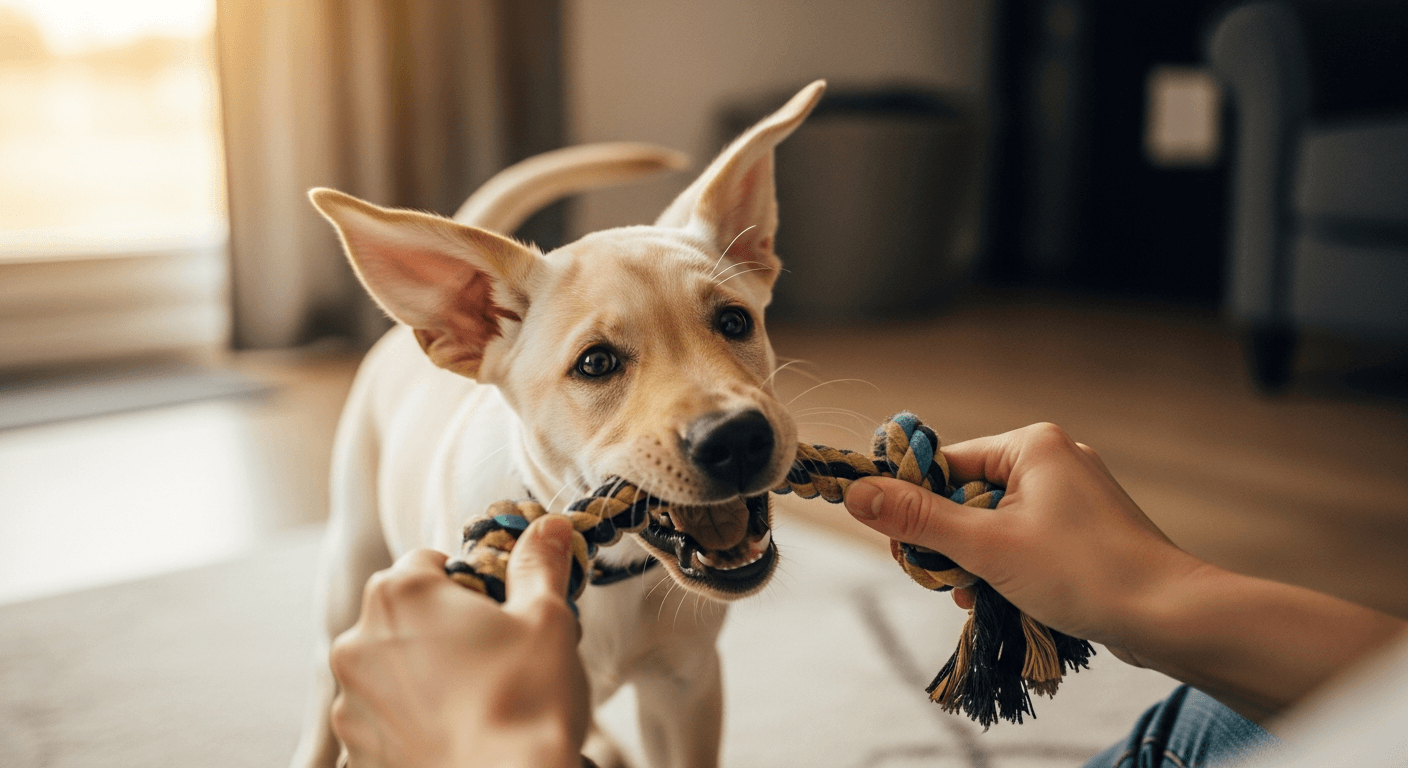
Labrador puppy behavior in the first months rarely matches the calm companion owners pictured. The puppy that seemed calm at the breeder’s is suddenly biting hands, sprinting into walls at 10 p.m., crying at night, and humping the couch cushions — we hear this exact list from new owners constantly. Most of this is completely normal. Some of it needs a response before it hardens into habit. This guide draws the line between the two — and gives the fix for each. It pairs with our Labrador puppy first-year guide.
Labrador puppies bite because they explore the world with their mouths and are still learning bite inhibition — the skill of controlling jaw pressure. That is normal puppy behavior. The goal is not to stop mouthing entirely but to teach that teeth on skin always ends play.
Normal Labrador Puppy Behavior: The Baseline
A healthy 8-to-12-week-old Lab puppy is mouthy, playful, easily distracted, and quick to fall asleep mid-game. Expect high-energy bursts, social enthusiasm toward everyone, a constant need to chew, and house-training accidents. All of it sits inside normal Labrador puppy behavior.
The energy comes in cycles, not a constant stream. The typical pattern is 20 to 40 minutes of intensity followed by 1 to 3 hours of deep sleep — a young puppy sleeps 18 to 20 hours a day in total. A puppy that never settles into naps is worth a vet conversation. So is one that sleeps more than 20 to 22 hours a day and shows little interest in play during its wake windows.
One thing is genuinely breed-specific: Labs mouth and chew more than most breeds. They were bred to carry game in their mouths, and that oral drive shows up early and strong. Heavy mouthing in a Lab puppy is breed-typical behavior, not early aggression.
Keep one distinction in mind all year: physical tired and mental tired are different. Bred to retrieve all day, Labs rarely run out of physical stamina — but a 5-minute training session drains one more reliably than a long walk — a fact that solves more behavior complaints than any correction.
Labrador Puppy Biting & Mouthing: Normal Behavior, Real Boundaries
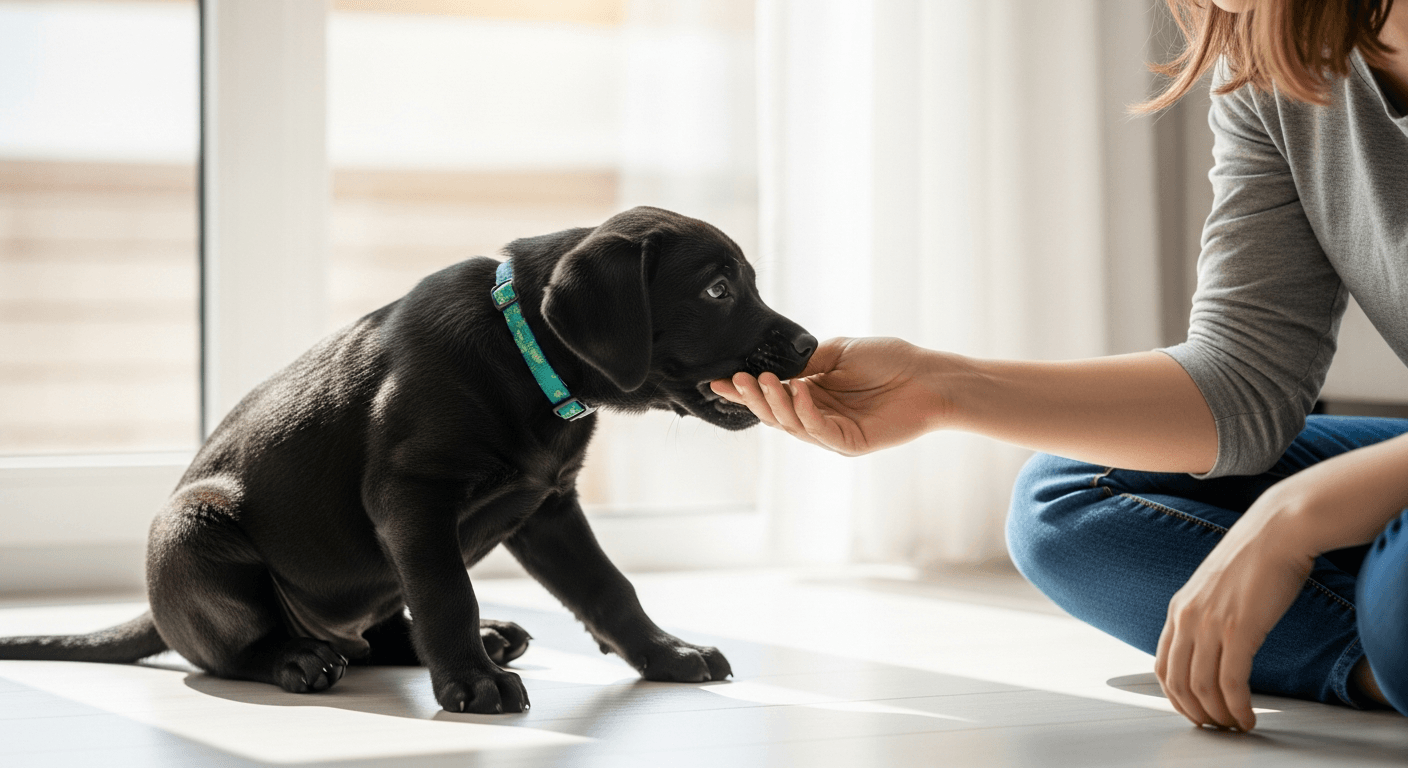
Labrador puppy biting is the number-one complaint we hear from new owners, and it has a developmental purpose. Puppies learn bite inhibition — how to modulate jaw pressure — through feedback. In the litter, a puppy that bites a sibling too hard gets a yelp and the game ends. A dog that learns this lesson as a puppy is far less likely to bite hard as an adult, even under stress.
Your job is to replicate the litter’s feedback. When teeth touch skin, give a sharp “ouch,” stop all play, and pull your hands out of reach. Wait 30 to 60 seconds, then re-engage calmly. If the puppy bites hard again, end the session completely for 2 to 3 minutes. Attention is the currency — hard teeth make it disappear.
Redirection does the other half of the work. Keep a puppy-rated chew like a Kong Puppy or Nylabone within reach and swap it in the moment mouthing starts. The message is consistent: teeth belong on toys, never on skin.
Three common responses backfire, and the AKC’s guidance on puppy biting agrees: don’t tap or flick the nose (teaches fear), don’t hold the muzzle shut (teaches hand avoidance), and don’t yell (in a breed this excitable, raised voices reliably raise arousal — and more arousal means more biting).
Mouthing peaks at 10 to 14 weeks and drops sharply by 5 to 6 months as adult teeth come in. The chewing urge spikes again during teething — our Labrador teething guide covers that phase — but hard biting on humans should keep declining.
Labrador Puppy Zoomies: Why Your Puppy Won’t Calm Down
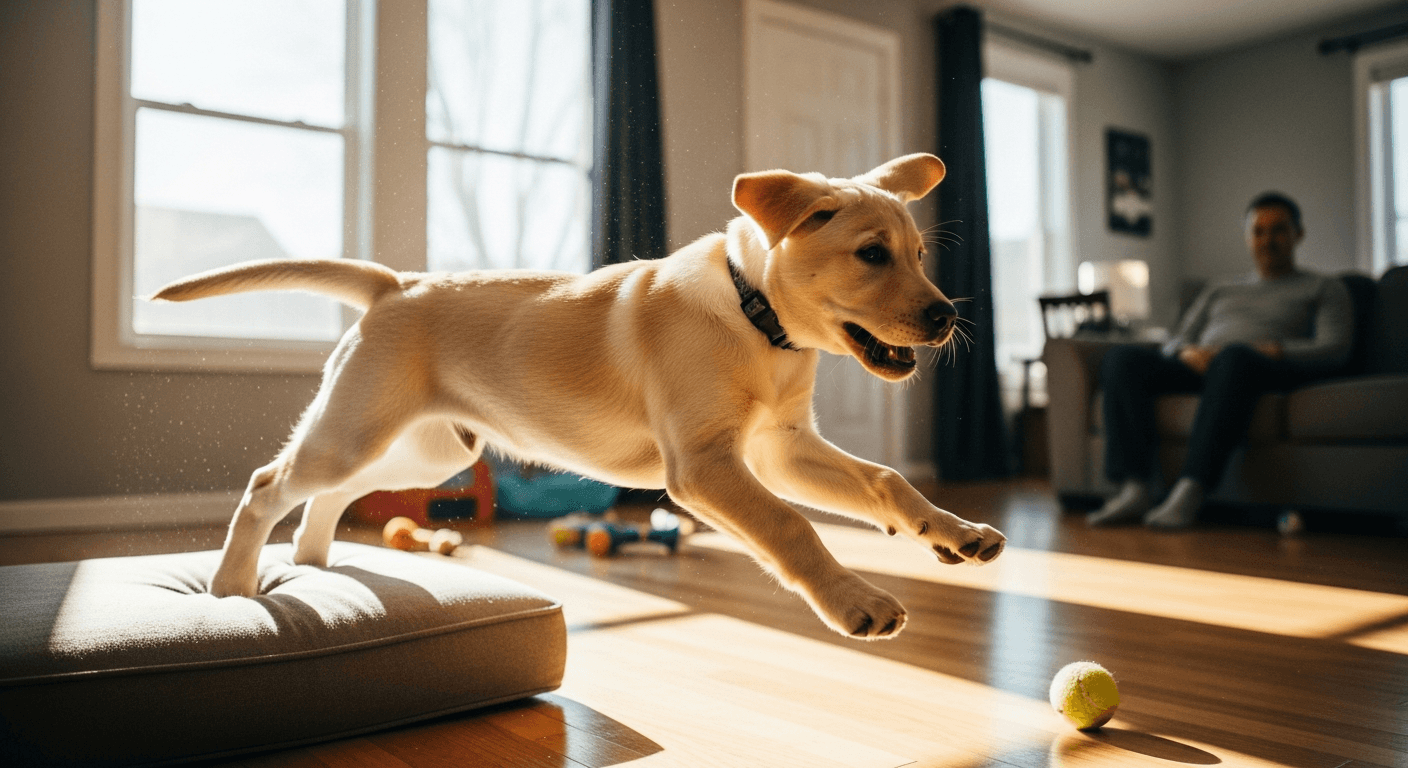
Those sudden bursts of sprinting, spinning, and bouncing off furniture have a formal name: frenetic random activity periods, or FRAPs. Labrador puppy zoomies are completely normal, usually hit in the evening or right after a bath, and act as a pressure-release valve for built-up energy. In a high-drive working breed like the Lab, evening FRAPs tend to run harder and longer than in lower-energy breeds. Most Labs outgrow intense daily zoomies by 12 to 18 months as they reach maturity — though occasional bursts persist into adulthood in high-drive dogs — according to the AKC’s explanation of zoomies.
During a zoomie session, do less, not more. Chasing or shouting escalates the arousal. Step back, make sure the space is safe, and let the storm pass — it rarely lasts more than a few minutes.
Now the counterintuitive part. Owners often respond to a hyper puppy with more exercise, and in young Labs that usually makes evenings worse. Long, intense exercise raises arousal and produces a puppy that is exhausted but wired — too keyed up to settle. What produces calm at this age is mental work and enforced rest cycles, not marathon walks.
Keep physical exercise inside safe limits while joints develop: a common veterinary rule of thumb is 5 minutes of structured exercise per month of age, up to twice a day. A 4-month-old Lab gets about 20 minutes per session. Fill the rest of the day with training games, food puzzles, sniffing time, and naps.
Labrador Puppy Whining at Night: What’s Normal & How Long It Lasts
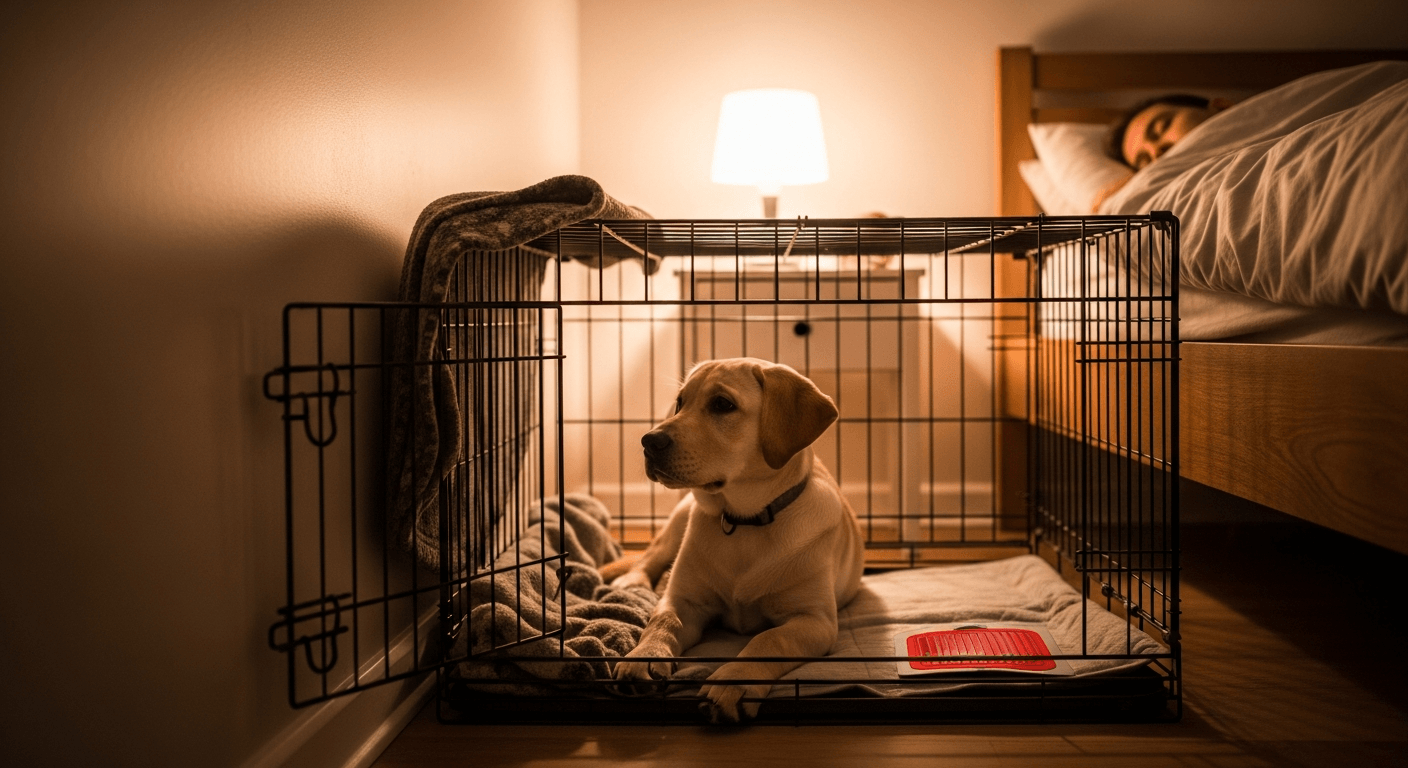
Labrador puppy whining at night is a distress call, not manipulation. Your puppy spent every night of its life in a pile of warm litter-mates, and now it is alone in the dark for the first time. Crying is the normal response to that social isolation.
The good news: it ends fast when handled well. Most Lab puppies settle dramatically within 3 to 7 nights, and by the end of week two most sleep from bedtime to their scheduled overnight potty break.
Setup does most of the work. Put the crate in or beside your bedroom — your breathing and scent are genuinely calming. Add a blanket-wrapped warm water bottle for litter-mate warmth, a worn T-shirt that smells like you, and a soft heartbeat-style snuggle toy if you want the full effect. Full crate setup and routine live in our guide to training your Labrador puppy.
Schedule the overnight potty break instead of waiting for crying. An 8-week-old needs out every 2 to 4 hours, so set an alarm and carry the puppy out quietly before it wakes you. If you only respond when crying starts, you teach crying as the alert system.
And when the puppy has been pottied, warmed, and settled but whimpers anyway? Wait 5 minutes before checking. Instant responses to every whimper train exactly the behavior you’re trying to end.
Humping, Resource Guarding & Other Lab Puppy Behaviors That Worry Owners
Humping. Both male and female puppies do it, and at this age it is not sexual — it is an outlet for over-excitement, stress, or social experimentation. Redirect calmly, remove the puppy from whatever is winding it up, and stay consistent. No scolding required.
Resource guarding. A puppy that stiffens or growls over its food bowl is showing early guarding, which is not rare in Labs. Never punish it — punishment confirms the fear that someone will take the food. Use the trade-up protocol instead: approach with something better, offer it, and return the original item. Practiced from 8 weeks, trade-ups prevent most adult guarding. If guarding persists past puppyhood, our guide to Labrador behavior problems covers the next steps.
Eating everything. Socks, mulch, rocks, unmentionables from the cat’s litter box — Labs scavenge because they are oral explorers with a breed-documented appetite drive. At this age, management beats training: puppy-proof the floor and yard ruthlessly. Start “leave it” training around 12 weeks as the long-term fix.
Sudden fear of familiar things. A puppy that startles at the trash can it ignored yesterday is likely in a fear period — one hits around 8 to 10 weeks and another in adolescence. Don’t force contact. Let the puppy investigate at its own pace and pay the bravery with treats.
Frequently Asked Questions
Is my Labrador puppy’s behavior normal?
Almost certainly. Biting, zoomies, night crying, humping, and eating strange things are all standard Labrador puppy behavior in the first months. The genuine red flags are different: a puppy that never sleeps, shows no interest in play, growls intensely with stiff body language, or cannot be roused — those warrant a vet call.
When do Labrador puppies calm down?
In stages. The worst biting fades by 5 to 6 months as adult teeth arrive. Intense zoomies taper between 12 and 18 months. Most Labs reach recognizable adult calm between 2 and 3 years. Structured training and enforced nap time bring noticeable day-to-day improvement much sooner.
Why does my Lab puppy go crazy in the evening?
Evening zoomies are a release of accumulated arousal at the end of a stimulating day — often made worse by over-tiredness. The fix is usually an earlier, calmer evening routine with a food puzzle or chew, plus more daytime naps. Ignore the sprinting; it burns out within minutes.
How do I get my Labrador puppy to stop crying at night?
Crate the puppy in or near your bedroom, add warmth and your scent, and schedule overnight potty breaks by alarm rather than waiting for cries. Most puppies settle within a week. If the puppy has been pottied and settled, wait 5 minutes before responding to renewed whimpering.
Why is my Labrador puppy humping everything?
Puppy humping is an over-excitement and stress outlet, not sexual behavior — it appears in males and females alike. Redirect calmly to a toy or a settle mat and remove the puppy from overstimulating situations. Consistent, boring redirection ends most of it; making it a big event prolongs it.
The chaos has an expiration date. By 6 months the worst of the biting is behind you, by 12 to 18 months the zoomies fade, and by 2 years you have a dog. The same intensity that makes Labrador puppy behavior exhausting at 10 weeks is the engine that makes the breed exceptional at 3 years. This week’s job is simple: protect the nap schedule, keep a chew toy in every room, and run one 5-minute training session a day.





One Comment