
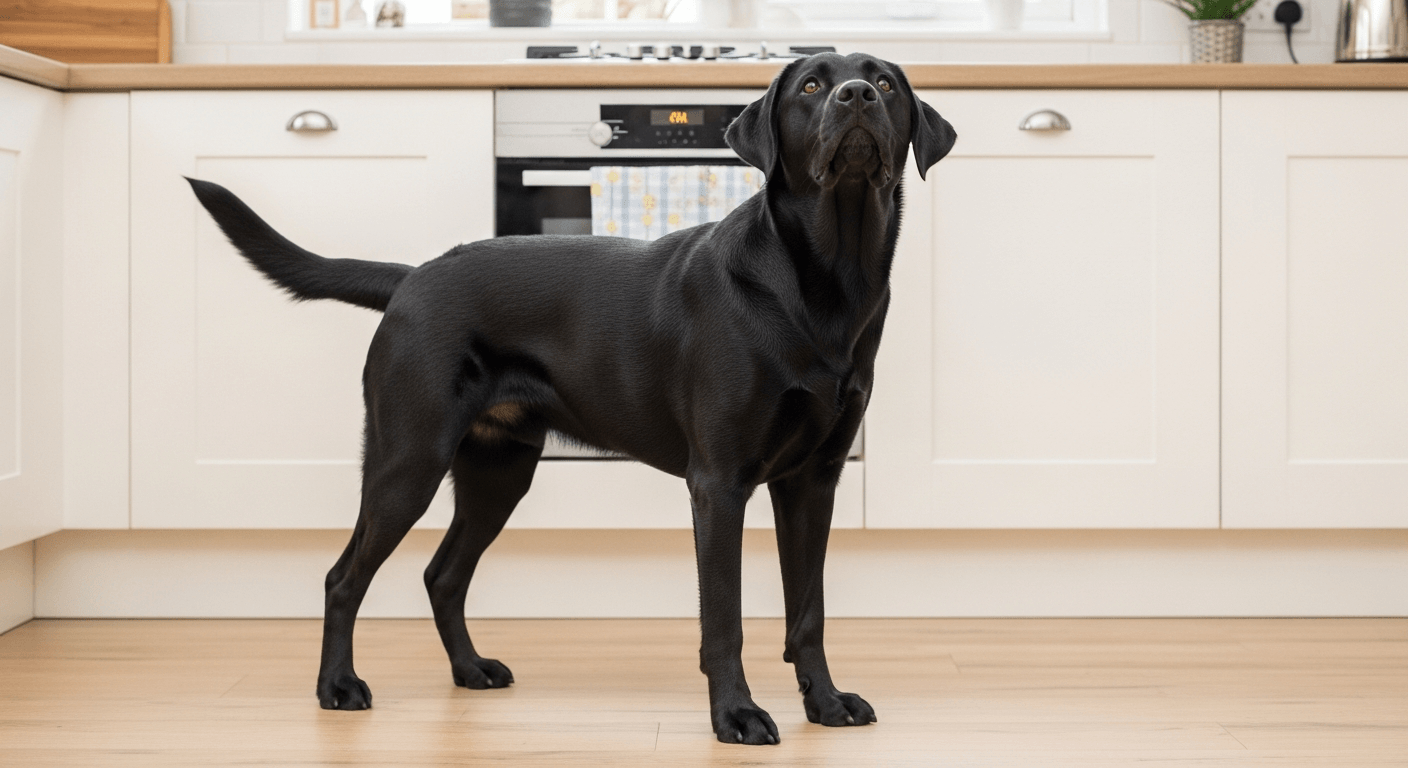
At nine months, veterinarian Kate Boatright’s Labrador growth chart estimates 55–70 lb for males and 45–60 lb for females. Healthy puppies can fall outside these ranges. The selective hearing that started at 6 months begins to ease. Recall becomes slightly more reliable, and pulling on the leash reduces a little with consistent handling. None of this happens all at once — but the trajectory has changed direction.
A single weigh-in gives you one point on your puppy’s growth curve. Bring a few dated weights to your vet and ask how the pattern fits your dog’s build and body condition. Height is nearly at adult level, though chest depth and musculature continue developing until 18–24 months. If you’re catching up, the 8-month-old Labrador guide covers the month you just left.
9 Month Old Labrador Size and Physical Development
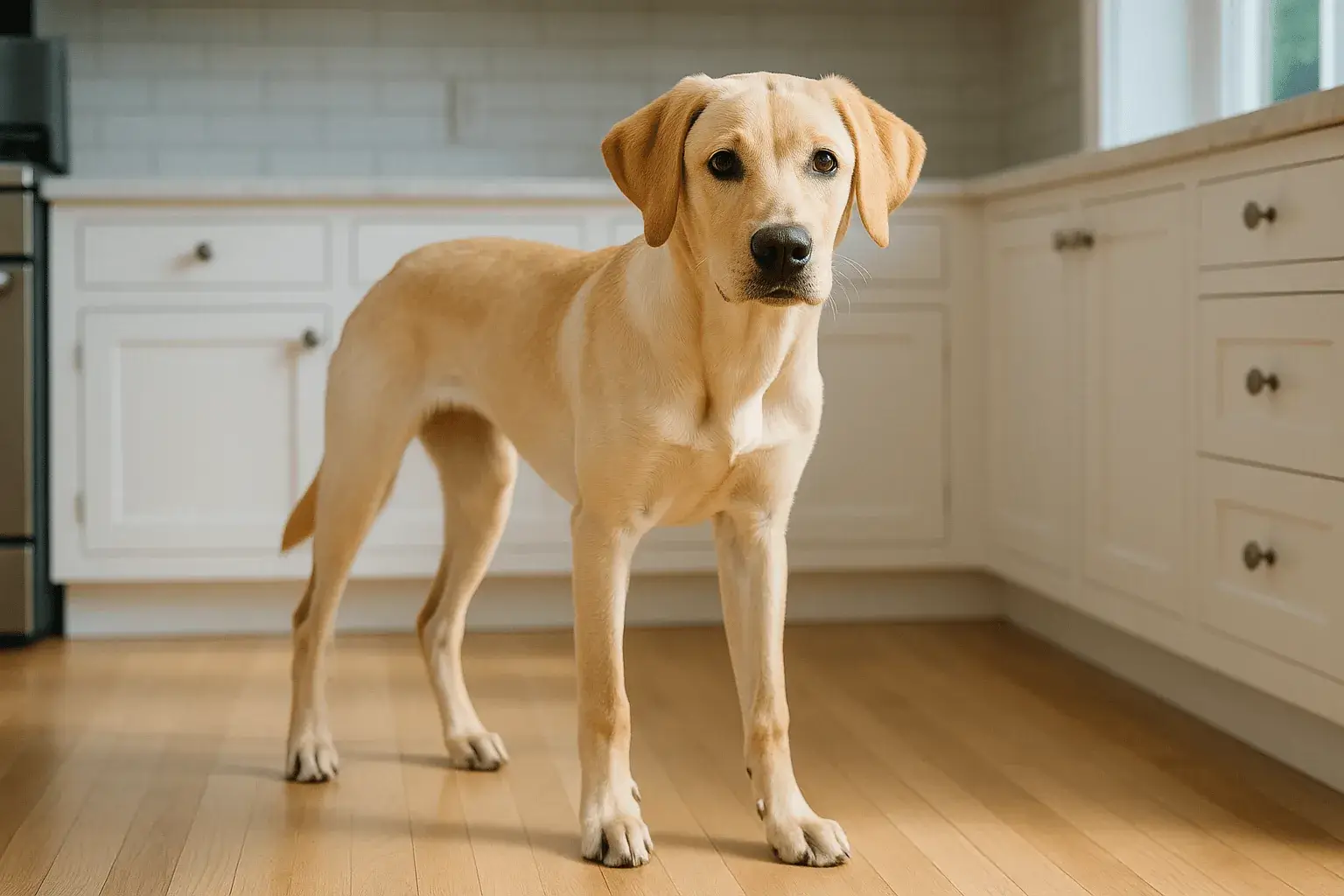
If you weigh your Lab at home, use the same scale under similar conditions and record the date. Puppies differ in how quickly they gain muscle and fill out. A fixed share of adult weight or a set monthly gain tells you little about your own dog. If your puppy loses weight or its usual growth pattern changes, take the record to your veterinarian.
What is still developing at 9 months: the chest continues filling in depth; the head broadens — this is particularly visible in English/show-line males; hindquarter musculature is still building. A 9 month Labrador and an 18 month Labrador standing side by side are clearly different dogs in body substance, even if their height and weight are close.
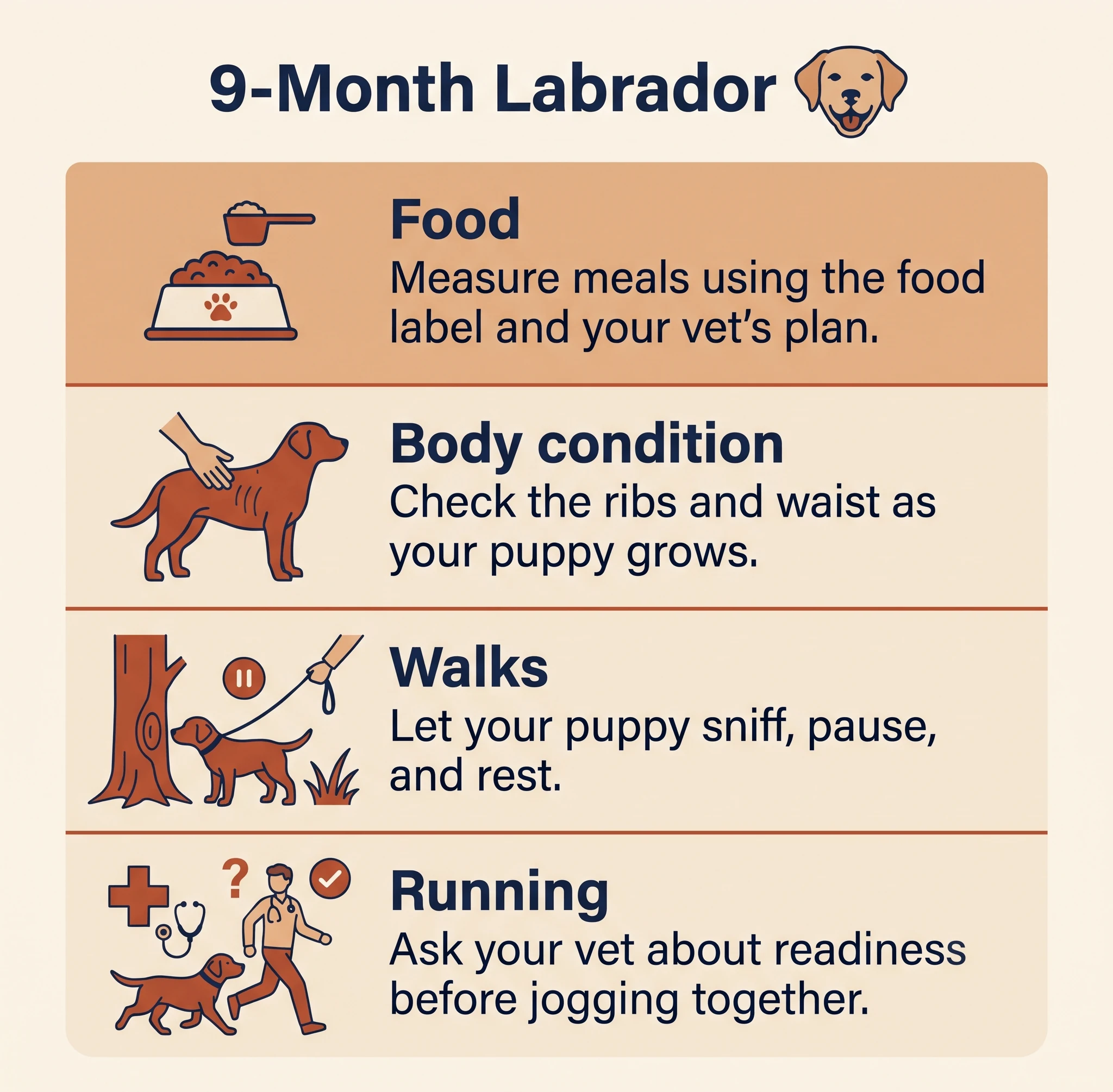
A nine-month-old Lab can look nearly grown while its skeleton is still developing. Choose walks and self-paced play for now. Before introducing regular jogging alongside you, ask your vet whether your dog is physically mature and moves comfortably. A birthday or a weight on the scale cannot establish readiness. For help measuring meals as your puppy grows, see our guide to how much to feed a Labrador.
9 Month Old Lab Behavior: Signs of Improvement
Most Labs begin showing the first consistent behavioral improvements between 9 and 12 months. The change is not sudden — good days alternate with adolescent days for several more months. But the ratio begins shifting. A dog that recalled reliably 30% of the time at 7 months may now respond 50–60% of the time in moderate-distraction environments. That is real progress, even if it does not yet feel like the dog the owner was expecting at 3 months.
The most common question from Lab owners at 9 months is “when will my Lab calm down?” The honest answer: most Labs reach behavioral maturity at 18–24 months, with a significant improvement inflection point at 12 months. A Lab that is well-exercised, consistently trained, and appropriately managed through adolescence will show meaningful improvement from 9 months onward. A Lab that has been under-exercised and under-trained will take longer to settle. Exercise and training consistency are the variables the owner controls.
What still requires active management at 9 months: counter-surfing continues in most Labs through 12 months — the impulse drive does not reduce until inhibition develops with maturity. Jumping on guests is still a work-in-progress. Off-leash reliability is improving but not yet safe in high-distraction settings. The improvements are real; the work is not finished. For the full month-by-month timeline from 8 weeks through adolescence, see our Labrador puppy’s first year guide.
Training at 9 Months: Building on What’s Working
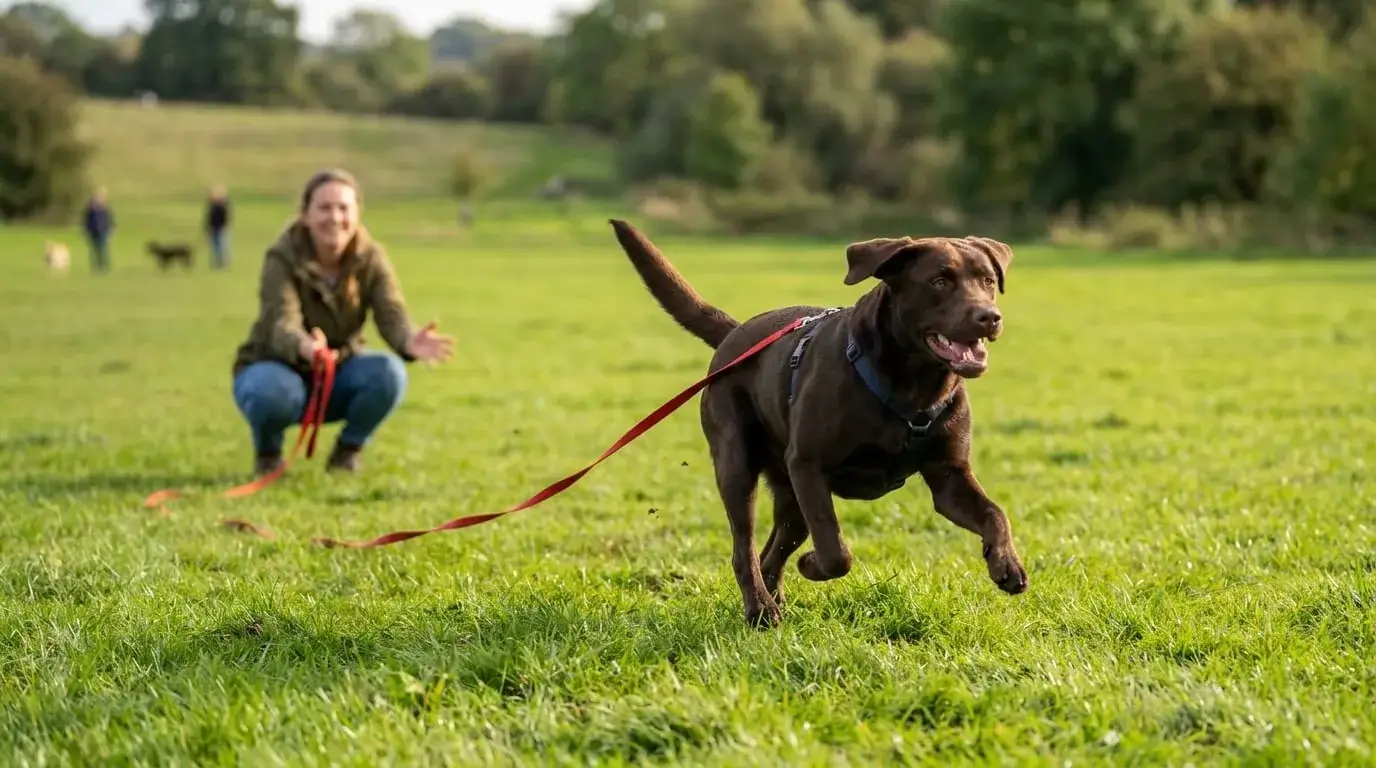
Nine months is when training begins to consolidate more visibly. The neural pathways reinforced during adolescence are firming up. Owners who maintained consistent training through the difficult months at 6–8 months are beginning to see the return on that investment — commands are sticking more reliably, attention spans are slightly longer, and the dog is checking in more frequently during walks.
Recall: Labs trained consistently on a long line since 6 months often begin passing the moderate-distraction recall test at 9 months — responding when called in a park with other dogs visible at a distance. This is meaningful progress. Extend the long-line length gradually as reliability increases and begin testing in lower-distraction off-leash settings. Do not remove the long line in high-risk environments yet — the recall that works in the park may still fail near wildlife or running children.
Leash manners: consistent application of the stop-and-wait technique throughout the adolescent months typically produces noticeable improvement at 9–10 months. Owners who have been consistent will observe the dog offering a loose leash more frequently without being prompted. If pulling is unchanged and as strong as it was at 7 months, the technique has not been applied consistently in every walk. A front-clip harness combined with consistent stop-and-wait, applied in every walk without exception, is the combination that works — one-session trainer guidance is worth considering if the pattern is entrenched. For the full method, see our Labrador puppy training guide.
Feeding and Exercise at 9 Months: Preparing for the 12-Month Transition
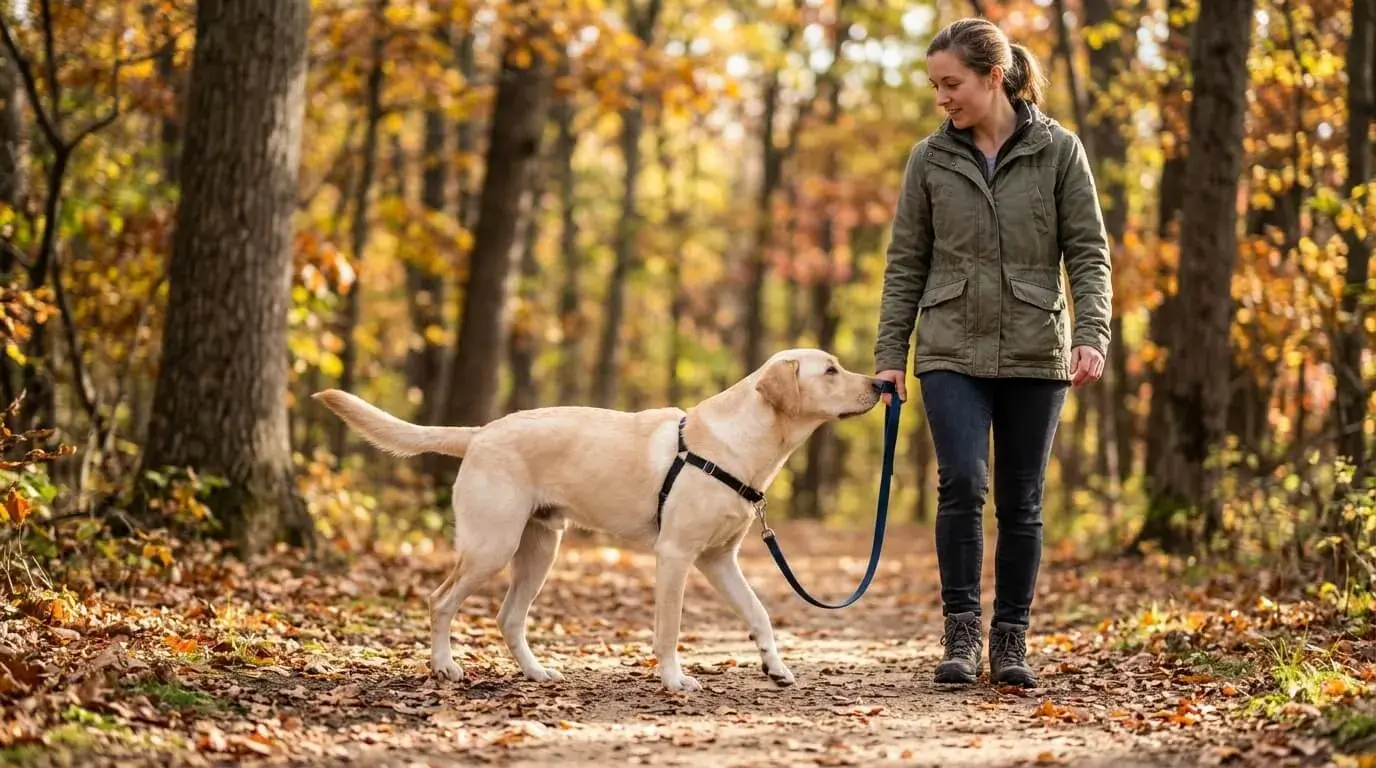
Feed a complete food formulated for the growth of large-breed puppies. Start with the feeding guide on your bag and measure the daily ration in grams. If you change foods, compare the calories per cup or per kilogram on the two labels. Account for training treats and check whether you can feel the ribs easily and see a waist from above. Your vet can adjust the amount to your Lab’s growth and body condition. The AAHA feeding guidelines explain what goes into an individual feeding plan.
Choose a walk your puppy can finish comfortably. Give your Lab time to sniff, stop, and explore, and shorten the outing on a hot day or a tougher trail. If your puppy lags behind or repeatedly sits down, pause and head home. Report limping or stiffness to your vet. PDSA’s puppy exercise guidance explains why age alone cannot set a walking limit. A Labrador growth chart can help track size but cannot clear a dog for sustained running.
At the next checkup, bring your puppy’s food label, a few dated weights, and an example of a typical walk. Ask when to switch your Lab to adult food and whether it is ready for the exercise you have in mind. These decisions may fall at different times. Keep practicing recall and loose-leash walking on familiar routes while you wait. Our Labrador health guide covers other questions to bring.
Frequently Asked Questions: 9 Month Old Labrador
How much should a 9 month old Labrador weigh?
The nine-month estimates are 55–70 lb for male Labradors and 45–60 lb for females. These are broad reference ranges. Check your puppy’s weight trend and body condition with your vet before adjusting meals to reach a number on a chart.
When will my 9 month Lab calm down?
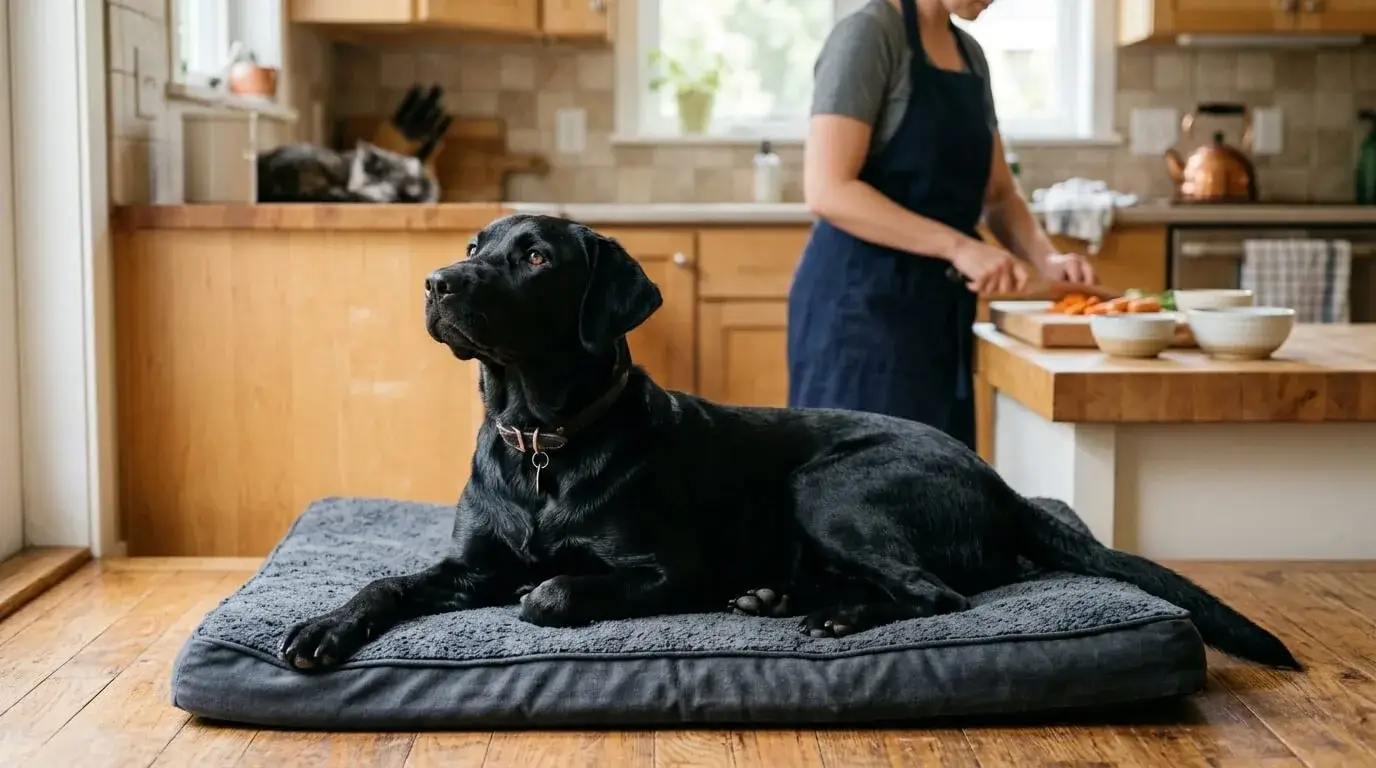
Many Labs begin to settle more easily as they mature. Track changes you can see in your own dog, such as resting on a mat while you cook. Give your puppy comfortable outings, short training sessions, and quiet time afterward. A longer walk is not a reliable cure for an unsettled evening.
Is my 9 month Lab ready to go off-leash?
Partially — it depends on the environment and the recall training history. A dog with a consistently reinforced recall that is responding 80%+ of the time in moderate distraction may be safe off-leash in quiet, enclosed parks. It is not yet safe near wildlife, livestock, or unfamiliar small animals regardless of home recall reliability. Extend off-leash environments gradually.
Should my Lab still be on puppy food at 9 months?
Many nine-month-old Labs still need a complete food for the growth of large-breed puppies. Use the product’s feeding guide as a starting point, and ask your vet to review your dog’s weight trend, body condition, and daily ration. When the time comes for an adult diet, introduce the new food gradually.
My 9 month Lab is still pulling heavily on the leash — is this normal?
Pulling that persists unchanged at 9 months typically indicates inconsistent application of the training technique rather than a dog that cannot learn. The stop-and-wait method produces results with consistent application across every walk — not every other walk. A front-clip harness plus consistent technique, applied by every person who walks the dog, is the combination that works.
How much exercise does a 9 month-old Labrador need?
Walk at a pace your puppy can sustain comfortably, with breaks to sniff and rest. The right amount varies with fitness, weather, and terrain. Choose a shorter route if your dog slows or struggles to keep up, and call the vet about limping or stiffness. Keep planned running for when your vet considers your Lab mature enough and ready for it.
Should I neuter my Labrador at 9 months?
Ask your vet about timing for your dog’s sex, health, and risk of an unplanned litter. A UC Davis study of 1,933 Labradors found more joint disorders in males neutered before six months and in females spayed before a year than in intact dogs of the same sex. The authors suggested waiting past six months for males and past a year for females. This was an observational study. At nine months, discuss the options for your Lab and how to prevent mating if you wait.
Nine months is not the finish line — but the trajectory has changed. Every month from here, the adult Lab becomes more visible through the adolescent surface. The recall gets more reliable. The leash gets lighter. The counter-surfing gets less inventive. Stay the course — our 10-month-old Labrador guide covers the final stretch. Month 12 marks a meaningful shift.


