Labrador puppy food has one job that matters more than any brand name: controlling portions. Labrador puppies will eat whatever you put in front of them and ask for more. Some Labs carry a POMC gene mutation associated with increased appetite and obesity risk; it is not present in every Labrador. Portion control still falls to the owner from day one, whatever the puppy’s genetic makeup. Here is exactly how to get it right.
| Puppy Age | Daily Amount | Meals Per Day |
|---|---|---|
| 8–12 weeks | 1–1½ cups | 3–4 |
| 3–4 months | 1½–2 cups | 3 |
| 4–6 months | 2–2½ cups | 3 |
| 6–9 months | 2½–3 cups | 2 |
| 9–12 months | 3–3½ cups | 2 |
These amounts assume a standard large-breed puppy formula at roughly 360 kcal per cup. Always check the specific number on your food’s bag and adjust for your puppy’s body condition.
What Labrador Puppies Need in Their Food
Protein comes first. Puppy food needs at least 22% protein, compared with 18% for adult maintenance food, to support rapid muscle development. The first ingredient on the bag should be a named meat source — chicken, beef, or salmon — not “poultry meal” or “meat by-products.”
DHA matters just as much. This omega-3 fatty acid drives brain and eye development through the first 12 months, so look for it on the ingredient list. The calcium-to-phosphorus ratio needs to sit between 1:1 and 1.8:1 for a growing large-breed dog. Too much calcium makes bones grow faster than the joints can keep up, raising the risk of skeletal problems and hip dysplasia — which is exactly why you should never add a calcium supplement to a complete puppy food.
Check the AAFCO statement on the bag. It needs to say “complete and balanced for growth” or “all life stages.” If it says “for maintenance,” that is adult food, and it does not belong in a puppy’s bowl.
One more thing is specific to this breed: most Labradors carry a mutation in the POMC gene that disrupts their satiety signal, so they genuinely feel hungry even after a full meal. Labs cannot self-regulate. Accurate portions are the owner’s responsibility.
How Much to Feed a Labrador Puppy
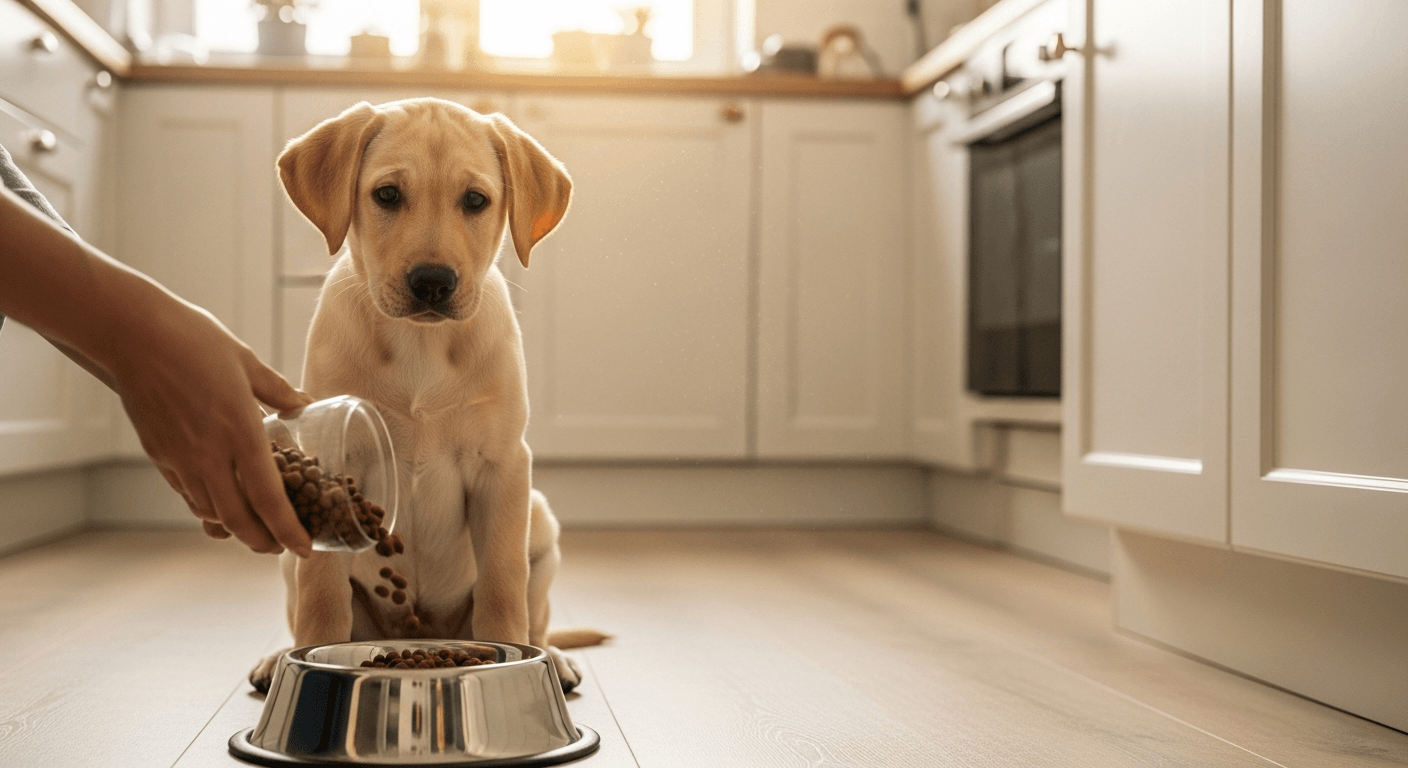
The table at the top of this guide gives the baseline, and each stage has its own logic. At 8 to 12 weeks, a Lab puppy at this age typically weighs just 10 to 15 lbs and has a stomach roughly the size of a walnut, so small, frequent meals are the only option. From 3 to 4 months, your Lab is in a rapid growth phase — this is not the age to underfeed. By 4 to 6 months, teething often starts, and a Lab’s strong chewing drive at this stage can mean scattered or gulped kibble, so soft or soaked food helps both comfort and portion control.
From 6 to 9 months, most owners move to two meals a day, and male Labs at this age average 45 to 55 lbs against 40 to 48 lbs for females, so male portions may need to run 10 to 15% higher. By 9 to 12 months, growth is slowing — most Labs have reached 85 to 90% of their adult frame by 9 months — but your puppy still needs a puppy formula, not an adult one.
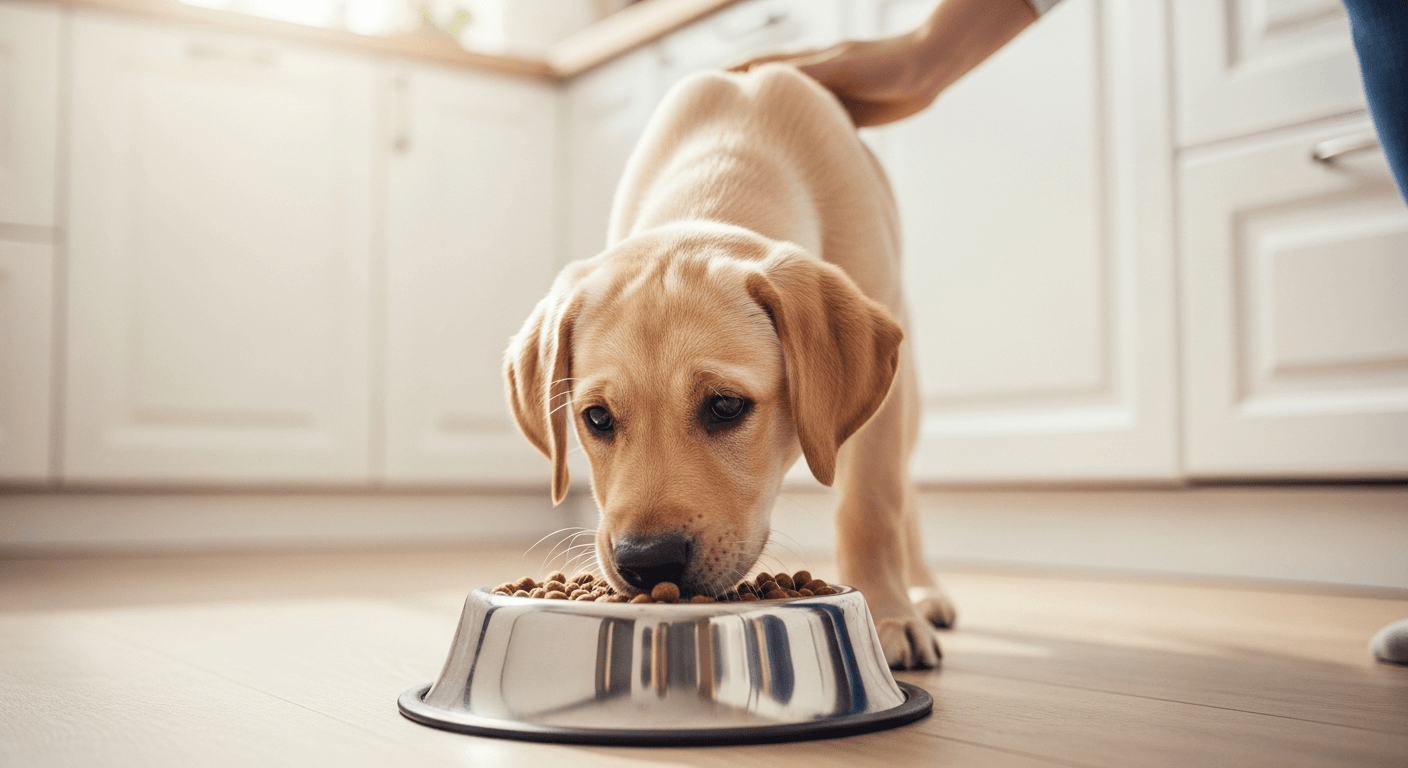
Run a body condition check regularly: slide your hands along your puppy’s ribs. You should feel them easily without pressing, and there should be a slight waist visible from above. If the ribs are hard to find or the waist has disappeared, cut portions by 10% for a week and recheck. Measure every meal with a standard kitchen measuring cup — a free-fill bowl and a Lab puppy are a bad combination.
Labrador Puppy Feeding Schedule: How Often to Feed at Each Age
At 8 to 12 weeks, feed 3 to 4 times a day. A puppy this young can’t hold a large meal, and multiple small meals also keep blood sugar stable.
Move to 3 meals a day around 12 weeks, once stomach capacity increases, and shift to the adult schedule of 2 meals a day — morning and evening — once your Lab is managing well on 3.
Timing consistency does double duty here, because it also drives house training. Puppies typically need to go out within 15 to 30 minutes of eating, so fixed meal times make the potty schedule predictable, while variable meal times mean unpredictable accidents. Fixed meal times are one of the most effective tools in house training — for the full approach, see our guide to training your Labrador puppy.
Skip food between meals except for training treats, and keep those pea-sized, since they count toward the daily calorie total. On heavy training days, trim the regular meal portion slightly to compensate. After meals, keep activity gentle for about 30 minutes — Labs carry lower gastric torsion risk than deep-chested breeds, but it is still good practice.
Best Puppy Food for Labrador Retrievers
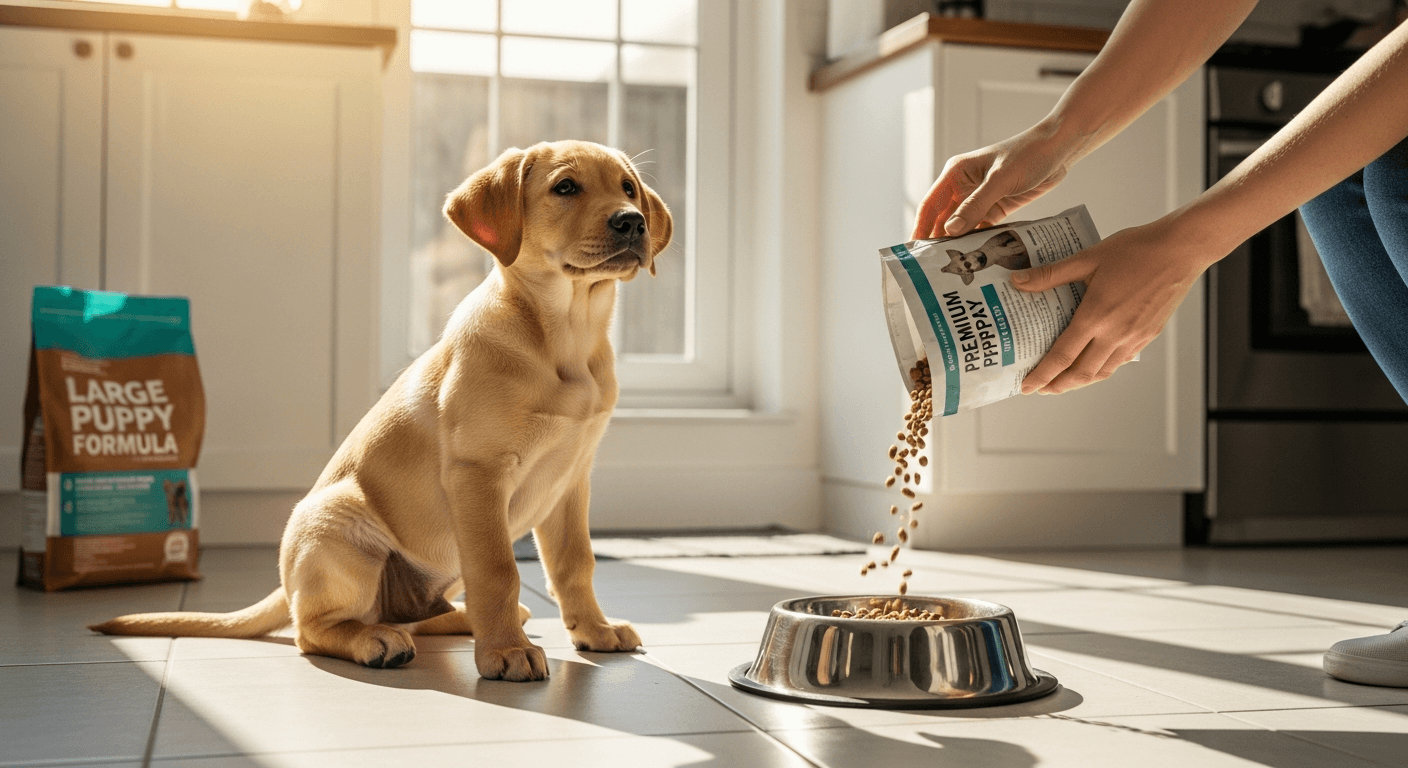
Before you compare bags, run the three-point checklist: a named protein as the first ingredient, an AAFCO “for growth” or “all life stages” statement, and “large breed” clearly stated on the packaging.
Our top recommendation is Purina Pro Plan Puppy Large Breed (chicken and rice formula). It controls calcium carefully, lists DHA, is widely available, and is one of the more extensively research-backed formulas on the market. Hill’s Science Diet Large Breed Puppy is our second pick — slightly lower protein at 24%, but excellent calcium control and a formula frequently recommended by vets, which makes it a solid choice for Labs with sensitive digestion. Royal Canin Labrador Retriever Puppy is worth considering too — a breed-specific formula built around the Lab’s calorie-control needs, at a higher price point.
A few things to avoid: grain-free formulas, which the FDA has flagged as a potential factor in dilated cardiomyopathy in dogs pending further research; any food listing “meat meal” as the first ingredient; and meal-topper supplements, which throw off the calcium balance in an otherwise complete food.
Why Labrador Puppies Need Large-Breed Puppy Food
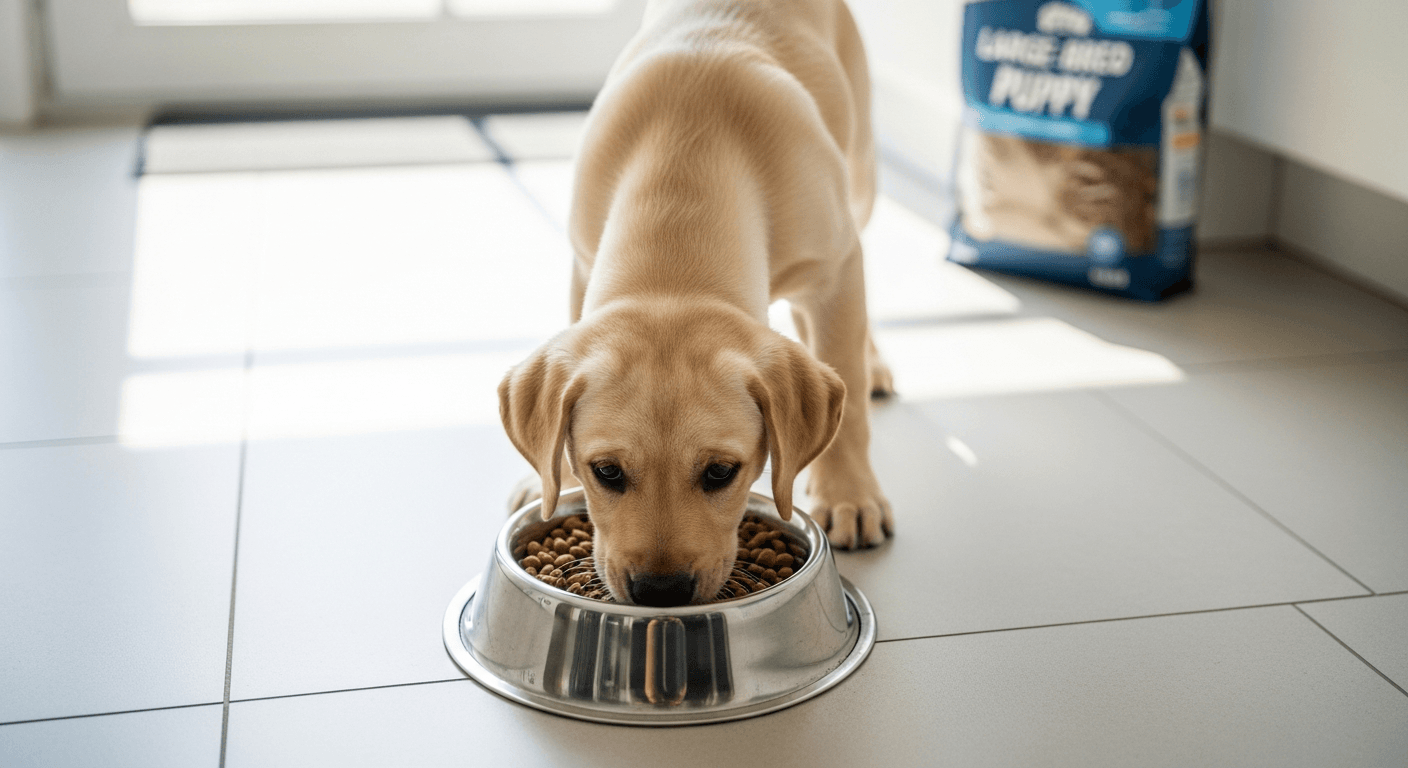
Labradors are a large breed by any measure — adult males typically reach 65 to 80 lbs, females 55 to 70 lbs — and that puts them squarely in the category where growth rate matters most. A Lab goes from roughly 7 lbs at 8 weeks to 55 to 70 lbs by 12 months, eight to ten times its birth weight in a single year. Bones and joints have to keep pace with that.
Regular, all-size puppy food is formulated to be calorie-dense with higher calcium, which is fine for a small breed but pushes a Lab’s growth faster than its bones and cartilage can calcify. That mismatch raises the risk of osteochondritis dissecans, a joint condition caused by too-rapid bone growth, on top of the hip dysplasia risk Labs already carry genetically — see our guide to Labrador hip dysplasia for the full picture.
Large-breed formulas solve this with tighter calorie control, typically 340 to 380 kcal per cup against 400 to 460 in regular puppy food, and calcium held between 0.7% and 1.2% of dry matter. According to VCA Animal Hospitals, matching a growing dog’s diet to its expected adult size is one of the most reliable ways to support healthy skeletal development. This is not a marketing category — the nutrient differences are real and documented.
When to Switch Your Labrador Puppy to Adult Food
Labs stay on puppy food longer than most breeds — typically until 12 to 18 months. Males, being larger and slower to finish growing, often need until 14 to 18 months, while females can usually transition around 12 months.
Watch for the signs that your Lab is ready: growth has visibly slowed, the body is filling out rather than lengthening, no new teeth are coming in, and monthly weight gains have flattened. For the full week-by-week transition method and which adult food to switch to, see our guide on when to switch your Labrador to adult food.
Common Labrador Puppy Feeding Mistakes
Guessing portions instead of measuring. Even being 10% off adds 100 to 150 extra calories a day, which becomes meaningful excess weight over six months of a vulnerable growth window. Use a standard kitchen measuring cup every time. (Prefer cooking yourself? See our guide to homemade dog food for Labradors — puppies need tighter recipe control than adults.)
Switching food brands suddenly. A puppy’s gut bacteria need 7 to 10 days to adjust to a new food. Transition gradually: 25% new food for two days, 50% for two days, 75% for two days, then 100% from day seven.
Adding supplements to a complete food. A food labeled “complete and balanced” already contains the right calcium, phosphorus, and vitamin balance. Extra calcium in a growing Lab is specifically documented to cause skeletal abnormalities.
Feeding adult food to a puppy. The protein and DHA levels are too low for a developing puppy. Labs started on adult food from 8 weeks often show slower muscle development.
Free feeding. Leave food out and a Lab will eat until the bowl is empty, then ask for more. Free feeding a Lab reliably produces an overweight Lab — timed meals only.
Oversized training treats. At 10 to 15 reps a session, treat calories add up fast. Use the lowest-calorie treat that still motivates your puppy, and count treats against the daily total.
Frequently Asked Questions: Labrador Puppy Food
How much Labrador puppy food should I feed?
It depends on age: 1 to 1½ cups a day at 8 to 12 weeks, rising to 3 to 3½ cups a day by 9 to 12 months, split across 2 to 4 meals depending on age. These figures assume a standard large-breed puppy formula around 360 kcal per cup — always check your specific bag and adjust for body condition.
What is the best puppy food for a Labrador Retriever?
Purina Pro Plan Puppy Large Breed and Hill’s Science Diet Large Breed Puppy are our top picks, both offering controlled calcium and DHA in a large-breed formula. Royal Canin Labrador Retriever Puppy is a breed-specific option built around the Lab’s calorie-control needs, at a higher price point.
Can I feed my Labrador puppy regular puppy food instead of large-breed formula?
We don’t recommend it. Regular puppy food is calorie-dense with higher calcium than a large breed needs, which pushes growth faster than the bones and joints can keep up, raising the risk of joint problems including hip dysplasia. Large-breed formula is specifically calorie- and calcium-controlled for dogs like Labs.
When should I switch my Labrador puppy to adult food?
Most Labs switch between 12 and 18 months — males often closer to 14 to 18 months, females around 12 months. Look for slowed growth, a filling-out body shape, and flattened monthly weight gain as the signs your puppy is ready.
Why is my Labrador puppy always hungry?
Most Labradors carry a POMC gene mutation that disrupts the signal telling the brain the stomach is full, so they feel hungry even after eating enough. This is a genuine biological quirk, not a training failure, which is why measured portions matter more for Labs than for most other breeds.
Getting Labrador puppy food right is mostly about consistency, not finding a perfect brand. Once feeding is sorted, the two areas that shape a Lab puppy’s first year most are training consistency and the broader developmental timeline. For training, see our guide to training your Labrador puppy. For the complete month-by-month roadmap, see our Labrador puppy first-year guide.