The Labrador Retriever has been the most registered breed in the United States for over 30 consecutive years. That is not coincidence — it reflects a genuine alignment between the breed’s characteristics and the requirements of modern family life.
The Lab’s food motivation is documented by veterinary geneticists as unusually intense: a POMC gene variant specific to Labrador Retrievers disrupts the neurological satiety signal in approximately 25% of the breed, producing a dog that is genuinely always hungry. Stanley Coren’s The Intelligence of Dogs (1994) places Labs 7th out of 138 breeds for working and obedience intelligence — no other breed in that top tier is as widely kept as a household pet.
The breed also carries specific health predispositions — hip dysplasia affects an estimated 12–13% of Labs per OFA data; obesity rates exceed 25% in clinic surveys; exercise-induced collapse (EIC) is documented in working lines — alongside coat maintenance demands and an adolescent energy phase lasting roughly 18–24 months that new owners consistently underestimate. This is the complete breed guide.
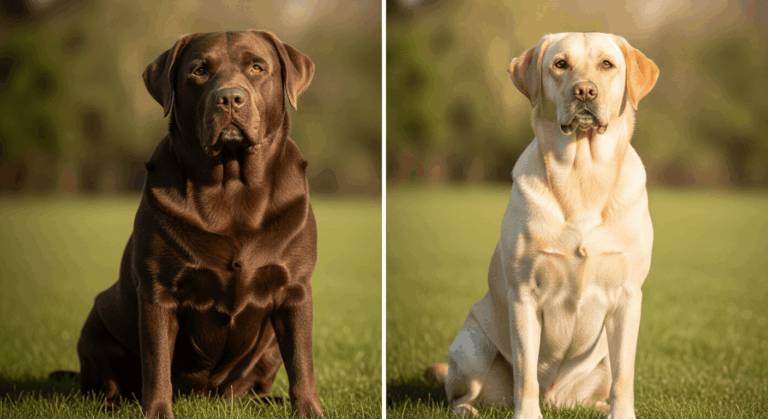
Labrador Retrievers are known for their friendly temperament, high trainability, and strong food motivation. Labs come in three AKC-recognised colors — black, yellow, and chocolate — and two distinct types: English/show-line dogs typically run 10–20 lbs heavier with a blockier build and lower field-trial drive than American/field-line dogs, which sustain high working energy through age 3–4.
Labrador Retriever Characteristics: Size, Build & AKC Breed Standard
The AKC breed standard specifies males at 65–80 lbs and 22.5–24.5 inches at the shoulder; females at 55–70 lbs and 21.5–23.5 inches. The AKC standard describes the Lab as strongly built, medium-to-large, with a broad skull, powerful jaws, an otter tail thick at the base and tapering to the tip, and webbed feet — all functional working adaptations that distinguish the Lab physically from other sporting breeds. The otter tail acts as a rudder when swimming; the webbed feet provide propulsion in cold water. Both are functional working adaptations present in both show and field Labs today, not cosmetic features. Ads for a miniature Labrador are marketing, not a second variety.
The double coat defines the breed’s maintenance requirements. A soft, dense undercoat sits beneath a harder, oil-producing outer coat — a cold-Atlantic survival adaptation inherited directly from the St. John’s water dog, not a cosmetic feature.
Labs blow their undercoat twice yearly and shed moderately year-round. No Lab, regardless of color or type, is a low-shedding dog. That coat structure cannot be bred out or groomed away — only managed.
Three colors are AKC-recognised: black, yellow (ranging from pale cream to fox red), and chocolate. Silver Labs are registered as a chocolate variant — technically a chocolate-dilute (dd dilution gene) — but per AKC breed registration policy (akc.org), silver Labs are recorded under the chocolate color code and are not recognised as a separate variety under the breed standard. The otter tail, webbed feet, water-resistant coat, and biddable temperament all trace directly to the breed’s working origin. A near-white white Labrador is still registered as yellow, not a separate color.
Labrador Retriever History and Origins
The Lab’s name is a geographic misnomer. The breed descends from St. John’s water dogs — working dogs used by fishermen on the island of Newfoundland, Canada, in the 18th and early 19th centuries. They retrieved fishing nets, lines, and fish from the cold North Atlantic. The name “Labrador” was applied later by English aristocrats who imported these dogs to Britain in the early 1800s — specifically the Earl of Malmesbury and the Duke of Buccleuch, who developed the breed for cold-water retrieval of upland game birds. The AKC formally recognised the breed in 1917.
This history is not trivia — it explains every behavioral pattern that new owners encounter. Biddability was bred in because retrieving requires tight handler coordination — Labs in particular were selected for extreme handler attentiveness, which is why the breed accounts for an estimated 70% of guide dogs trained in the US, according to guide-dog organizations. The soft mouth reflects selective pressure to retrieve game and fish without damage — a properly trained Lab applies so little bite pressure when retrieving that it can carry an egg unbroken. Water affinity is both structural and instinctive.
High food motivation was selectively reinforced over generations of working-dog breeding: the most food-driven workers retrieved most reliably and were most consistently retained for the next generation. The adolescent Lab that scavenges food, leaps into every body of water, and brings objects to its owner is behaving exactly as its ancestors were bred to behave. Understanding the origin of a behavior is the first step to managing it. According to the American Kennel Club, the Labrador Retriever’s defining qualities — friendliness, trainability, and working drive — are among the most consistent of any breed in the sporting group.
Labrador Retriever Temperament and Personality
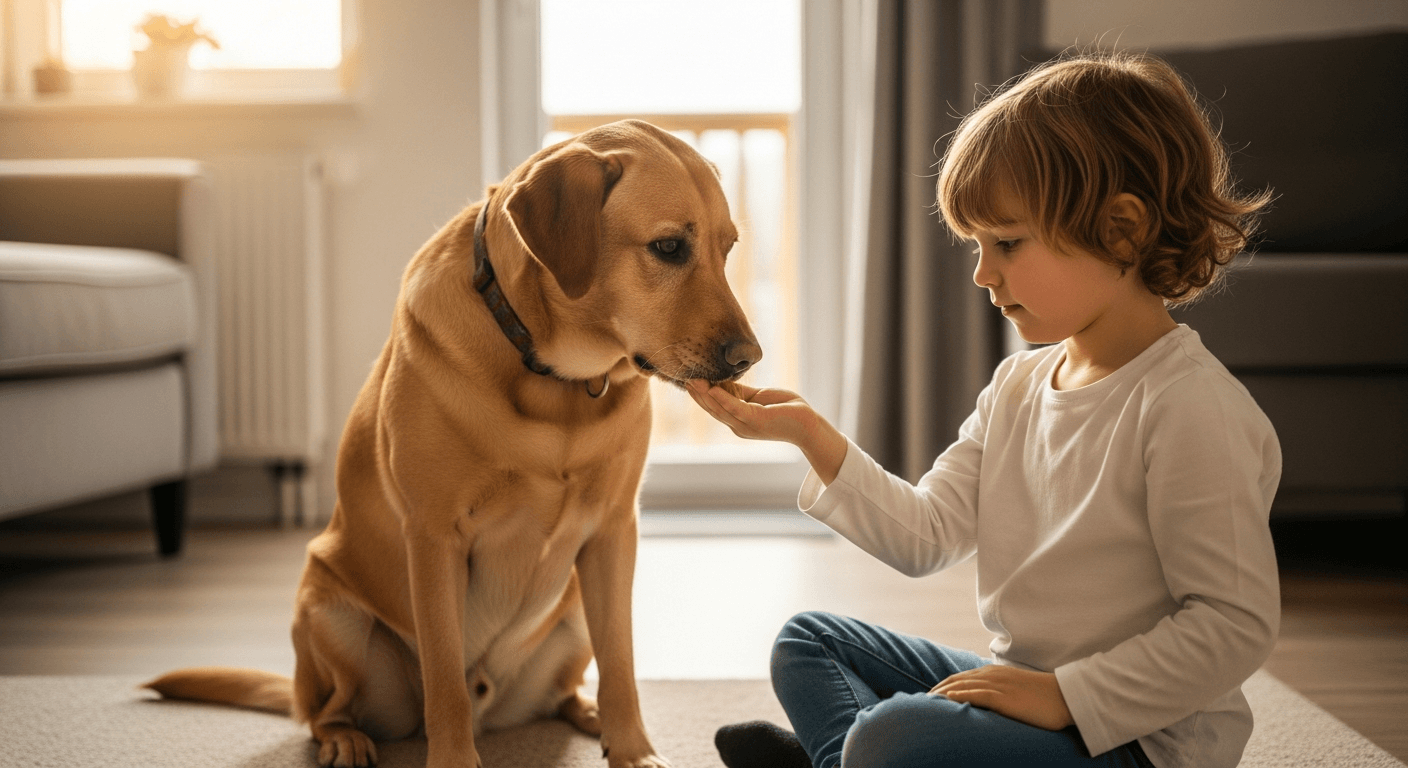
The consistent traits across Labs are well-established: sociable with people and typically with other dogs, highly trainable through positive reinforcement, food-motivated to a degree that makes training efficient, energetic in the first two to three years of life, and reliably good-natured with children in well-socialised individuals. These are not aspirational qualities — they are breed characteristics expressed reliably across the population. Labs are also used as guide dogs, assistance dogs, search-and-rescue dogs, and therapy dogs for exactly these reasons: they work closely with humans, tolerate novelty well, and remain focused under distraction when trained.
What new owners frequently do not anticipate is the duration of the adolescent phase. Labs are not settled adults until 18–24 months. Before that threshold, the typical Lab is unable to settle indoors for more than short periods, pulls consistently on the lead, counter-surfs any accessible surface, and selectively ignores recall despite having demonstrated the behavior reliably at 12 weeks. The calm 8-week puppy that performed perfectly in the breeder’s living room becomes a 7-month adolescent that exhausts new owners before becoming the calm family dog the breed is known for. That transformation is real — but it is 18 months away, not immediate.
The POMC gene mutation deserves specific attention. Approximately 25% of Labs carry a mutation in the POMC gene that removes the neurological satiety signal — these dogs are genuinely always hungry regardless of how much they have eaten. They are not disobedient when they beg or scavenge; they are physiologically compelled. Labs with the POMC mutation require strict portion control their entire lives. The mutation also makes affected Labs among the most food-motivated dogs in any training context — the same trait that drives counter-surfing also makes food-reward training exceptionally effective.
Labrador Colors: Black, Yellow, Chocolate and the Silver Debate
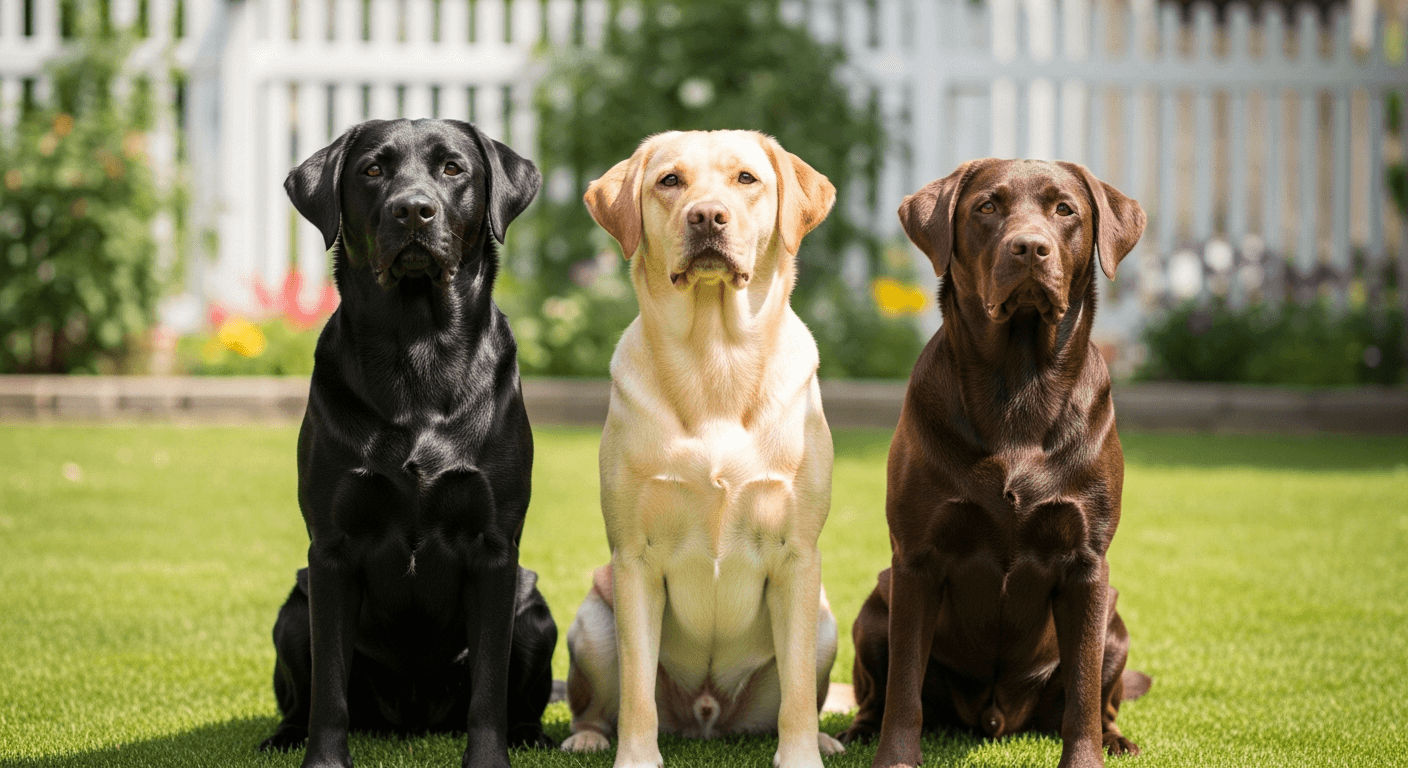
Three colors are recognised by the AKC: black, yellow, and chocolate. Black is genetically dominant — a Lab with at least one E allele and at least one B allele will express black. Yellow results from the recessive ee genotype, which prevents eumelanin expression in the coat. Chocolate is the bb genotype, where eumelanin is expressed as brown rather than black. Fox red is the darkest shade within the yellow classification and is not a separate AKC color. It is simply a deeply pigmented yellow Lab.
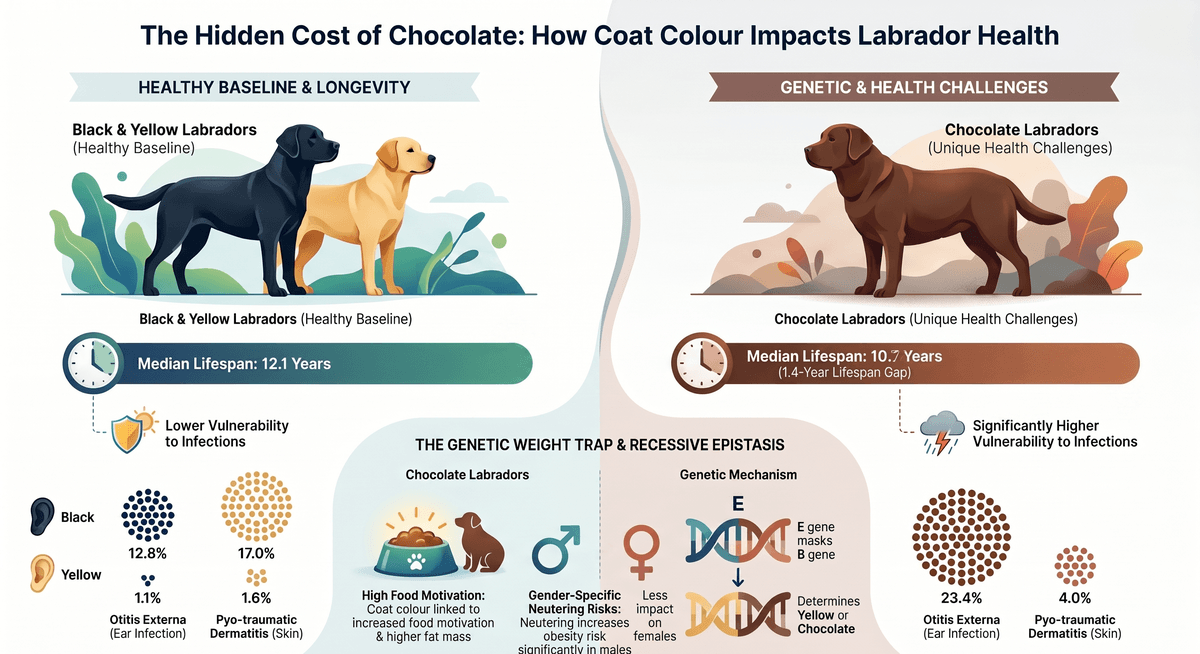
Color does not determine temperament. The belief that chocolate Labs are more hyperactive, yellow Labs are calmer, or black Labs make better working dogs is not supported by evidence. Individual variation within each color exceeds variation between colors. What the evidence does show is a lifespan difference: the 2018 Adams et al. study of 33,320 UK Labradors found chocolate Labs have a median lifespan of 10.7 years compared to 12.1 years for black and yellow Labs. The researchers linked this to the reduced genetic diversity associated with the bb genotype and to higher rates of ear and skin infections in chocolate Labs — conditions that contribute to earlier mortality. Color is not a direct cause; it is a marker for genetic bottleneck effects in the chocolate population.
Silver Labs are registered by the AKC as chocolate — they carry the dilution gene (dd) that lightens the chocolate coat to silver-grey. Charcoal (dilute black) and champagne (dilute yellow) follow the same pattern. The Labrador Retriever Club does not recognise silver, charcoal, or champagne as valid Lab colors and does not consider them consistent with the breed standard. For the full overview, start with our labrador colors guide. For detailed profiles on each color and what the genetic science says, see: black Labrador, chocolate Labrador, yellow Labrador, silver Labrador, charcoal Labrador, and fox red Labrador.
English vs American Labrador: Two Types of the Same Breed
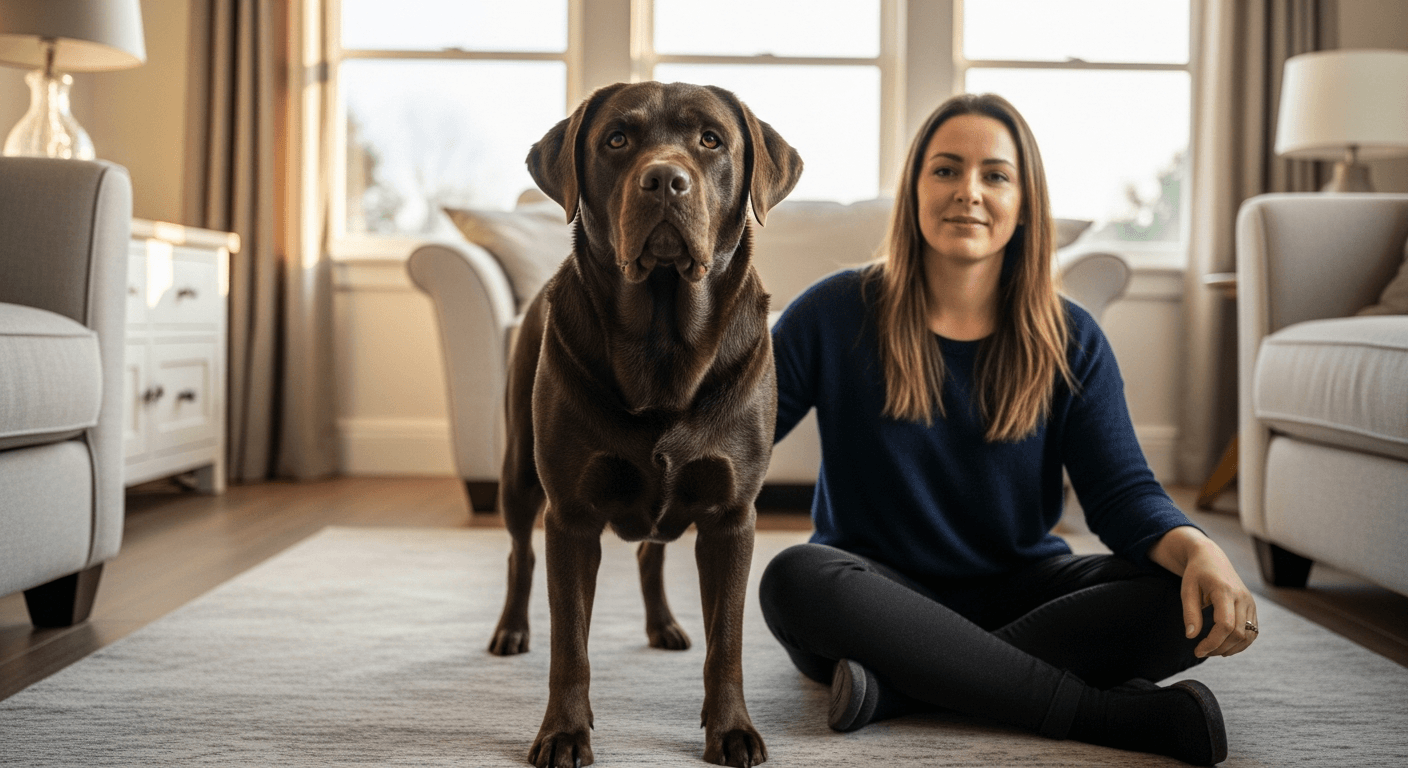
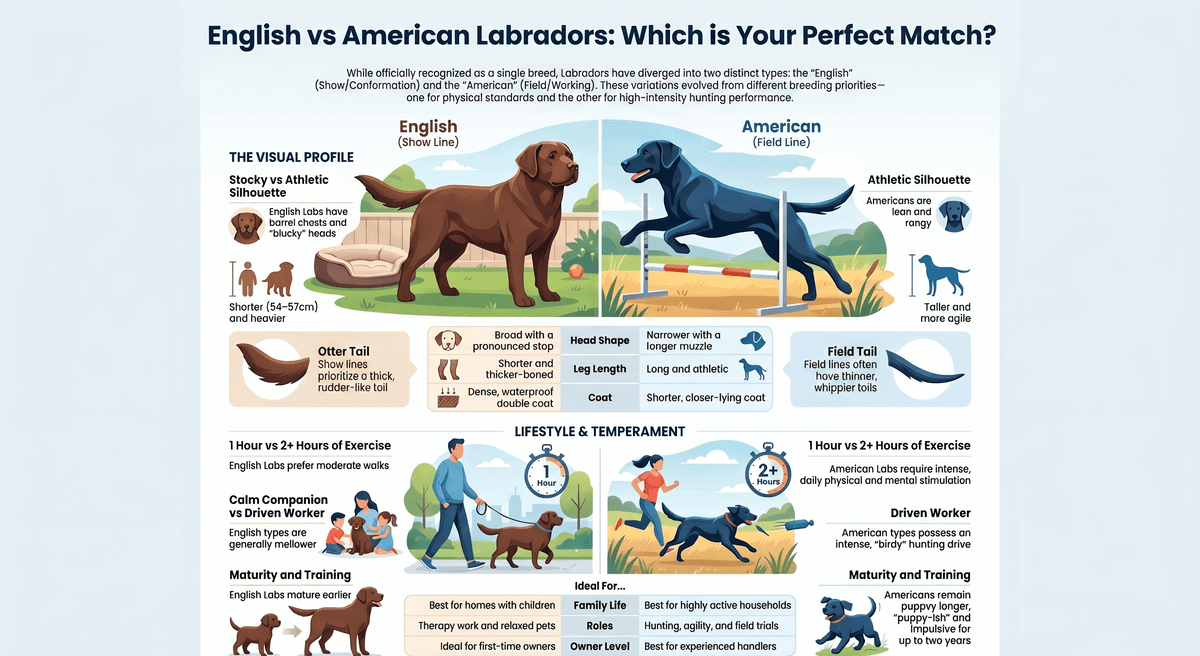
The AKC recognises one Labrador Retriever breed — but two distinct types have developed through divergent selection pressures over the past century. The English (show/bench) Lab was bred to the conformation ring standard: broader build, blockier skull, shorter muzzle, heavier bone, and a calmer energy profile. Most English Labs settle into manageable adult behavior by 18–24 months. The American (field/working) Lab was bred for hunt test and field trial performance: leaner, longer-muzzled, more athletically built, with higher sustained energy output that often persists to age 3 or beyond.
Both types carry the same genetic health risks and are equally intelligent — the difference is energy profile and physical build. Neither type is superior. For households without a working or sporting context, the English Lab’s earlier settling and slightly lower peak energy typically produces a more manageable family dog in the first two years. For owners who want a high-drive working or sporting companion, the American Lab’s sustained energy and field instincts are assets. The AKC does not officially classify these types, and many Labs fall somewhere between the two ends of the spectrum. For the full comparison including health considerations and which type suits different lifestyles, see English vs American Labrador.
Labrador Health: Genetic Predispositions Every Owner Should Know
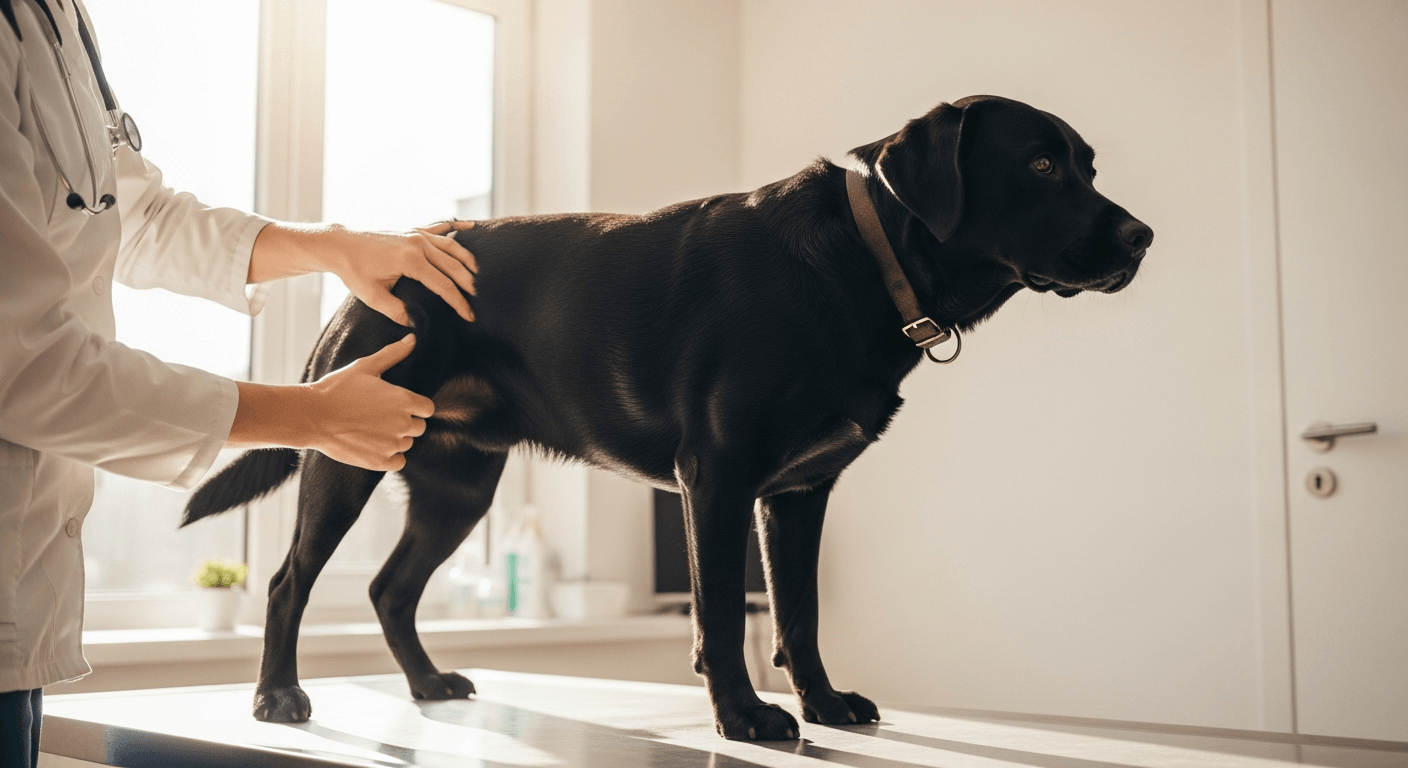
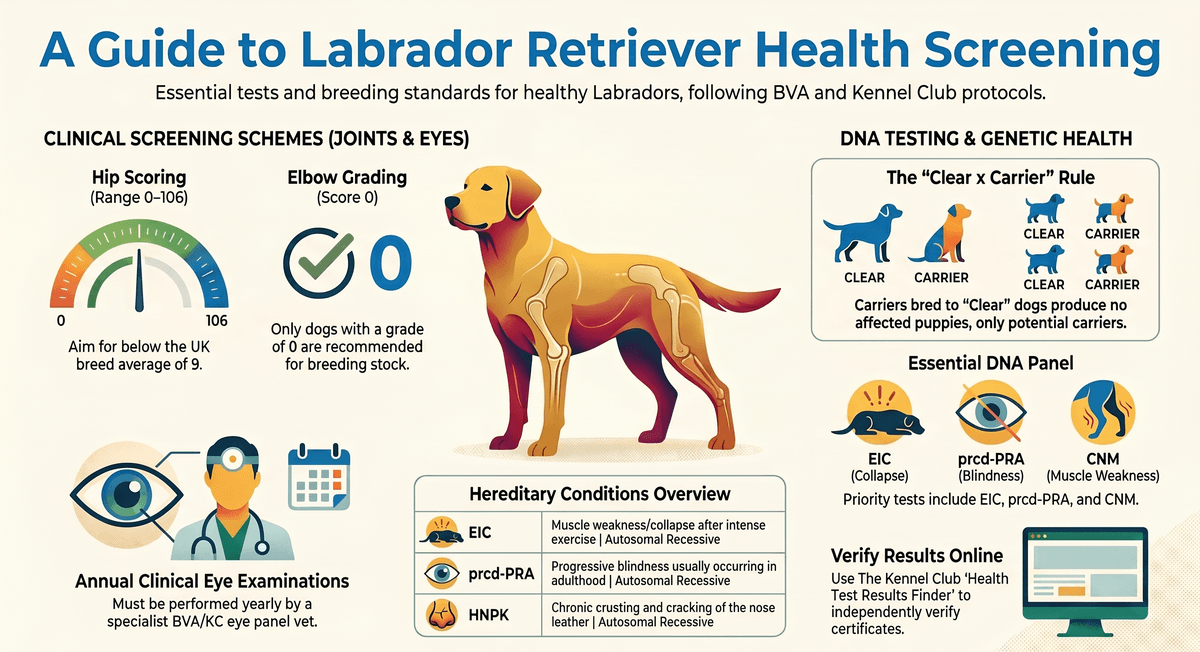
The primary genetic health concerns in Labs are hip dysplasia (OFA data indicates approximately 12% of tested Labs are affected), elbow dysplasia, hereditary eye conditions (HC4 hereditary cataracts and prcd-PRA progressive retinal atrophy), exercise-induced collapse (EIC — a genetic condition triggered by intense activity in affected dogs), and obesity driven by the POMC mutation. Each of these is a manageable risk when identified early and handled correctly.
Responsible breeders provide specific documentation: OFA or PennHIP hip evaluation for both parents, OFA elbow evaluation for both parents, CAER or OFA annual eye exam for both parents, and DNA test results for both prcd-PRA and HC4 cataracts. These are minimum requirements — not optional extras. Buyers who do not receive this documentation from a breeder have not been given the information needed to make an informed purchase decision.
The most preventable health problem in Labs is obesity. Labs that maintain a healthy body weight throughout life have significantly better joint outcomes, longer lifespans, and lower surgical risk than overweight individuals. The POMC mutation means most Labs will always appear to want more food — managing this requires consistent portion discipline maintained across the entire lifespan. For the complete guide to all major Lab health conditions, prevention strategies, and when to call a vet, see our Labrador health guide, which covers hip dysplasia, ear infections, skin problems, eye conditions, and senior care in full.
Labrador Exercise Requirements: How Much Activity a Lab Actually Needs
Adult Labs require 1.5–2 hours of structured daily exercise. This is not a rough guideline — it is the activity level needed to prevent the destructive behaviors, weight gain, and anxiety that characterise under-exercised Labs. A 30-minute walk does not meet the exercise requirements of a healthy adult Labrador. Swimming, fetch, trail running, and off-leash play in enclosed areas are all appropriate high-output activities.
Puppies are a different case. The AKC and most veterinary guidelines recommend the “five-minute rule” for puppies — five minutes of formal exercise per month of age, twice daily, up to about 12 months. This is because Labrador growth plates do not close until 12–18 months, and repetitive high-impact activity before closure increases the risk of orthopedic injury. A 4-month-old puppy needs 20 minutes of structured exercise twice daily, not a 2-hour run. Instinctive play, sniffing, and low-impact exploration do not carry the same risk and should not be restricted.
Mental stimulation matters alongside physical exercise. Labs working their brains through training sessions, puzzle feeders, and scent work are meaningfully calmer than Labs who receive only physical output. For the full breakdown of exercise requirements by age — including what activities are safe at each stage and how to structure a week’s routine — see our guide on how much exercise a Labrador needs.
Training a Labrador Retriever: What the Breed Responds To
Labs are among the easiest breeds to train — the same food motivation and biddability that defines the breed’s working history translates directly into training efficiency. A food-motivated, handler-focused dog responds quickly to positive reinforcement. Basic obedience (sit, down, stay, come, heel) can typically be introduced from 8 weeks and solidified by 6 months with consistent daily sessions of 5–10 minutes.
The adolescent phase complicates this picture. Labs between 6 and 18 months frequently appear to “forget” previously trained behaviors — especially recall. This is normal canine adolescence: the prefrontal cortex is undergoing rapid development, impulse control fluctuates, and environmental distractions become more compelling. The training strategy during adolescence is to increase training frequency and reduce session length, not to punish regression. Consistent positive reinforcement through adolescence produces the reliable adult dog the breed is known for.
Counterproductive training methods are especially damaging in Labs. Punishment-based training suppresses behavior without teaching the dog what to do instead, and Labs trained primarily through aversive methods lose the food-motivated confidence that makes the breed so trainable. For the complete training system covering every stage from 8-week puppy through adult obedience, see our complete Labrador training guide.
Labrador Grooming and Shedding: What to Expect Year-Round
The Lab’s double coat sheds year-round and undergoes two heavy coat blows annually — typically spring and fall — during which the undercoat releases en masse for 2–4 weeks. During coat blows, daily brushing is necessary to manage the volume. Between blows, brushing 2–3 times weekly with a slicker brush or deshedding tool keeps shedding manageable and reduces the amount landing on furniture and clothing. No brushing frequency eliminates Lab shedding entirely.
Bathing is needed every 6–8 weeks under normal circumstances. Labs that swim regularly or work in muddy environments may need more frequent bathing. The water-resistant outer coat repels surface dirt but holds odor — a dog-specific shampoo formulated for double-coat breeds performs better than general pet shampoos. Ear cleaning after every bath and every swim is non-negotiable for Labs: the floppy ear anatomy traps moisture, and Labs have among the highest rates of ear infection of any breed. For detailed grooming instructions, brush recommendations, and a weekly maintenance schedule, see our guides on Labrador shedding and how to groom a Labrador.
Popular Labrador Mixes: What You’re Getting When You Cross a Lab
Labs are crossed with more breeds than almost any other dog in the US. The appeal is straightforward: the Lab’s trainability, social temperament, and physical robustness make it a desirable genetic contributor. The most popular crosses are the Goldador (Lab × Golden Retriever), the German Shepherd Lab Mix (Sheprador), the Labrador Husky Mix (Huskador), the Pitbull Lab Mix (Labrabull), the Borador (Border Collie Lab Mix), the Blue Heeler Lab Mix, the Boxer Lab Mix (Boxador), the Rottweiler Lab Mix (Labrottie), and the Black Mouth Cur Lab Mix. The Labradoodle is also common — see our full guide to Labrador mix breeds for more crosses we cover. One of the most-searched crosses is the Mountain Cur Lab mix, a hardy working hybrid we cover in depth.
First-generation (F1) crosses are a 50/50 genetic split — which parent’s traits dominate is unpredictable per puppy. Buyers who expect a Lab with different-colored fur often receive a dog with significantly different energy levels, independence, or prey drive depending on the other parent’s genetic contribution. Health testing still applies regardless of mix status: responsible breeders of Lab crosses provide OFA clearances from both parent lines, not just the Lab parent. Each of these crosses blends the Labrador’s friendly, trainable nature with the other breed’s temperament and working style.
Bringing Home a Labrador Puppy: The First-Year Reality
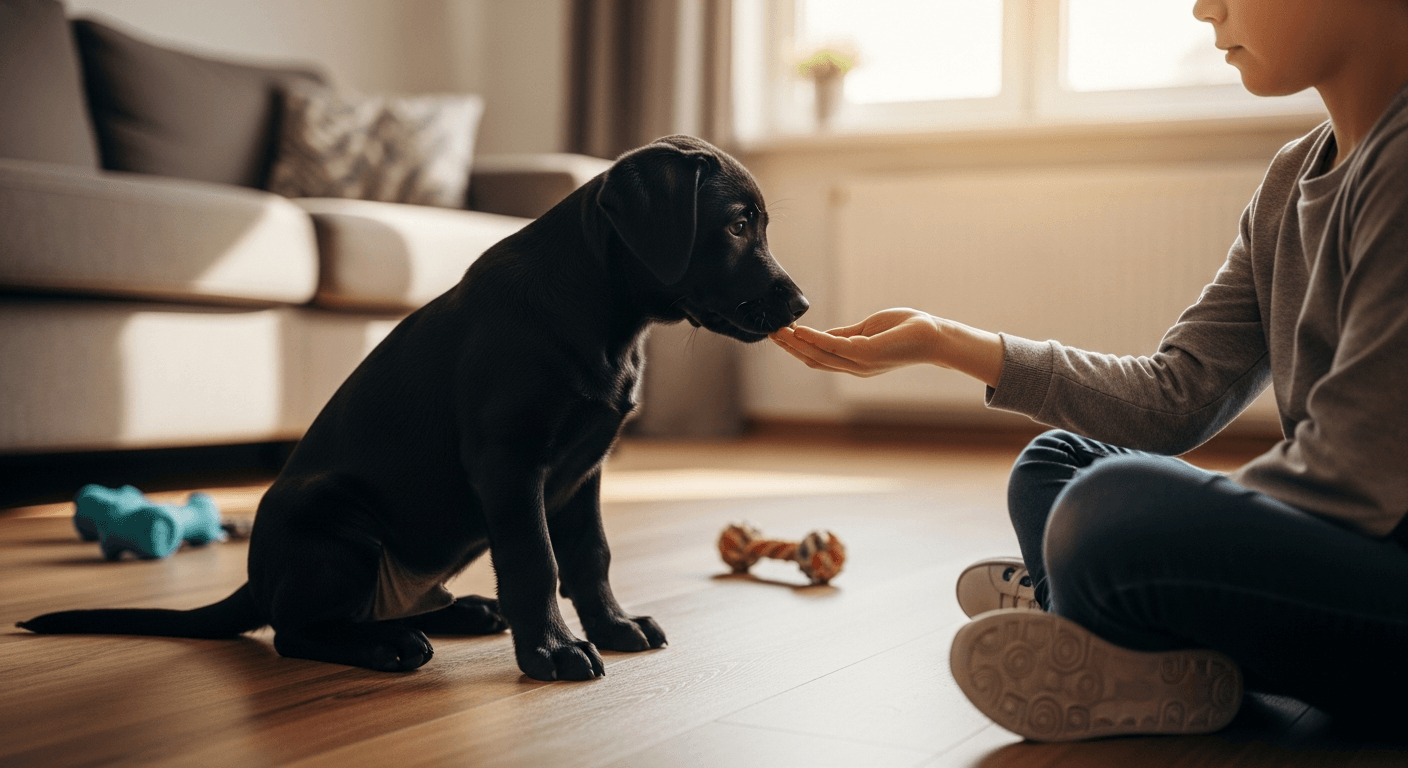
The first year with a Labrador puppy sets the trajectory for the next decade. Labs that are socialised broadly between 8 and 16 weeks — exposed to different people, surfaces, sounds, and environments in positive contexts — develop into the confident, adaptable adults the breed is known for. Labs that miss this socialisation window can develop fearfulness or reactivity that is much harder to address at 2 years than it would have been at 12 weeks.
The first year has four distinct phases: the puppy phase (8–16 weeks, focused on house training, socialisation, and basic obedience), the juvenile phase (4–6 months, introducing formal obedience and managing teething), the adolescent phase (6–18 months, maintaining training through hormonal changes and increased distraction sensitivity), and the young adult phase (18–24 months, consolidating training into reliable adult behavior). Owners who understand this timeline are not surprised by the adolescent regression and are prepared to maintain consistent training through it.
For the complete week-by-week guide to what to expect in the first year — including developmental milestones, feeding stages, vaccination schedule, and training priorities at each phase — see our Labrador puppy first year guide.
Is a Labrador Right for You? The Honest Suitability Assessment
Labs are genuinely excellent dogs — for owners who match the breed’s actual requirements. The ownership requirements are not negotiable: 1.5–2 hours of structured daily exercise in adulthood; consistent positive training from 8 weeks through 18 months; strict portion control and weight management for the dog’s entire life; regular ear cleaning and dental maintenance. These are the non-negotiables of Lab ownership, not preferences. If you are still choosing between this breed and its closest rival, our Labrador vs Golden Retriever comparison breaks down which to choose.
Labs suit active individuals and families who enjoy outdoor exercise, owners who want a highly trainable and sociable companion, households with children over 5 years old where active supervision during play is maintained, and owners who want a dog suited to therapy, service, or sporting work. Labs also adapt well to rural and suburban environments when exercise requirements are met.
Who should think carefully: apartment dwellers without a committed daily outdoor exercise routine and access to an enclosed exercise space; owners who work 10+ hours daily without a midday exercise and enrichment plan; anyone who wants a dog that is calm and settled before age 2; owners who want a low-shedding or hypoallergenic dog — no Lab qualifies on either count. The Lab vs Golden Retriever comparison is the most common decision point for prospective owners: the Lab is lower-maintenance on grooming, the Golden settles marginally earlier. For the full picture of what daily life with a Lab actually looks like once you own one, see our complete guide to living with a Labrador.
Frequently Asked Questions: Labrador Retriever
What is the Labrador Retriever known for?
High trainability, friendly temperament, and consistent food motivation. The Lab has been the most registered AKC breed for over 30 consecutive years. The breed combines working-dog biddability with a sociable, people-oriented temperament — the combination that makes it effective in service, therapy, guide dog, and family roles.
How long do Labrador Retrievers live?
The 2018 Adams et al. study of 33,320 UK Labs found median lifespan is 12.1 years for black and yellow Labs and 10.7 years for chocolate Labs. The difference is linked to the reduced genetic diversity of the bb genotype and higher infection rates in chocolates. Weight management and health-tested parents are the owner-controlled variables with the greatest lifespan impact.
Do Labradors shed a lot?
Yes — consistently and heavily. The double-coat structure means Labs shed year-round with twice-yearly heavy coat blows in spring and fall. No coat management routine eliminates shedding. Regular brushing (2–3 times weekly) and daily brushing during blow-out seasons manage the volume but do not stop it.
What are the two types of Labrador?
English (show/bench line) and American (field/working line). English Labs are broader, blockier, and calmer, typically settling by 18–24 months. American Labs are leaner, higher-energy, and maintain working drive longer — often past 3 years. The AKC recognises one breed; the type distinction is informal but meaningful for prospective owners.
Are Labradors good family dogs?
Yes — with honest expectations. Labs are sociable, good-natured, and typically excellent with children. They are not calm or settled until 18–24 months, they shed heavily, and they require substantial daily exercise. A well-trained, well-exercised Lab in a household that can commit to those requirements is an exceptional family dog.
What health tests should a Lab breeder provide?
Both parents should have OFA or PennHIP hip evaluations, OFA elbow evaluations, and CAER/OFA annual eye exams. DNA test results for prcd-PRA (progressive retinal atrophy) and HC4 hereditary cataracts should be provided for both parents. These are minimum requirements — not optional documentation.
The Labrador Retriever’s 30-year run as America’s most popular breed is not accidental. It is a dog that delivers consistently — trainable, sociable, robust. The ownership requirements are real but manageable with preparation. Understanding both the strengths and the demands is what separates successful Lab ownership from the statistics on breed surrenders.