
The biggest differences in a Labrador vs Golden Retriever comparison are coat maintenance, energy profile, and emotional sensitivity — and those three things decide which breed fits your life. Labs and Goldens are the two most popular family dogs in the US for overlapping reasons. Both are friendly, trainable, and good with children. But they are not interchangeable. This is the side-by-side breakdown that takes positions instead of telling you they are both wonderful.
Labradors and Golden Retrievers are both friendly, trainable family dogs — but they differ meaningfully in coat maintenance (Goldens need far more grooming), energy profile (Labs hold higher physical energy longer), and sensitivity (Goldens react more strongly to correction and household stress).
Labrador vs Golden Retriever at a Glance
Here is how a Labrador and Golden Retriever compare at a glance. Every difference is expanded in the sections that follow.
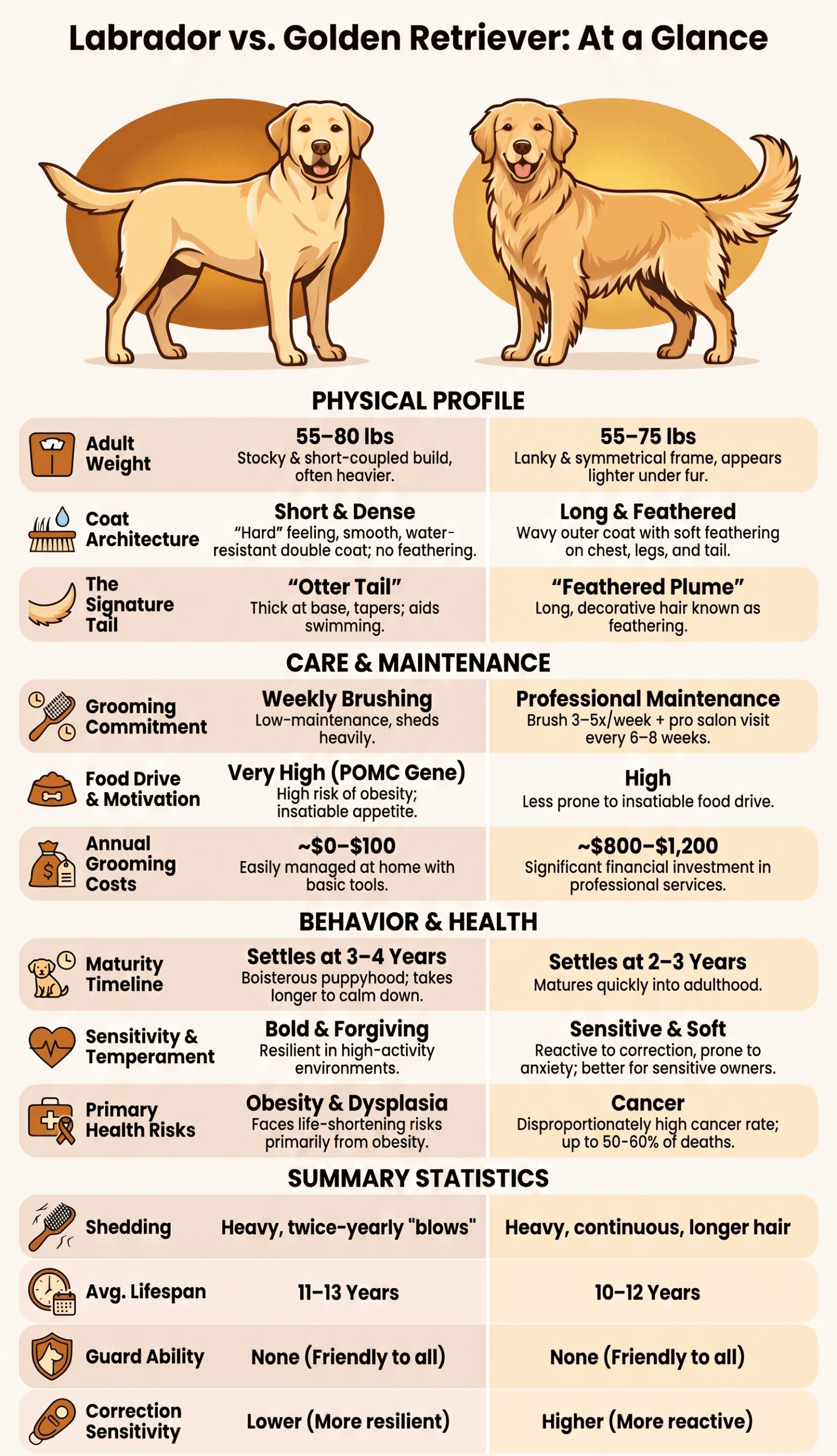
Both breeds rank at the very top of the AKC’s most popular breeds in the US, and both belong to the Sporting Group. The differences are real, but neither is a wrong choice for an active home.
Where Labradors and Golden Retrievers Come From
Both breeds are 19th-century sporting retrievers bred to work alongside hunters and carry game in a soft mouth. That shared job explains the traits they have in common: strong trainability, water affinity, gentle bite, and a persistent drive to fetch. If you pick either breed, you are getting a working retriever and everything that comes with one. The Labrador itself splits into two breeding lines worth knowing before you choose – our English vs American Labrador guide breaks them down.
The Labrador traces to Newfoundland fishing dogs, then was refined in England through the 1800s for cold-water retrieving. That background built a physically robust, weather-resistant, energetically dense dog. The persistence and stamina in today’s pet Labs is a direct legacy of hauling nets and retrieving in icy water.
The Golden Retriever was developed in Scotland in the 1860s by Lord Tweedmouth, who crossed a yellow Wavy-Coated Retriever with a Tweed Water Spaniel. The goal was a biddable, tender-mouthed gun dog for upland terrain. That history produced a softer, more handler-attuned temperament and the flowing coat the breed is known for. The practical takeaway: the Lab’s origin made a harder, more driven dog, and the Golden’s origin made a more sensitive, coat-heavy one.
Appearance and Size: Labrador vs Golden Retriever
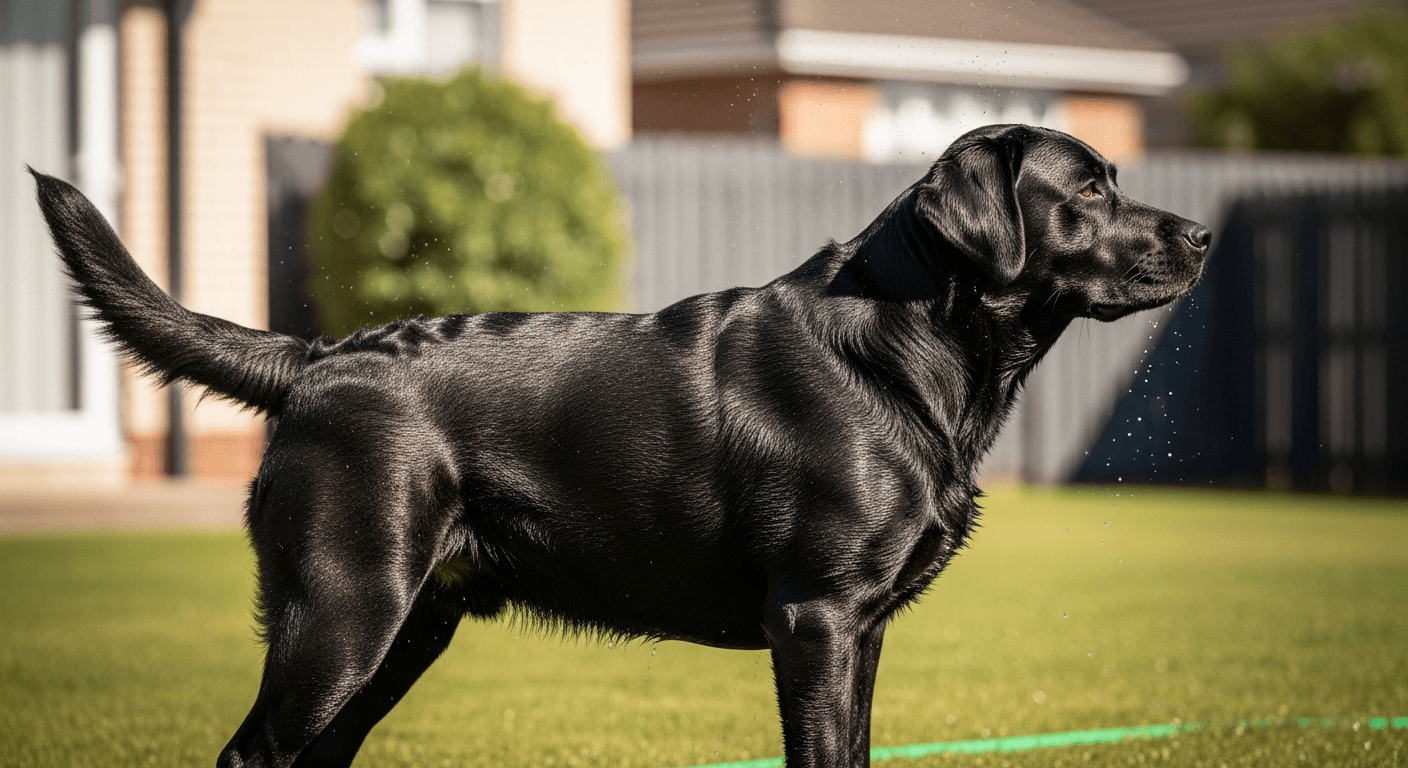
Size is nearly identical. Male Labs run 65–80 lbs and males Goldens 65–75 lbs, with females of both breeds 55–70 lbs. Standing next to each other, the two dogs are close in height and weight. The differences are in coat and outline, not bulk.
The Labrador wears a short, dense double coat that lies flat and sheds water fast. There is no feathering anywhere on the body, and the tail is thick and tapered — the famous “otter tail.” The build reads as blocky and powerful, with a broad head and heavy bone.
The Golden Retriever carries a longer, wavy outer coat with distinct feathering on the chest, legs, belly, and tail. The coat ranges from light cream to deep red-gold. The overall outline is softer and more elegant than the Lab’s, and the feathering is the single most recognizable visual marker between the two breeds. Labs come in three colors — black, yellow, and chocolate — while Goldens appear only in shades of gold.
Temperament: Golden Retriever vs Labrador
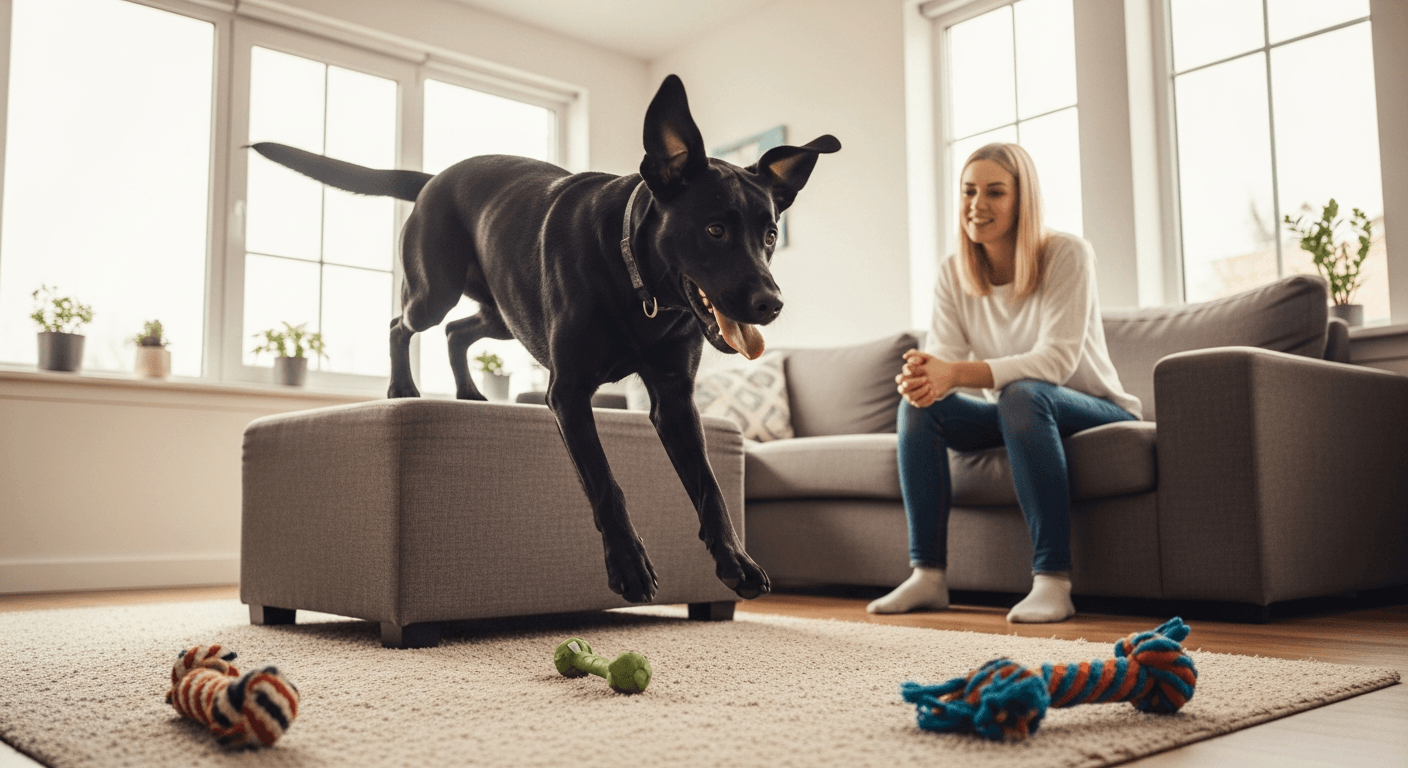
Temperament is where the golden retriever vs labrador temperament question gets real answers, and energy persistence is the first one. Labs commonly stay high-energy until 3–4 years of age. Most Goldens settle into a calmer indoor temperament by 2–3 years. For owners who want a mellow housemate sooner, the Lab’s puppy phase simply runs longer.
Emotional sensitivity separates the two more clearly than any other trait. Goldens respond sharply to raised voices, household tension, and inconsistent handling. A Golden that meets harsh corrections tends to get anxious rather than compliant. Labs are more resilient — a clumsy training session still makes progress with a Lab but can set a sensitive Golden back. For first-time owners still learning technique, that resilience matters.
Food drive is high in both, but the Lab’s POMC gene mutation removes the satiety signal that tells most dogs they are full. The result is a dog that acts perpetually hungry. That makes Labs slightly easier to motivate with treats and significantly more prone to obesity without strict portions. Goldens are food-motivated too, but most self-regulate better.
Both breeds are deeply social and neither makes a guard dog. Labs tend to greet strangers with confident curiosity. Goldens lean more “velcro” — they follow their people closely and are more demonstrative with the family they know. Both are reliably good with other dogs when properly socialized.
Training and Intelligence: Lab vs Golden Retriever
In any lab vs golden retriever training comparison, both score near the top of working-dog intelligence. Both learn new commands quickly and both excel as service, therapy, and assistance dogs. The difference is not ability — it is how they respond to your methods.
Goldens are exceptionally responsive to positive reinforcement and read human emotion closely. That sensitivity is a gift with a skilled, calm handler and a liability with an inconsistent or sharp one. Labs are more forgiving of mistakes. They tolerate variation in timing, tone, and consistency better, which is why they are often the easier first dog to train.
We recommend reward-based training for both breeds from 8 weeks. Harsh, correction-heavy methods are unnecessary for either and are actively counterproductive with a Golden. For the full method we use with Labs, see our Labrador puppy training guide.
Exercise and Energy: Labrador vs Golden Retriever
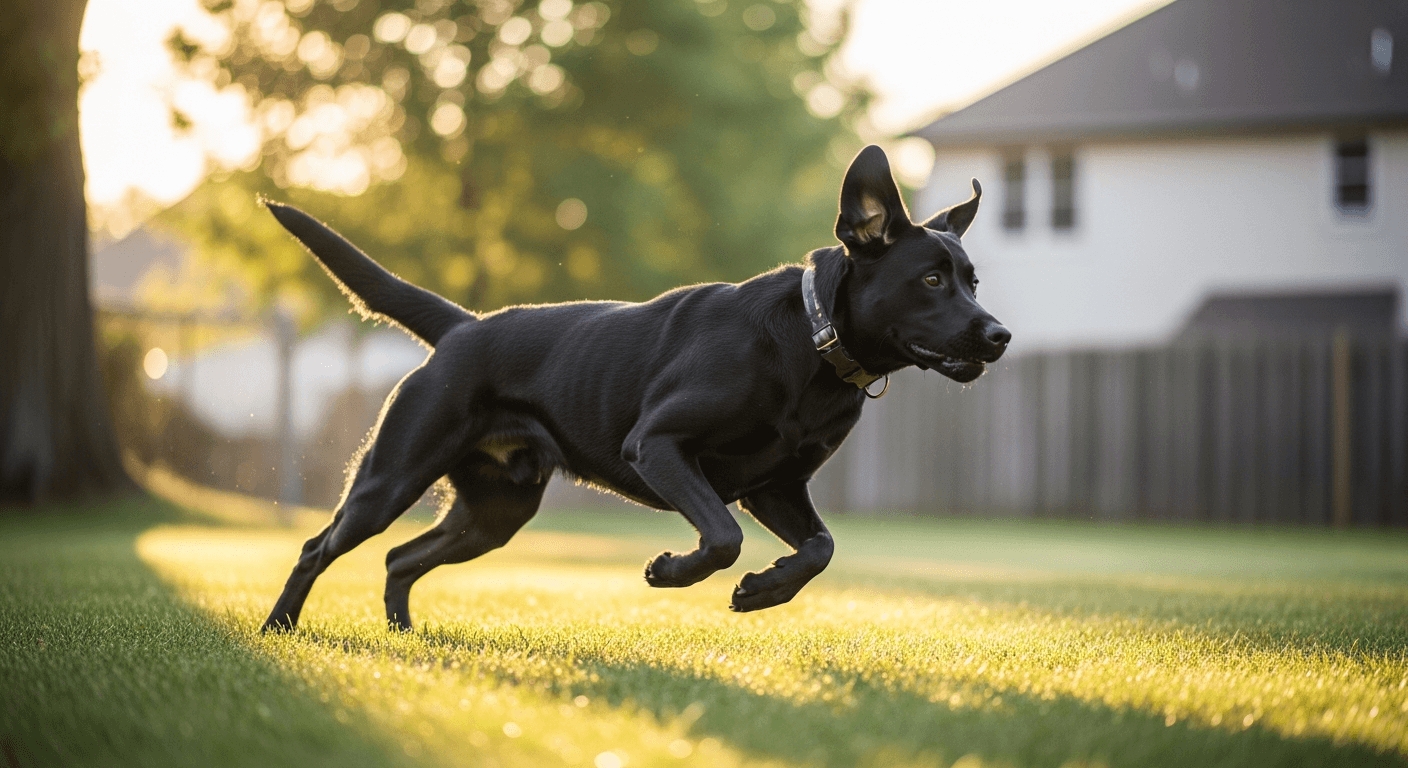
Both breeds need real daily exercise — plan on 1.5 to 2 hours for an adult of either breed. These are athletes bred for a full day’s work, and neither does well as a sedentary house pet. Skip the exercise and both will redirect that energy into chewing, digging, and barking.
The practical difference is how each handles a light day. A Golden manages an occasional low-activity day with more grace. A Lab — especially a young one with that 3–4 year energy runway — feels every skipped walk and gets restless faster. If your weekday schedule is unpredictable, the Golden absorbs the variation better.
Both breeds love water and both have the stamina for running, hiking, and fetch sessions that would exhaust most dogs.
Shedding and Grooming: Labrador vs Golden Retriever
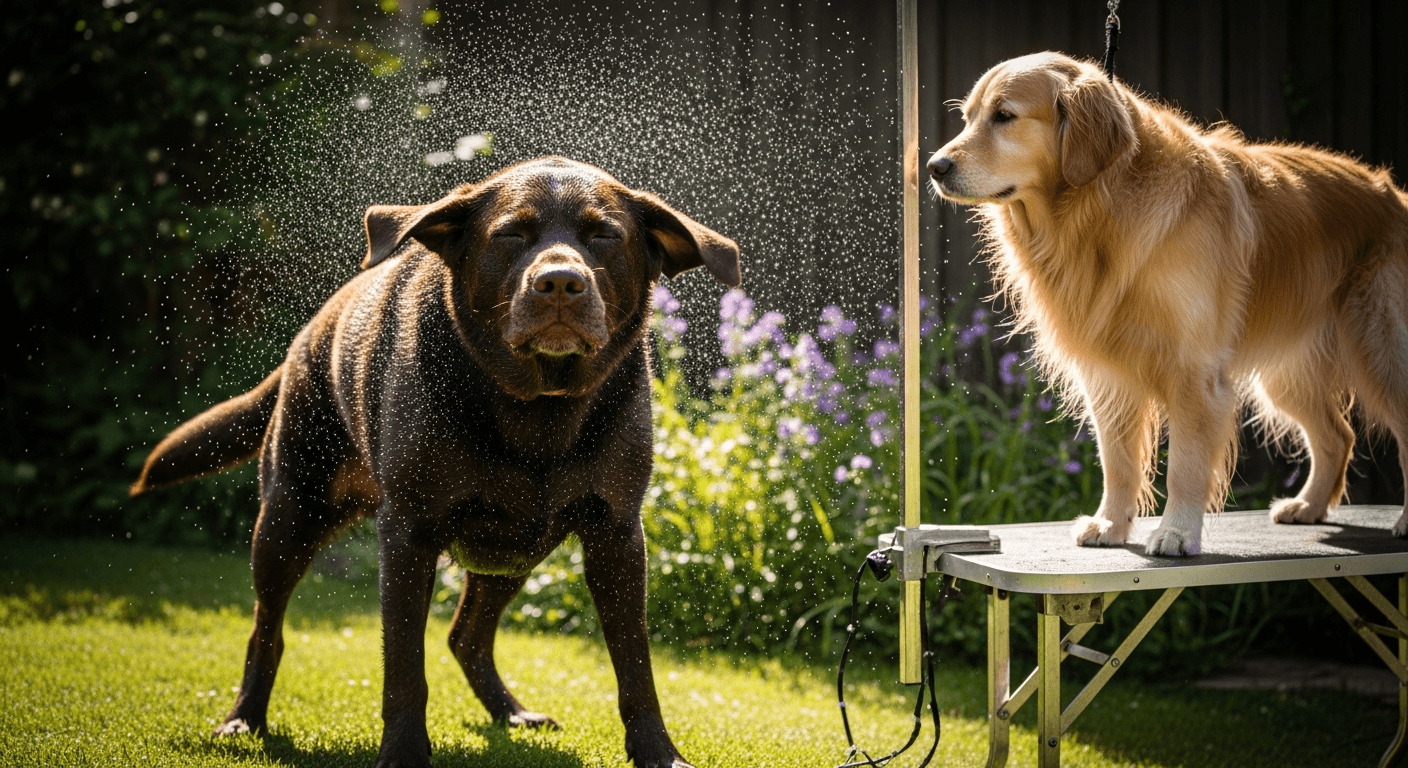
This is the most practically decisive section for many homes, and it favors the Lab clearly. Labrador vs golden retriever grooming is not a close call.
The Golden’s long coat with feathering needs brushing three to five times a week to prevent mats in the feathered areas. After a wet or muddy walk, that coat holds water and debris, so cleanup is active. Most Golden owners also book professional grooming every six to eight weeks for trimming and a deep coat-out. At current salon rates, that runs roughly $800–$1,200 per year. Over a 10–12 year life, the grooming cost gap between the breeds is substantial.
The Lab’s short double coat needs only weekly brushing outside of seasonal coat blows, which call for more frequent brushing for two to three weeks twice a year. There is no matting risk and no professional grooming required at any point. Dirt dries and brushes off within an hour of a muddy walk.
On the labrador vs golden retriever shedding question, neither wins. Both shed heavily — Labs blow their double coat twice yearly and shed moderately year-round, while Goldens shed their longer coat continuously. In our experience, Golden hair is more visible draped on dark fabric, while Lab hair embeds deeper into upholstery. Neither breed is hypoallergenic.
| Grooming factor | Labrador | Golden Retriever |
|---|---|---|
| Brushing frequency | 1x/week (more in shed season) | 3–5x/week |
| Professional grooming | Not needed | Every 6–8 weeks |
| Matting risk | None | Moderate (feathering) |
| Est. annual grooming cost | ~$0–$100 | ~$800–$1,200 |
| Post-muddy-walk cleanup | Minimal | Active |
Health and Lifespan: Labrador vs Golden Retriever
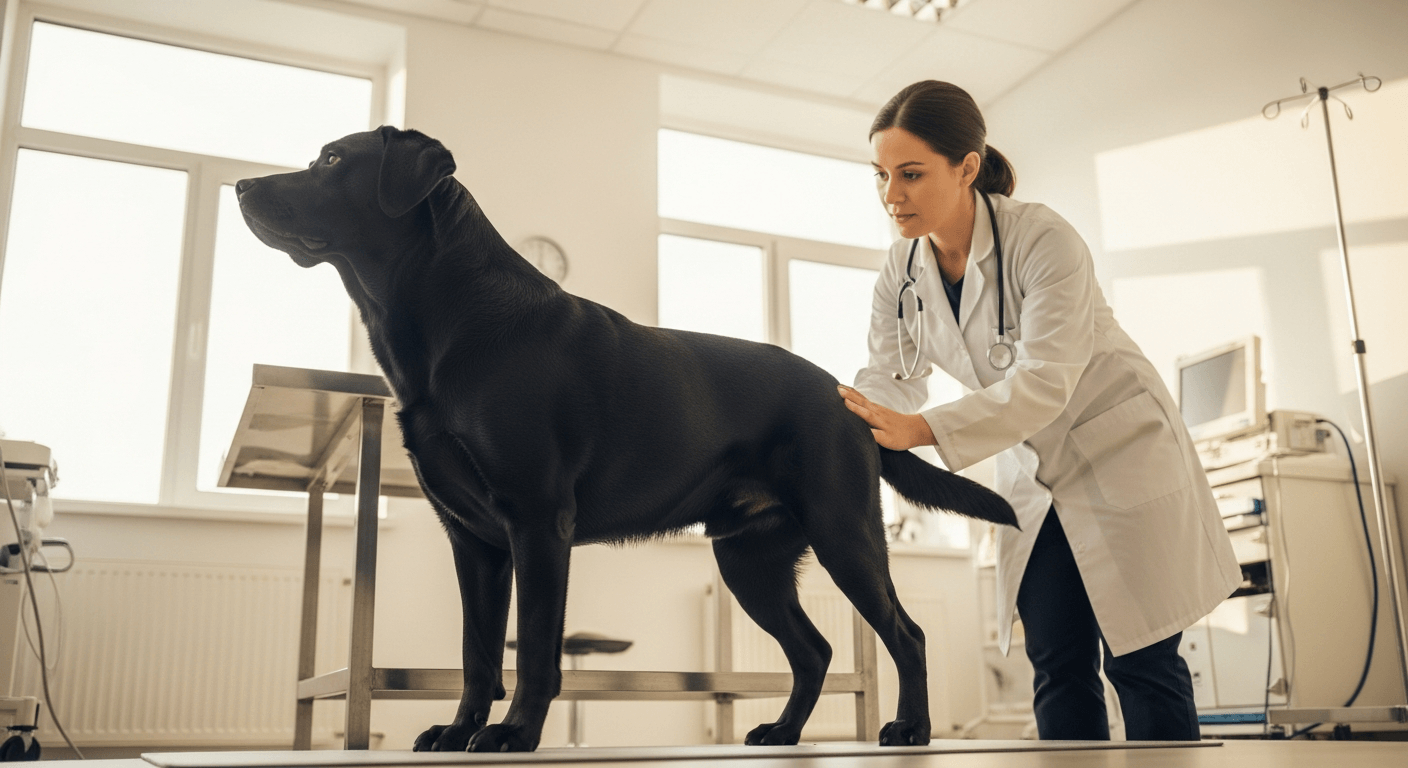
Both breeds share the large-retriever health risks: hip and elbow dysplasia, eye conditions such as progressive retinal atrophy, and obesity. Responsible breeders of both screen parent dogs for hips, elbows, and eyes — always ask for clearances before buying a puppy — our guide to getting a Labrador puppy shows exactly what paperwork a reputable breeder provides.
The defining health difference is cancer. Golden Retrievers carry one of the highest cancer rates of any breed — studies place lifetime cancer mortality around 60%, far above the rate in Labradors. According to VCA Animal Hospitals, hemangiosarcoma and lymphoma are particularly common in the breed. This should weigh heavily in pet insurance decisions for a Golden. Labs do not carry an equivalent cancer burden, though their POMC-driven appetite makes obesity — and the joint and metabolic problems that follow — the bigger everyday risk.
Lifespan reflects this. Labs average 11–13 years and Goldens 10–12. Diet discipline extends a Lab’s healthy years; early cancer screening matters most for a Golden. For more on maximizing a Lab’s years, see our guide to Labrador life expectancy.
| Health factor | Labrador | Golden Retriever |
|---|---|---|
| Average lifespan | 11–13 years | 10–12 years |
| Top breed-specific risk | Obesity, hip/elbow dysplasia | Cancer (~60% lifetime mortality) |
| Shared risks | Dysplasia, eye conditions, ear infections | Dysplasia, eye conditions, ear infections |
| Insurance priority | Joint and weight management | Cancer coverage |
Cost of Ownership: Lab vs Golden Retriever
Up front, the two breeds are similar. A well-bred puppy from health-tested parents runs roughly $1,200–$3,000 for either breed, depending on region and lines. Food, routine veterinary care, and training costs are comparable across both.
The lifetime gap is grooming. A Golden’s professional grooming at $800–$1,200 a year adds up to $8,000–$14,000 across the dog’s life — money a Lab owner never spends. Set against that, a Golden’s higher cancer risk can drive larger late-life veterinary bills, which makes pet insurance more valuable for the breed. A lab vs golden retriever budget comparison, then, comes down to predictable grooming costs for the Golden versus a higher tail-risk of major medical costs.
For a tight or variable budget, the Lab is the lower-maintenance financial commitment. For an owner happy to budget steady grooming and insure against cancer risk, the Golden’s costs are manageable and predictable.
Should I Get a Lab or Golden Retriever? The Decision Framework
Here is the direct answer to “should I get a lab or golden retriever,” with no hedging.
Choose a Labrador if you want minimal grooming and no salon costs, you have a consistently active household that can meet 1.5–2 hours of daily exercise, you want a dog that tolerates inconsistent training while you build your skills, and you prefer a confident, robust companion that bounces back from a chaotic schedule.
Choose a Golden Retriever if you want a calmer indoor dog sooner (by age 2–3), you are happy to brush several times a week and budget for grooming, you want an emotionally attuned dog that mirrors your household’s tone, and you prefer a dog less likely to bowl over a toddler in play.
Neither is right if you want a low-shedding dog (neither qualifies), you want any guard function (neither qualifies), or you cannot commit to 1.5+ hours of daily exercise (both turn destructive and anxious without it).
The tiebreaker is usually simple. The grooming difference alone settles it for owners who want low maintenance — the Lab needs almost none. The sensitivity difference settles it for owners who want a dog that reflects their emotional temperature — the Golden delivers that more consistently. For first-time owners who want the most forgiving breed, the Lab tolerates imperfect ownership better. For an introduction to the breed itself, start with our Labrador Retriever breed guide.
Frequently Asked Questions: Labrador vs Golden Retriever
What is the main difference between a Labrador vs Golden Retriever?
The three biggest differences are grooming, energy, and sensitivity. Goldens need far more grooming — brushing several times a week plus salon visits — while Labs need only weekly brushing. Labs stay high-energy longer (3–4 years vs 2–3). Goldens are more emotionally sensitive to correction and stress than the more resilient Lab.
Which is easier to train, a Lab or a Golden Retriever?
Both are highly trainable and rank among the smartest breeds. Labs are more forgiving of inconsistent technique, which helps first-time owners. Goldens respond beautifully to positive reinforcement but are more easily set back by harsh corrections. Trained well from 8 weeks, either breed becomes an excellent adult dog.
Do Labs or Goldens shed more?
Both shed heavily twice a year and moderately year-round, and total annual volume is similar. Golden hair is longer and shows more on dark fabric, while Lab hair embeds deeper into upholstery. Neither breed is hypoallergenic or a good fit for owners seeking a low-shedding dog.
Are Goldens calmer than Labs?
Generally yes, and sooner. Most Goldens mellow into a calmer indoor temperament by 2–3 years, while Labs often stay high-energy until 3–4. In adulthood, both are settled and calm indoors when exercised enough. The gap is most obvious in the first three years.
Which breed is healthier, a Labrador or a Golden Retriever?
Both face hip and elbow dysplasia and eye conditions. The key difference is cancer: Golden Retrievers have one of the highest cancer rates of any breed, around 60% lifetime mortality, while Labs do not. Labs’ bigger everyday risk is obesity. Labs average 11–13 years and Goldens 10–12.
Which is better for families with young children?
Both are excellent family dogs. Goldens tend to be slightly more body-aware around toddlers, while Labs are more physically robust and resilient to clumsy handling. The difference is modest in well-socialized dogs. Active supervision applies to both breeds around children under five — see our guide to whether Labradors are good with kids.
Both breeds are excellent dogs — that is exactly what makes the comparison useful. The grooming difference alone resolves the Labrador vs Golden Retriever question for many homes. If you would rather spend your time exercising the dog than maintaining its coat, the Lab is your breed. If you want a dog that mirrors your emotional temperature and you are happy to brush, the Golden rewards that choice.