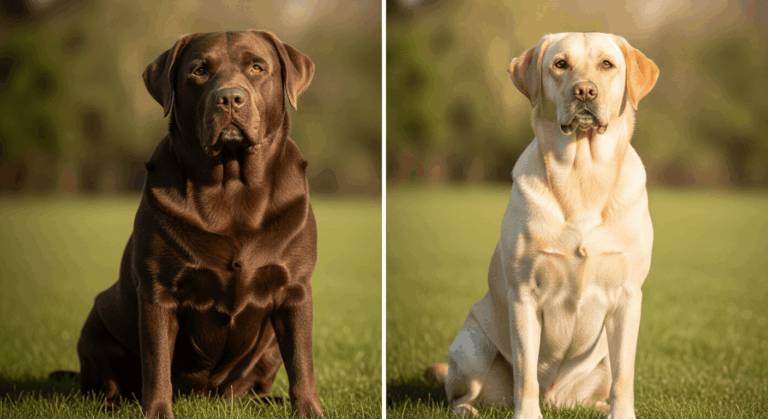
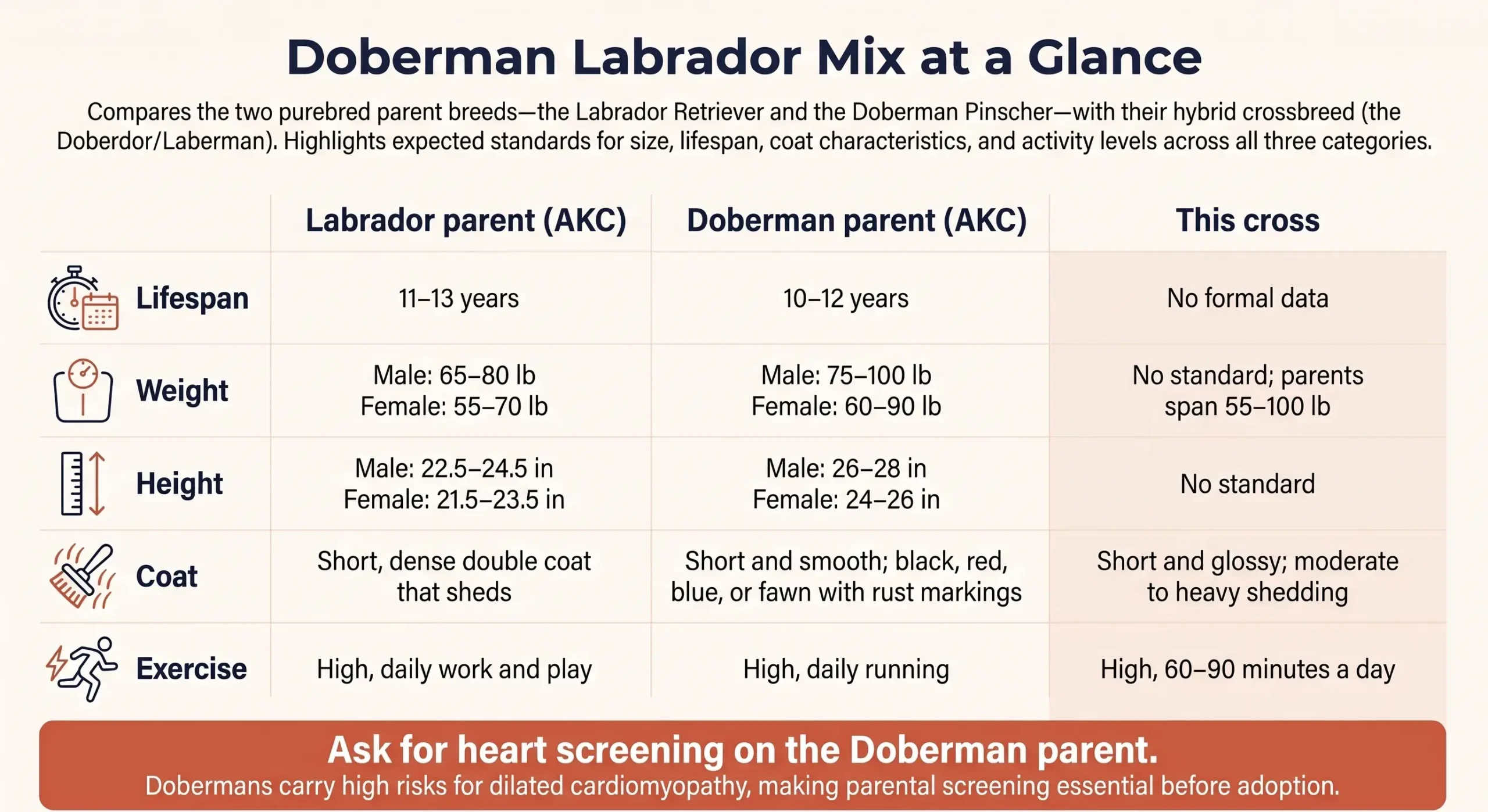
A doberman labrador mix is a large, short-coated dog whose parents span 55–100 pounds. The American Kennel Club lists Doberman males at 75–100 pounds and females at 60–90. Labrador males are 65–80 pounds and females 55–70.
Those ranges belong to the parents, not to every doberman labrador mix. No club publishes a standard for this cross, and littermates can look very different. What you can count on: a big, athletic, short-coated dog that needs daily work and early socialization.
Names People Use for the Same Cross
Doberdor is the most common name. Dobrador and labraman show up too. All three mean a Doberman Pinscher crossed with a Labrador Retriever. None of them is an AKC breed.
Most puppies sold under these names are first-generation crosses: one purebred Doberman parent and one purebred Lab. Some are second-generation, from two mixed parents. Ask which you are getting. Second-generation litters vary even more.
The parents come from very different jobs. The Doberman was developed in Germany in the late 1800s, credited to a tax collector named Louis Dobermann who wanted a protective companion. The Lab was bred to retrieve game for hunters.
One breed was shaped to guard. The other was shaped to cooperate and fetch.
Shelters often list these dogs simply as “Lab mix” or “Doberman mix.” A black dog with tan points and a Lab head in a rescue listing may be a doberman labrador mix with no paperwork at all. A DNA test can suggest ancestry. Treat the result as an estimate, not a pedigree.
That split is the whole story of this mix. The rest of this page is about how it plays out.
What the Coat and Build Tend to Take
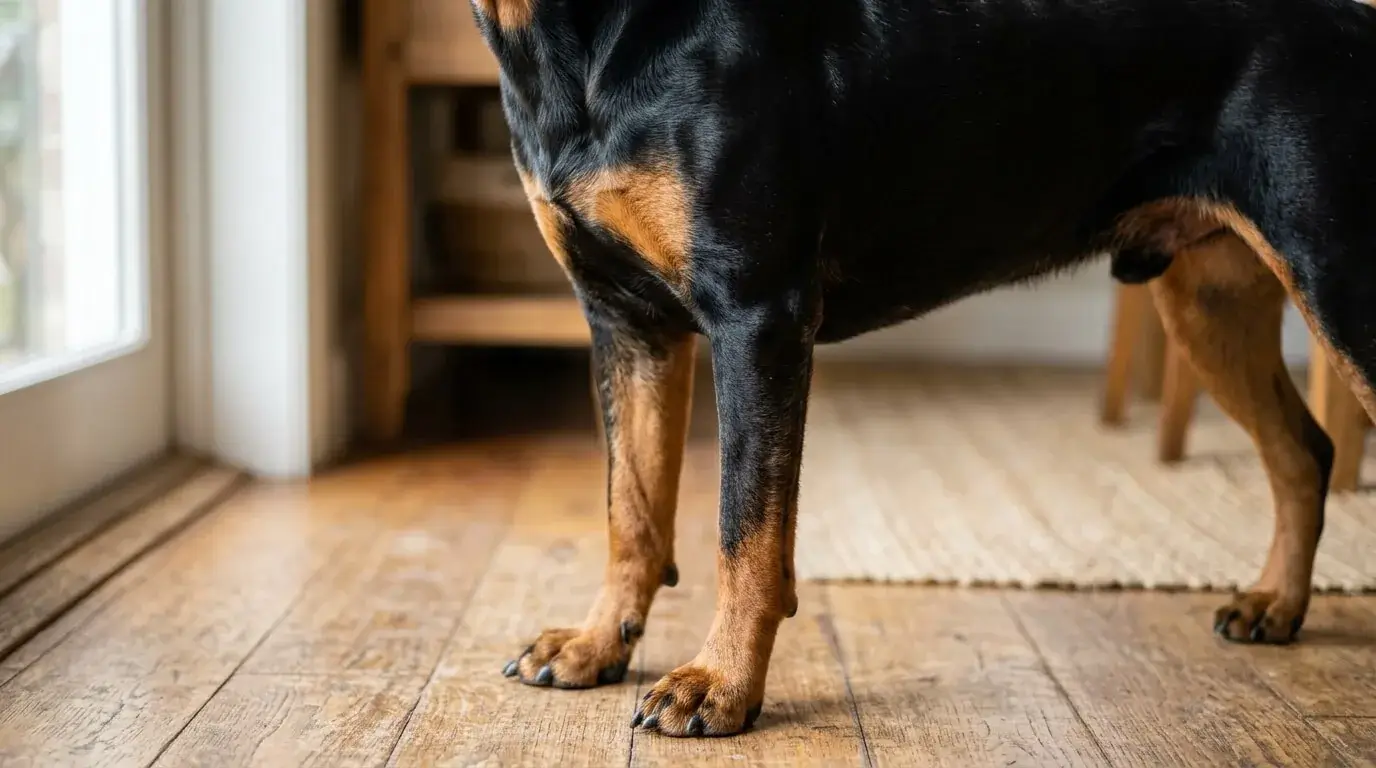
Both parents have short coats, so a doberman labrador mix almost always has one too. The Lab coat is a dense double coat. The Doberman coat is a short, smooth single coat. The mix usually lands somewhere between: short and glossy, with some undercoat.
Color is a draw. The AKC lists Doberman colors as black, red, blue, and fawn, each with rust markings. Lab colors are black, yellow, and chocolate.
Photos of this cross most often show solid black or black with tan points on the muzzle, chest, and legs. Chocolate and brown with rust markings appear too. Yellow is less common. Nobody tracks the odds, and we will not guess them.
Build varies by litter in a doberman labrador mix. Some puppies take the Doberman’s lean, long-legged frame and deep chest. Others take the Lab’s thicker body and broader head. Most land in between: athletic, strong, and heavier than they look.
Height follows the same lottery. Doberman males stand 26–28 inches, and females 24–26. Lab males stand 22.5–24.5 inches, and females 21.5–23.5. Expect a dog in that span.
Puppies from a mixed litter are born with natural ears and a natural tail. The cropped ears and docked tail you see on some Dobermans are procedures, not genetics.
Shedding is moderate to heavy. The Lab half brings a seasonal blow. Weekly brushing with a rubber curry or short bristle brush keeps loose hair down. This cross is not hypoallergenic.
The rest of the weekly care is simple. Trim nails every few weeks, since a heavy, fast dog on long nails changes how it stands. Lab-type ears drop and hold moisture, so check and dry them after swims. Brush teeth a few times a week.
A thin coat has one catch: less padding in the cold. Doberman-leaning dogs can feel winter more than a Lab does. A jacket on cold, wet days is practical, not fussy.
Friendly Retriever Versus Watchdog
This is the question most buyers are really asking. Will a doberman labrador mix protect the house, or greet the burglar with a toy?
The honest answer: either, or somewhere in between. The Lab half can wash the watchdog story out. The Doberman half can keep it. Littermates can split both ways.
A Doberman-leaning dog may be alert, reserved with strangers, and quick to bark at the door. A Lab-leaning dog may love everyone it meets. Many land in the middle: loud at the doorbell, friendly once you let the guest in.
Do not buy a doberman labrador mix as a guard dog. It is not a trained protector, and guarding instincts are not guaranteed. Do not buy it as a “friendlier Doberman” either. Some keep the Doberman’s wariness.
Our piece on whether a Lab will guard the house covers the retriever side. Most Labs alert and then want to make friends.
Whatever the draw, early socialization shapes the adult. Between about 8 and 16 weeks, let the puppy meet many calm people, dogs, sounds, and places. Reward calm behavior. Keep going through adolescence, when watchful traits often sharpen.
Both parents are smart and responsive to training. Dobermans are known for their trainability, and Labs for their eagerness. In practice, a doberman labrador mix learns fast. It also learns bad habits fast.
Short daily sessions with food rewards work well. Harsh corrections can make a sensitive, alert dog more anxious.
Compare this with the cane corso labrador mix, which pairs the Lab with a heavier, more serious guardian. The Doberman cross is usually faster, lighter, and more handler-focused.
How Much Running This Dog Actually Needs
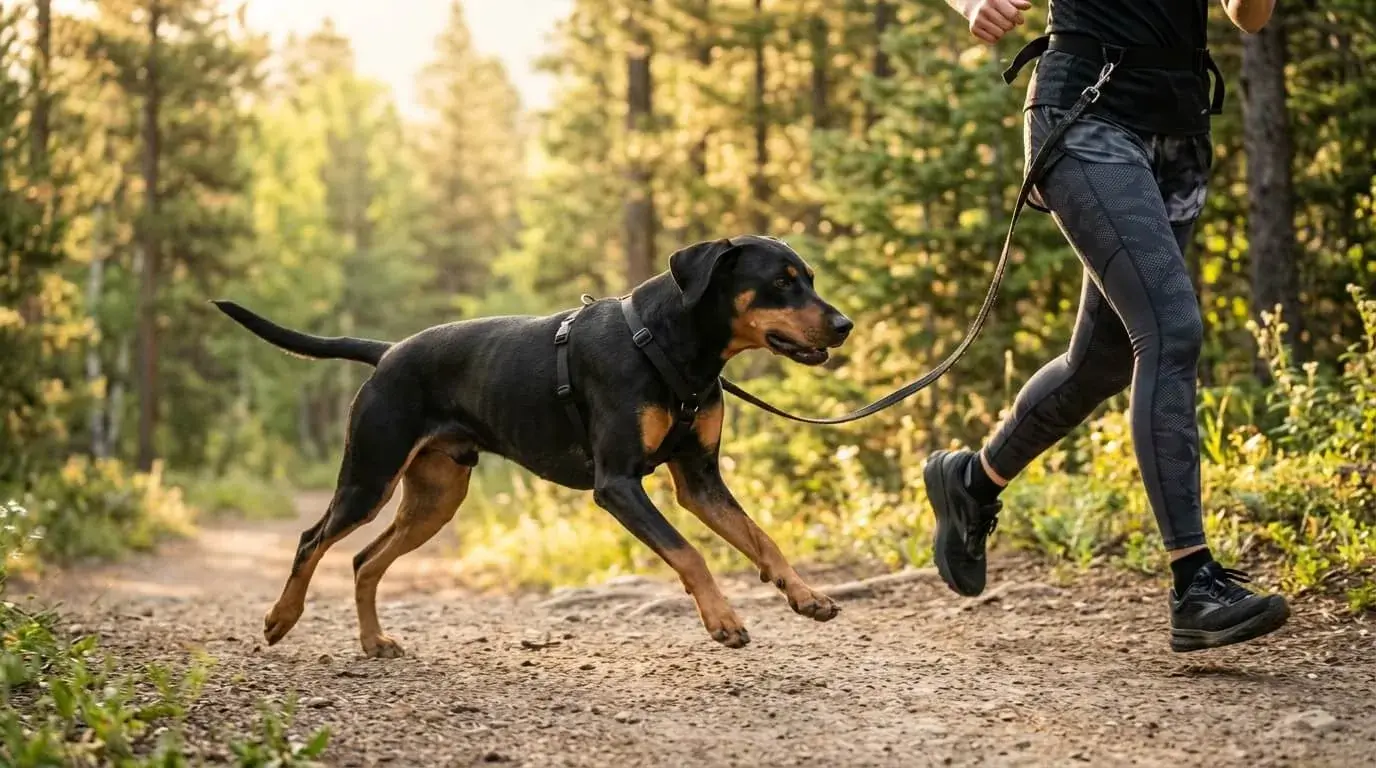
Both parents are high-energy working dogs. Every doberman labrador mix needs real exercise every day, not a lap around the block.
A fair adult day is 60 to 90 minutes of activity. That can be a run, a long hike, a swim, or fetch in a fenced field, plus some training. Split it into at least two sessions. Skip that exercise, and a doberman labrador mix often invents jobs: chewing, barking, pacing, or counter-surfing.
Mental work counts too. Both parents were bred to think on the job. Good options include:
- Obedience or rally training.
- Scent games and hide-and-seek with toys.
- Agility, once the dog is an adult.
- Running or canicross with a proper harness, once your vet clears it.
Puppies need less. Large dogs grow until about 18 months or later. Avoid forced running, long jogs, and repeated jumping until the growth plates close. Free play on soft ground and short walks are enough early on.
Recall needs work with a doberman labrador mix. A Lab nose and a Doberman’s speed can put this dog far away fast. Train recall early and use a long line in open areas until it is reliable.
Parent Risks Worth Asking a Vet About
No formal data exists for how long a doberman labrador mix lives. The AKC lists Dobermans at 10–12 years and Labs at 11–13. The mix has no number of its own.
There is also no mix-specific health study. The useful questions come from the parents.
Heart disease is the big Doberman-side question.
Dobermans are a breed known for dilated cardiomyopathy, a disease where the heart muscle weakens and enlarges. VCA Animal Hospitals names it the most common cause of heart failure in certain large breeds, and Doberman Pinschers are on that list. Ask the breeder whether the Doberman parent had heart screening from a veterinary cardiologist, and ask your vet when to start screening your dog. We do not know the rate in the mix, and nobody else does either.
Bleeding disorders are the second Doberman question. Von Willebrand disease is a known inherited clotting problem in the breed. A DNA test on the Doberman parent answers it. Tell your vet before any surgery, including a spay or neuter.
Both parents are large dogs, so joints matter. Ask for hip and elbow scores on both parents. Keep your dog lean. Extra weight strains growing joints, and the Lab half will eat anything.
Learn the signs of bloat before you need them. Deep-chested large dogs are at higher risk of the stomach filling with gas and twisting, and VCA lists the Doberman among predisposed breeds. Unproductive retching, a swollen belly, and restlessness mean a vet visit within the hour. Ask your vet about feeding smaller meals.
Eyes are a Lab-side question. Many Lab breeders test for inherited eye disease and have eyes checked by a veterinary ophthalmologist. Ask if the Lab parent was checked.
Who Should Not Get This Dog

A doberman labrador mix can be a great family dog in the right home. It is a hard dog in the wrong one.
Skip this cross if:
- It is your first dog and you have no support from a trainer.
- You live in an apartment with no easy access to open space.
- You work long hours and the dog would be alone most of the day.
- You cannot give 60 to 90 minutes of exercise every day, in every season.
- You want a guaranteed guard dog, or a guaranteed social butterfly.
- You have toddlers and cannot supervise a strong, bouncy adolescent.
A good fit is an active household with a fenced yard, time for daily training, and patience through a long adolescence. That owner gets a smart, athletic, loyal dog.
Budget matters too. Expect a doberman labrador mix to eat like a large athlete, and heart screening on a Doberman-leaning dog is an added vet cost. Price the food, the vet plan, and a trainer before you commit.
Still deciding? A rescue that fosters adult dogs of this cross can tell you how each one acts at home. That beats guessing from a puppy.
FAQ
Are they good with kids?
A doberman labrador mix is often good with kids when raised with them and well socialized. They are big and bouncy, especially under two years old. School-age kids who know the house rules are an easier match than toddlers. Always supervise.
Do they shed?
Yes, moderately to heavily, with a heavier shed in spring and fall. Weekly brushing helps. No doberman labrador mix is hypoallergenic.
Are they easy to train?
They learn quickly, since both parents are responsive breeds. That cuts both ways, because bad habits stick fast too. Short, daily, reward-based sessions work best.
Is a doberman labrador mix AKC-recognized?
No. The AKC recognizes the Doberman Pinscher and the Labrador Retriever as separate breeds. A doberman labrador mix cannot be registered as a breed. Some mixed-breed programs allow it in dog sports.
A doberman labrador mix is a fast, smart, short-coated dog that needs a job and a heart check on the Doberman side. Plan the daily run and the early socialization before you plan the name.
If the fit is wrong, our other Labrador crosses include calmer options. Read the retriever parent in the Labrador Retriever breed guide before you expect the Lab half to make this dog calm. It rarely does on its own. Exercise and training do that work.