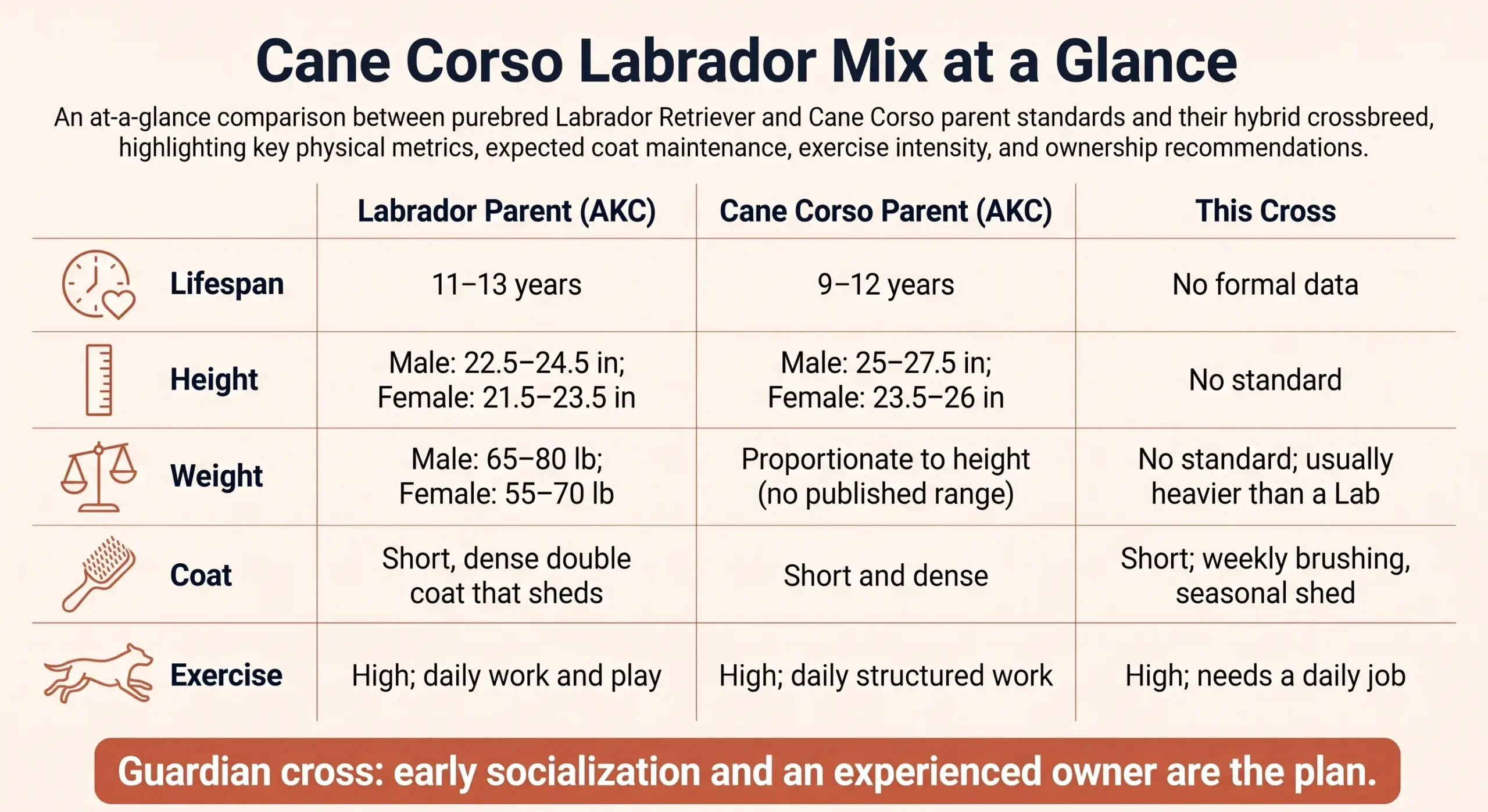
A cane corso labrador mix is a large guardian cross that often weighs more than a Lab’s 80 pounds. The American Kennel Club lists Cane Corso males at 25–27.5 inches and females at 23.5–26 inches. Weight is listed only as “proportionate to height.” Labrador males are 65–80 pounds and females 55–70.
Labrador corso is a nickname for the same cross. It is not an AKC breed, and no club publishes a standard or a history for it. What you get is a first-generation mix of an Italian guardian and a British-bred retriever, and every puppy is its own draw.
Why This Is Not a Generic Lab Mix
Most Lab crosses mix a friendly retriever with another friendly dog. This one does not. The AKC calls the Cane Corso a “peerless protector” and notes the name roughly means “bodyguard dog.” That is a working description, not a marketing line.
A Lab tends to greet strangers as friends. A Corso tends to watch them and decide. Your cane corso labrador mix can take either temperament, or a blend that changes as the dog matures. Guardian traits often sharpen in adolescence, so the friendly puppy is not a preview of the adult.
That is why the labrador corso temperament question has no single answer. Some are soft family dogs with a big bark. Some are serious about their yard and their people. You will not know which from an 8-week photo.
Plan for the guardian end with any cane corso labrador mix. If the dog turns out softer, you lose nothing. If it turns out serious and you planned for a Lab, you have a 100-pound problem.
This is not a reason to fear the cross. It is a reason to buy it with open eyes.
Where does the cane corso labrador mix come from? No one documented a first litter. Like most designer crosses, it shows up in breeder ads and shelter listings without a founding story.
The parents are old breeds. The AKC traces the Corso to Roman-era working dogs. The Lab was developed in Britain from water dogs brought over from Newfoundland. Many are loyal, calm, and affectionate at home. They just need an owner who leads.
Size and Strength in a Family House

We do not publish one adult weight for this cross. The AKC does not give the Corso a pound range, only height and proportion. Breed-info sites print various numbers. None of those come from a club, and we will not repeat them as fact.
What we can say: a cane corso labrador mix is usually heavier boned than a Lab and more muscular through the chest and neck. Littermates vary. One may look like a stocky black Lab. The next may carry the Corso head and mass.
Strength is the real issue, not weight. A dog this strong can pull an adult off their feet on a sudden lunge. That is a safety issue for you, your kids, and anyone the dog lunges at.
Leash manners are not optional. Start them at 8 weeks, while you can still steer the puppy.
Around the house, a cane corso labrador mix takes up a hallway. A tail wag clears a coffee table. A happy greeting knocks a small child down. Teach “sit before hello” from day one, and hold to it.
Coat is the easy part. Both parents have short coats, so weekly brushing covers most weeks. The Lab half adds a seasonal shed. A Corso-leaning head with looser lips drools more, so keep a towel by the water bowl.
Budget for size too. Large crates, large beds, and food for a big dog add up. So do vet costs, since sedation and medication are dosed by weight.
A cane corso labrador mix is a poor fit for apartments. The size, the strength, and a possible guardian bark all work against shared walls and tight elevators.
Strangers, Dogs, and a Late Start
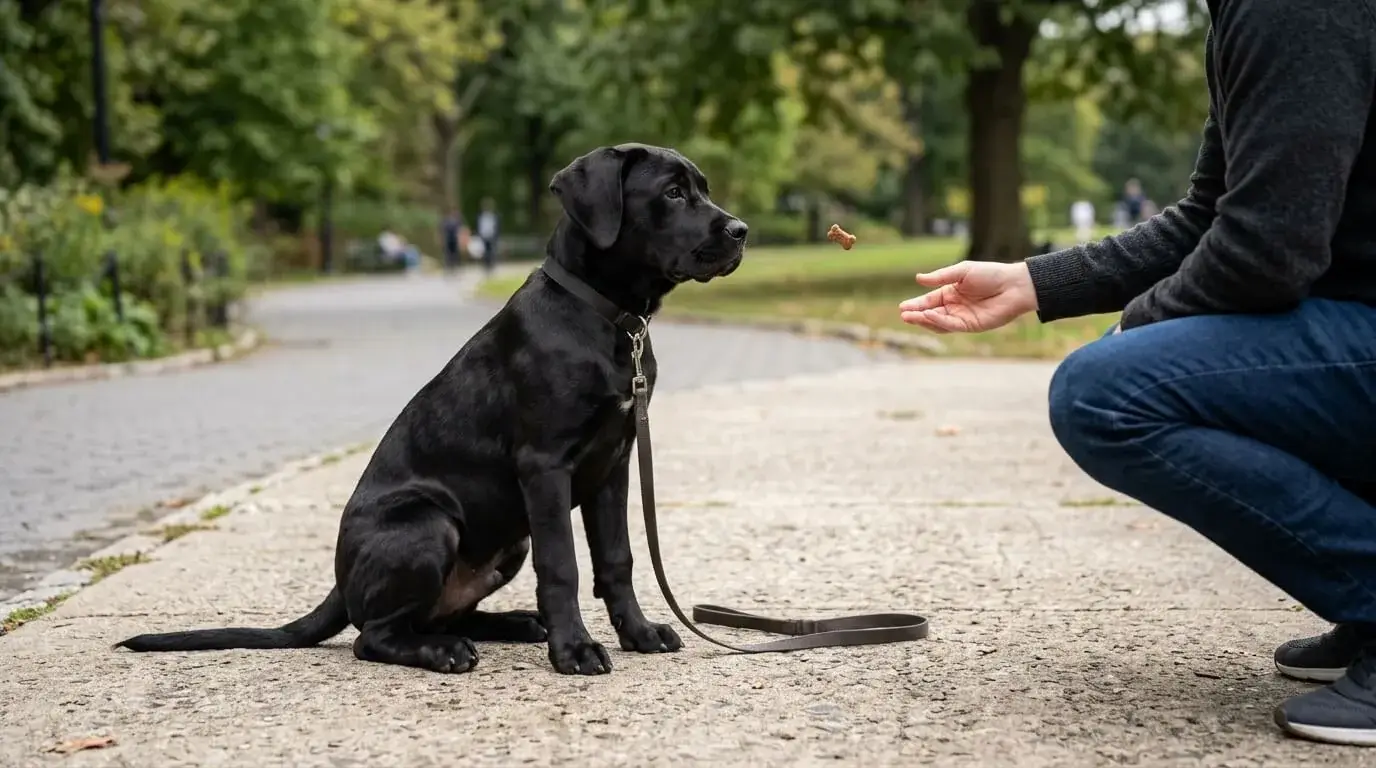
Socialization is the most important thing you will do with a cane corso labrador mix. It is not a cute bonus. For a guardian cross, it is the difference between a calm adult and a reactive one.
The key window is roughly 8 to 16 weeks. In that time, the puppy should meet many calm people: men, women, kids, people in hats, people with canes, delivery drivers.
Let the puppy watch from a distance and take treats. Do not force greetings. Keep sessions short and upbeat.
Keep going after that window. Guardian traits often show up in adolescence, around 6 to 18 months. A dog that was fine with strangers at 4 months can start barking at the fence at 14 months. That is when owners need to keep working, not quit.
Dogs are a separate question. The Corso parent can be selective about other dogs, especially of the same sex. Expect that a cane corso labrador mix may play well with dogs it grew up with and still dislike strange dogs on its turf.
Do not count on dog parks. Choose known, calm playmates.
A “late start” means a dog adopted older or not socialized as a puppy. That dog can still improve, but it takes longer and needs more care. Work with a certified trainer who uses reward-based methods. If you see growling, stiff staring, or lunging, bring in a veterinary behaviorist.
Harsh corrections backfire with a cane corso labrador mix. A strong, watchful dog that learns people cause pain gets more defensive, not less. Use food, distance, and calm repetition.
The Lab side of guarding is milder. Our piece on Labrador guarding instincts explains why most Labs alert and then relax. The Corso side may not relax so fast.
A Great Pyrenees Labrador cross is a guardian mix of a different kind, bred to guard flocks rather than people and property.
A Doberman Lab cross is usually lighter, faster, and more handler-focused. An Akita Lab cross is another guardian mix, with more selectivity toward other dogs.
Exercise and a Job for a Guardian Cross
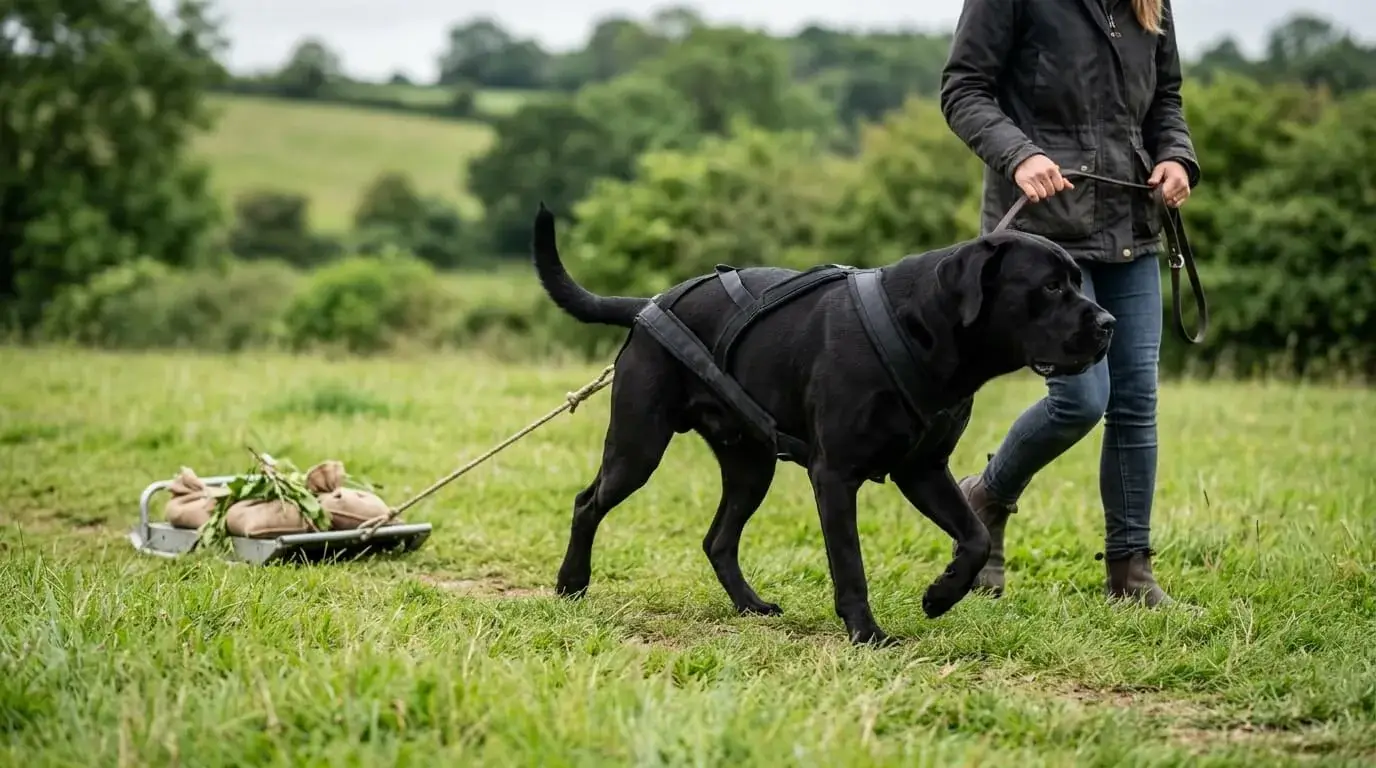
Both parents were bred to work. A Lab retrieved birds all day. A Corso guarded farms and property. Every cane corso labrador mix needs daily physical work and a mental job to stay settled.
A fair adult day is at least an hour of structured activity. That can be two long walks, a hike, a swim, or a training session plus a walk. Structure matters more than speed. A bored guardian finds its own job, and it is often barking at the fence.
Good jobs for this cross:
- Obedience training, a little every day.
- Scent work, where the dog searches for a hidden treat or toy.
- Drag or cart work with a proper harness, once the dog is an adult.
- Long leash walks through new places, which tire the brain as well as the body.
Avoid crowded fetch games in public parks. A strong dog chasing a ball through other dogs is a conflict waiting to happen.
Puppies need less. Large breeds grow for 18 to 24 months. No forced running, jumping off high places, or long jogs until your vet says the growth plates are closed. Short walks and free play on soft ground are enough.
Watch the heat with a cane corso labrador mix. A shorter muzzle than a Lab’s and a heavy frame can overheat faster. Walk in the cool hours in summer. Stop when the dog starts to slow.
Health: Hips, Bloat, and Eyes as Parent Questions
No formal data exists for how long a cane corso labrador mix lives. The AKC lists the Cane Corso at 9–12 years and the Labrador at 11–13. We will not average those into one number.
Hips and elbows come first. Both parents are large dogs where joint problems are a known concern. Ask the breeder for hip and elbow scores on both parents.
Keep the dog lean, because extra weight loads growing joints.
The emergency on this list is bloat. Large, deep-chested dogs are at higher risk of gastric dilatation-volvulus, where the stomach fills with gas and can twist. VCA Animal Hospitals lists unproductive retching, a swollen belly, and restlessness among the signs. That needs a vet within the hour. Ask your vet about smaller meals and whether preventive gastropexy suits your dog.
Eyes are a question for both sides. Corso lines can carry eyelid problems, where the lid rolls in or droops out. Labs can carry inherited eye disease. Ask whether the parents had eye exams by a veterinary ophthalmologist.
Ask how long the grandparents lived and what ended their lives. A vague reply tells you how much health history the breeder actually kept.
Who Should Not Take This Puppy
This section is the one other pages skip. Not every home suits a cane corso labrador mix, and that is fine.
Pass on this cross if:
- It is your first dog. A strong guardian cross is a hard place to learn.
- You live in an apartment or share walls closely.
- You cannot commit to daily training and socialization for two years.
- You want a dog-park dog that loves every dog it meets.
- You have toddlers and no way to supervise every moment.
- Your housing, insurance, or city limits large or guardian breeds. Check before you bring the dog home.
- You want a guard dog. This cross is a family dog with possible guarding instincts. Those instincts need management, not encouragement.
A good fit looks like this: an experienced owner, a fenced yard, time to train every day, and a calm household. That owner can get a loyal, steady companion.
Cost is part of fit. Expect a cane corso labrador mix to eat like a large dog, need large-dog gear, and possibly need a trainer’s help through adolescence. Put those numbers on paper before the deposit.
If you are unsure, meet adult dogs of this cross first. Rescues often know the adult temperament of the dogs in their care. That is more reliable than a puppy guess.
FAQ
Is a cane corso labrador mix a good dog?
For the right owner, yes. An experienced handler with time to train and socialize can have a loyal, calm family dog. For a first-time owner in a small home, it is usually a poor match.
Are they aggressive?
No, a cane corso labrador mix is not aggressive by default. Aggression is not destiny for any mix. Risk rises when a strong, watchful dog is poorly socialized, harshly handled, or under-exercised. Early socialization and reward-based training matter more here than with a typical Lab cross.
Are they good with kids?
A cane corso labrador mix is often gentle with its own family, and very strong. Older kids who follow house rules do better than toddlers. Supervise every interaction, and watch for guarding when children’s friends visit.
How big do they get?
There is no standard. The AKC lists the Corso at 23.5–27.5 inches by sex with weight proportionate to height, and Labs at 55–80 pounds. Most of these crosses land heavier than a Lab.
Are they easy to train?
They are trainable, not easy. The Lab half is usually eager. The Corso half can be confident and independent.
Short, daily, reward-based sessions work. Harsh corrections make a guardian cross more defensive.
A cane corso labrador mix is a strong family guardian that asks for real leadership. If you have the experience, space, and time, it can be a devoted companion. If you wanted an easy Lab, pick an easier cross.
Browse more Labrador crosses for a better match. Read the retriever parent in our Labrador breed guide before you expect the Lab half to soften the guardian.