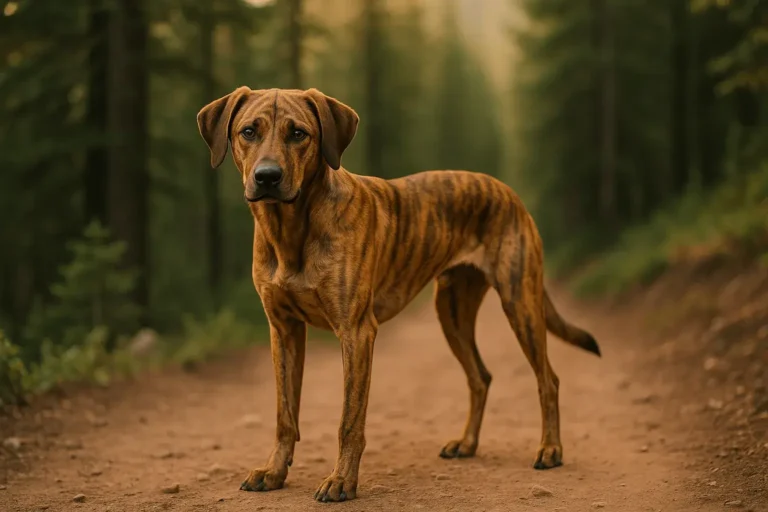
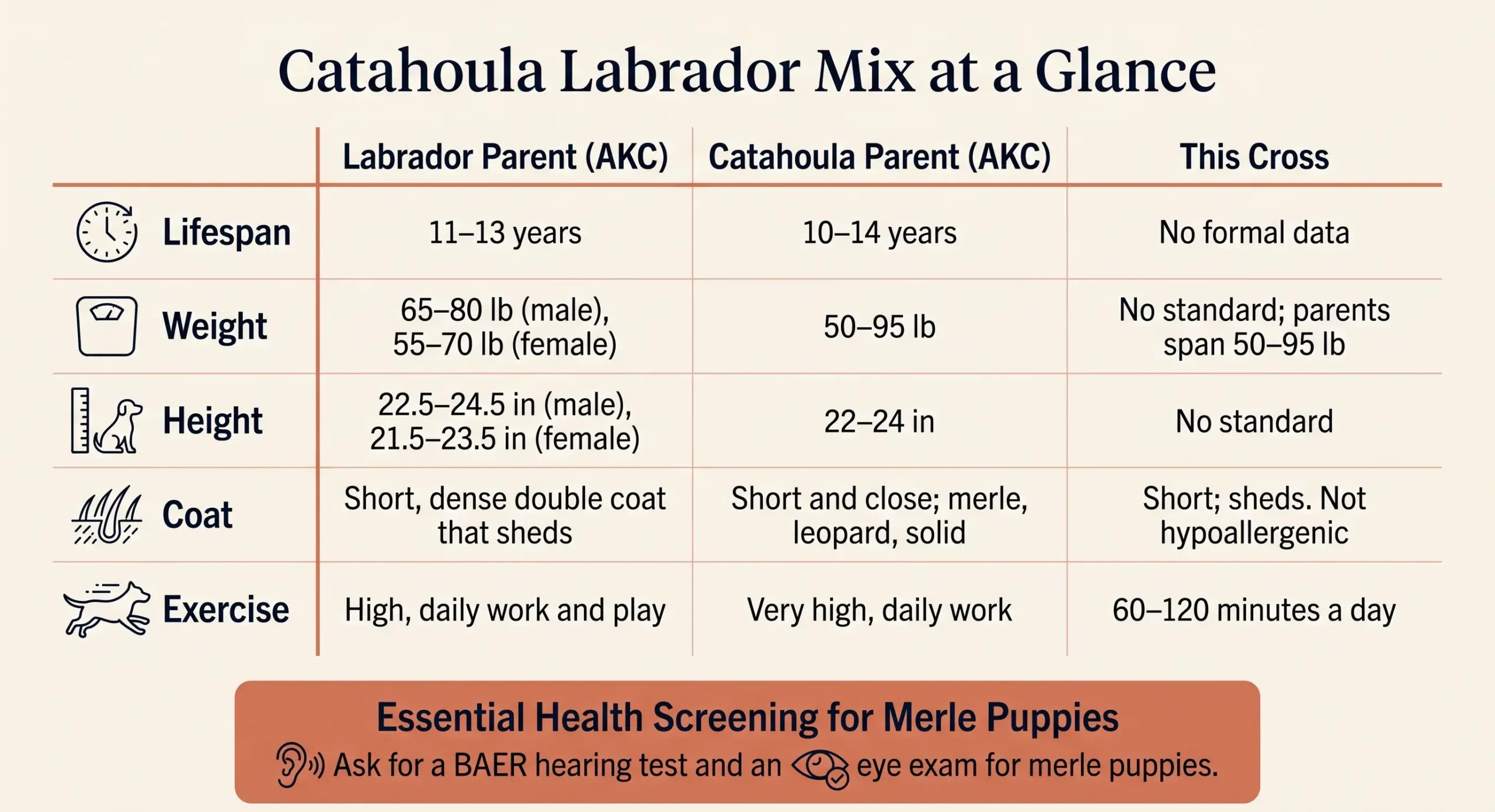
A catahoula labrador mix is a muscular, high-energy cross whose parents weigh anywhere from 50 to 95 pounds. The American Kennel Club lists the Catahoula Leopard Dog at 22–24 inches and 50–95 pounds. For the Labrador Retriever, the range is 55–80 pounds.
No club sets a standard for this cross, and littermates can look nothing alike.
One claim needs correcting up front. Some pages call this mix hypoallergenic or low-shedding. It is neither. A Lab parent sheds, and the Catahoula is not a hypoallergenic breed.
Labahoula, and Why the Puppy May Not Look Like the Photo
Labahoula is the name most sellers use. Catahoula Lab and Catahoula Lab mix mean the same dog: a Catahoula Leopard Dog crossed with a Labrador Retriever. No kennel club registers a catahoula labrador mix as a breed under any of those names.
The Catahoula is an American breed with a Louisiana story. The AKC notes it is the only breed known to have originated in the state. Louisiana named it the state dog in 1979. The name traces to Catahoula Parish and a Choctaw word often translated as “sacred lake.”
Catahoulas worked as hog and cattle dogs in the swamps and woods. They found, gathered, and held stock. The AKC also lists them as Catahoula Cur and Catahoula Hog Dog. The breed has been in the AKC’s Foundation Stock Service since 1996, which is a step short of full recognition.
The Lab came from Newfoundland and was bred to retrieve. Both are working dogs, but with different jobs and different attitudes.
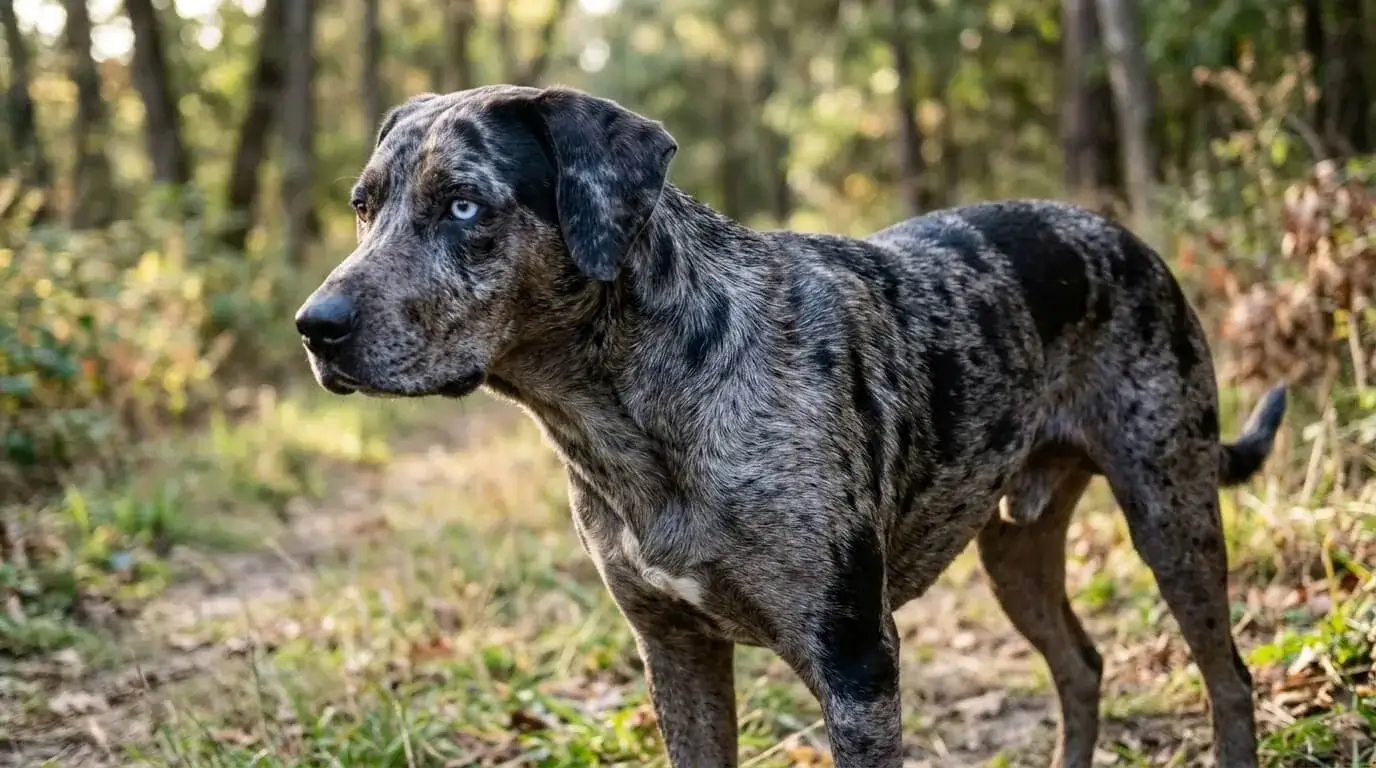
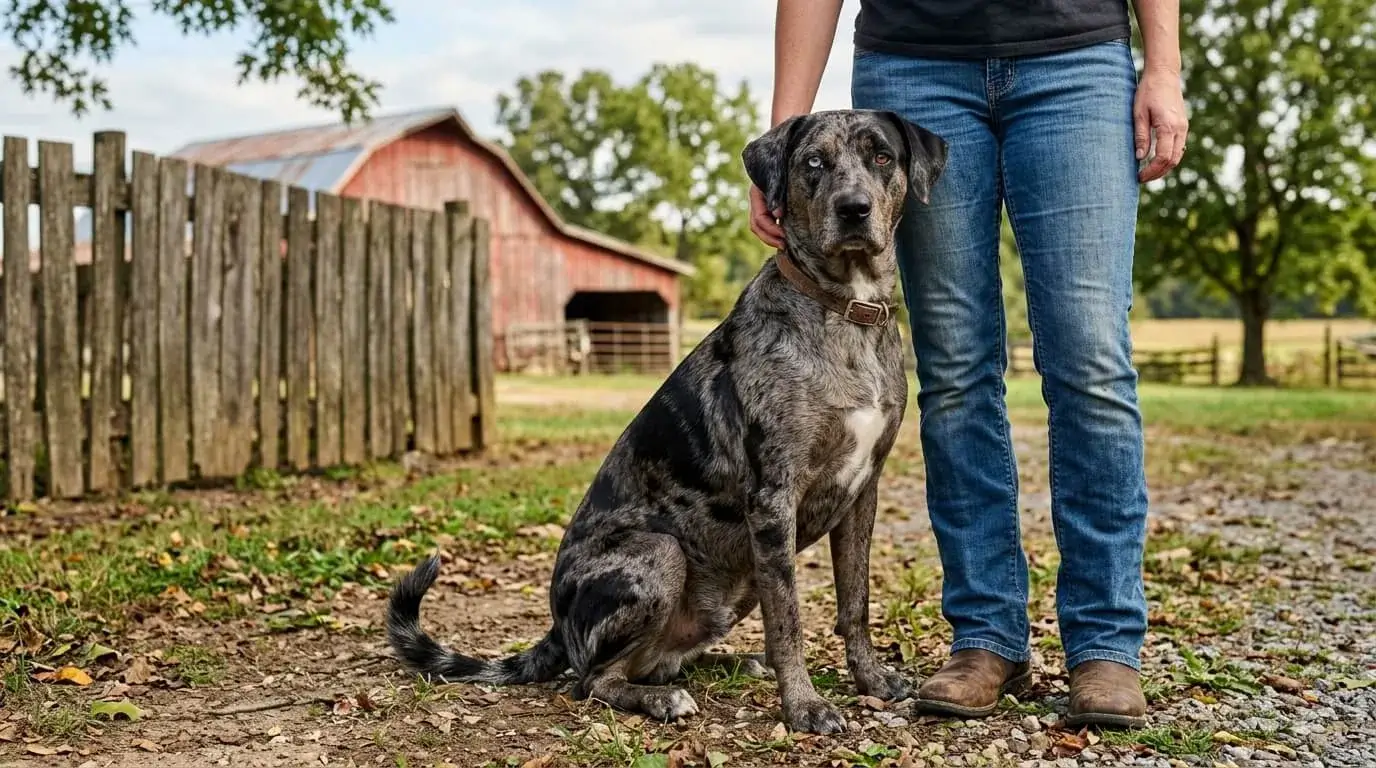
Photos online usually show the most striking dog in a litter: a merle coat and bright blue eyes. Your puppy may not look like that. A catahoula labrador mix litter can include solid black puppies that look like Labs, merle puppies with patches, and everything in between.
Eye color varies too. Catahoulas are known for “glass” eyes, a pale blue, and some have two different eye colors. A cross may have brown eyes, blue eyes, or one of each.
Pick a catahoula labrador mix puppy for temperament and health, not for the coat pattern. The spots fade from the photo quickly once you live with the dog. The energy level does not.
Shelters in the South see many dogs of this type. A merle dog with a Lab face may be listed as a Catahoula mix, an Aussie mix, or a hound mix. A DNA test can narrow it down, as long as you read the result as an estimate.
Coat, Spots, and Shedding
This is the section where the top-ranking pages go wrong. Two of them sell the catahoula labrador mix as “low shedding,” and one claims the mix usually inherits a hypoallergenic coat.
Here is what the parents actually have. The Lab has a short, dense double coat that sheds year-round and blows seasonally. The Catahoula has a short coat that also sheds. The AKC does not list the Catahoula among its hypoallergenic breeds.
So the cross sheds. Some dogs shed less than a Lab, especially if they take the Catahoula’s tighter coat. None is safe for a person with dog allergies. No catahoula labrador mix should be sold as hypoallergenic.
Coat patterns come from both sides. Catahoulas come in leopard merle (blue, red, or gray patches), solid colors, brindle, and patchwork. Labs come in black, yellow, and chocolate. Many crosses end up solid black, black with white trim, or merle with Lab-like coat texture.
Weekly care is simple:
- Brush once or twice a week with a rubber curry or bristle brush.
- Brush more often during seasonal sheds.
- Trim nails regularly. The AKC notes the Catahoula’s nails are strong and fast-growing.
- Check and clean the ears, especially after swims.
- Brush teeth a few times a week.
The retriever half of that hair is covered in our guide to how much Labs shed. Expect the catahoula labrador mix to land in the same broad range.
Drive: Herding and Hunting in a Pet House
Catahoulas were bred to find and hold stock in rough country. That job needs independence, toughness, and stamina. It also needs a dog that thinks for itself.
The AKC describes the Catahoula as independent, territorial, and protective. It says the breed needs firm guidance and early socialization. It also says Catahoulas will not accept mistreatment and may assert themselves in self-defense. Any catahoula labrador mix that takes after this parent needs the same fair, steady handling.
Put that in a family home and you get a dog that may:
- Guard the yard and bark at people passing by.
- Chase cats, squirrels, and livestock.
- Try to control other dogs during play.
- Ignore a cue it thinks is pointless.
Your catahoula labrador mix may lean either way. Some are as social and eager as a Lab. Others are watchful and independent. Many are affectionate with family and reserved with strangers.
Socialization shapes the outcome. Between about 8 and 16 weeks, let the puppy meet calm adults, kids, and vaccinated dogs. Pair each new sight and sound with food. Keep going through the teenage months, when territorial habits often show up.
Fencing is not optional for a catahoula labrador mix. A secure, tall fence and a leash outside it are the baseline for a dog with this much drive.
Small pets need a plan. Introduce cats slowly and supervise. Keep chickens and small livestock behind a separate fence unless the dog has been trained around them.
Training When the Dog Is Not a Lab
Labs are famous for trying hard to please. Catahoulas are famous for deciding for themselves. A catahoula labrador mix can have either attitude, and it can switch between them.
That makes training harder than with a Lab. It is not impossible, and the dog is often very smart. It simply needs a handler who is clear, consistent, and patient.
What tends to work:
- Short sessions of 5 to 10 minutes, several times a day.
- High-value food rewards and toys.
- Clear, calm cues and a set routine.
- Rewarding the behavior you want the moment it happens.
What tends to fail:
- Harsh corrections. A tough, independent dog may push back.
- Long, repetitive drills. Boredom sets in fast.
- Inconsistent rules between family members.
For most first-time owners, a catahoula labrador mix is not a good choice. A person who has trained a dog before, and who enjoys it, is a better match. If you are new, budget for a trainer from the first week.
Recall is the skill to invest in most. A dog bred to range and hunt can disappear fast. Train it early, use a long line in open areas, and only drop the leash in fenced space until it is reliable.
Eyes, Hips, and Merle Breeding Ethics
No mix-specific health study exists for the catahoula labrador mix. The questions come from the parents.
The AKC notes that hip dysplasia, deafness, and eye problems have occasionally occurred in the Catahoula. It also says most of the breed are healthy dogs. Lab breeders commonly screen hips, elbows, and eyes.
Merle matters most for health. Breeding two merle dogs together can produce puppies with deafness and eye defects. Responsible Catahoula breeders avoid merle-to-merle pairings for that reason.
A Lab does not carry merle, so a first-generation catahoula labrador mix, with one purebred parent of each breed, cannot be a double merle. Second-generation litters from two merle crosses can be. Ask about both parents’ coat colors.
Blue eyes and merle coats are not a health guarantee either way. A blue-eyed dog is not automatically deaf. A brown-eyed dog is not automatically clear. Ask for the tests.
Questions to ask the breeder:
- Hip and elbow results on both parents.
- An eye exam by a veterinary ophthalmologist on both parents.
- A BAER hearing test on the puppies, especially merle or mostly white ones.
- Both parents’ colors, so you know whether a double merle is possible.
A breeder who breeds merle to merle for color is a breeder to walk away from.
Keep the dog lean. A strong, active dog carries its weight on its joints, and the Lab parent brings a big appetite.
Lifespan has no firm number. The AKC gives Catahoulas 10–14 years and Labs 11–13. No formal data exists for a catahoula labrador mix.
Exercise and a Job
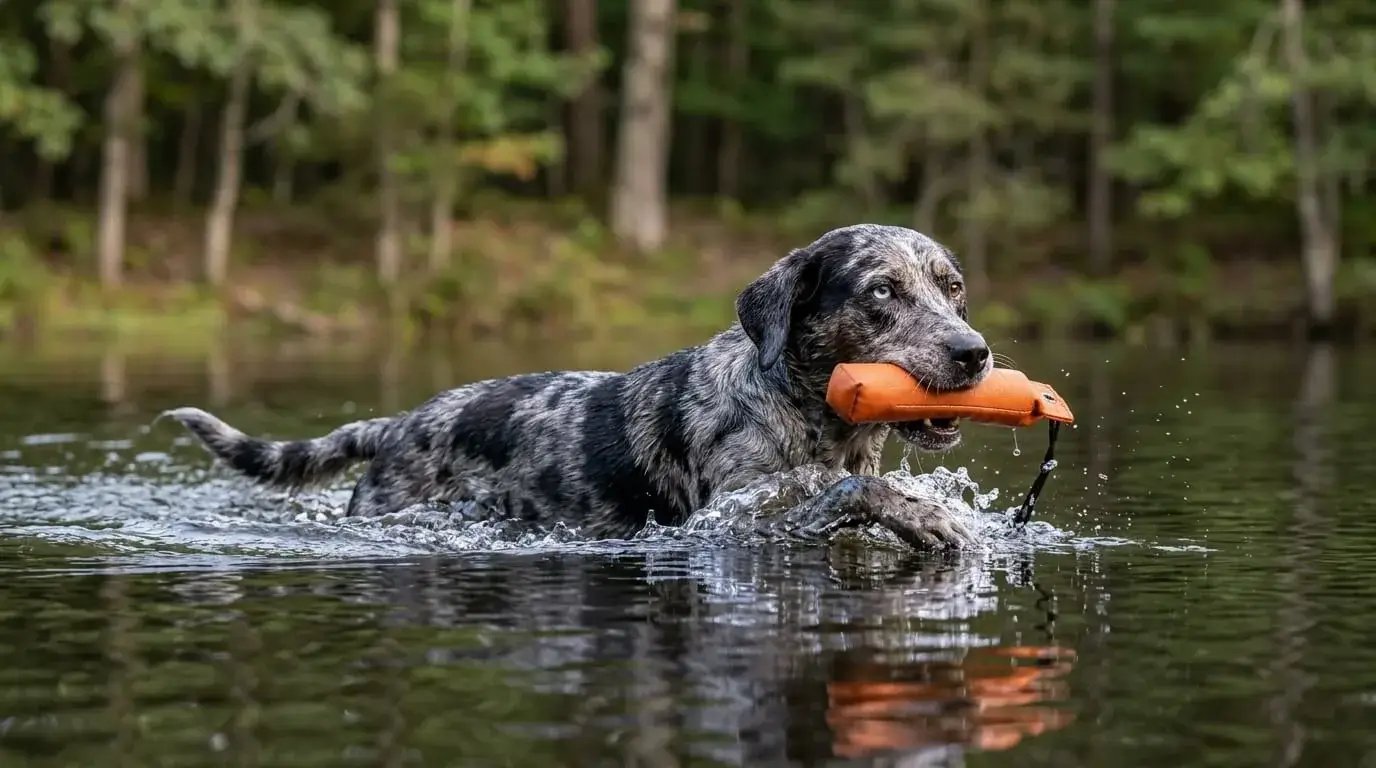
The AKC says the Catahoula needs space, “always needs a job to do,” and is not suited for the city or an apartment. Without enough exercise, it says, the dog will start digging and chewing.
Plan for 60 to 120 minutes of activity for an adult catahoula labrador mix each day. Split it into at least two sessions, and add mental work.
Good jobs for this cross:
- Swimming and retrieving. The AKC calls the Catahoula an excellent swimmer, and Labs love water.
- Hiking and trail running, once the dog is grown.
- Agility, rally, or obedience classes.
- Scent work and tracking games.
- Frisbee and fetch in a fenced field.
Our guide to how much exercise a Lab needs covers the retriever side. Expect a catahoula labrador mix to need more than that baseline.
For a similar herding-drive cross, compare the aussie labrador mix. Both need work. The Catahoula cross tends to be tougher and more independent.
Summer needs care. Both parents love water, which helps, but a muscular dog working hard in Southern heat can overheat fast. Work early and late on hot days, carry water, and rest in the shade.
Puppies need a gentler plan. Skip forced running and repeated jumping until your vet confirms the joints are mature. Short walks, free play, and training games are enough early on.
FAQ
Are catahoula labrador mixes hypoallergenic?
No. Both parents shed, and the Catahoula is not a hypoallergenic breed. Some crosses shed a little less than a Lab, but no catahoula labrador mix is safe for people with dog allergies.
How big are they?
Usually medium to large. The parents span about 50 to 95 pounds and 21.5 to 24.5 inches. Without a breed standard, a seller who quotes one exact adult weight is guessing.
Are they good with kids?
Often yes with their own family, when raised with kids and well socialized. They can be protective and may herd running children. Supervise, and teach kids calm rules around the dog.
Do they need an experienced owner?
Usually, yes. This cross can be independent and territorial, and a catahoula labrador mix often tests new owners. An owner with training experience, or a first-timer with a trainer on board, is the safest bet.
In short, a catahoula labrador mix is a striking, tough, clever dog that needs a job and a confident handler. Pick the puppy for health and temperament, not for its spots.
If this sounds like too much dog, our Labrador mixes include calmer options. The Labrador Retriever breed guide explains what the retriever parent brings to the cross.