
The chocolate Labrador carries more myths than any other Lab color. They are more hyper, harder to train, and do not live as long — or so the internet says. Two of those claims are false. The third — the lifespan difference — is backed by a study of over 33,000 Labradors (Adams et al., Canine Genetics and Epidemiology, 2018) and deserves honest attention. This is the full chocolate Lab profile: genetics, personality, the real health data, and what it means for you as an owner.
Do chocolate Labs have more health problems? Yes — a 2018 UK study of over 33,000 Labradors found that chocolate Labs have a median lifespan of 10.7 years, compared to 12.1 years for black and yellow Labs. Chocolate Labs also had higher rates of ear and skin conditions. Researchers attribute this to the genetics of coat color selection, not to the color itself.
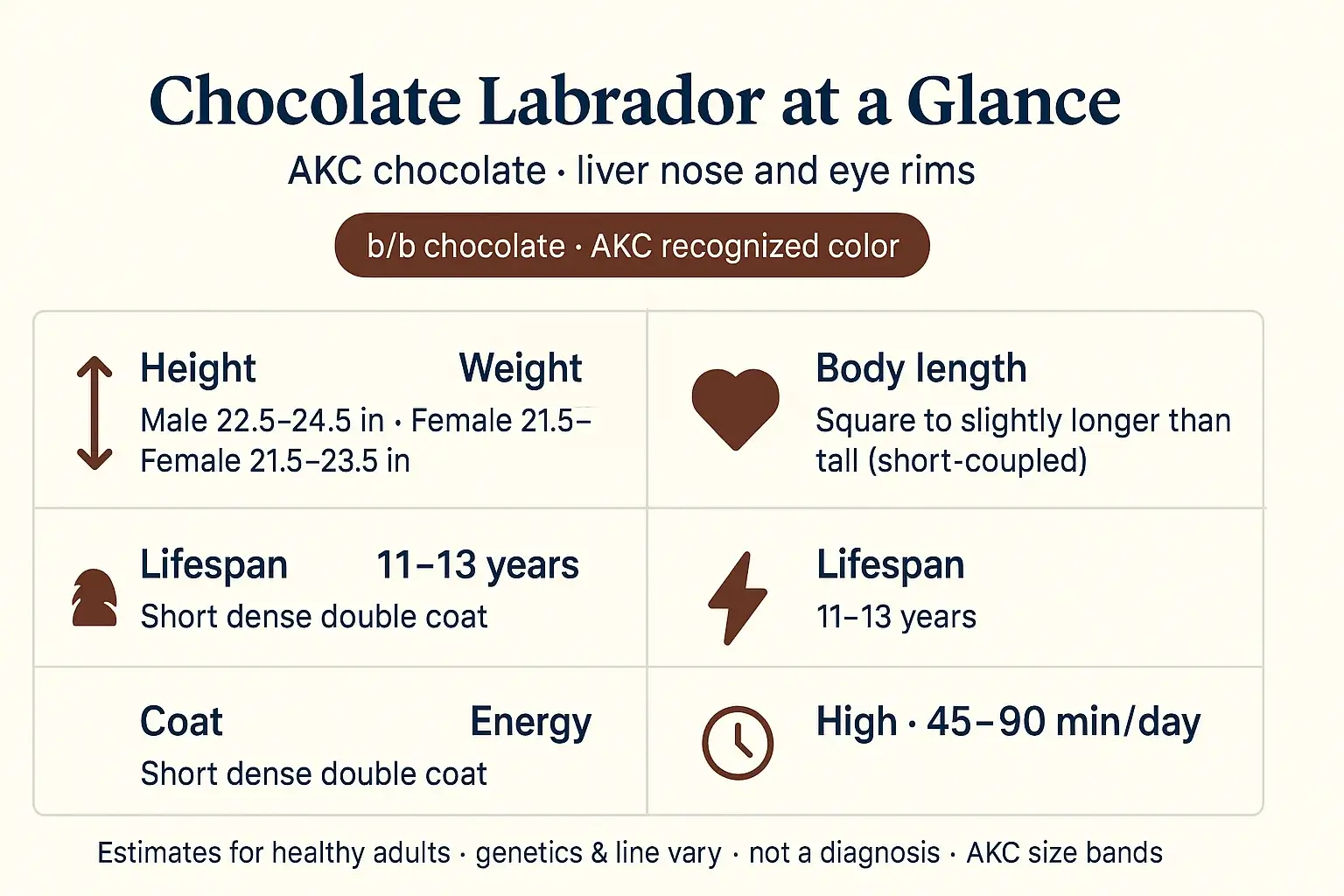
What Makes a Chocolate Labrador? Color Genetics Explained

Chocolate Labrador coat color is controlled by two gene pairs. The B locus determines whether a Lab produces black or brown pigment. Dogs with at least one dominant B allele express black. Dogs with two recessive b alleles (bb) express chocolate. The E locus controls whether any pigment reaches the coat at all — which is how yellow Labs occur regardless of B locus genotype.
A chocolate Lab is always bb at the B locus. Both parents must carry at least one b allele for chocolate puppies to appear in a litter. Two black Labs that each carry one hidden b allele (Bb × Bb) have roughly a 25% chance of producing chocolate puppies.
This recessive inheritance pattern has a practical consequence. Breeders wanting to produce chocolate litters reliably have historically mated chocolate to chocolate or to known carriers. Over generations, this created a narrower gene pool in some chocolate Lab lines than exists in the broader black Lab population. The American Kennel Club recognizes three Lab colors — black, yellow, and chocolate. Chocolate is also called “brown” or “liver” in some breed standards. The color is a direct expression of the bb genotype. It is not a dilute or modified shade. (The diluted version of chocolate exists too — that’s the controversial silver Labrador.)
Chocolate Lab Personality and Temperament
No scientific study has found a reliable temperament difference between chocolate Labs and other Lab colors when breeding line is held constant. The claim that chocolate Labs are more hyperactive, harder to train, or less intelligent is not supported by controlled research.

The myth persists for a traceable reason. In the US, demand for chocolate Labs as a color grew faster than responsible breeding kept pace. Breed historians and responsible breeders widely attribute this pattern to the color-driven demand of that era — many chocolate Labs sold in the 1990s and 2000s came from breeders who prioritized color over temperament testing, health screening, and line selection. Dogs from poorly selected stock — of any color — tend to be more difficult. When chocolate was the dominant color in those programs, the behavior problems got attributed to the color rather than the breeding quality.
A chocolate Lab from calm, health-tested parents is as gentle, trainable, and food-motivated as any other well-bred Labrador. The breed temperament applies uniformly across colors: outgoing, friendly, eager to please, and strongly motivated by food. The POMC gene variant that disrupts satiety signaling — producing a dog that is genuinely always hungry — affects all Lab colors equally. According to VCA Animal Hospitals, the Labrador’s defining personality traits are consistent regardless of coat color.
The practical takeaway when selecting a chocolate Lab puppy: prioritize lineage and health testing over color. Ask about the dam’s temperament. Request OFA and DNA clearances. A chocolate puppy from calm parents with full OFA hip, elbow, eye, and EIC DNA clearances is a sound choice.
Chocolate Lab vs Black Lab vs Yellow Lab: What Is Actually Different
The most meaningful difference between chocolate Labs and other colors is the health and lifespan data covered in the next section. The remaining differences are cosmetic.
Temperament does not vary reliably by color when lineage is equivalent. The perceived hyperactivity in some chocolate Labs reflects breeding selection history, not a color-based trait.
Chocolate Labs have the same dense double-coat structure as all Labs. Prolonged UV exposure can cause the chocolate coat to fade from rich brown to a lighter, copper-tinted shade — a cosmetic effect called sun bleaching. Some chocolate Labs also develop amber or hazel eyes rather than the darker brown typical of black Labs. Nose and eye rim pigmentation in chocolate Labs is brown (liver-colored), compared to the black pigmentation in black Labs. Yellow Labs can carry either, depending on their B locus genotype.
Chocolate Labs have historically been underrepresented in the conformation ring — not because they are disqualified but because of breeder preference and the dominance of black in field and guide dog lines. This is gradually changing. Price differences are modest: chocolate Labs from well-bred lines sometimes cost slightly more due to perceived rarity, though true scarcity is not the case.
For breed profiles specific to the other colors, see our guides to the black Labrador and yellow Labrador (coming soon).
Chocolate Lab Health and Lifespan: What the Data Shows
The 2018 study published in Canine Genetics and Epidemiology (Adams et al.) remains the most rigorous analysis of Labrador health by color. It analyzed veterinary records for 33,320 UK Labradors. The findings for chocolate Labs: a median lifespan of 10.7 years, compared to 12.1 years for both black and yellow Labs — a 1.4-year gap. Chocolate Labs also showed significantly higher rates of ear infections and skin conditions than the other two colors.
The proposed mechanism is not the color itself. Brown pigmentation does not cause disease. The explanation is that breeding for a recessive trait — which requires both parents to carry bb — historically narrowed the gene pool in chocolate lines. Reduced genetic diversity correlates with increased prevalence of certain health conditions across a population. The color is a marker for the breeding pattern, not the cause of the health outcomes.
A chocolate Lab bred by someone who selects for genetic diversity — crossing chocolate with black or yellow carriers, using health-tested dogs from multiple bloodlines — can have an individual lifespan comparable to any other color. The study describes population averages. Your dog’s health is better predicted by the health testing of its parents than by its coat color.
The shared health risks that apply to all Labradors apply equally to chocolate Labs: hip dysplasia, elbow dysplasia, progressive retinal atrophy (PRA), exercise-induced collapse (EIC), and obesity. OFA or PennHIP hip clearance, OFA elbow certification, CAER/OFA eye clearance, and EIC DNA testing on both parents remain the relevant criteria regardless of color. For the full guide to hip dysplasia in Labs, see our Labrador hip dysplasia guide.
(Adams et al., Canine Genetics and Epidemiology, 2018)
Caring for a Chocolate Labrador: Grooming and Coat Care
Chocolate Labs shed as heavily as black or yellow Labs — same double-coat structure, same volume. The coat blows out twice yearly in spring and fall. Brown fur on light-colored furniture and clothing is highly visible. Brushing 2–3 times weekly during shedding season and once weekly the rest of the year keeps the volume manageable. A deshedding tool like the FURminator (available on Chewy) used during seasonal blows removes loose undercoat before it reaches the sofa.
Sun fade is the most distinctive cosmetic consideration for chocolate Lab owners. Prolonged UV exposure bleaches the chocolate pigment from rich brown to a lighter, washed-out shade. This is cosmetic only — no health impact. A moisturizing or UV-protective dog shampoo (Chewy carries several Lab-appropriate options) helps preserve color between baths. Limiting extended sun exposure during peak hours also reduces fading.
Nose depigmentation affects some chocolate Labs seasonally. The brown nose lightens to pink during colder months — called “winter nose” or “snow nose.” This is benign and typically reverses as temperatures rise. Rapid or irregular color changes outside seasonal patterns warrant a vet check.
Bathing once monthly is appropriate for most chocolate Labs. For the complete grooming guide covering nail care, ear cleaning, and bathing technique, see our Labrador grooming guide. For the full breed overview, see our Labrador Retriever breed guide.
Frequently Asked Questions: Chocolate Labrador
Do chocolate Labradors have more health problems than other Labs?
The 2018 UK study of 33,320 Labradors found chocolate Labs have a shorter median lifespan (10.7 years vs 12.1 for black and yellow) and higher rates of ear and skin conditions. Researchers attribute this to reduced genetic diversity in chocolate breeding lines, not to the color itself. A chocolate Lab from health-tested, genetically diverse parents can match the lifespan of other colors.
Are chocolate Labs more hyper than black or yellow Labs?
No — not because of their color. The perception arose because some chocolate Lab lines in the US were bred with less focus on temperament during periods of high color demand. A chocolate Labrador from well-selected parents has the same trainable, friendly temperament as any other well-bred Lab.
How long do chocolate Labs live?
The median lifespan for a chocolate Labrador is approximately 10.7 years based on the Adams et al. 2018 study. Individual lifespan depends on genetics, health testing of parents, diet, weight management, and veterinary care. Responsible breeding for genetic diversity improves individual outcomes beyond population averages.
Are chocolate Labs harder to train than other colors?
No. Trainability in Labradors depends on breeding line, individual temperament, and training consistency — not coat color. Chocolate Labs are as food-motivated and handler-focused as any other well-bred Lab.
What is a liver Labrador?
Liver is an alternative name for the chocolate coat color used in some countries and breed standards. A liver Labrador is a chocolate Labrador. The AKC standard uses the term “chocolate.”
Chocolate Labs are Labradors in every way that counts — same temperament, same trainability, same exercise requirements. The lifespan data is real and worth understanding, but a chocolate puppy from health-tested parents has every opportunity to live as long as any other well-bred Lab. Focus on lineage and health clearances, not color.