
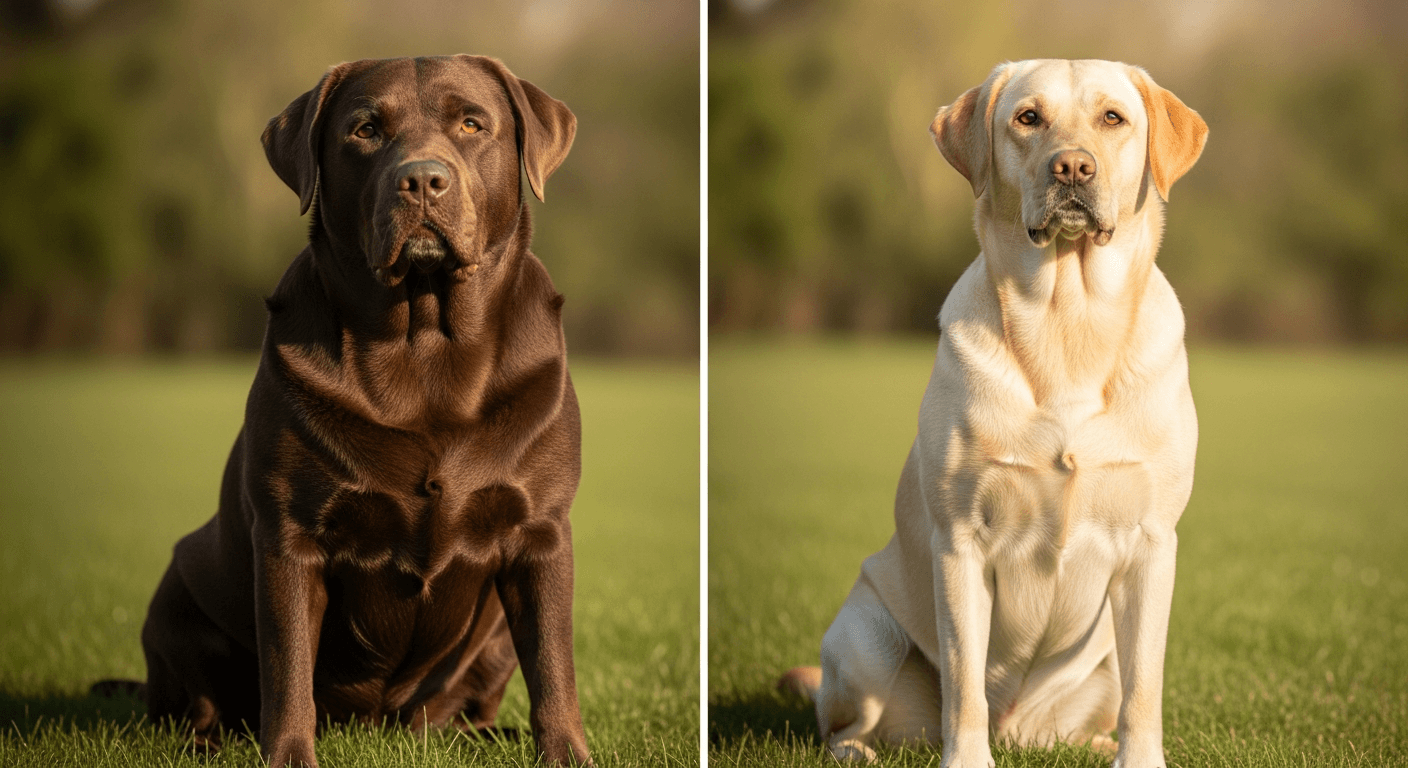
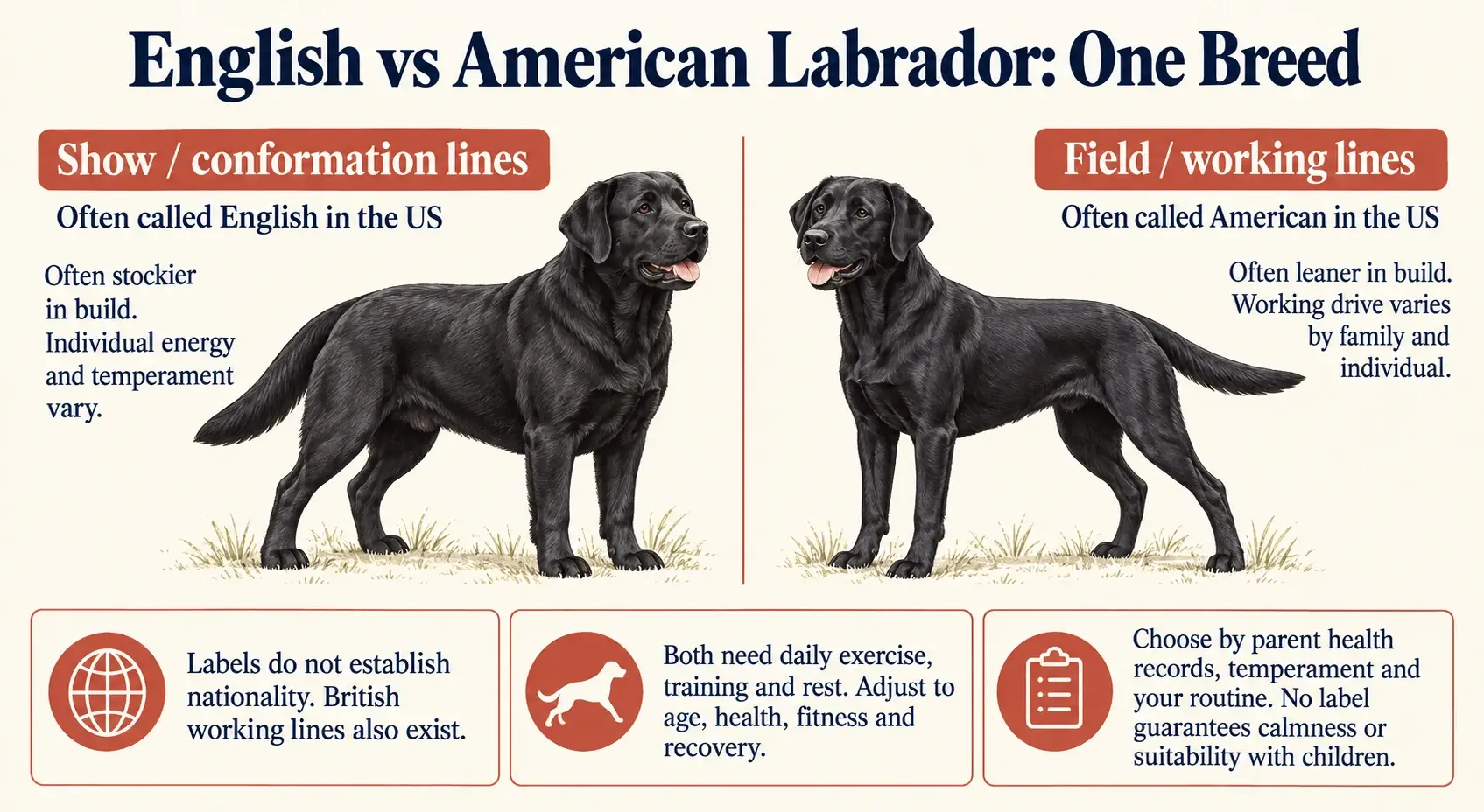
English vs American Labrador usually means show/conformation lines versus field/working lines in US conversation. These are informal descriptions within one breed, and they do not establish the dog’s nationality, health or temperament. Use the comparison to ask better questions about a particular family of dogs, rather than to choose a guaranteed personality.
Show-line Labradors often look stockier, while field-line dogs often look leaner and longer-legged. Many dogs sit between those outlines, and breeders may combine show and working families. Both need appropriate exercise, training and rest. A stocky show dog is not a miniature Labrador, and a smaller or heavier appearance should not be confused with a separate breed.
Physical Differences: What English and American Labs Actually Look Like
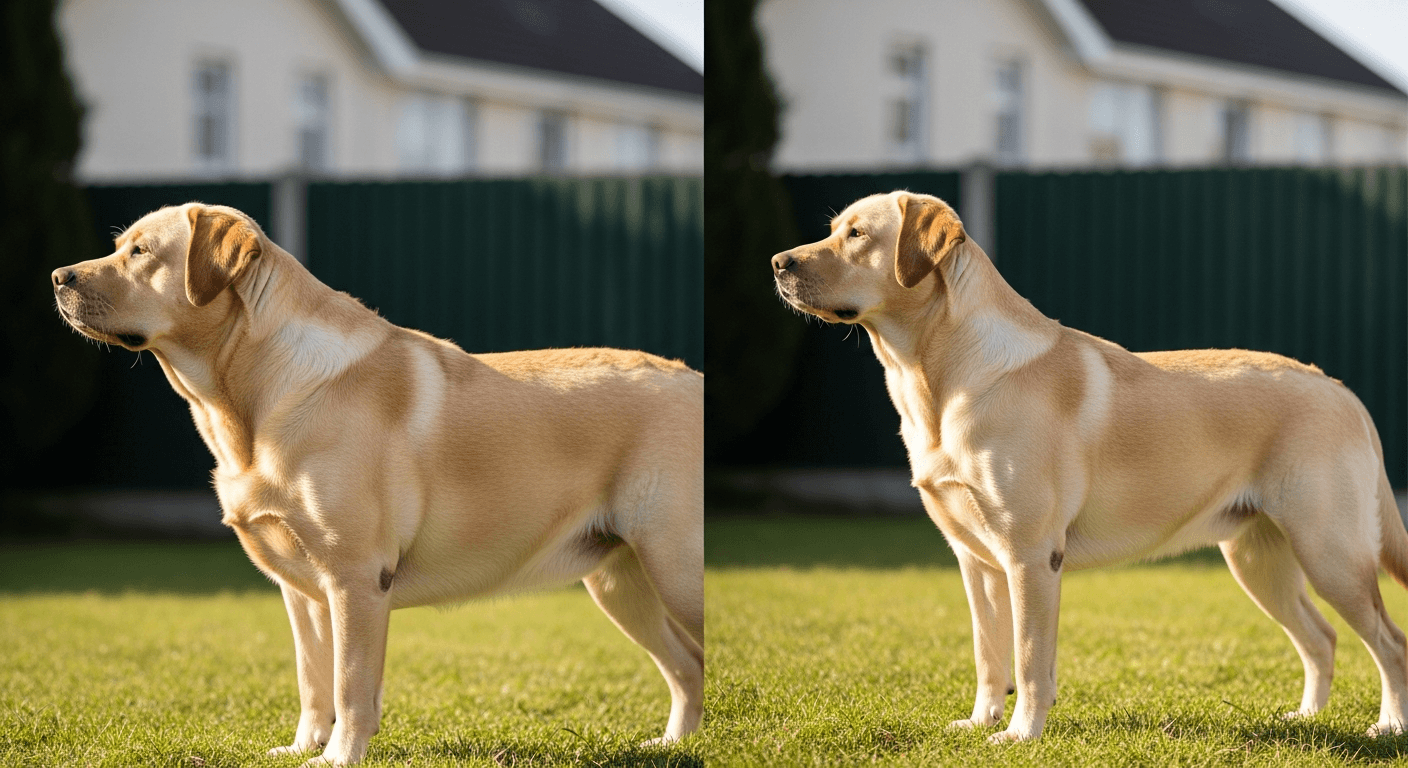
A show-bred outline may include a broad head, substantial bone and a dense coat, but the extremes seen in comparison pictures do not describe every dog. Look at the whole adult dog in good condition, ideally standing and moving. A thick coat or broad chest can make it harder to judge weight visually, so body condition still needs a hands-on assessment.
A field-bred dog may look lighter in bone and more athletic in outline, with a narrower head. That appearance reflects breeding choices within the same retriever breed, not a different registration or a different set of universal health rules. There is overlap between families. Photos, coat color and the position of the ears in one moment are not reliable tests of ancestry or purpose.
The AKC Labrador profile describes one breed. The Labrador Retriever Club explains why show/conformation and working/field are more useful descriptions than nationality labels. Neither label sets a separate adult weight, shedding rate or grooming calendar. Assess the coat and condition of the actual dog and ask what adult relatives look like.
Temperament: Which Type Has the Calmer Personality?

Some show families may suit a companion routine better than some highly selected field families, but the label alone cannot establish calmness. Ask what the breeder’s adults do between activities, how they respond to visitors and whether they can relax indoors. A calm moment in a kennel visit is useful information, but it is only one part of the picture.
Show selection includes conformation and presentation, while behavior still depends on the family and individual. Do not assume every show-bred Lab will mature sooner or tolerate children, noise and handling automatically. Puppies from any line need patient training, suitable social experiences, sleep and management. Ask about the breeder’s goals and what support is available if your puppy’s needs differ from expectations.
Field selection can emphasize retrieving ability, persistence and willingness to work. Those qualities may require an owner who enjoys structured training, but a field label is not a prescribed daily exercise quota. Add activity gradually and assess recovery. If a dog is chewing, pacing or unable to settle, check the routine, environment and health rather than assuming it simply needs a harder workout.
In practical terms: compare the daily lives of the breeder’s adult dogs with your own. Can you provide walks, sniffing, play, training and rest on workdays as well as weekends? How will you manage a puppy while cooking, working or helping children? Plan around those ordinary situations. Both show and field families can produce dogs that need more support than a broad stereotype suggests.
Working Purpose and Heritage: Show Lines vs Field Lines
Every Labrador shares the same origin — working retrievers on the coast of Newfoundland in the 1700s, brought to Britain in the early 1800s and refined into the modern breed through the 1800s. The first Labs were working dogs: compact, hardy, and retrieving waterfowl in icy water for hunters and fishermen.
Show breeding places weight on conformation and presentation against the standard, while some breeders also work their dogs. A show pedigree does not mean a dog lacks retrieving interest, just as a working title does not describe every aspect of household behavior. Ask about demonstrated activities and the particular family rather than treating show and working goals as mutually exclusive.
Field breeding places weight on practical retrieving or competitive working performance. Ask what kind of work the family actually does: a sporting home, a field-trial program and a companion home may value different traits. Titles are useful evidence of an activity, but they do not remove the need to discuss trainability, everyday management and the behavior of close relatives.
Both show and working Labradors are bred in Britain, North America and elsewhere. In particular, British working lines exist, so British does not automatically mean show-line. Ask what a seller means by each term and request a clear description of the parents’ background. The Labrador Retriever breed guide covers the shared breed history and daily-care expectations.
Health Differences: What Each Type Is More Prone To

Both styles can face the familiar Labrador health concerns: hip and elbow disease, inherited eye conditions and exercise-induced collapse. PRA is one example of why an eye examination and relevant DNA results answer different questions. Do not infer the presence or absence of a condition from a broad head, a lean body or a geographic label.
Keep any Labrador at an appropriate body condition. A stocky outline is not permission for excess fat, and a lean-looking field dog still needs regular assessment. Discuss growth, weight and any lameness with your veterinarian. Our Labrador hip dysplasia guide explains the difference between screening records and the diagnosis or management of an individual dog.
Ask for the registered names, dates and actual results of both parents’ relevant evaluations. Do not stop at a seller’s claim that a line is naturally healthier, less anxious or more robust. Test results, family history and a clinical assessment give different pieces of information. A working dog may still need rest or treatment even if it is eager to continue an activity.
Health findings for a color group should also be kept separate from show-versus-field labels. Our chocolate Labrador guide explains the limited UK sample behind the commonly repeated longevity comparison. Neither color nor style supplies an individual prognosis. Screening can reduce uncertainty and guide decisions, but no parent test panel guarantees every aspect of a puppy’s future health.
Which Type Is Right for You? English Lab or American Lab
For an English vs American Labrador choice, first describe your household and goals. Then look for a breeder or rescue able to discuss a specific dog honestly. An owner interested in retrieving sports may prioritize demonstrated working traits, while a companion home may prioritize observed ability to settle. Those preferences are starting questions, not proof that one entire category fits every home.
When considering a show/conformation family: ask how the adult dogs spend a normal day, how much training they receive and how they respond to ordinary household interruptions. Meet suitable adult relatives where possible. Look for a comfortable, functional dog in good condition rather than choosing an exaggerated outline or assuming a show label guarantees a quiet pet.
When considering a field/working family: discuss the actual sport or work you want to do, your experience and the time available for training. Ask how those dogs behave away from work and whether the breeder has placed relatives in comparable companion homes. Be realistic about managing enthusiasm while also teaching rest and safe behavior around distractions.
Neither type guarantees a match or rules one out. A yard, a rural address or an active weekend does not establish a suitable weekday routine. Consider who will handle walks, supervision, grooming and unexpected veterinary needs. If you are choosing between breeds as well as lines, our Labrador vs Golden Retriever comparison addresses the wider decision.
Ask about both parents and the wider family, not only the dam. Genetics, early care, later experience and the individual dog all matter. For an adult rescue, request observations from the foster or previous home and discuss any unknown history. Honest uncertainty is more useful than a promise that one parent’s calmness or one type label predicts the whole dog.
Frequently Asked Questions: English vs American Labrador
What is the difference between an English and American Labrador?
In common US usage, English often means show/conformation lines and American often means field/working lines. Some physical trends differ, but there is substantial overlap. They are one breed, and the terms do not establish nationality or a fixed personality.
Are English Labs calmer than American Labs?
Some show families may be less intensely selected for working drive, but English is not a guarantee of calmness. Ask about the actual family, observe adults where practical and consider health, early experience and training as well as appearance.
Which type of Labrador is better for families with children?
Choose the individual dog and family background that fit the household. Neither type guarantees tolerance of children. Teach calm interactions, supervise appropriately and provide a place where the dog can rest without being approached.
Is a British Lab the same as an English Lab?
Not necessarily. English is often used for show-style dogs in US conversation, while British can refer to origin and includes working families. Ask the breeder to explain the pedigree and breeding purpose rather than treating the labels as interchangeable.
Are English Labs less healthy than American Labs?
Neither label establishes health. Both need appropriate screening and individual care. Review the actual parent records and family history, keep the dog in suitable condition and discuss concerns with your veterinarian rather than assigning risk from body style alone.
Whichever side of the English vs American Labrador question fits you, the next step is preparing for the dog itself. Our Labrador puppy first-year guide walks through what to expect from day one, so you bring home the right Lab and start it well. And if you have not found the dog yet, our getting a Labrador puppy guide covers vetting breeders for either line.


