
Silver Labradors exist. You can register one with the AKC, buy one from a growing number of breeders across the US, and it will look and behave like a Labrador. What is disputed — by canine geneticists, the Labrador Retriever Club, and most established Lab breeders — is whether a silver Labrador is a purebred Labrador at all.
Here is what the evidence actually shows.
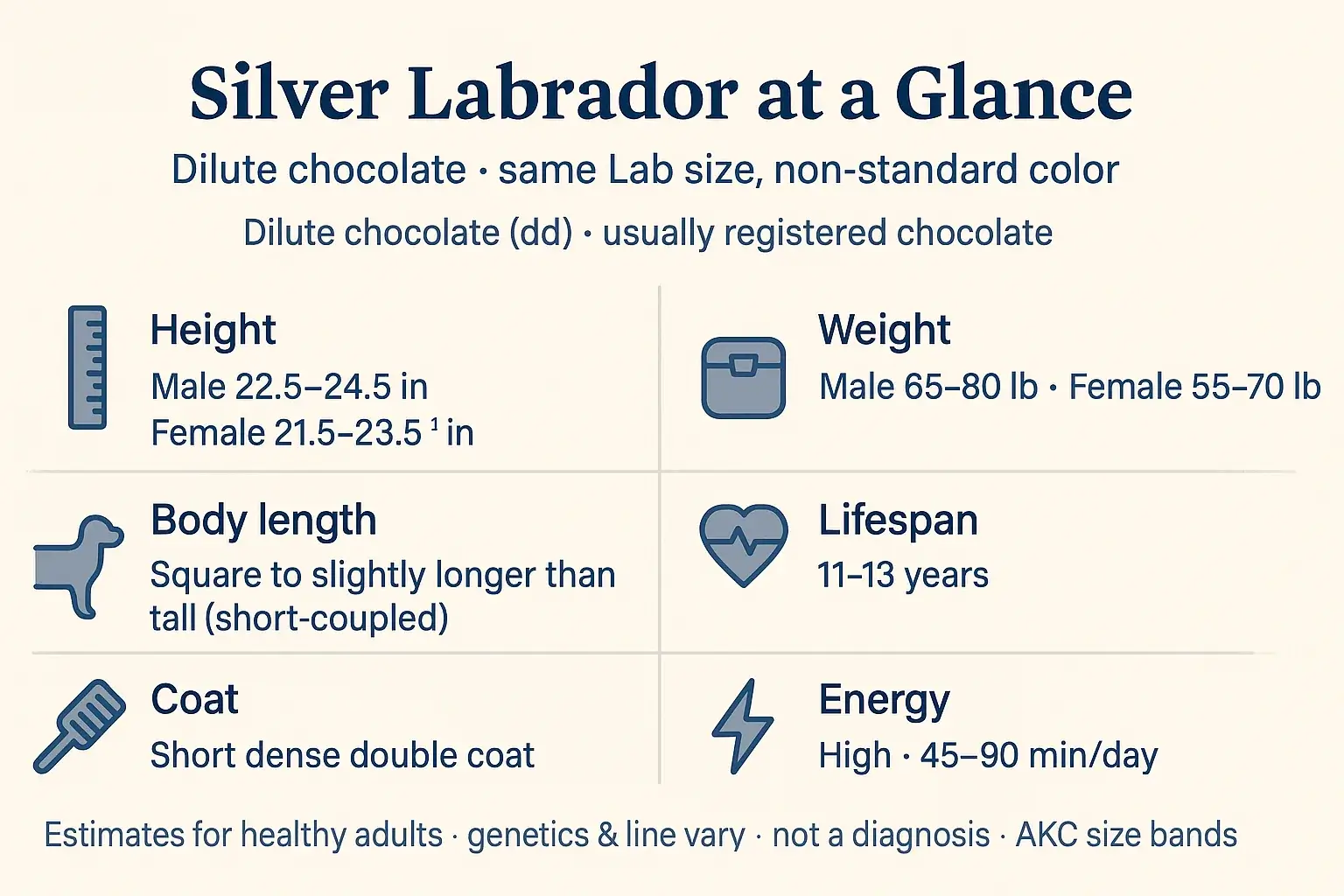
The AKC registers silver Labradors as chocolate Labs — they are a diluted chocolate. Whether they are purebred is disputed: the silver coat requires the “dd” dilution gene, which is absent in traditional Labrador lines. Most canine geneticists believe the dilution gene entered through Weimaraner crossbreeding, making silver Labs likely mixed-breed dogs registered as purebred.
What Is a Silver Labrador? Color Genetics Explained

Labrador coat color is controlled by two primary gene pairs — the B locus (black vs chocolate) and the E locus (color expression). The silver Labrador coat results from an additional gene at the D locus: the dilution gene. Dogs with two copies of the recessive dilution allele (dd genotype) have their pigmentation diluted.
On a chocolate Lab (bb genotype), the dd dilution turns brown pigment to silver-grey. The same dilution on a black Lab produces “charcoal.” On a yellow Lab, it produces “champagne.”
All three dilute variants — silver, charcoal, and champagne — are the same genetic mechanism applied to different base colors. The AKC registers silver Labradors under the chocolate classification, since they are genetically bb + dd. There is no separate AKC color category for silver, charcoal, or champagne.
The dilution gene is well-established in several other breeds. Weimaraners, Italian Greyhounds, Great Danes, and Doberman Pinschers all carry it naturally. Understanding which breeds carry this gene is key to evaluating whether it could have entered Labrador lines independently or through crossbreeding.
The MLPH gene mutation that produces a silver-grey Weimaraner is molecularly identical to the mutation that produces a silver Labrador. That identity is central to the breeding controversy.
The Silver Lab Controversy: Are Silver Labs Purebred?

This is the question prospective buyers are actually trying to answer — and it deserves a direct response.
The Labrador Retriever Club (LRC), the AKC’s parent club for the breed, has stated that silver cannot be a legitimate Labrador color. The LRC has maintained this position for decades. Their stance is that the dilution gene was introduced via crossbreeding — most likely with Weimaraners — and that a silver Labrador cannot be considered purebred.
The AKC still registers silver Labs. This does not mean it endorses their purebred status. AKC registration is based on the registered status of the parents, not on genetic purity testing.
A silver puppy born to two AKC-registered “chocolate” Labs who both carry the dilution gene is registerable.
AKC registration is a paper trail of documented parentage. It is not a certification of breed purity.
The genetic evidence is clear on one point: the MLPH dilution gene responsible for silver Labradors is absent from documented historical Labrador breeding records. It appeared in US Labrador lines in the early 1980s, concentrated among a handful of breeding programs, most tracing back to one or two original kennels. The mutation is molecularly identical to the Weimaraner dilution gene.
The simplest explanation for a previously absent gene appearing in a small cluster of breeding programs from the same region and timeframe is introduction from another breed. No peer-reviewed study has produced evidence that the dilution gene existed in Labrador lines before this period.
The counterargument from silver Lab advocates: the dilution gene may have existed as a deeply recessive trait in Labs for generations, only recently expressed due to specific pairings. This is theoretically possible but unsupported by documentary or genetic evidence.
The honest summary: the weight of evidence suggests silver Labradors are mixed-breed dogs — Labrador-type in appearance and temperament — carrying a color gene introduced from outside the Labrador gene pool. They breed true because the dilution gene is now fixed in those lines.
What Silver Labradors Are Like as Dogs
Whatever the breeding controversy, silver Labradors that have been bred to look and behave like Labs across multiple generations share most Labrador traits. They are generally friendly, energetic, food-motivated, trainable, and good with families.
One practical note: some breeders and trainers report that silver Labs can show slightly more anxiety or reactivity than typical standard-line Labs. If this pattern is real — and the evidence is anecdotal — it likely reflects less rigorous temperament selection in silver Labrador breeding programs, where color production has been the primary focus. The dilution gene itself does not affect temperament.
Exercise and care needs are the same as any Labrador. Silver Labs are not low-energy dogs. The standard Lab requirements — 45 to 90 minutes of daily exercise, consistent training, mental stimulation, and a structured feeding routine — apply identically.
If you already own a silver Labrador: the breeding controversy is about buyer information and breed integrity, not a judgment on the dog itself. Your silver Lab deserves the same training, care, and regard as any Lab.
Silver Lab Health Problems: Color Dilution Alopecia & Standard Risks
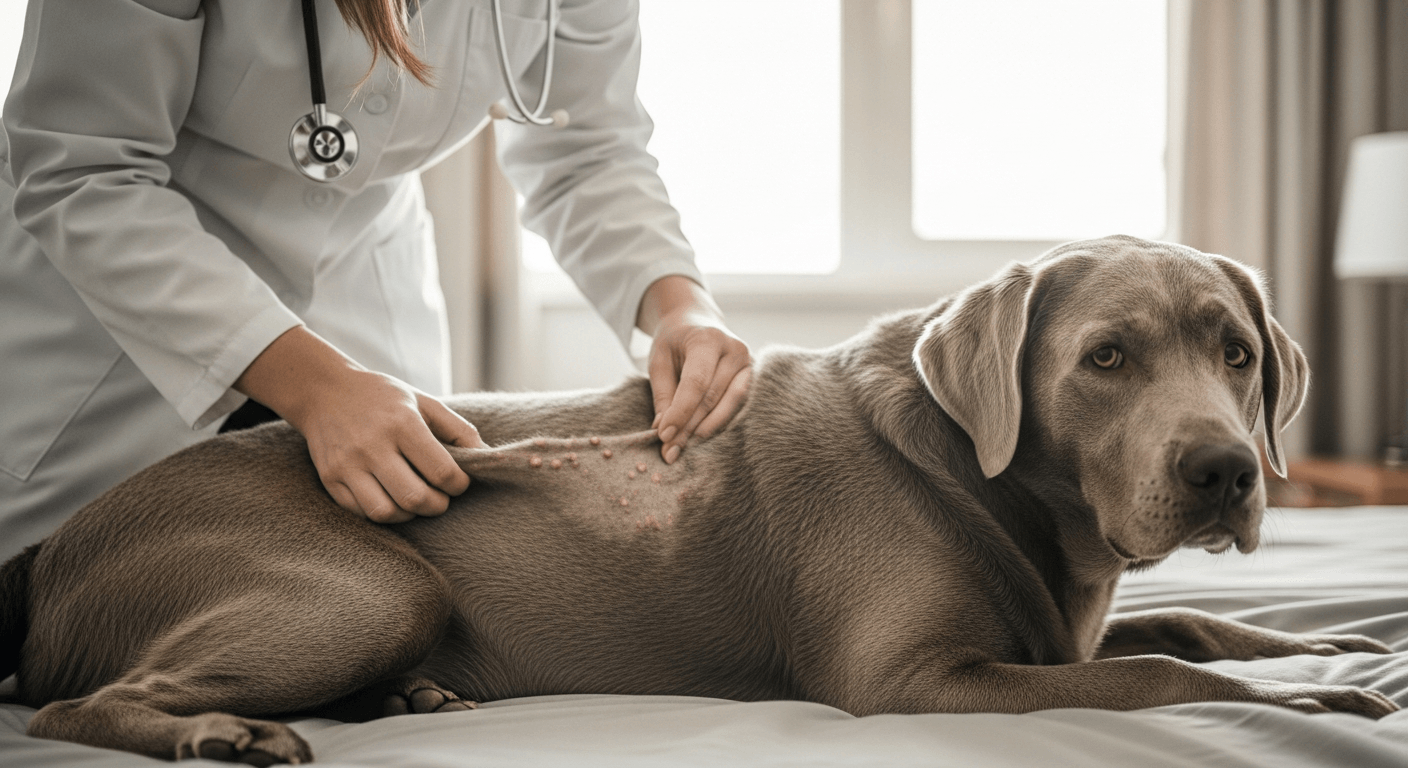
The most significant health risk specific to silver Labradors — and to all dilute-colored dogs carrying the dd genotype — is color dilution alopecia (CDA).
CDA is a skin and coat condition linked to the dilution gene mutation. According to the Merck Veterinary Manual, CDA affects multiple dilute-colored breeds including Weimaraners, Dobermans, and dilute Dachshunds. In affected dogs, the diluted hair shafts are structurally fragile.
This leads to recurrent bacterial folliculitis, progressive hair thinning along the back and flanks, and dry, flaky skin.
CDA typically appears in the first 1 to 3 years of life. Not all dd dogs develop CDA — penetrance varies — but silver Labradors face elevated risk compared to standard-color Labs, who carry no dilution gene.
There is no cure for CDA. Management involves regular bathing with a medicated or dermatological shampoo, omega-3 fatty acid supplementation to support coat and skin health, and treatment of secondary bacterial infections as they arise. These are ongoing costs, not one-off treatments.
For skin conditions and management more broadly, see our Labrador skin problems guide.
The standard Labrador health risks also apply: hip dysplasia, elbow dysplasia, progressive retinal atrophy (PRA), exercise-induced collapse (EIC), and obesity. Silver Labrador breeding programs have historically focused on color production rather than rigorous health testing.
This makes it especially important to request OFA hip and elbow clearances, EIC DNA testing, and CAER/OFA eye certification from any silver Lab breeder. For the full hip dysplasia guide, see our Labrador hip dysplasia resource.
Should You Buy a Silver Labrador? What the Price Premium Reflects
Silver Labradors are priced at $1,500 to $4,000 or more by many US breeders — substantially above the $1,000 to $2,000 range typical for a health-tested black, yellow, or chocolate Lab from a responsible program. Understanding what that premium reflects is the key purchasing decision.
The premium reflects scarcity of the dilution gene in Lab-type dogs and high buyer demand for the appearance. It does not reflect superior health testing, better temperament selection, greater genetic diversity, or compliance with a rigorous breed standard. In many cases, silver Labrador breeders health-test less thoroughly than established show or field line breeders.
The case against buying one: you are likely paying a premium for a mixed-breed dog that cannot be verified as purebred; health testing in many silver Lab programs is inconsistent; color dilution alopecia is a genuine ongoing management burden; and purchasing at premium prices from color-focused breeders rewards a practice that prioritizes appearance over welfare.
The case for: if purebred status is not a priority, if you have researched the CDA risk and are prepared to manage it, if you find a breeder who health-tests thoroughly, and if you want a Labrador-type companion with an unusual appearance — you can make that decision with full information. The dog itself is not lesser for its genetics.
Frequently Asked Questions About Silver Labradors
Are silver Labs purebred?
Probably not in the traditional sense. The AKC registers silver Labradors as chocolate Labs, but registration reflects parentage documentation — not genetic purity. The dilution gene responsible for the silver coat was absent from historical Lab lines and appeared in US breeding programs in the 1980s. The Labrador Retriever Club believes it was introduced via Weimaraner crossbreeding.
What health problems do silver Labs have?
The most significant silver-specific risk is color dilution alopecia (CDA) — a skin and coat condition affecting dogs with the dd dilution genotype. CDA causes hair thinning, folliculitis, and dry skin, particularly along the back. It has no cure and requires ongoing management. Silver Labs also share the standard Labrador health risks: hip dysplasia, elbow dysplasia, EIC, PRA, and obesity.
Are silver Labs recognized by the AKC?
The AKC registers silver Labs as chocolate Labradors. It does not recognize silver as a separate color. The Labrador Retriever Club — the AKC’s parent club for the breed — does not recognize silver as a legitimate Labrador color.
Why are silver Labs so expensive?
The premium reflects scarcity of the dilution gene and high buyer demand for the appearance. It does not reflect superior health testing, better temperament, or breed standard compliance. The price is driven by novelty and demand, not quality indicators.
What is a charcoal or champagne Lab?
Charcoal Labs are dilute black Labs (black genotype + dd dilution). Champagne Labs are dilute yellow Labs (yellow genotype + dd dilution). All three — silver, charcoal, and champagne — are produced by the same MLPH gene mutation applied to different base coat colors. The same breeding controversy and CDA health risk apply to all three.
Silver Labradors are interesting-looking dogs. If you buy one with full knowledge of the breeding controversy, the CDA risk, and the limited breed standards in most silver Lab programs, that is an informed decision. Going in blind — paying a premium for assumed purebred status — is what this post exists to prevent. For an overview of all Labrador colors and varieties, see our Labrador Retriever breed guide.
Silver is not the only coat that stirs debate in Labrador circles — see the fox red Labrador for the other shade that splits breed purists.