
A white Labrador is simply a very pale yellow Labrador Retriever — not a separate breed, and not an albino. The coats sold as “white,” “polar white,” or “snow white” sit at the lightest end of the yellow range, which the American Kennel Club recognizes as one color: yellow. Every white Lab is a yellow Lab whose coat happens to carry almost no visible warmth.
That pale shade is not a distinct breed. The AKC registers these dogs as yellow. A true white Lab keeps a dark nose, dark eye rims, and brown eyes, and that pigment is exactly what separates it from a genuine albino dog.
What Is a White Labrador?
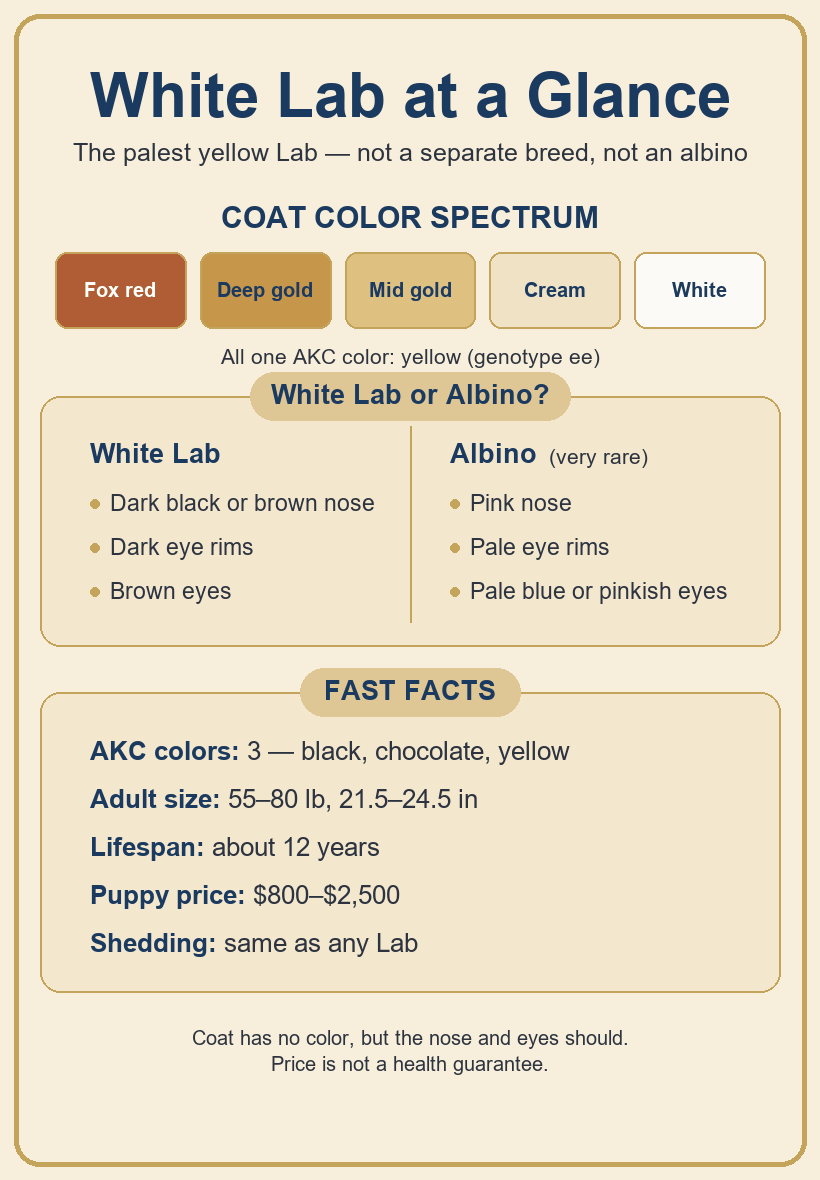
A white Labrador is a yellow Lab so pale that its coat looks cream or nearly white in most light. There is no “white” listed in the breed standard. The AKC recognizes three Labrador colors — black, chocolate, and yellow — and white falls under yellow, at the far light end of that range.
The names do the confusing. Breeders market these dogs as “white,” “polar,” “snow,” or “English Cream” because pale coats sell. None of those are official categories. They describe one thing: a light yellow coat. For the full breakdown of every shade and label, see our guide to Labrador colors, and for the wider yellow range — from cream to gold — our yellow Labrador guide covers where white sits on the spectrum.
So a “white labrador retriever” and a “cream Lab” are the same dog described two ways. The paperwork will say yellow either way.
White Labrador vs Albino Labrador

This is the distinction that matters most, and most sources gloss over it. A white Labrador is not an albino. The two look different if you know where to look.
A white Labrador has normal pigment in the right places: a black or brown nose, dark eye rims, and brown eyes. The coat lacks color, but the skin and features do not. Albinism is a genetic condition that removes pigment almost everywhere. A true albino Lab would have a pink nose, pink or pale eye rims, and very pale blue or pinkish eyes — and true albinism is extremely rare in Labradors.
If a “rare white Lab” for sale has a pink nose and pale eyes, that is not a premium trait to pay extra for. It can signal albinism or health considerations worth a vet’s review, not a bonus. In a healthy pale Lab, the dark nose and brown eyes are the tell.
The Genetics Behind a White Labrador’s Coat

Coat color in Labs runs on a few genes. A yellow Labrador — white included — is genetically ee, a recessive pairing that switches the coat from black or brown pigment (eumelanin) to the red-yellow pigment (phaeomelanin). Every yellow Lab, from fox red to white, carries that same ee base.
What makes one yellow Lab pale and another deep gold is a set of modifier genes that control how strongly that red-yellow pigment shows. Turn it down far enough and you get cream or white. Turn it up and you get the copper of a fox red Labrador. Same color classification, opposite ends of the range. Two yellow parents can produce puppies across the whole spectrum in one litter.
Very pale coats show up most often in English show lines, which is why “English Cream” and “white” get used together. Do not confuse an “English Cream” Labrador with a cream Golden Retriever, though — despite the shared label, they are two different breeds. But English versus American is a difference in body type and breeding purpose — stockier show dogs versus leaner field dogs — not a color. Our English vs American Labrador guide covers that split in full. A dog can be pale from either line.
Two quick clarifications, because both cause confusion. A white Lab is not a silver Labrador — silver is a diluted chocolate, a gray coat, and a separate genetic story from the yellow spectrum. And a pale yellow Lab with a pink or liver nose is a Dudley, which is a pigment variation covered alongside our yellow Labrador coverage, not the same thing as a healthy dark-nosed white Lab.
Are White Labradors Rare?
Honestly? Uncommon, not ultra-rare. Pale yellow and cream Labs are produced steadily by English show-line breeders, and they are easy enough to find if you look. They are less common than mid-gold yellows or black Labs, but “rare” is mostly a sales word here.
The “rare white Lab” framing usually justifies a higher price. It should not. Paleness is a shade, not a scarcity, and it carries no health or temperament advantage. Pay for health testing and line quality, not for how light the coat looks in a photo.
White Labrador Temperament & Family Fit
A white Labrador has the same temperament as any other Lab, because color and personality are not linked. Coat shade tells you nothing about how a dog will behave. What predicts temperament is the line the dog comes from and the individual’s breeding.
The “white Labs are calmer” idea is common and has a real explanation — it is just not about color. Many pale white and cream Labs come from English show lines, which have been bred for a steadier, more settled temperament than high-drive field lines. The calm comes from the line, not the color. A white Lab from working field stock will be every bit as energetic as any field Lab.
For a family, that means the same expectations you would set for any Labrador: friendly, people-focused, food-motivated, highly trainable, and in need of real daily exercise and mental work. Meet the parents, ask about the line, and judge the individual puppy — not the coat.
White Labrador Health & Sun Care
A white Lab shares the exact health profile of every other Lab. The color adds no separate disease and takes none away. The breed’s core concerns apply equally: hip dysplasia, elbow dysplasia, progressive retinal atrophy (PRA), exercise-induced collapse (EIC), and obesity. Responsible breeders test parents for hips, elbows, eyes, and EIC before breeding — ask to see that paperwork.
Lifespan is the same too. Labs live a median of roughly 12 years, based on a 2018 UK study of more than 30,000 dogs, and coat color does not change that baseline. Our life expectancy of a Labrador guide covers what actually moves that number — keeping your Lab lean is near the top.
One care note is genuinely coat-specific. Very pale dogs can have lighter skin and a lighter nose, so sun exposure matters more than it does for a black Lab. On long summer days, watch for pink, tender skin on the belly, ears, and nose, and use a dog-safe sunscreen on thin-coated or exposed areas if your vet recommends it. A pale nose that lightens further in winter (“snow nose”) is cosmetic and not a health problem.
Shedding, Grooming & Coat Stains
A white Lab sheds the same as any Lab — heavily during the twice-yearly coat blow and moderately the rest of the year. Color does not reduce shedding, whatever a sales page claims. Our do Labradors shed a lot guide covers the reality; a rubber curry comb or slicker brush two to three times a week keeps it manageable.
The visible difference with a pale coat is staining, not shedding volume. White and cream Labs show porphyrin stains — reddish-brown discoloration around the muzzle, eyes, and paws from saliva and tear fluid. It is common in light-coated dogs and is not an infection. Wiping the muzzle and paws with a damp cloth after meals reduces buildup.
A word of caution on whitening shampoos: use them sparingly. Products marketed to brighten a white coat can dry out skin if overused. A gentle dog shampoo and monthly bathing suit most white Labs fine, with a brightening wash reserved for occasional use.
How Big Does a White Labrador Get?
A white Lab is a standard-size Labrador. Per the AKC breed standard, adult Labs stand about 21.5 to 24.5 inches at the shoulder and weigh roughly 55 to 80 pounds, with males at the larger end. Coat color has no effect on size.
Pale English-line dogs sometimes look blockier — heavier heads, thicker bodies — because show-line conformation runs stockier than field lines. That is a body-type trait, not a “white Lab” trait. Expect a full-grown white Lab to reach adult size around 12 to 18 months, filling out in the chest through age two.
Cost of a White Labrador Puppy

White Labrador puppies from health-tested parents commonly run between $800 and $2,500, with pale “English Cream” show lines often sitting at the higher end. That premium reflects marketing and demand for the look — not better health or genuine rarity.
Price is not a health guarantee in either direction. A high sticker with no hip, elbow, eye, or EIC clearances on the parents is a red flag. So is a breeder selling the coat as “rare white” while dodging health questions. Judge a white Lab puppy by parent health testing, the breeder’s transparency, and the puppy’s temperament — not by how light or how expensive it is.
Frequently Asked Questions About White Labradors
Is a white Labrador a purebred?
Yes. A white Lab is a purebred Labrador Retriever registered as yellow — the palest end of the yellow color range. “White” is a shade description, not a separate breed or a crossbreed. A properly bred white Lab has the same pedigree and papers as any other yellow Lab.
Are white Labs albino?
No. A white Lab has a lack of color in the coat only, while keeping a dark nose, dark eye rims, and brown eyes. A true albino Lab — extremely rare — has a pink nose and pale eyes. If a “white” dog has a pink nose and pale eyes, ask a vet before assuming it is a healthy premium color.
Are white Labradors rare?
They are uncommon but not ultra-rare. Pale yellow and cream Labs come mainly from English show lines and are findable if you look. “Rare white Lab” is usually a pricing pitch. Paleness is a shade with no health or temperament advantage, so it should not command a big premium.
Do white Labradors shed a lot?
Yes, the same as any Lab. White Labs shed heavily twice a year and moderately year-round. Coat color does not change shedding volume. The pale coat mainly changes what you notice — shed fur and reddish porphyrin stains show up more on a light dog than a dark one.
Are white Labs calmer than other Labs?
Not because they are white. Many pale white and cream Labs come from English show lines bred for a steadier temperament, so the calm comes from the line, not the color. A white Lab from field lines is just as energetic as any working Lab.
How much does a white Labrador puppy cost?
Most white Labrador puppies from health-tested parents cost between $800 and $2,500, with English Cream show lines often priced higher. That premium reflects the look’s popularity, not better health. Always weigh parent health clearances over coat color when judging price.
A white Lab is a Labrador in every way that counts — the pale coat is cosmetic, while the temperament, health needs, and care are pure Lab. Choose one on line quality and parent health testing, not on how white it looks. For where every color fits within the breed, start with our Labrador Retriever breed guide.