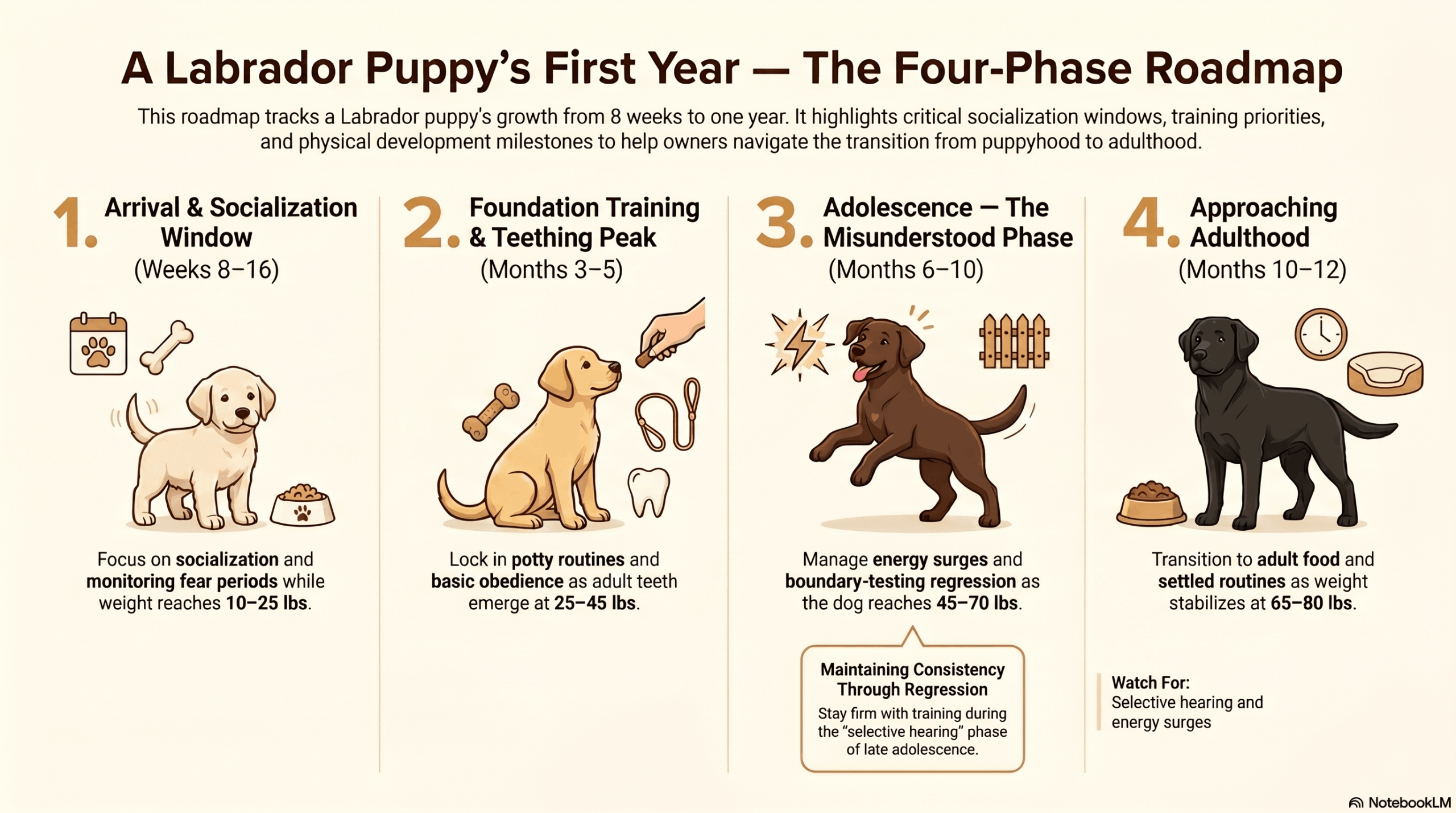
A Labrador puppy’s first year breaks into four distinct phases. Phase 1 is arrival and the socialization window — weeks 8 through 16. Phase 2 is foundation training and the teething peak — months 3 through 5. Phase 3 is adolescence, the most difficult and most misunderstood — months 6 through 10. Phase 4 is the approach to adulthood — months 10 through 12. Knowing which phase you’re in makes every challenge predictable and every decision clearer.
Most first-time Lab owners are caught off guard by Phase 3. The dog that was learning reliably at 5 months appears to forget everything at 8 months. That’s not a training failure — it’s neurology. This guide explains what’s happening at each stage, what to do about it, and what you cannot afford to skip.
The Four-Phase Roadmap: What to Expect in Year One
The four phases are not arbitrary divisions. Each one reflects a genuine neurological and physical shift in your Lab puppy’s development. The transitions are predictable — which means the challenges are predictable too.
| Phase | Age | Key Focus | Common Challenge |
|---|---|---|---|
| 1 — Socialization Window | Weeks 8–16 | Exposure to the world | Missing the window |
| 2 — Foundation Training | Months 3–5 | Commands, crate, recall | Teething and biting |
| 3 — Adolescence | Months 6–10 | Maintaining what was taught | Recall drops, pulling |
| 4 — Approach to Adulthood | Months 10–12 | Transitions and consolidation | Food change, exercise increase |
Phase 1 runs from the puppy’s arrival at 8 weeks to the close of the socialization window at 16 weeks. During this window, the puppy’s brain is in a heightened state of absorption. What it encounters now becomes the baseline for “normal.” A puppy that experiences traffic noise, strangers in hats, children, and varied surfaces during this window builds a nervous system calibrated for confidence. What it doesn’t encounter can become a fear trigger later. Labradors are bred for novel environments and close handler partnership — their high stimulus-seeking drive makes early socialization especially critical for channeling that energy toward confidence rather than anxiety.
Phase 2 covers months 3 through 5. The socialization window has closed. The teething peak begins at 3.5 months as adult teeth displace baby teeth (our 4-month-old Labrador guide covers this stretch month by month). Basic commands should be solidifying — sit reliably, down introduced, early recall foundation established. Exercise remains limited by the five-minutes-per-month rule: a 4-month Lab gets a maximum of 20 minutes of structured walking per session.
Phase 3 is adolescence: months 6 through 10. Hormonal changes rewire the dog’s brain for adult independence. The handler becomes less salient; the environment becomes more salient. Recall reliability drops. Pulling on lead increases. Counter-surfing begins. This is not defiance — it is a neurological shift, and it passes.
Phase 4 runs from months 10 to 12. Adolescent volatility eases. Behavioral improvement becomes consistent. The food transition to adult large-breed formula is due. Graduated running on appropriate surfaces becomes appropriate as growth plates begin closing. Neutering decisions are typically made during this window.
Phase 1 (Weeks 8–16): Preparation, Arrival & the Socialization Window
Before the Puppy Arrives
Preparation before the puppy arrives determines how the first week goes. The crate — see our step-by-step crate training guide — should be positioned in its permanent location and introduced from day one — not introduced as a last resort when the puppy won’t settle. Puppy-proofing should be complete: cables secured, toxic plants removed, small swallowable objects cleared from floor level. A puppy at 8 weeks will put anything in its mouth.
If you are still choosing your dog, our Labrador Retriever breed guide covers temperament, colors, and what to expect from the breed. Purchase large-breed puppy food and match it to whatever the breeder was feeding. An abrupt food change combined with the stress of a new home produces gastrointestinal upset that complicates the first week unnecessarily. Ask the breeder for the brand and formula. If they don’t have a preference, choose a large-breed puppy formula from a brand with an AAFCO statement confirming it meets large-breed puppy nutritional requirements.
Book the first vet appointment within 48–72 hours of collection — not a week later. The puppy needs a baseline health check and a deworming assessment. Pet insurance should also be purchased before this first appointment, not after. Any condition identified at the first check becomes a pre-existing condition excluded from most policies.
The Socialization Window: Use It or Lose It
The socialization window runs from approximately 3 weeks to 16 weeks. The final portion — weeks 8 to 16 — is under your direct control. This window does not reopen after 16 weeks. It closes regardless of what the puppy has or hasn’t been exposed to, and the nervous system calibrates around whatever was normal during that period.
During this window, your puppy should encounter as many variations of the world as possible. People of different ages, in different clothing, with hats, glasses, uniforms, beards, walking sticks. Environments with different surfaces — grass, gravel, wood floors, metal grates, stairs. Sounds — traffic, children playing, vacuum cleaners, thunder recordings. Other vaccinated dogs. Controlled car journeys. All of this before 16 weeks.
The AVMA supports controlled socialization before the vaccination schedule is complete. The behavioral risk of under-socialization significantly outweighs the infectious disease risk of careful, controlled exposure in most settings. A puppy that misses the socialization window has a higher likelihood of anxiety-based behavior problems in adulthood. For the full socialization checklist and vaccination-safe strategies, see our Labrador Puppy Socialization guide. For what to look for when selecting a breeder or puppy, see our Getting a Labrador Puppy guide.
First Weeks: Training Priorities
Training priorities at weeks 8 through 12 are specific and limited. Name recognition should be solid by week 10 — call the puppy’s name, reward every response. Sit is the first formal command: lure with food, mark the moment the rear touches the floor, reward. Crate entry on cue means the puppy walks in voluntarily for a food reward — not shoved in or coaxed with stress. Recall foundation means the puppy hears its name and a happy tone and comes running toward you for a high-value reward.
Sessions are 3 to 5 minutes each, run several times per day. The puppy’s attention span is genuinely short at 8 weeks. Sessions that end before the puppy disengages build positive associations with training. Sessions that push through disengagement teach the puppy to check out. End on success, always.
The puppy sleeps 16 to 18 hours per day at this age. Work with the energy pattern — short burst, then crash. The crash periods are crate time. Never disturb a sleeping puppy unless necessary — sleep is when the brain consolidates what it just learned.
For week-by-week development specifics at this age, see our 3-month-old Labrador guide.
Phase 2 (Months 3–5): Foundation Training & the Teething Peak
Command Milestones by Month
The training milestones for months 3 through 5 are specific. A Lab puppy that arrives at 6 months without these foundations is entering adolescence with no anchor — and adolescence is when every foundation you’ve built gets tested hardest.
| Command | When to Introduce | Target: Reliable By |
|---|---|---|
| Sit | Week 8–10 | Month 3 |
| Down | Month 3 | Month 4 |
| Name recall | Week 8 | Month 4 (5+ environments) |
| Crate entry on cue | Week 8 | Month 3 |
| Loose-leash walking | Month 3 | Month 5 (low distraction) |
| Stay (5–10 seconds) | Month 4 | Month 5 |
| Leave it | Month 3–4 | Month 5 |
Leave it deserves particular attention. Labs are indiscriminate eaters. They will eat grass, stones, socks, and anything dropped on pavement. A solid leave it established before adolescence is a safety command — it interrupts the impulse to eat something dangerous before swallowing becomes an option. Train it on low-value objects first, then food on the floor, then food in your hand, then food dropped accidentally. Build the sequence before the dog reaches counter-surfing height.
Recall: The Investment That Pays Off in Phase 3
Recall deserves more focus in months 3 through 5 than any other command — see our Labrador obedience training guide for the full command-by-command breakdown. Here’s why: the recall a Lab has at 8 months is largely the recall that was built between months 3 and 5. Adolescence makes the environment more compelling and the handler less compelling. The only thing that offsets that shift is a recall reinforced so many times, in so many locations, that it has become near-automatic.
The method: use a long line (5 to 7 meters), choose high-value treats (real cooked chicken or cheese — not dry biscuits), call once in a happy tone, and follow through if the puppy doesn’t respond within 3 seconds. Never call the puppy and then do something unpleasant. Never call the puppy and put it straight in the crate after a good walk. If the puppy comes, the world becomes better — every single time. For the complete training timeline and command sequencing, see our Labrador puppy training timeline.
Managing the Teething Peak
The teething peak hits between 3.5 and 5 months as adult teeth push through simultaneously. Mouthing and biting intensifies during this phase. This is physiological — the discomfort drives the puppy to chew and bite to relieve pressure. It is not a behavioral regression and it is not aggression.
Provide appropriate outlets before applying corrections. Frozen Kongs — stuffed with kibble and water or mashed banana, then frozen — give the puppy cold contact pressure on the gums. Rubber teething toys rated for heavy chewers. Bully sticks for supervised sessions. When the puppy mouths a hand or ankle: a sharp, high-pitched yelp followed by withdrawing play for 30 to 60 seconds. Not a muzzle hold, not a nose flick. The yelp communicates “that was too hard” — which is what the puppy needs to learn.
Exercise stays limited. The five-minutes-per-month rule applies: a 4-month Lab gets 20 minutes of structured walking per session. Over-exercise on developing joints increases the risk of growth plate injury and long-term joint disease. Off-lead play in a safe garden is lower impact than forced structured walks — the puppy self-regulates pace. For the full teething guide and what to expect tooth by tooth, see our Labrador teething guide. For development specifics at this age, see our 4-month-old Labrador and 5-month-old Labrador guides.
Phase 3 (Months 6–10): Adolescence — The Most Misunderstood Phase
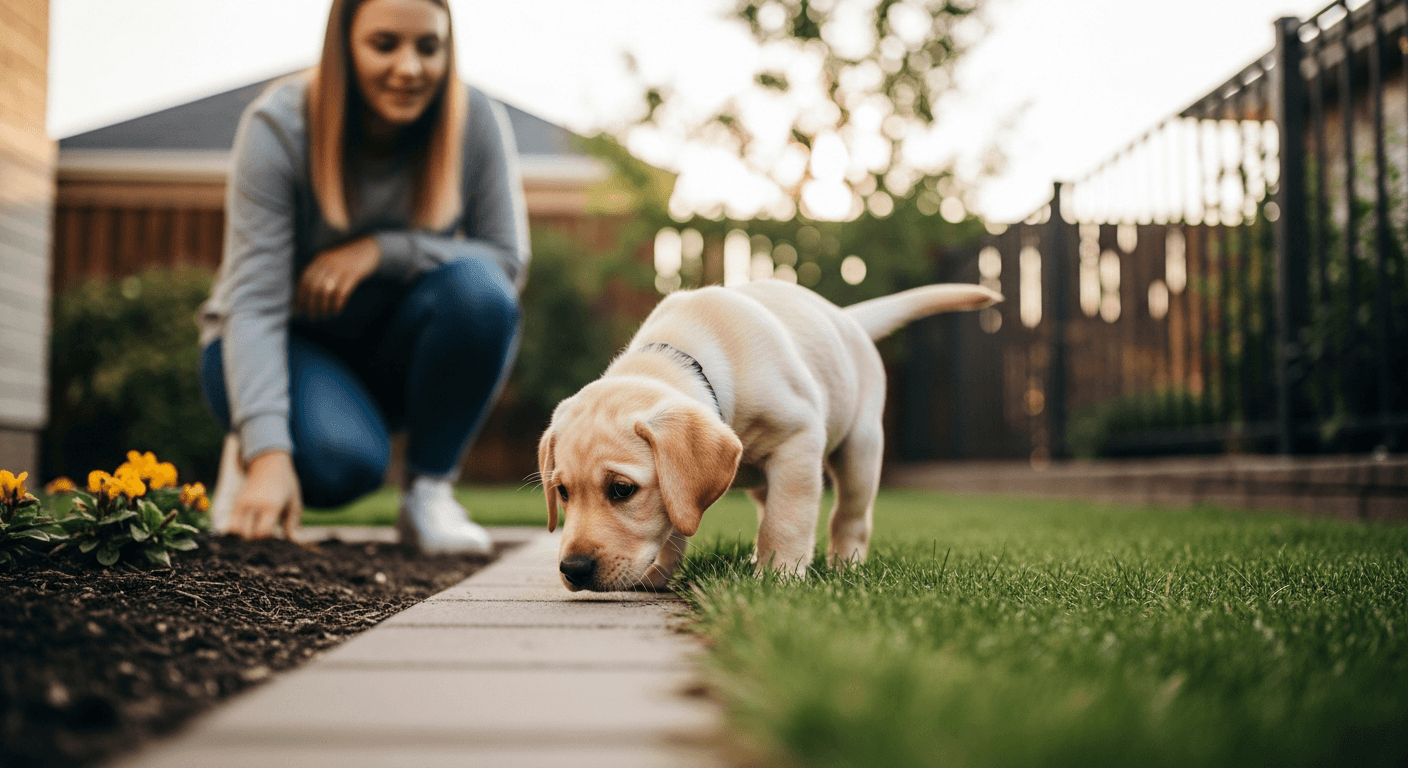
What’s Actually Happening
Adolescence in Labs is biological. Hormonal changes that begin around 6 months rewire the brain for adult independence. The dog’s attention shifts away from the handler and toward the environment. This is the same mechanism that produces adolescent behavior in humans and other mammals — it is not defiance, it is not ingratitude for the training investment. It is neurology, and it passes.
The practical effects are predictable. Recall becomes less reliable — the dog hears its name and keeps sniffing anyway. Pulling on lead reaches near-adult strength. Counter-surfing begins as the dog’s front paws reach table height — Labs are particularly prone to this given their documented food motivation and the fact that males reach 65–80 lbs with a reach that clears most kitchen counters by 8 months. Jumping on guests becomes harder to interrupt because the reward (human contact and reaction) is highly salient. The secondary fear period overlaps with this phase between 8 and 14 months — a dog that confidently approached strangers at 5 months may become hesitant at 9 months. That is not regression. It is a developmental sensitivity period, and it responds to patient positive-association management.
The adolescence peak for Labs is typically 7 to 9 months. Most Labs begin showing consistent improvement from around 10 months. Full behavioral maturity arrives at 18 to 24 months. The 12-month birthday is a genuine inflection point — not a finish line.
The Biggest Mistake: Stopping Training
The single biggest mistake owners make in Phase 3 is stopping training because the dog seems to have forgotten everything — a pattern we break down fully in our Labrador behavior problems guide. A Lab at 8 months that ignores recall commands it knew reliably at 5 months is frustrating. But every training session during this phase — even imperfect ones — builds the neural pathways the mature brain will use reliably. Owners who maintain consistent training through adolescence reach the 12-month improvement point faster than those who don’t.
What works during adolescence: upgrade the reward value. A Lab that worked for dry kibble at 4 months often needs real cooked chicken, cheese, or hot dog pieces at 8 months. The environment has become more compelling — so must the reinforcer for ignoring it. Keep sessions short (5 to 10 minutes). End on success. Practice recall with a long line in moderate-distraction environments rather than abandoning it because the dog fails in high-distraction settings.
Managing the Environment
The second lever is environmental management. Counter-surfing rehearsed 50 times becomes a deeply established habit by 10 months. A dog that cannot counter-surf because there is nothing on the counter does not learn to counter-surf. This is not about giving up on training — it is about not allowing the dog to rehearse problem behaviors at a frequency that hardens them into habits.
The same logic applies to jumping. A Lab that jumps and consistently receives attention — even negative attention like a push — is a Lab that learns jumping works. Remove the reward by turning away before the paws make contact. Four feet on the floor gets attention immediately. Rehearsed 500 times during adolescence, this becomes the default.
For month-by-month adolescence guidance, see our guides for the 6-month-old Labrador, 7-month-old Labrador, 8-month-old Labrador, and 9-month-old Labrador.
Phase 4 (Months 10–12): Approaching Adulthood & the First-Year Transitions
From 9 to 12 months, most Labs show the first consistent behavioral improvements. Recall becomes more reliable. Lead pulling reduces with consistent handling. The dog begins checking in voluntarily during walks — offering attention to the owner rather than relentlessly scanning the environment. The adolescent phase is not over at 12 months, but it has changed direction.
The Food Transition
The food transition is due at 12 to 15 months. Large-breed puppy formula is calibrated for rapid growth — its caloric density and calcium-to-phosphorus ratio exceed what a dog past the active growth phase needs. Continuing on puppy formula past 15 months increases the risk of excess weight gain and over-supplementation of nutrients calibrated for growth, not maintenance.
Transition using a 7-day gradual blend:
| Day | Puppy Food | Adult Food |
|---|---|---|
| 1–2 | 75% | 25% |
| 3–4 | 50% | 50% |
| 5–6 | 25% | 75% |
| 7+ | 0% | 100% |
Choose a large-breed adult formula specifically — not a generic adult food. Large-breed adult formulas control caloric density and joint-supporting nutrients for dogs in the 55 to 80 lb adult weight range. For the detailed transition protocol, see our transition to adult food guide. For ongoing portion guidance, see our guide to how much to feed a Labrador.
Exercise and the Growth Plate Decision
Growth plates begin closing from 12 months in Labs. Before the plates close, the cartilage at the end of long bones is softer and more vulnerable to compression injury than the surrounding mature bone. Structured running on hard surfaces before 12 months carries a genuine injury risk that casual walking and off-lead play in grass do not.
From the first birthday, graduated running on appropriate surfaces is appropriate. In Labradors, growth plates typically close between 12 and 18 months — earlier in smaller females, later in large-framed males. Start with five-minute jog segments on grass or packed dirt (not concrete), and increase by five minutes per week over four to six weeks. Avoid repetitive pavement running at high volume until 18 months, when plate closure is more complete in most Labs.
Neutering: The Timing Decision
The 2020 Hart et al. study from UC Davis found that Labrador Retrievers neutered before 12 months showed significantly higher rates of hip dysplasia, elbow dysplasia, and cruciate ligament rupture than those neutered at 12 months or later. The standard 6-month neutering recommendation most practices still give reflects historical protocol, not current large-breed evidence.
Discuss timing with a veterinarian who is current on this research. The evidence supports waiting until at least 12 months for male Labs. For females, the evidence is less clear-cut and involves weighing joint disorder risk against mammary tumor risk — a conversation that requires your vet’s input and your individual dog’s health status. For the complete 10 to 12 month development guide, see our 10-to-12-month-old Labrador guide.
Labrador Puppy Nutrition: Feeding at Each Phase
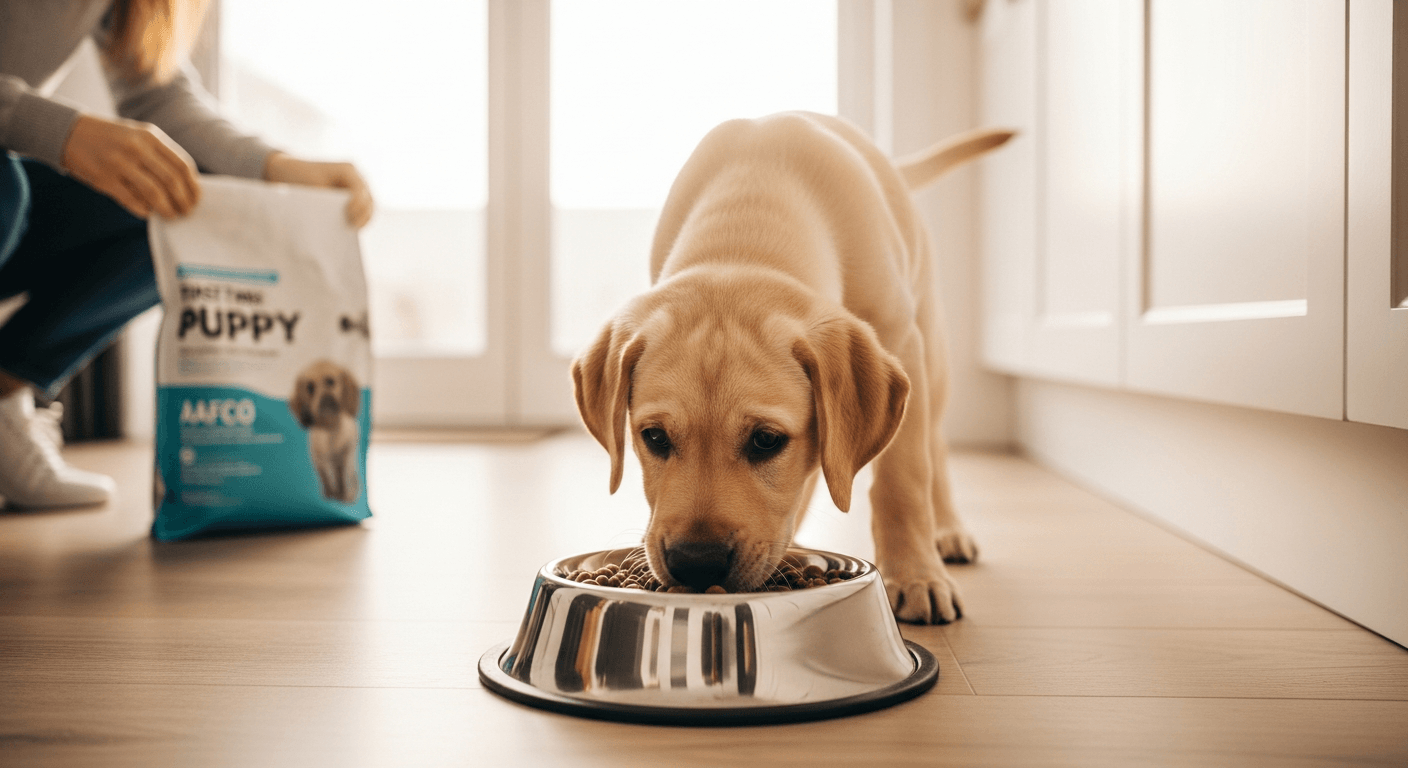
The Large-Breed Puppy Formula Requirement
Large-breed puppy formula is required throughout the first 12 to 15 months — not generic puppy food, not adult food, not whatever is on offer at a discount. Large-breed puppy formulations control the calcium-to-phosphorus ratio that governs skeletal development in fast-growing breeds. Too much calcium during the growth phase accelerates bone growth in ways that increase developmental joint disease risk. The breed-size-specific formulation is not marketing. It reflects a real physiological requirement.
Look for an AAFCO statement on the bag that says “formulated to meet the nutritional levels established by the AAFCO Dog Food Nutrient Profiles for growth of large-sized dogs.” If that language isn’t on the bag, the food has not been validated for large-breed puppies. For specific food recommendations, see our Labrador puppy food guide.
Meal Frequency and Portions
Meal frequency changes once during the first year. Feed three meals per day from 8 weeks to 6 months. Move to two meals per day from 6 months through the adult food transition at 12 to 15 months. The shift from three to two meals happens at 6 months — not when it seems convenient, not when the puppy stops eating one of the three meals. At 6 months, the change is appropriate regardless of the puppy’s apparent preference.
| Age | Meals Per Day | Formula |
|---|---|---|
| 8 weeks – 6 months | 3 | Large-breed puppy |
| 6 months – 12 months | 2 | Large-breed puppy |
| 12–15 months (transition) | 2 | Blend (puppy → adult) |
| 15 months+ | 2 | Large-breed adult |
Measure every meal. Labs do not self-regulate food intake — for owners considering an alternative approach, see our homemade dog food guide (with a vet-reviewed framework for getting the balance right). Free-feeding a Labrador puppy produces an overweight Lab, typically by 9 to 12 months, with the joint load implications that carries for a large-breed dog’s working life.
The POMC Gene: Why Some Labs Are Always Hungry
Approximately 25% of Labs carry a POMC gene mutation that removes the neurological signal between meals that produces the feeling of fullness. These dogs are genuinely always hungry. Not because they are underfed. Not because the food is wrong. Because the mechanism that produces satiety is absent at the neurological level.
A Lab with the POMC mutation will solicit food constantly, appear obsessed with the food bowl, and scavenge aggressively. This behavior is managed through consistent portion discipline across the dog’s entire life — it is not outgrown, and it cannot be resolved by switching foods. Use body condition score to judge whether the current portion is correct: ribs should be palpable under moderate hand pressure, and a waist taper should be visible from above. Appetite level is not a reliable guide in Labs regardless of POMC status.
Health Calendar: Vaccinations, Vet Visits & First-Year Screening
Core Vaccination Schedule
The core vaccination schedule runs through the first four months and must be completed in full — see our complete guide to puppy vaccinations for what each one protects against. DA2PP covers distemper, adenovirus, parvovirus, and parainfluenza — administered at 8 weeks, 12 weeks, and 16 weeks. Rabies is administered as required by local law, typically at 12 to 16 weeks. Annual boosters begin at 12 months.
| Vaccine | 8 Weeks | 12 Weeks | 16 Weeks | Annual |
|---|---|---|---|---|
| DA2PP (core) | ✓ | ✓ | ✓ | Booster at 12 months |
| Rabies | — | Optional | ✓ | As required by law |
| Bordetella | Optional | ✓ (if classes planned) | — | Annually |
| Leptospirosis | — | — | Optional | Regionally dependent |
| Lyme | — | — | Optional | Regionally dependent |
Bordetella (kennel cough) is required before puppy classes, boarding, or daycare. Leptospirosis and Lyme vaccines are regionally appropriate — a vet in a rural area near standing water will recommend Lepto; a vet in an urban environment may not. Follow local veterinary guidance on these.
Parasite Prevention
Parasite control runs alongside the vaccination schedule. Monthly heartworm prevention begins from 8 weeks. Flea and tick prevention appropriate to your region should be established and maintained consistently — Labs are ground-level dogs that spend time in grass, which increases tick exposure. At each puppy vet visit, request a fecal test for intestinal parasites. Roundworms and hookworms are common in puppies and not always visibly apparent in stool.
First-Year Vet Schedule
| Visit | Age | Purpose |
|---|---|---|
| New puppy check | Within 72 hours of collection | Baseline health, deworming, insurance |
| First booster | 12 weeks | DA2PP + Bordetella if needed |
| Final puppy booster | 16 weeks | DA2PP, Rabies |
| Wellness check | 6 months | Body condition, neutering discussion |
| Adult wellness | 12 months | DA2PP booster, annual parasite check |
At each visit, request a body condition assessment. Labs are prone to excess weight from puppyhood. A vet who identifies a puppy carrying too much condition at 4 months allows early dietary correction before the weight becomes structural load on developing joints — joint health is covered in depth in our Labrador health guide. For the complete vaccination and health schedule with what to discuss at each visit, see our Labrador puppy health guide.
Puppy Behavior: What’s Normal and What Needs Attention
Normal Behaviors That Alarm First-Time Owners
Several puppy behaviors routinely alarm first-time Lab owners and represent normal development. Mouthing and biting at 8 to 16 weeks is bite inhibition learning — the puppy is calibrating jaw pressure through feedback, not displaying aggression. Zoomies (frenetic random activity periods) are a normal energy release pattern, typically triggered by excitement, post-meal energy, or confinement release — our guide to mental stimulation covers how to channel that energy productively. Sleeping 16 to 18 hours per day is essential for a developing puppy — a puppy that sleeps heavily after play is not ill, it is recovering. Our Labrador puppy behavior guide covers the full normal-versus-concerning breakdown.
Whining in the crate during the first 3 to 7 nights is a settling phase. The puppy is adjusting to sleeping without littermate contact. Responding with attention on demand extends the whining phase rather than resolving it. Place the crate next to the bed if needed so the puppy can hear you breathing — that proximity reduces anxiety without creating a dependency on human presence inside the crate.
Resource guarding over the food bowl at 8 to 10 weeks is common and manageable at this age: approach the bowl while the puppy is eating and drop a higher-value piece of food in. The puppy learns that a human approaching the bowl makes the bowl better, not worse. This is far easier to address at 9 weeks than at 9 months.
Behaviors That Warrant Attention
Loose stools persisting more than 48 hours warrant a vet call — a single soft stool after a diet change is normal, persistent loose stool is not. Lethargy not linked to recent hard exercise or heat is worth investigating. Loss of appetite for more than 24 hours in a puppy warrants a same-day vet call. Any limping or reluctance to bear weight on a limb warrants assessment within 24 hours — growth plate injuries in puppies can be subtle but progress quickly.
Growling directed at family members warrants immediate professional trainer assessment. Not management, not punishment — assessment. A growl is a communication signal. Punishing a growl removes the warning and does not remove the underlying discomfort that produced it. A Lab puppy that growls at an owner during handling is telling you something about that experience, and a trainer who works with resource-guarding and handling sensitivity can address the root cause. The same behavior at adult Lab weight carries different consequences than at 9 weeks. For the full puppy behavior guide including bite inhibition protocol, see our Labrador puppy behavior guide.
Frequently Asked Questions: Labrador Puppy’s First Year
When does a Labrador puppy settle down?
Most Labs show consistent behavioral improvement from 9 to 12 months, with meaningful settling by 18 to 24 months. The 12-month birthday is a genuine inflection point — recall improves, pulling reduces, and the dog begins checking in voluntarily on walks. Full maturity is 18 to 24 months. Labs trained and exercised consistently through adolescence reach the settled adult phase faster.
What is the hardest age for a Labrador puppy?
For most owners, 7 to 9 months. This is the peak of adolescence — recall is least reliable, pulling is strongest, counter-surfing and jumping are most frequent, and the improvement that comes with neurological maturity is still 2 to 3 months away. Understanding that this phase is developmental and temporary makes it more manageable.
What should I prioritize in my Lab puppy’s first year?
In order of long-term impact: socialization during weeks 8 to 16 (the window cannot be recovered after it closes), recall training from months 3 to 5 (the foundation that protects against adolescent unreliability), crate training from day one (produces a dog that settles independently), and consistent weight management throughout. Obedience commands matter — but the first three determine the adult dog’s baseline.
How much should a Labrador puppy eat?
This varies by brand, formulation, and body condition. The rule that applies universally: measure every meal, feed large-breed puppy formula three times daily until 6 months and twice daily from 6 months onward, and use body condition score — not appetite — to judge whether the portion is correct. For weight-specific portions by age, see our guide to how much to feed a Labrador.
When should I start training my Lab puppy?
From the day the puppy arrives at 8 weeks. Socialization is the training priority at 8 to 16 weeks. Foundation commands are the priority at months 3 to 5. Adolescence management is the priority at months 6 to 10. For the complete developmental training sequence with what to teach at each age, see our Labrador puppy training timeline.
How long does the Labrador puppy phase last?
Labs are classified as puppies until 12 months, but behaviorally they remain adolescent until 18 to 24 months. The physical puppy phase — rapid growth, growth plate vulnerability, three meals per day — ends at 12 to 15 months. The behavioral adolescent phase ends at 18 to 24 months depending on the individual dog and training consistency. You are not getting a calm adult dog at the 12-month birthday. You are getting the beginning of one.
The first year is the most intensive year of Lab ownership and the most consequential. The socialization window, the training foundations laid in months 3 to 5, and the management habits built during adolescence define the adult dog in year two and beyond. Every hour invested in year one compounds. The Lab at 3 years old — calm, reliable, off-lead safe — is built almost entirely from decisions made before the first birthday.