A realistic Labrador puppy training schedule changes by age. This guide maps exactly what to teach at 8 weeks, 3 months, 6 months, and 12-month benchmarks.
What your Lab puppy can learn at 8 weeks is different from what’s realistic at 6 months. For technique and session mechanics at each stage, see Training Your Labrador Puppy — this guide focuses on timing, not method.
Start training the day your puppy comes home, typically around 8 weeks old. Labs can learn basic commands at 8 weeks, and the socialization window (8–16 weeks) is the most important developmental period in a puppy’s life. Training that begins during this window has more lasting impact than training that starts later.
For the full first-year picture, including feeding, health, and socialization milestones alongside this training schedule, see our Labrador puppy first-year guide.
Training at 8–12 Weeks: The Foundation Phase
This phase of the Labrador puppy training schedule is the most critical, and the one where new owners feel the least certain. The 8-week-old Lab brain is highly plastic — it absorbs new associations quickly because there is little competing experience yet.
Sessions should run three to five minutes at most. Longer sessions produce diminishing returns once the puppy’s attention fades. Three to four short sessions daily beats one long one.
What to teach a Lab puppy first: four priorities cover the first four weeks.
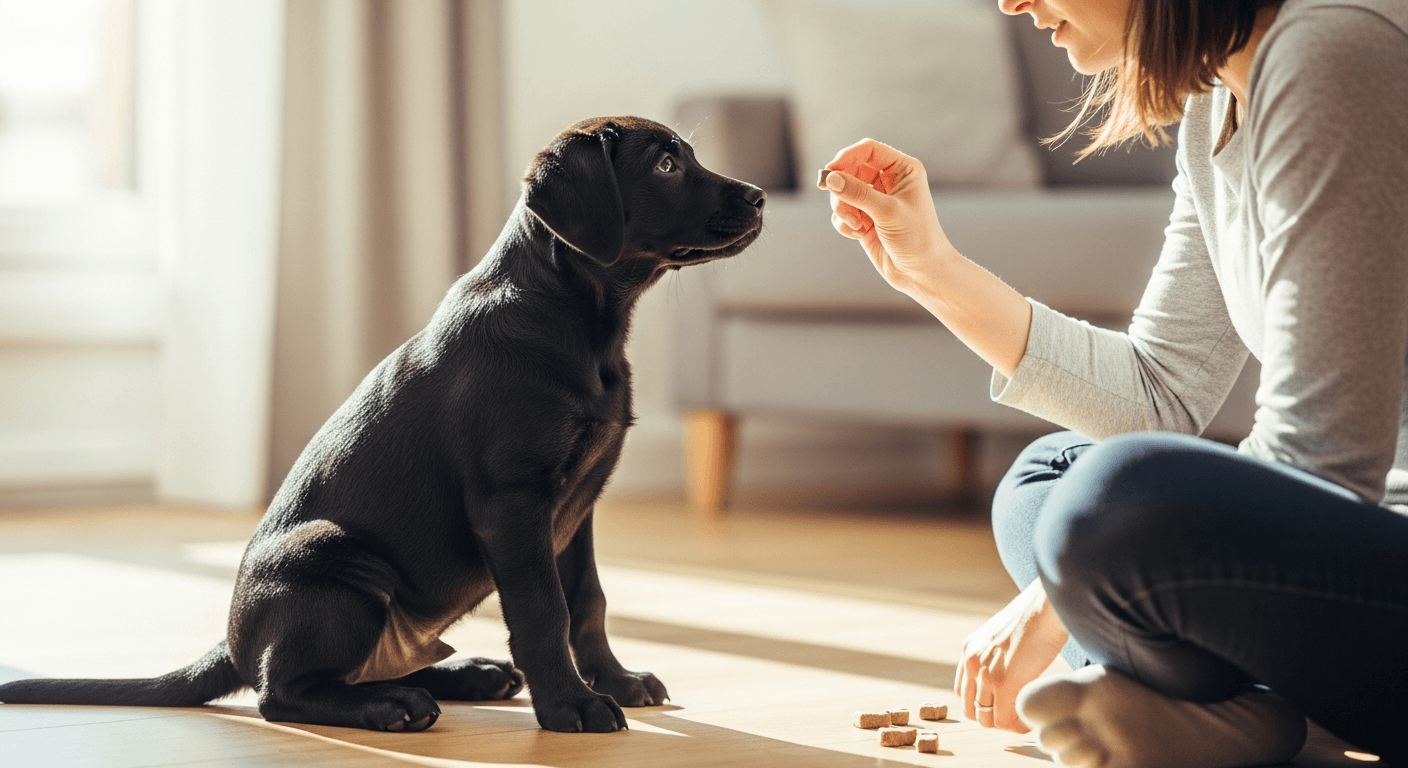
- Name recognition. Say the puppy’s name, then reward with a small treat the instant it looks at you. This is not a command — it is an attention cue.
Once the name reliably produces eye contact, every later command becomes easier to teach.
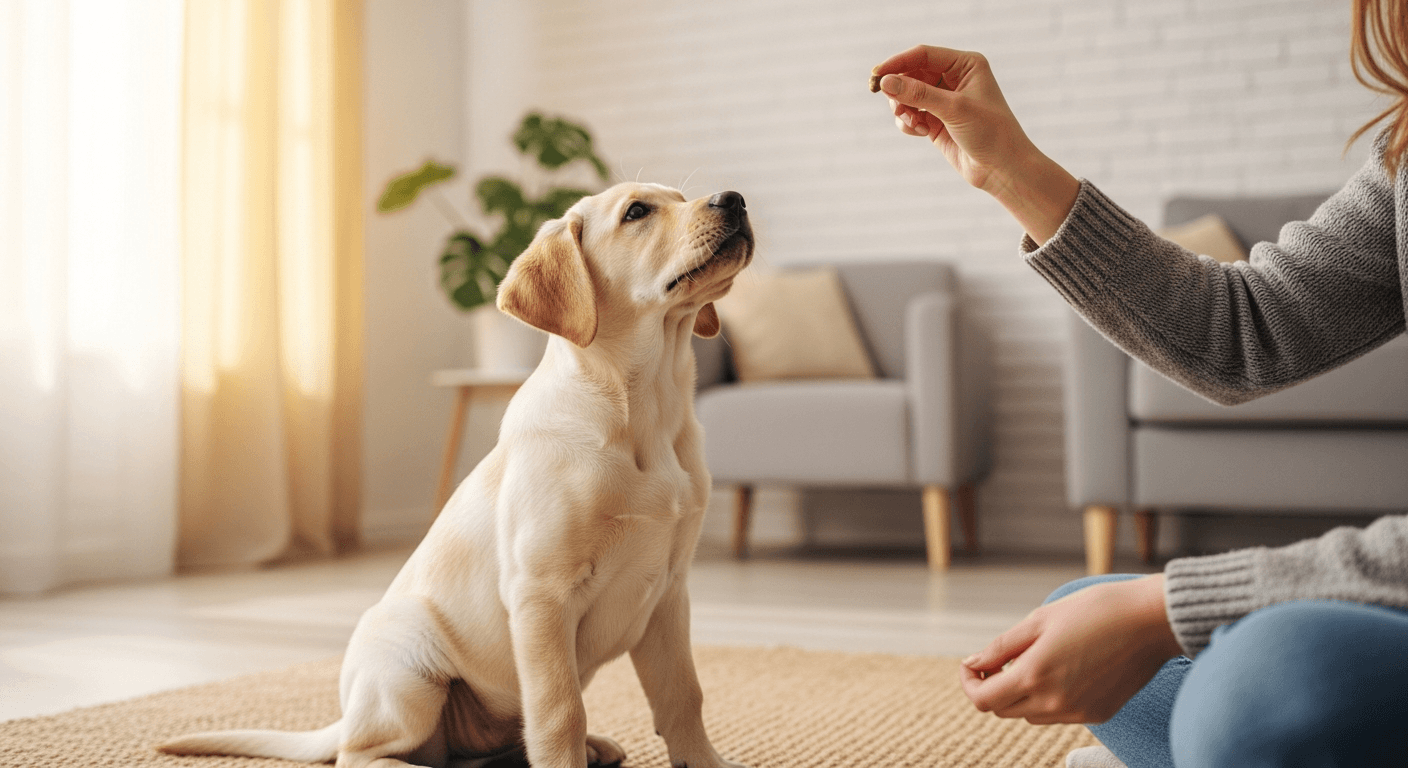
- Sit. The easiest command to teach with a lure. Hold a treat at the puppy’s nose, then move it slowly back toward the tail.
Mark the moment the bottom touches the floor and deliver the treat immediately. Most 8-week Labs learn a reliable sit within two to three sessions.
- Come (recall). Begin in a safe, enclosed space. Crouch down, use an enthusiastic tone, and reward generously when the puppy arrives.
Recall built at 8–12 weeks forms the emotional foundation for a reliable adult recall. A puppy conditioned early is far easier to recall at 6 months than one that skipped this step.
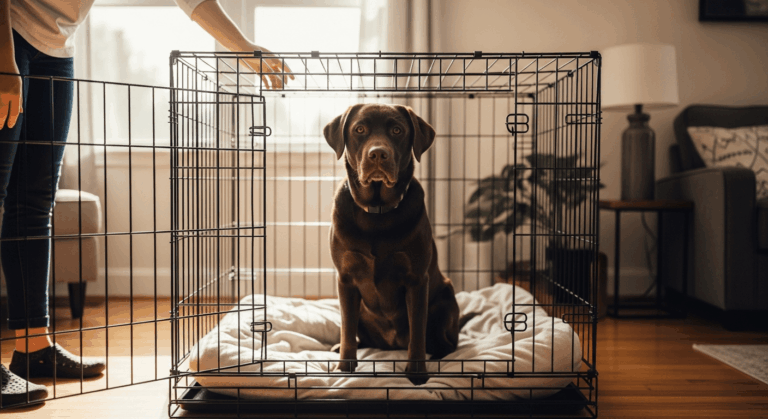
- Crate acceptance. The goal at this age is positive association: the crate produces good things, never punishment or isolation. Labs’ strong food motivation makes treat-based crate conditioning especially fast and reliable for this breed.
Feed meals inside it and drop treats in randomly, building duration gradually. For the full crate training protocol, see Training Your Labrador Puppy.
Skip these for now: stay, which requires impulse control the 8-week brain doesn’t have yet, and leash walking in public before vaccination is complete. Any command that depends on sustained focus can also wait. Keep sessions short, positive, and frequent.
The Socialization Window: 8–16 Weeks
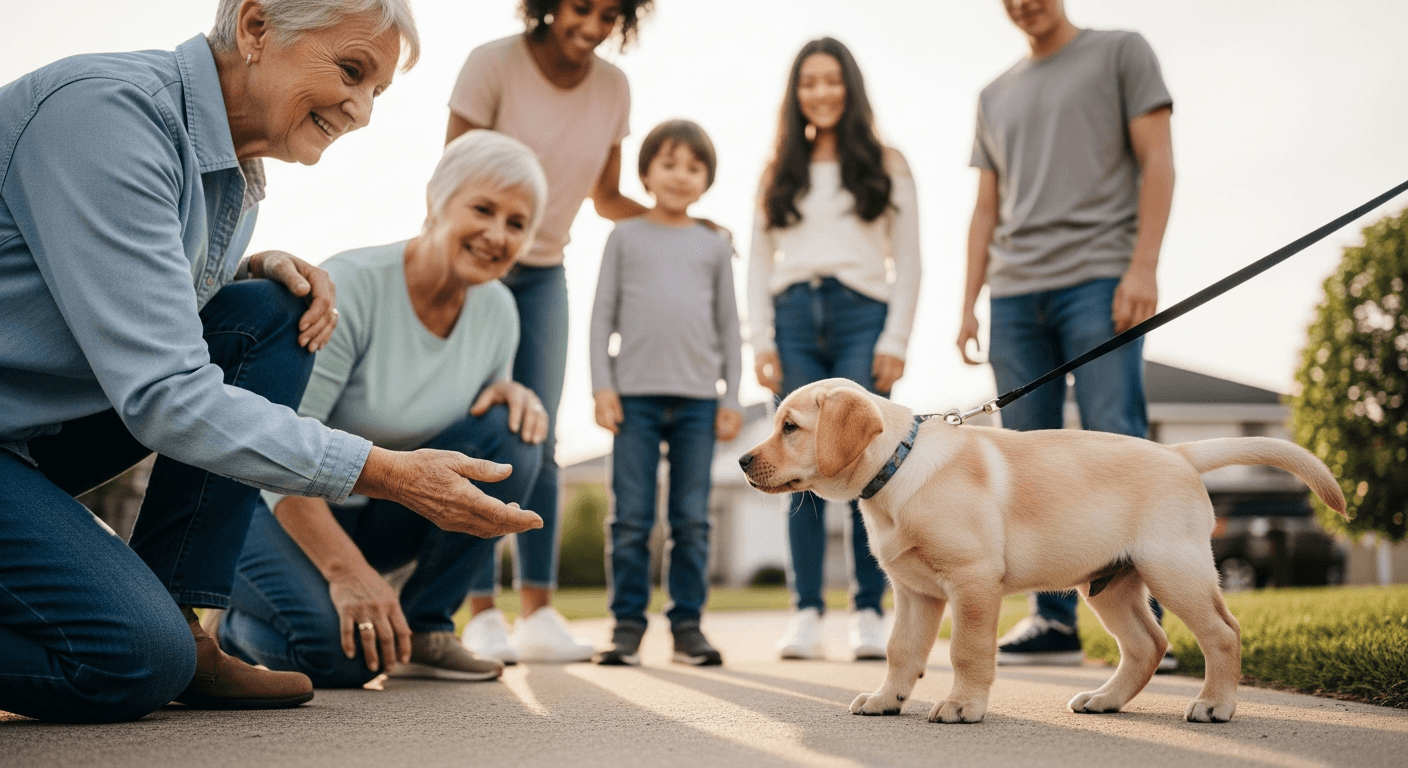
The socialization window is the developmental period when novel experiences are processed as normal rather than threatening. Before 16 weeks, a puppy’s brain accepts new people, animals, surfaces, and sounds as part of everyday life — and Labs’ naturally high sociability makes this window especially productive for building the confident, people-friendly temperament the breed is known for.
After 16 weeks, the window does not close entirely, but new experiences increasingly trigger caution instead of automatic acceptance. Labs socialized thoroughly before 16 weeks are significantly less likely to show fear-based reactivity to strangers or new environments as adults, according to most veterinary behaviorists — a gap that can persist for the dog’s whole life.
Socialization during this window covers four categories:
- People: varied ages, appearances, and clothing — hats, beards, children, uniforms, older adults
- Environments: different surfaces, stairs, vehicles, and unfamiliar sounds — Labs bred for waterfowl retrieval especially benefit from early, positive exposure to water, docks, and boats
- Other animals: vaccinated dogs, cats, and livestock if relevant to the dog’s future
- Handling: ears, paws, and mouth, plus the positions used during a veterinary exam
Three to five positive exposures a day is the target. Quality matters more than quantity — a single frightening experience does less damage than repeated negative ones.
The vaccination paradox deserves a direct answer. Many owners hold back socialization until the vaccination series finishes around 16 weeks, which is exactly when the socialization window is closing.
The AKC and the American Veterinary Medical Association both support carefully managed early socialization before vaccination is complete. In most typical environments, the risk of behavioral problems from under-socialization is higher than the risk of disease.
Puppy classes in clean, well-run settings and visits to vaccinated dogs are appropriate before the full vaccination series is done.
Watch for the first fear period, which often appears around 8–10 weeks. During this window, a single frightening event can leave a lasting impression.
Keep new experiences positive and low-pressure, and don’t force a puppy toward anything it seems uncertain about. We cover the full socialization checklist and exposure plan in our Labrador puppy socialization guide — for now, prioritize variety, positivity, and pace over volume.
Training at 3–5 Months: Building the Command Set
By 3 months, a Lab puppy on schedule should have name recognition, sit, come at short distances, and crate acceptance in place. Those are the foundation — and for everything happening outside training at this age (weight, behavior, sleep), see our 3-month-old Labrador guide. The 3–5 month phase of the training schedule builds on top of them with commands that need more impulse control and focus.
New skills to introduce from 3–4 months:
Down. The most useful impulse control command in the whole progression. A dog in a down position is calm, stationary, and easy to manage almost anywhere.
Lure from a sit, bringing the treat toward the floor between the front paws. Session length at this age can stretch to five to eight minutes, matching the puppy’s longer attention span.
Stay. Start with a one- to two-second duration only. Ask for a sit, say “stay,” pause for one second, then mark and reward before the puppy breaks position.
Build to five seconds before adding any distance. Stay is the command owners rush most often — duration has to be solid before distance gets added.
Leave it. Place a treat on the floor and cover it with your hand when the puppy lunges. Mark and reward the moment the puppy looks away from your hand instead. Leash walks bring leave it into the real world, where it becomes a genuine adult-life safety command.
Bite inhibition work continues through this stage too. Permanent teeth start arriving between 3 and 6 months, and mouthing intensity often increases as a result.
End play immediately if teeth touch skin, and redirect to an appropriate chew toy. For teething management strategies during this phase, see Labrador Teething.
Impulse control habits woven into daily life matter as much as formal commands at this stage. Waiting at the food bowl before eating, waiting for permission at doors, and four paws on the floor before getting attention all count. These aren’t commands on a list, but they build the self-control that every later obedience skill depends on.
Training at 6–12 Months: Adolescence and the Regression Phase
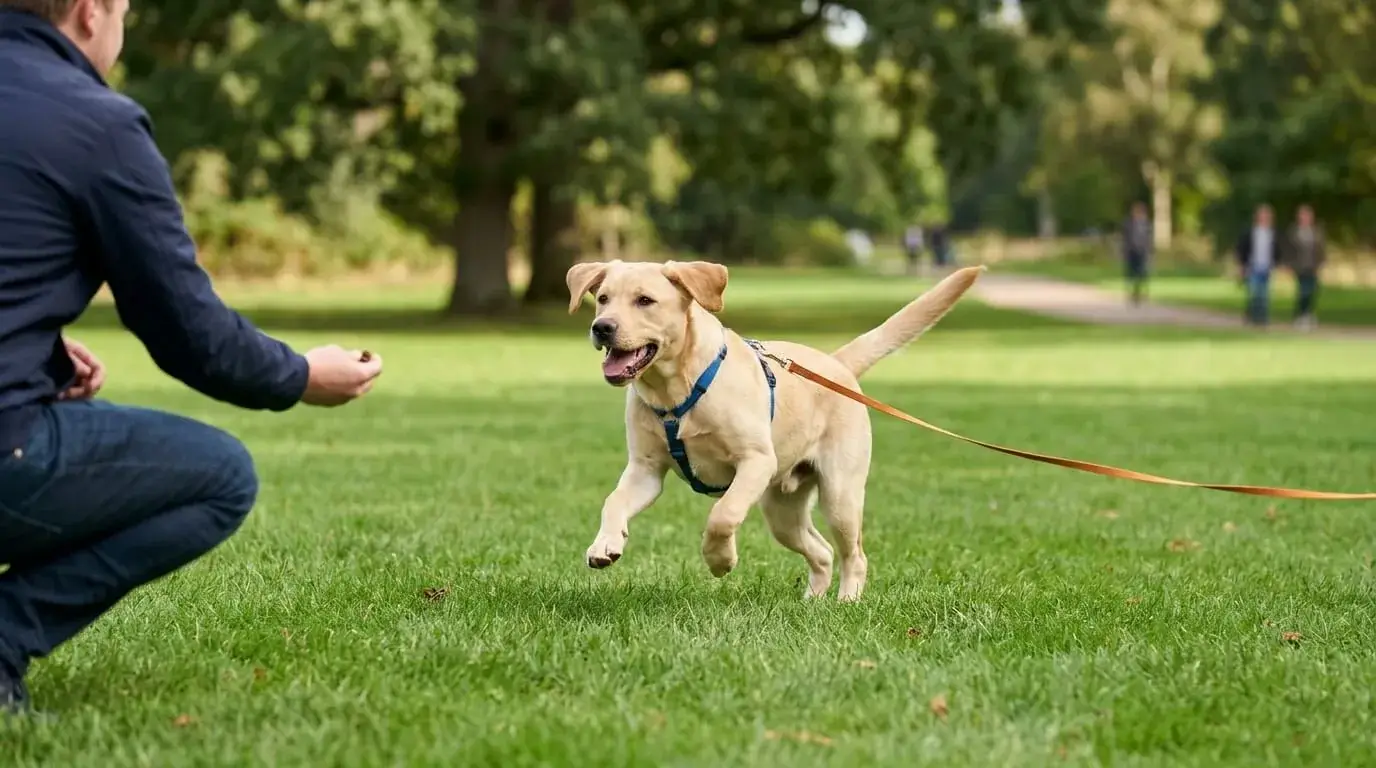
Adolescence begins around 5–7 months in Labs and peaks between 8 and 12 months. Hormonal changes, brain rewiring, and growing independence combine to produce a dog that seems to have forgotten everything it knew.
This is the point in the Labrador puppy training schedule where most owners lose confidence. Pulling back on training here is exactly the wrong response.
The regression is real, but it isn’t permanent. Commands learned before adolescence aren’t erased; they’re temporarily de-prioritized while the brain goes through major structural change.
According to most veterinary behaviorists, adolescence produces a measurable, temporary drop in recall reliability. This dip is most noticeable around 8–9 months, even in dogs that were well trained as young puppies.
The puppy that reliably sat on the first cue at 12 weeks now sometimes looks at you and looks away instead. The recall that worked in the yard fails in the park with squirrels in view. This is normal, not a sign that training failed.
The right response is more consistency, not more pressure. Reduce distraction levels temporarily and ask for known commands in places where the puppy can still succeed.
Raise the value of the reward when the environment is competing hard for attention. Keep sessions frequent and short rather than long and demanding.
This is the moment to bank easy wins, not to punish a dog whose brain is mid-renovation. For behavior problems that commonly surface during this stage, see Labrador Behavior Problems.
New skills worth adding from 6 months onward include extended stays with more duration and distance, plus heel work for genuinely loose-leash walking. Recall practiced under real distraction matters too. So does impulse control in everyday situations — at the front door, near food left on the counter, when another dog approaches on leash.
Neutering timing matters here too. Neutering before full physical maturity, typically 12–18 months in Labs, can extend the adolescent phase in some individuals. Talk timing through with a vet before deciding, especially for a male Lab showing significant behavioral turbulence during this stretch.
What Good Training Looks Like at 12 Months
By this point in the training schedule, a well-trained Lab should reliably show these behaviors:
- Sits on the first cue in low-distraction environments
- Downs on cue
- Comes when called in the yard or other low-distraction areas
- Walks on a loose leash most of the time
- Waits at the door for permission to exit
- Leaves food dropped on the floor when cued
- Crates calmly without protest
- Greets people without jumping
These are practical family-dog benchmarks, not performance-dog standards. A Lab meeting this list at 12 months is manageable and safe in most everyday situations.
What’s not expected yet at 12 months: perfect recall under high distraction, complex off-leash control in open spaces, or long, layered command sequences. Full recall reliability typically develops closer to 18–24 months.
Many Labs hit their best trainability between 18 months and 3 years, once adolescence has passed. For the full command progression beyond these basics, see Labrador Obedience Commands.
Frequently Asked Questions: Labrador Puppy Training
When should I start training my Labrador puppy?
The day it comes home, typically around 8 weeks old. Labs can learn basic commands at 8 weeks, and the socialization window (8–16 weeks) is the most developmentally important period of a puppy’s life. Training started at 8 weeks carries more lasting impact than training started at 12 or 16 weeks.
How long should training sessions be for a puppy?
Three to five minutes per session at 8–12 weeks. By 3–4 months, five- to eight-minute sessions are appropriate. Three to four short sessions spread through the day beats one long one. End every session on a success — a command the puppy already does reliably.
Why has my Lab puppy stopped listening at 6 months?
Adolescence. The 5–12 month stretch involves significant neurological rewiring. Commands learned earlier aren’t forgotten — they’re temporarily deprioritized. Recall reliability in particular tends to dip around 8–9 months. Stay consistent, cut back on distractions, raise reward value, and keep training. The regression passes.
What is the most important thing to teach a Lab puppy first, according to a training schedule?
Name recognition and recall. Name recognition unlocks every command that follows. Recall built at 8–12 weeks forms the emotional foundation for a reliable adult recall — the single skill with the highest safety payoff. Everything else builds on top of these two.
What should a Labrador know by 12 months?
A well-trained 12-month Lab should sit, down, and come on cue in low-distraction settings, walk on a loose leash most of the time, wait at doors, and greet people without jumping. Full recall under distraction typically arrives by 18–24 months. These are family-dog standards, achievable with consistent training from 8 weeks on.
Training a Lab puppy is a year-long project with a clear developmental map, not a single milestone to hit. Our Labrador puppy behavior guide covers what’s normal at each of those stages. The socialization window is the most time-sensitive stretch — everything else builds on what you establish in those first 16 weeks. Follow this training schedule consistently and you’ll have a dog that’s genuinely easy to live with by 18 months.