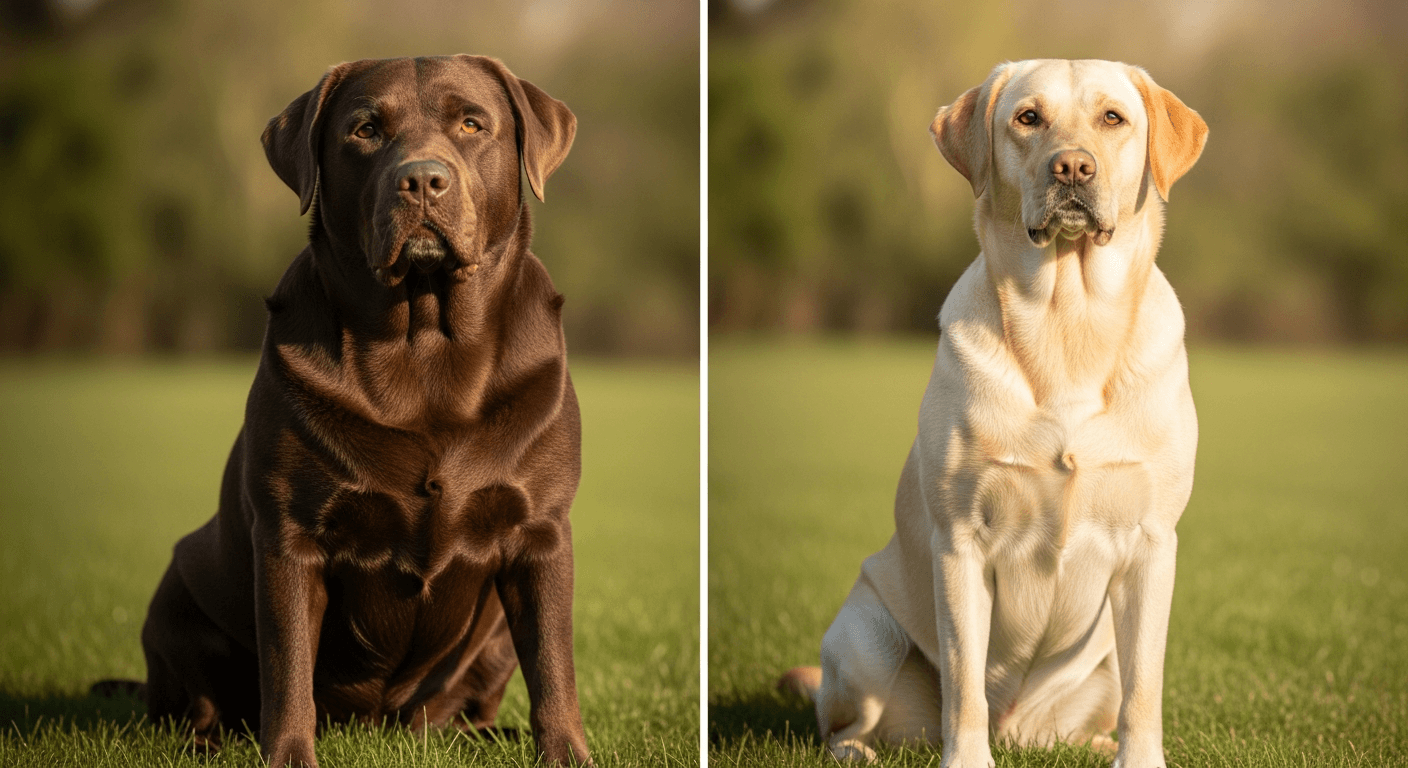
The English vs American Labrador question confuses many first-time buyers, because the AKC recognizes only one Labrador Retriever. Yet spend five minutes in any breeder community and you will hear about English Labs and American Labs as if they were separate dogs. The truth sits between those extremes — the differences in build, energy, and temperament are real, and they matter enormously when you choose a puppy. Here is what actually separates the two.
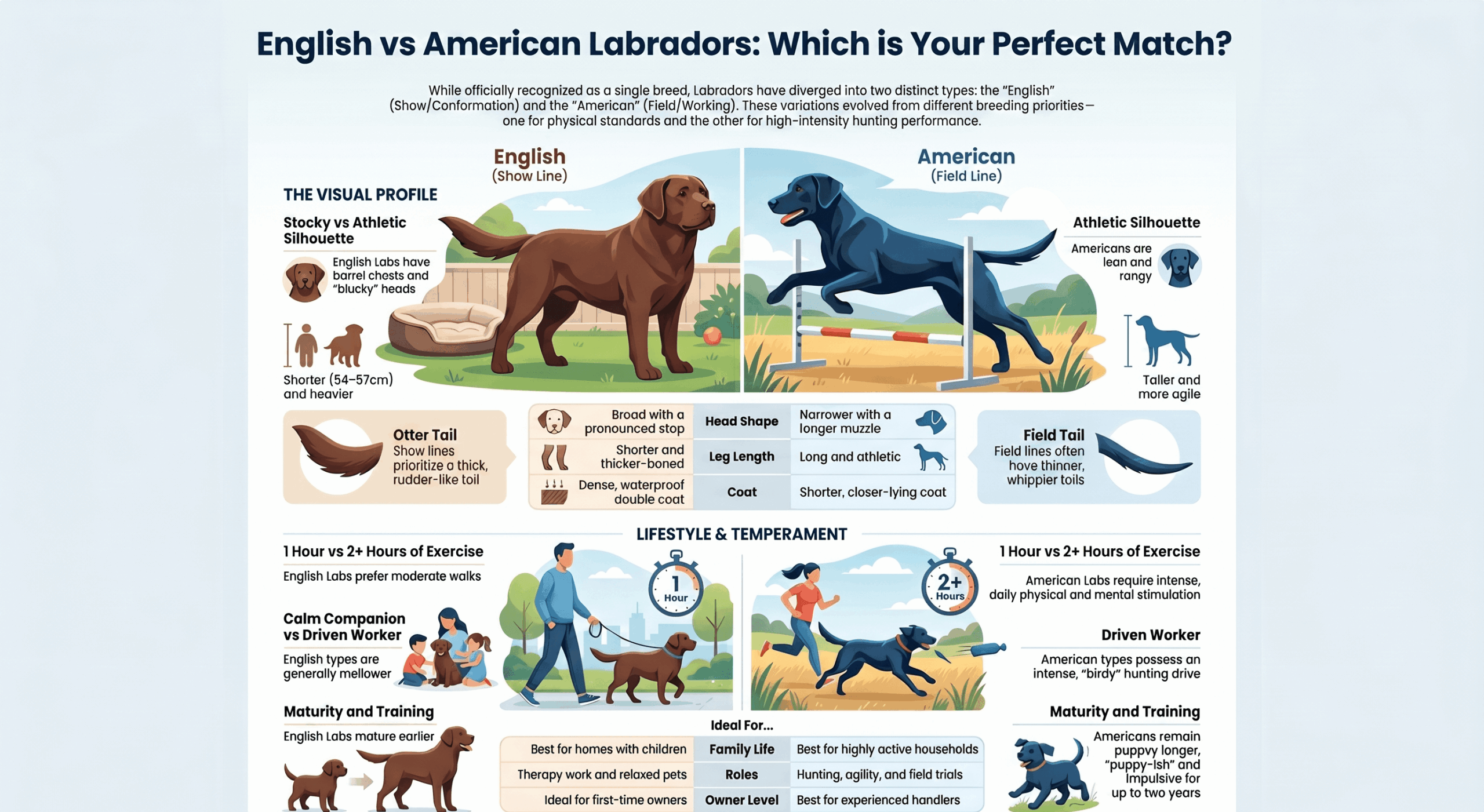
English Labradors (show lines) are stockier, calmer, and bred for conformation. American Labradors (field lines) are leaner, more athletic, and bred for working drive. The AKC recognizes only one Labrador Retriever breed — “English” and “American” are informal terms for two distinct breeding lines, not separate breeds. A stocky show Lab is not a miniature Labrador.
Physical Differences: What English and American Labs Actually Look Like
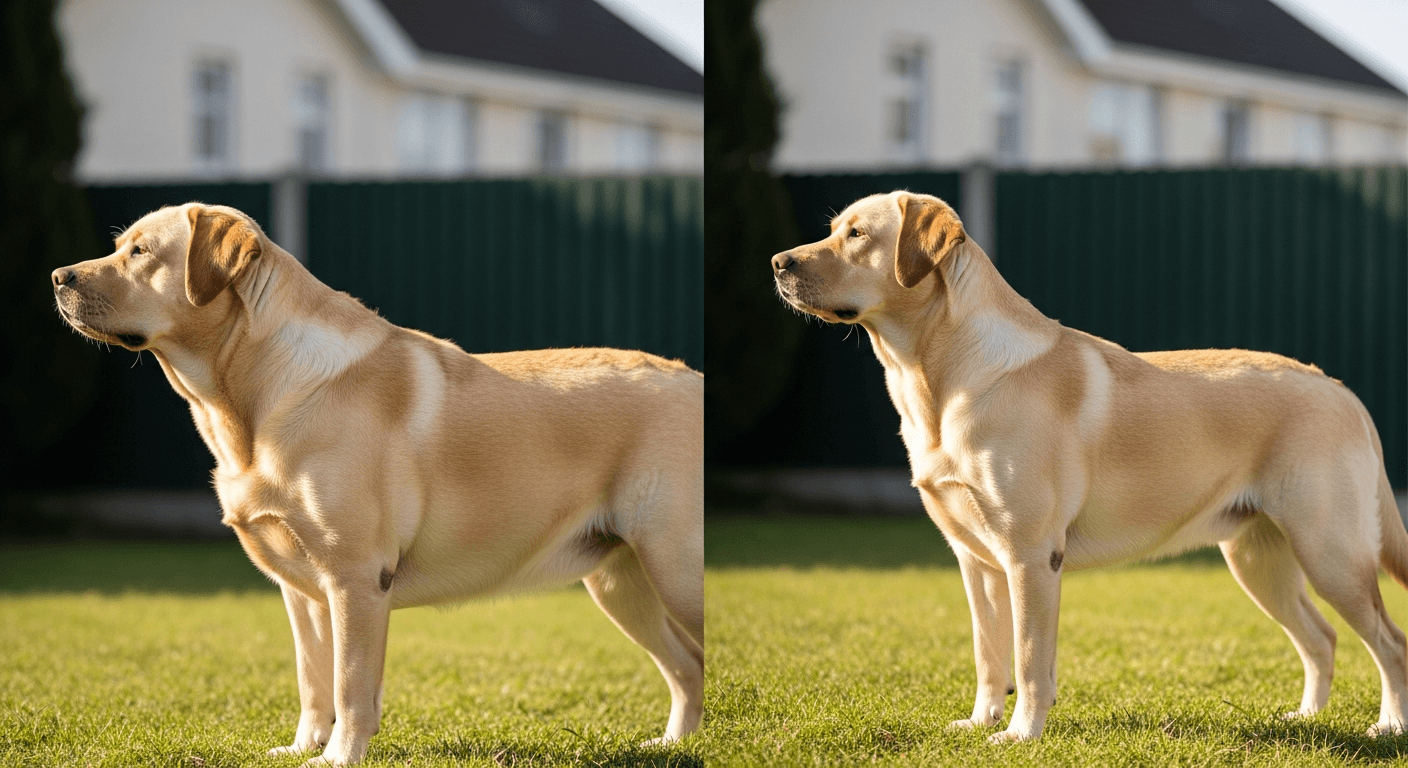
The difference between the two types is visible at a glance once you know what to look for. The English Lab’s silhouette is often called “otter-shaped” — a broad, blocky head with a short, wide muzzle, a deep chest, a thick neck, and a stocky body set lower to the ground. The tail is thick and otter-like at the base. The coat is dense and heavy, sometimes slightly wavy over the neck and back.
The American Lab is a different profile entirely. The head is narrower with a longer, leaner muzzle. The body is higher on the leg, more athletic in outline, and leaner overall. The coat is typically flatter and shorter, with a noticeably thinner tail. The overall impression is a sporting dog rather than a show dog — exactly what field-line breeding set out to produce.
| Feature | English Lab (Show Lines) | American Lab (Field Lines) |
|---|---|---|
| Head shape | Broad, blocky, wide muzzle | Narrower, longer muzzle |
| Body build | Stocky, deep-chested, lower-slung | Lean, athletic, longer legs |
| Coat | Thick, dense, sometimes wavy | Flatter, shorter, thinner tail |
| Typical male weight | 65–80 lbs | 60–75 lbs |
| Overall silhouette | “Otter-shaped” | Sporting/athletic |
Both types meet the same AKC breed standard — it is broad enough to accommodate both. The difference reflects what breeders have selected for over generations: the show ring versus the hunting field. Neither type has a separate AKC registration, and many breeders cross the two lines on purpose. The English coat usually sheds more heavily simply because there is more of it. Expect to deshed an English-type Lab two to three times a week, versus about once a week for the flatter American coat, with both blowing coat hard twice a year.
Temperament: Which Type Has the Calmer Personality?

This is the question most prospective owners are really asking, and the direct answer is that English Labs are generally calmer. The difference is real, consistent, and worth understanding before you pick a breeder.
English show-line Labs were bred for the show ring, where composure and biddability are rewarded. Generations of that selection produced dogs that settle more easily indoors, react less to everyday commotion, and tolerate the chaos of family life well. They also mature sooner — most English-type Labs behave like adults by 2 to 3 years. The boisterous adolescent stretch of jumping, mouthing, and selective recall usually peaks between 8 and 18 months.
American field-line Labs were bred to hunt. Drive, stamina, and intense focus were the selection criteria, so the result is a dog with higher energy through the day and a longer adolescent phase that can stretch to 3 or 4 years. Without 90 to 120 minutes of hard daily activity, an American-type Lab turns that retrieving drive inward, counter-surfing, chewing, and pacing — not because it is poorly bred, but because it was built to work and has no work to do.
In practical terms: an English Lab in a suburban home with 60 to 90 minutes of daily exercise is usually calm and settled. An American Lab in that same home will often pace, seek stimulation, and demand more from you. For a household that hunts, runs, or spends weekends near water, that retrieving drive and the breed’s love of swimming are an asset. For a family with young children in a small home, the same Sporting Group energy is a real challenge. Both types are friendly and gentle by nature — the difference is energy and drive, not character. Within-type variation is large, so meeting the parents tells you more than the label alone.
Working Purpose and Heritage: Show Lines vs Field Lines
Every Labrador shares the same origin — working retrievers on the coast of Newfoundland in the 1700s, brought to Britain in the early 1800s and refined into the modern breed through the 1800s. The first Labs were working dogs: compact, hardy, and retrieving waterfowl in icy water for hunters and fishermen.
Labs entered the British show ring in the early 1900s. Show breeders began selecting for conformation — the broad head, deep chest, and dense coat written into the breed standard. Dogs that looked correct in the ring became breeding stock, whether or not they could work a field. Over time, show-line Labs grew more physically distinctive and, through selection for composure, more placid.
Field breeders kept selecting for function: marking ability, swimming stamina, drive under pressure, and the focus to handle long, complex retrieves. These dogs stayed lean, fast, and intense, because a dog without drive does not win field trials.
By the mid-1900s the split was clear enough that buyers began informally separating the lines — “English” for British-influenced show stock, “American” for North American field stock. Neither term is official, and both types are now bred worldwide. For the full story of the breed, see our Labrador Retriever breed guide.
Health Differences: What Each Type Is More Prone To

Both types share the same genetic health risks as the wider Labrador breed: hip dysplasia, elbow dysplasia, progressive retinal atrophy (PRA), and exercise-induced collapse (EIC). What differs is the pattern of risk, shaped by what each line was bred to do.
English Labs are more prone to obesity. Their calmer nature and lower self-directed activity, combined with the breed’s strong food drive, make weight gain a constant management task. Excess weight compounds joint disease — an overweight English Lab faces a higher risk of clinical hip and elbow dysplasia than the same dog kept lean. For the full picture on that condition, see our guide to Labrador hip dysplasia.
American Labs are generally leaner and hold a healthy weight more easily, but their drive can mask early joint pain — a field-line dog often pushes through discomfort that would slow another dog down. Some field lines have also been linked to higher rates of anxiety and noise sensitivity, a byproduct of breeding for high-stimulus work.
One risk crosses both lines but tracks color, not type: chocolate Labs of any line have shorter average lifespans and higher rates of skin and ear problems. A large 2018 UK study of more than 33,000 Labradors found chocolate Labs lived a median of 10.7 years versus 12.1 years for black and yellow Labs — see our chocolate Labrador guide for the detail. For any Lab, the strongest predictor of health is the parents’ screening — OFA or PennHIP hips, OFA elbows, CAER eyes, and an EIC DNA test — not the type label.
Which Type Is Right for You? English Lab or American Lab
The English vs American Labrador choice comes down to lifestyle, not which dog is better. This is the decision the comparison builds toward, and the honest answer is not “it depends on the dog.” The two types reliably suit different lives.
Choose an English (show-line) Lab if:
– You want a family companion that settles indoors
– You have young children or a quieter household
– You live in a suburban or urban setting with standard exercise opportunities
– You prefer a dog that matures temperamentally by 2 to 3 years
– Your daily exercise budget is 60 to 90 minutes
Choose an American (field-line) Lab if:
– You lead an active outdoor life — hiking, running, hunting, or field sports
– You can commit 2 or more hours of structured exercise daily
– You want a dog for sport, field work, or scent work
– You enjoy training a high-drive dog and can channel that drive
Neither type is superior. A high-energy American Lab with a sedentary owner in a small flat is a welfare problem; an English Lab paired with a hunter who needs a working partner is a mismatch the other way. The question is which life you actually have, not the one you hope to have. If you are also weighing the breed against another popular family dog, our Labrador vs Golden Retriever comparison covers that choice in the same honest detail.
A practical tip within your chosen type: meet the dam. Her temperament is the single strongest predictor of how the puppies turn out. Many breeders also cross show and field lines deliberately to land a dog with working intelligence and a manageable energy level — ask them directly about the lines behind both parents.
Frequently Asked Questions: English vs American Labrador
What is the difference between an English and American Labrador?
English Labs (show lines) are stockier, calmer, and bred for conformation — a broader head, thicker coat, and a more settled temperament. American Labs (field lines) are leaner, more athletic, and bred for working drive. The AKC recognizes one breed; “English” and “American” are informal labels for two breeding lines that have diverged over the past century.
Are English Labs calmer than American Labs?
Yes, as a general rule. English show-line Labs were selected for composure in the show ring, which produced a dog that settles more easily indoors. American field-line Labs were bred for drive and stamina, which produces a higher-energy dog with a longer adolescent phase that needs more daily exercise and stimulation to stay settled.
Which type of Labrador is better for families with children?
English Labs are usually easier in a home with young children — they settle sooner, mature faster, and are less persistently boisterous. An American Lab in that home is manageable but demands far more exercise and active training. Both types are non-aggressive and child-tolerant by nature; supervision applies to any large dog around small children.
Is a British Lab the same as an English Lab?
Yes. “British Lab,” “English Lab,” and “show-line Lab” all describe the same breeding type — Labradors from British show lines selected for conformation to the breed standard rather than working performance. Breeders and owners use the terms interchangeably, though no kennel club officially recognizes any of them.
Are English Labs less healthy than American Labs?
Neither is definitively healthier — they carry different risk patterns. English Labs are more prone to obesity, which worsens joint disease. American Labs stay leaner but can mask joint pain through drive. Both share the same genetic risks, so health testing of both parents matters far more than the type when you assess a puppy.
Whichever side of the English vs American Labrador question fits you, the next step is preparing for the dog itself. Our Labrador puppy first-year guide walks through what to expect from day one, so you bring home the right Lab and start it well. And if you have not found the dog yet, our getting a Labrador puppy guide covers vetting breeders for either line.