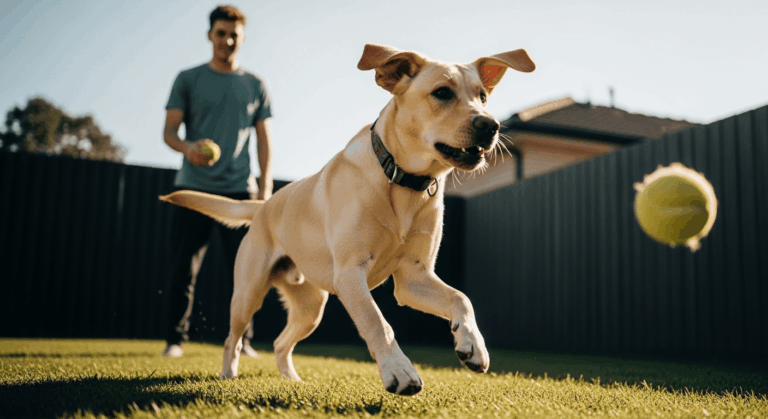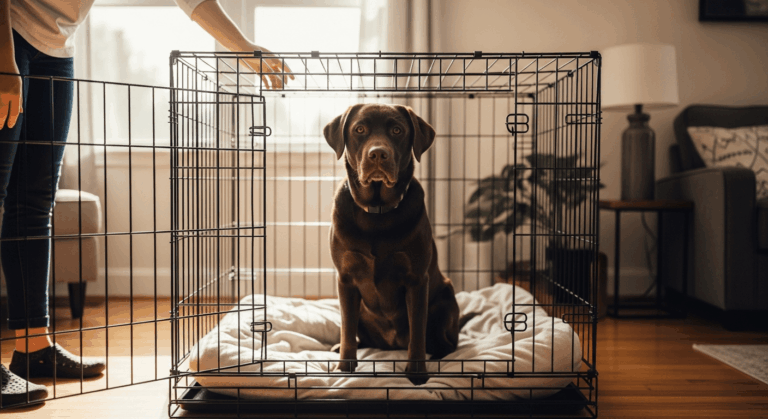
A 4 month old Labrador has just crossed a developmental line: the socialization window closed at 16 weeks, and the teething peak plus the first edges of adolescence are moving in. This is the month puppy ownership stops getting easier on its own — and the month the foundation you built earlier starts paying off. Here are the normal size ranges, the behavior shifts to expect, and the one skill to prioritize this month: recall. The full roadmap lives in our Labrador puppy first-year guide.
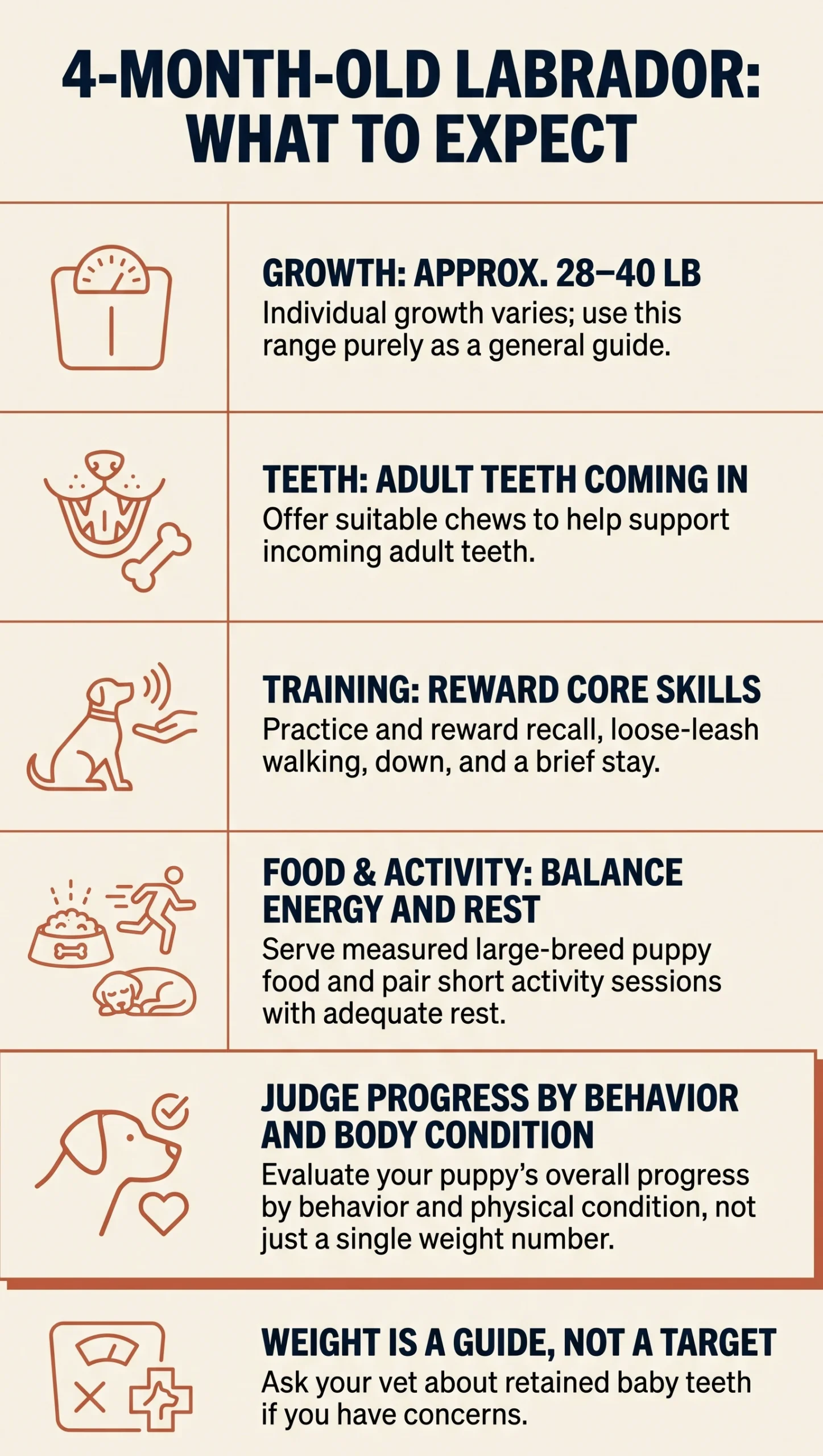
At 4 months (16 weeks), a Labrador puppy typically weighs 28 to 40 lbs. Males usually land at 33 to 40 lbs and females at 28 to 35 lbs, with weekly gains of about 1.5 to 2 lbs still normal. Steady weekly gain and good body condition mean more than any single number.
4-Month-Old Labrador Size & Weight: The Normal Range
Your puppy’s weight has roughly doubled since 8 weeks — this is the fastest growth stretch a Lab goes through. At 16 weeks, most sit between 28 and 40 lbs and are approaching half of their adult weight, tracking the curve in the AKC’s puppy growth chart. Height is even further ahead: most 4-month-olds already stand around 15 to 18 inches at the shoulder, on the way to roughly 70% of adult height by 6 months — which is why a 4-month-old looks like it’s all legs.
Those long legs and shallow chest are normal. The proportions balance out as the chest deepens between 12 and 18 months.
One warning specific to this breed: do not judge portions by appetite. Most Labs carry the POMC gene variant that blunts the feeling of fullness, so a 4-month-old Lab acts starving no matter how much it just ate. Owners who read that as underfeeding create an overweight puppy by 6 months. Judge by body condition instead — ribs easy to feel without pressing, a visible waist from above — and calibrate portions with our guide to how much to feed a Labrador.
Call the vet if the trend breaks: weight loss, less than 1 lb gained across two weeks of normal eating, or a plateau paired with low energy.
4-Month-Old Lab Behavior: What’s Normal (and What Isn’t)
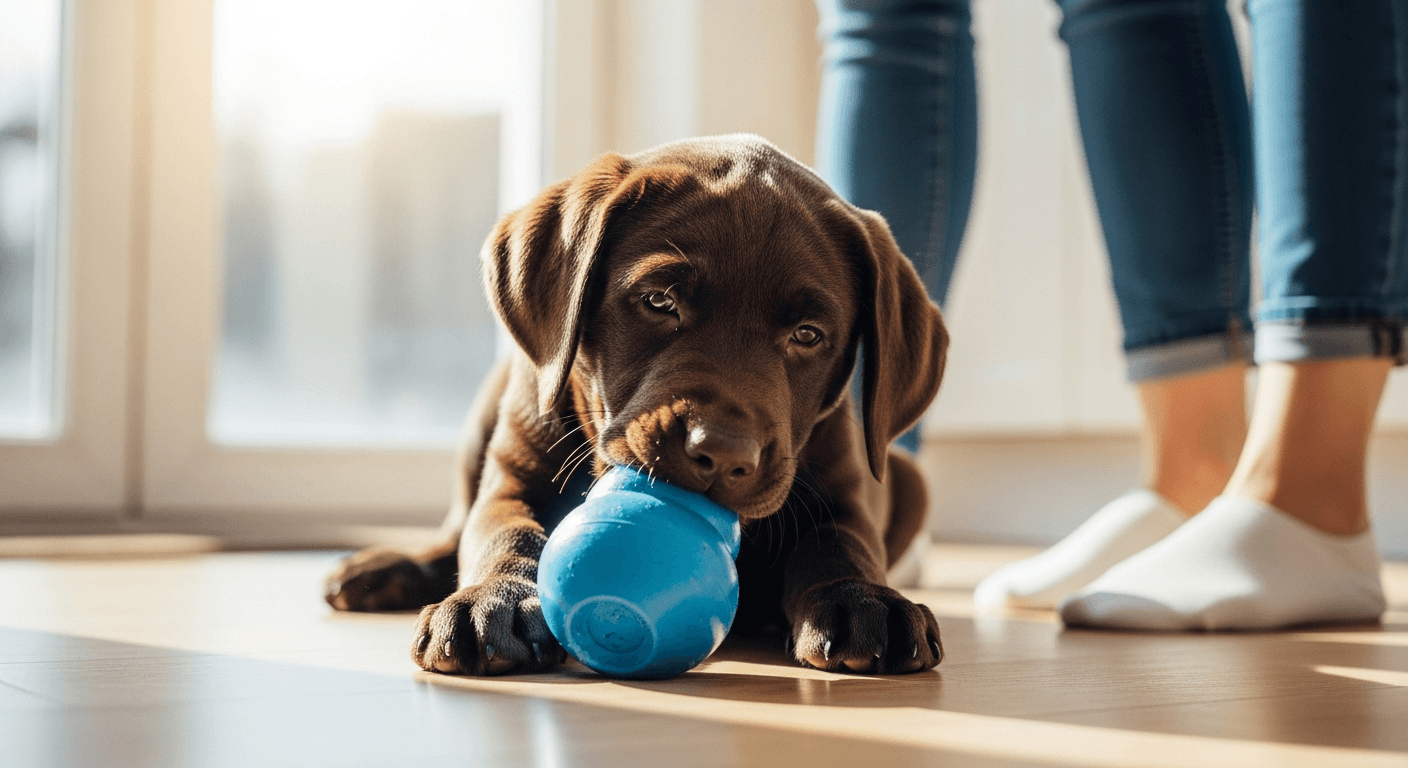
The biting got worse, didn’t it? That is the single most common 4-month complaint, and it is not a training failure. Teething intensifies between 3.5 and 5 months as 42 adult teeth push out 28 baby ones, and real gum pain drives the chewing. Frozen rubber chews — a frozen Kong Puppy is the classic — give the pain somewhere to go. The full timeline is in our Labrador teething guide; the short version is that this peak passes.
The socialization window is now closed, but the work isn’t over. New experiences still shape your puppy — they just take longer to accept and cost more repetition. If there are gaps in the exposure list (children, traffic, other dogs, handling), fill them now with calm, treat-paired sessions rather than waiting. Food-driven Labs make this easier than most breeds — few dogs counter-condition faster when the treats are good.
You may also notice the first adolescent static: the recall that looked solid at 12 weeks suddenly seems broken at 17. It isn’t. Your puppy is becoming more aware of the environment, and for a scent-driven retriever the outdoors is one big auction — squirrels and smells have started outbidding you. That’s the cue to raise your rewards, not your voice.
More independence rounds out the picture — wandering farther in open spaces, more sniffing, less shadowing you from room to room. All of it is normal development, not a fading bond. One Lab-specific tell: the wandering often comes back carrying something — a stick, a shoe, a lost glove — because the retrieving instinct matures right alongside the independence.
Training a 4-Month-Old Lab: Recall Comes First
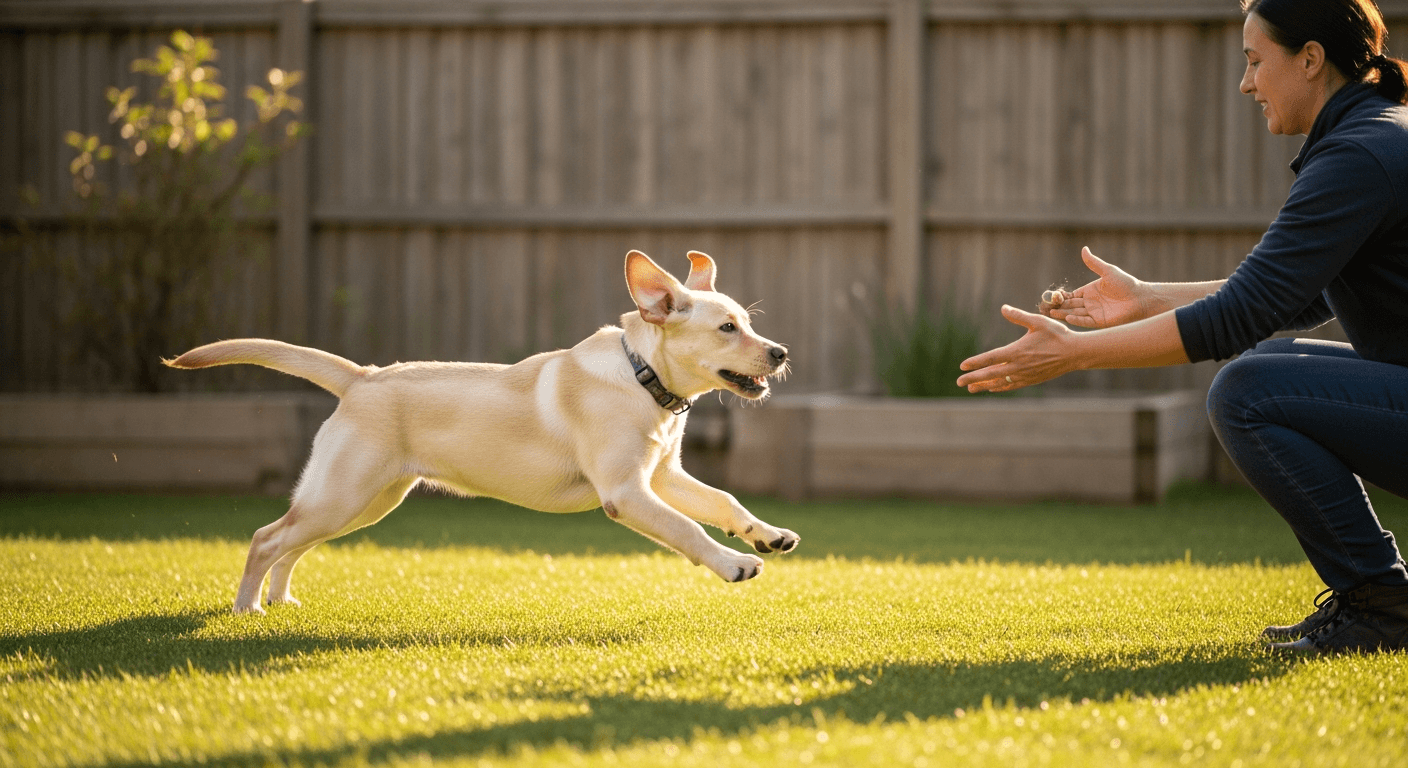
Take stock first. By 16 weeks a Lab puppy should have sit, name response, crate comfort, and basic leash awareness. If any of those are shaky, consolidate them before adding anything new.
If the foundation is solid, this month has one standout priority: recall. Adolescence arrives at 6 to 8 months and will stress-test recall harder than anything else. A recall built now — 10 to 15 short repetitions a day, rotated across at least 3 different locations each week, every one paid with high-value rewards — survives adolescence. One built during adolescence fights an uphill battle. Pay every single return with something worth running for; pea-sized, smelly training treats outperform kibble by a wide margin.
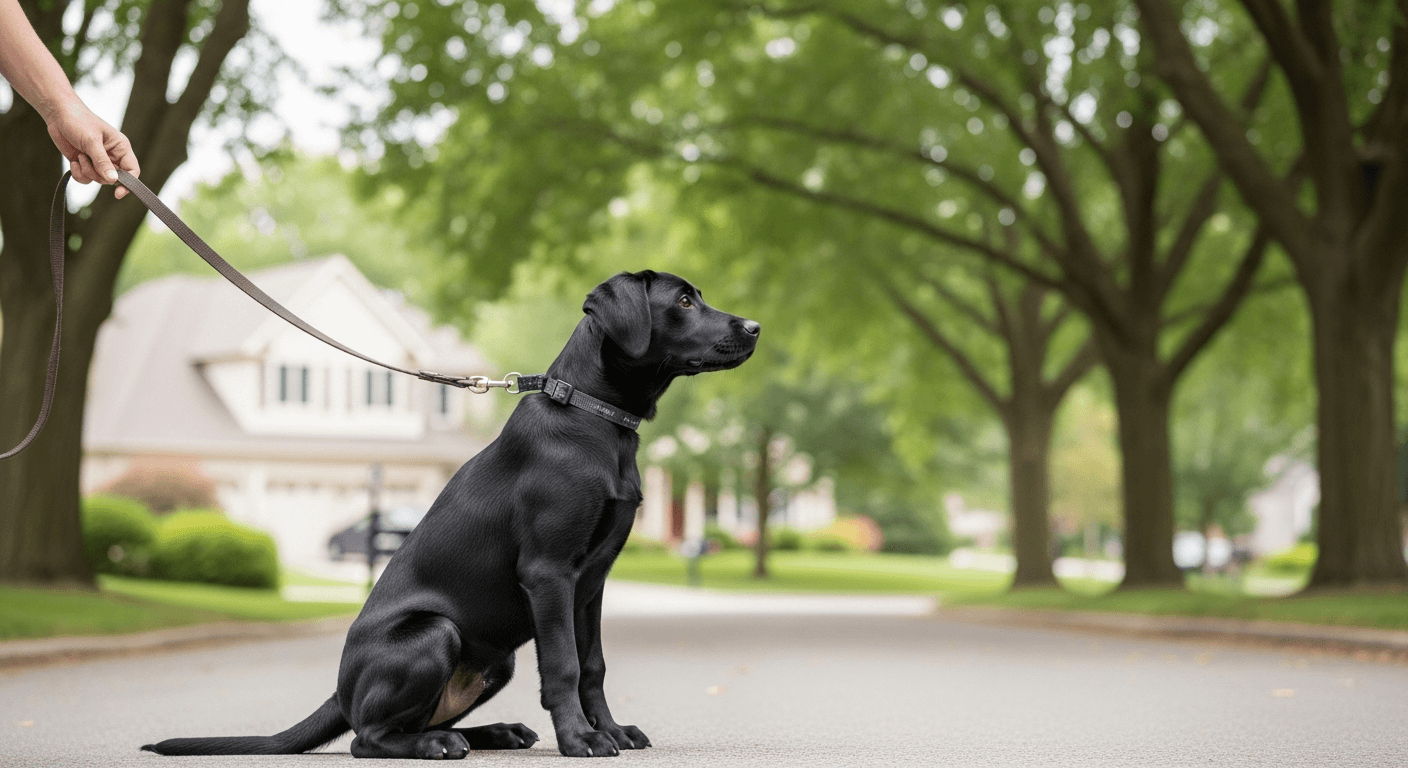
New skills worth adding at 16 weeks: “down” taught with a food lure, “stay” starting at 1 to 2 seconds, and loose-leash walking in quiet places. Keep sessions at 3 to 5 minutes, several times a day, and end while the puppy still wants more.
Keep the socialization habit running alongside — one new environment or sound each week prevents the fears that surface in under-socialized adolescent Labs. Full command protocols live in our complete Labrador training guide, and the month-by-month plan is in the Labrador puppy training schedule.
Feeding & Exercise for a 4-Month-Old Labrador
Keep the large-breed puppy formula and the 3-meal schedule. Most 4-month-old Labs eat about 2 to 2.5 cups of dry food per day split across those meals, though the right number varies by brand calorie density and your puppy’s build. The bag chart is the starting point; the rib check is the referee.
Exercise still runs on the 5-minutes-per-month-of-age rule: at 4 months, structured leash walks cap at 20 minutes per session, up to twice daily. Free play at the puppy’s own pace remains unlimited. What to avoid is repetitive impact — fetch marathons on pavement, jumping on and off furniture, and multiple stair runs a day — because growth plates are still open and a 4 month old Labrador’s joints are under construction.
Mental work fills the energy gap that physical limits leave. A puzzle feeder or snuffle mat turns one meal a day into 15 minutes of focused effort, and a “sniff walk” where the puppy’s nose sets the route tires a Lab about as much as a structured walk twice as long.
Frequently Asked Questions
Why is my 4-month-old Labrador biting more than before?
Teething. Adult teeth erupt hardest between 3.5 and 5 months, and gum pain drives a real spike in chewing and mouthing. It reads like a training regression but is physiological. Keep redirecting to frozen chews and ending play when teeth hit skin — the peak passes as adult teeth settle in.
How much should a 4 month old Labrador weigh?
Between 28 and 40 lbs for most puppies — males typically 33 to 40 lbs, females 28 to 35 lbs. That’s roughly double the 8-week weight and close to half of adult size. Steady gains of 1.5 to 2 lbs per week with an easy-to-feel ribcage beat any single target number.
How far can a 4-month-old Labrador walk?
About 20 minutes of structured leash walking per session, up to twice a day — the 5-minutes-per-month-of-age guideline. Open growth plates are the reason for the cap. Off-leash mooching around the yard at the puppy’s own pace doesn’t count, and sniff-heavy walks buy more fatigue per minute anyway.
How much should a 4-month-old Labrador eat?
Roughly 2 to 2.5 cups of large-breed puppy food daily, split into three meals — adjusted to your bag’s calorie chart and the puppy’s body condition. Ignore the begging: most Labs carry a gene variant that keeps them acting hungry after a full meal, so the rib check outranks the sad eyes.
How much sleep does a 4-month-old Labrador need?
Fifteen to seventeen hours a day, though many puppies fight it hard. Most of that total happens in daytime naps rather than one long night stretch, so build the routine around scheduled quiet time in the crate after meals and play. An overtired four-month-old bites more, settles worse, and learns nothing — if late afternoons turn into a biting frenzy, the fix is usually a nap, not more exercise. By five months the total drops slightly and consolidates overnight.
When do Labradors start adolescence?
The main event runs from about 6 to 18 months, but the first signs — ignoring known commands, wider wandering, sudden selective hearing — often appear at 16 to 20 weeks. It’s environmental awareness rising, not defiance. Heavy recall reinforcement now is the best insurance for the months ahead.
What vaccinations does a 4-month-old Labrador need?
By 16 weeks your puppy should be finishing the core series — the final DHPP booster lands at 16 weeks, and rabies is given at 12 to 16 weeks depending on state law. Monthly heartworm and flea prevention should already be running. The complete first-year schedule is in our Labrador puppy health guide. If your puppy started the series late, your vet will compress the remaining boosters — keep the 16-week visit either way.
Four months is when the early work starts to matter. The teething peaks, then ends. Adolescence builds, then passes. The recall you fund with treats and repetition this month decides whether your 9-month Lab comes back off-leash next spring — so book those 5-minute sessions like appointments. To see what’s coming next, start with the 5-month-old Labrador guide, then read what changes in a 6-month-old Labrador.