

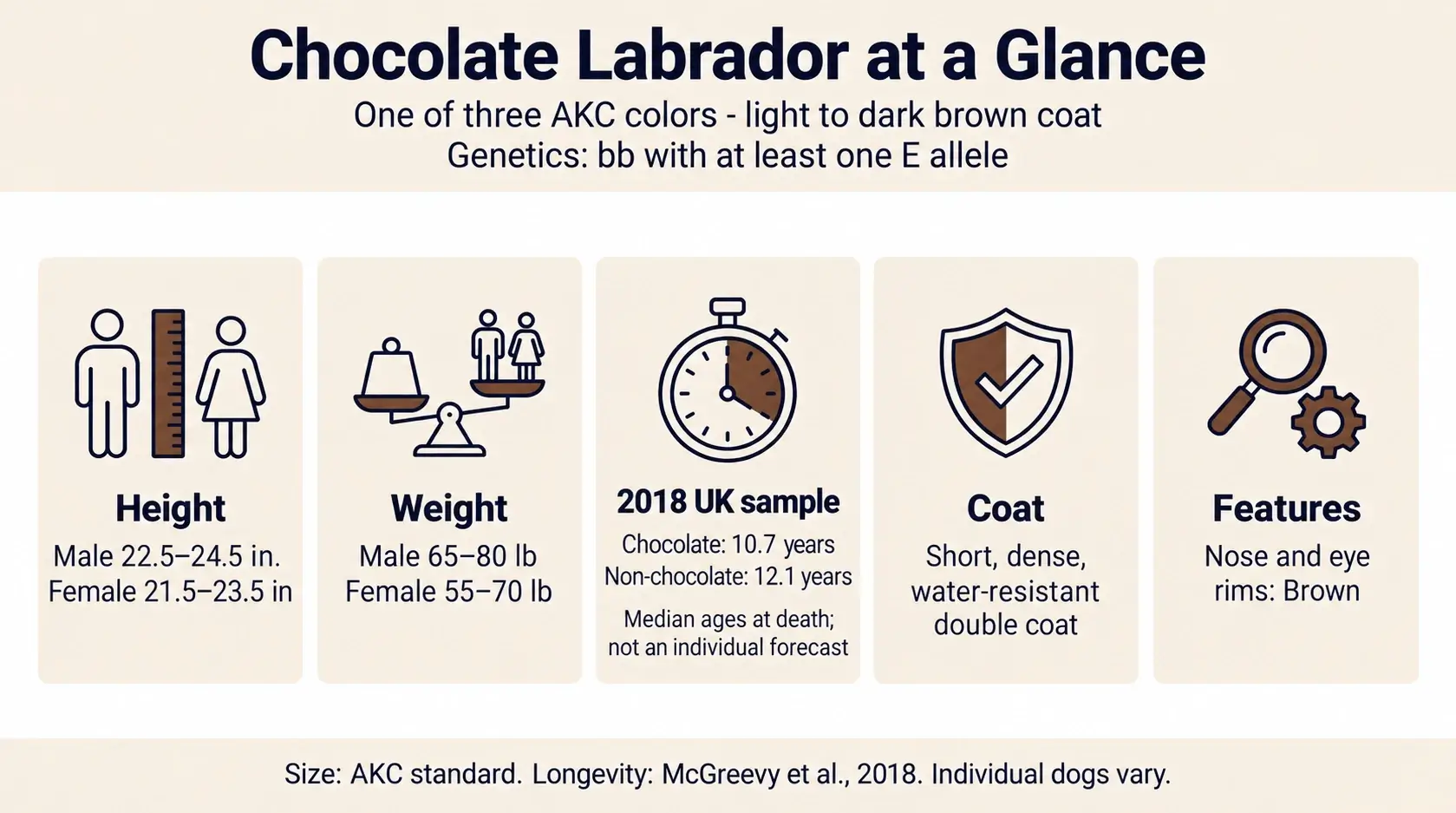
A chocolate Labrador is a brown-coated Labrador Retriever, with the same breed standard as black and yellow Labs. Coat color alone does not tell you how easy a puppy will be to train or how long it will live. This guide explains the genetics, the limits of a much-quoted UK health study, and practical checks before choosing a dog.
The 2018 UK study found shorter median longevity and more recorded ear and certain skin disorders in its chocolate group. That is a population association, not a forecast for every chocolate Lab or proof that brown pigment causes disease. Parent health records, the individual dog, and ongoing care still matter.
What Makes a Chocolate Labrador? Color Genetics Explained

Two interacting gene locations help explain the standard Labrador colors. At the B locus, bb changes black eumelanin to brown. At the E locus, at least one E allele allows that dark pigment in the coat; ee produces a yellow coat instead. A chocolate coat therefore needs bb together with E_. The same bb genotype under a yellow coat can show through as brown nose and pad pigment.
Each parent must pass on a b allele for a chocolate puppy, but neither parent has to be chocolate. Bb × Bb gives a one-in-four probability of bb at the B locus; it does not by itself specify coat color. If both black parents are also Ee, the simple two-locus cross gives 3/16 chocolate, because some bb puppies will be ee and yellow. These are probabilities for each puppy, not a promise about a small litter.
The American Kennel Club recognizes three Labrador chocolate Labrador coat colors: black, yellow, and chocolate. Brown or liver are other names for the chocolate pigment. A standard chocolate coat is distinct from the diluted chocolate appearance discussed in our silver Labrador guide. Color genetics can answer a color question; it does not replace a pedigree check or a breeding health assessment.
Chocolate Lab Personality and Temperament
Choose a chocolate Lab as an individual, rather than assuming that a brown coat means hyperactivity or poor trainability. Breeding purpose, family history, early experiences, health, and daily training can all affect behavior. A color label does not measure those things, and a quiet puppy at one brief visit does not establish its adult temperament.

When you compare litters, ask what the breeder selects for besides color. Ask how the dogs live, how puppies experience ordinary household activity, and whether you can see the parents relaxed as well as excited. Request examples of adult dogs from previous litters. A clear explanation of temperament and management is more useful than a claim that one coat produces a particular personality.
Many Labradors enjoy food rewards, retrieving, and close interaction, but enthusiasm varies. A chocolate Labrador can still need help learning to rest, greet people politely, or ignore distractions. Use small rewards and short sessions, and include training food in the daily ration. Do not assume that every food-motivated dog has the same appetite-related genetic variant or that apparent hunger establishes a need for more calories.
Before paying a deposit, request the registered names of both parents and verify the relevant screening results. Hip, elbow and eye evaluations and appropriate DNA results answer different questions. A completed test is not necessarily a normal result, and a carrier result needs interpretation in the proposed pairing. Ask your veterinarian or the breed club if a report is unclear; paperwork reduces uncertainty without guaranteeing a healthy puppy.
Chocolate Lab vs Black Lab vs Yellow Lab: What Is Actually Different
The three standard colors belong to one breed. Body size, shedding and activity still vary between individual dogs, so comparing color alone is a poor way to choose a pet. The health study below is worth understanding, but it should not be used to assign a fixed lifespan to every dog in a color group.
Meet the dog and discuss the household you can actually provide. If you need a companion comfortable with visitors, children or another pet, ask about observed behavior in those situations. For an adult rescue, foster observations may be more informative than guesses based on its appearance. For a puppy, family information and a sensible early-care plan are useful, while adult behavior remains uncertain.
Chocolate Labs have the same dense double-coat structure as all Labs. Prolonged UV exposure can cause the chocolate coat to fade from rich brown to a lighter, copper-tinted shade — a cosmetic effect called sun bleaching. Some chocolate Labs also develop amber or hazel eyes rather than the darker brown typical of black Labs. Nose and eye rim pigmentation in chocolate Labs is brown (liver-colored), compared to the black pigmentation in black Labs. Yellow Labs can carry either, depending on their B locus genotype.
Chocolate is an accepted standard color. Price, rarity language, show awards and attractive photographs do not establish health or suitability. Compare what a breeder or rescue can document: the dog’s identity, health history, parent records where available, the home assessment and what support is offered if a problem develops. A lower or higher asking price cannot answer those questions by itself.
The UC Davis explanation of brown pigment describes why bb affects black pigment in both the coat and skin. It also explains why a yellow dog can have brown nose pigment without a chocolate coat. Use the E and B results together rather than reading a single color test as the entire answer.
Chocolate Lab Health and Lifespan: What the Data Shows
The McGreevy et al. 2018 study described 33,320 UK Labradors under veterinary care in 2013, with detailed disorder and mortality information extracted from a random sample of 2,074. Among deceased dogs with color information, median longevity was 10.7 years for 34 chocolate dogs and 12.1 for 139 non-chocolate dogs. The comparison was not a separate 12.1-year estimate for each other color.
Chocolate dogs in that clinical sample also had more recorded otitis externa and pyotraumatic dermatitis. The authors discussed selection for a recessive color and a potentially restricted breeding pool as a possible explanation. The study did not establish the mechanism or prove that a particular mating strategy will remove the difference. Association in one population should remain separate from a claim about cause.
For an individual chocolate Labrador, those medians leave considerable uncertainty. They describe ages at death in the study, not a deadline or a guarantee for a puppy bought today. Ask about the family’s health and longevity, maintain an appropriate body condition, and discuss ear or skin changes early. No coat color, test panel or breeder can promise that a dog will avoid every inherited or acquired disease.
The familiar Labrador concerns remain relevant: hip and elbow disease, inherited eye conditions, exercise-induced collapse and excess weight. Ask for the specific results and dates rather than accepting the phrase health tested. An eye examination and a DNA test do not measure the same thing. Current breed recommendations and a veterinarian’s interpretation are more useful than assuming one short checklist covers every family history.
When choosing between a puppy and an adult rescue, consider how much uncertainty you can manage. A puppy offers an opportunity to shape early habits but still needs months of supervision and training. An adult may have an observable size, coat and daily routine; ask what is known about behavior, medical care and time alone. Neither route becomes safer simply because the dog has a particular color.
Caring for a Chocolate Labrador: Grooming and Coat Care
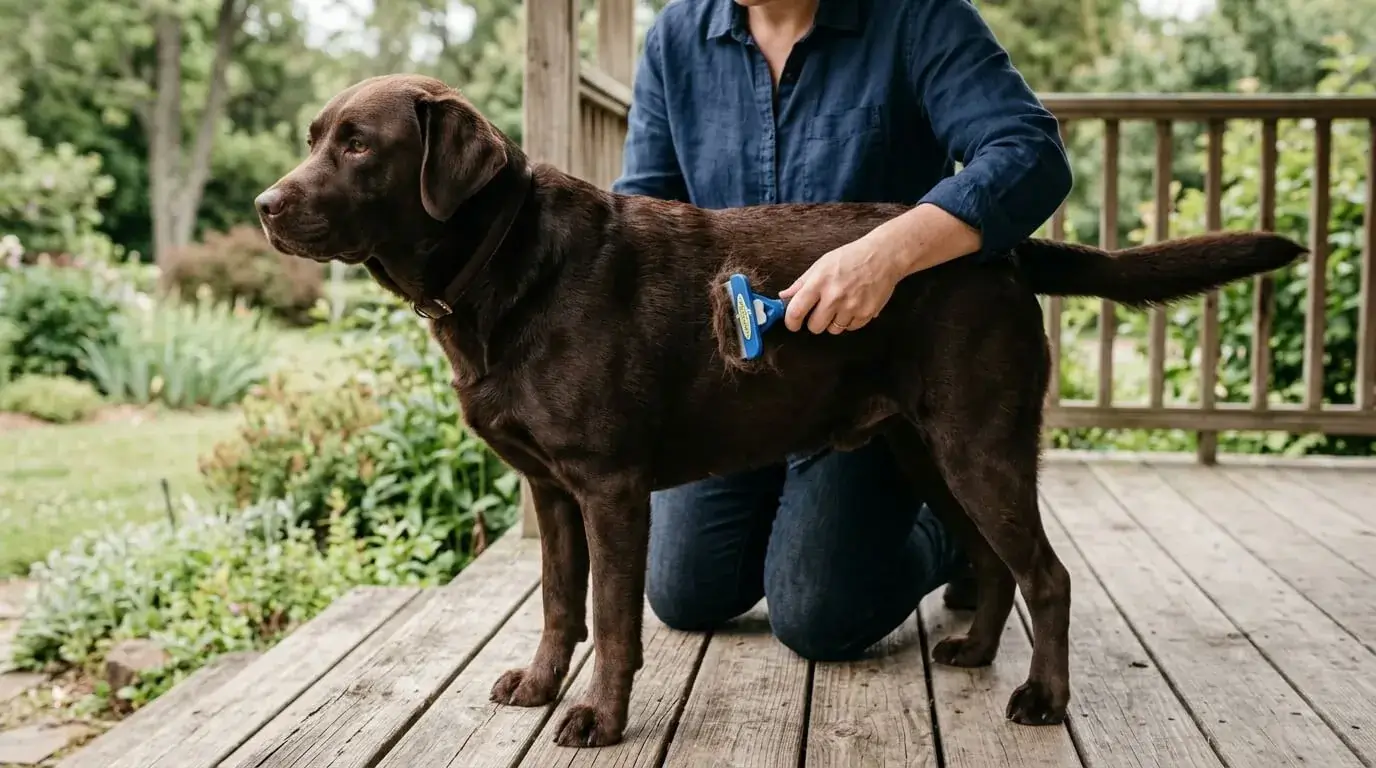
The short double coat sheds, including seasonal increases, but the amount and timing differ between dogs and homes. Brush gently with a suitable tool, checking the skin while you work. Stop if the dog seems uncomfortable or the skin becomes irritated. Do not use the amount of hair from one session to diagnose a problem; thinning patches, sores or unusual itch deserve veterinary advice.
A brown coat can look lighter after sun exposure or as old hair changes, but a photograph is not enough to distinguish ordinary fading from a skin problem. Provide shade and avoid prolonged heat. Do not rely on a color-preserving shampoo as sun protection or a medical treatment. Ask your veterinarian about any persistent coat change, inflamed skin or need for a dog-safe protective product.
Nose color can also change. Seasonal fading may be harmless, but new, patchy or persistent change, soreness, crusting or discharge should be checked rather than automatically called snow nose. Notice whether the change has always been present or is new, and take a clear photograph to help your vet compare it over time. Pigment alone does not establish overall health.
Bathe when the dog is dirty or according to a veterinary skin-care plan, using a suitable dog shampoo and thorough rinsing. Check nails and ears as part of the routine without prescribing the same cleaning frequency to every dog. Our Labrador grooming guide covers the practical steps; the Labrador Retriever breed guide puts daily care in the wider breed context.
Frequently Asked Questions: Chocolate Labrador
Do chocolate Labradors have more health problems than other Labs?
One 2018 UK study found shorter median longevity and more recorded ear and certain skin disorders in its chocolate group. It did not prove that brown pigment causes disease or predict an individual dog’s outcome. Read the sample and comparison details above and discuss your dog’s risks with your veterinarian.
Are chocolate Labs more hyper than black or yellow Labs?
A chocolate coat does not establish how energetic or easy to settle a dog will be. Consider breeding purpose, the parents’ behavior, early experiences and the individual dog. Ask for specific observations rather than choosing by color stereotypes.
How long do chocolate Labs live?
In the deceased chocolate group of the 2018 UK sample, median longevity was 10.7 years. That is a study finding, not a universal lifespan or an individual forecast. Family history, weight, health and care all deserve attention.
Are chocolate Labs harder to train than other colors?
Coat color alone is not a useful training assessment. A chocolate Labrador may enjoy food and play rewards, but learning also depends on the individual, health, experience, environment and the consistency of training.
What is a liver Labrador?
Liver is an alternative name for the chocolate coat color used in some countries and breed standards. A liver Labrador is a chocolate Labrador. The AKC standard uses the term “chocolate.”
Choose the dog and the care plan together: verify records, assess the household fit, and budget time for training and veterinary care. The chocolate coat is part of the dog’s appearance; it does not settle the questions that matter most for a long-term companion.


