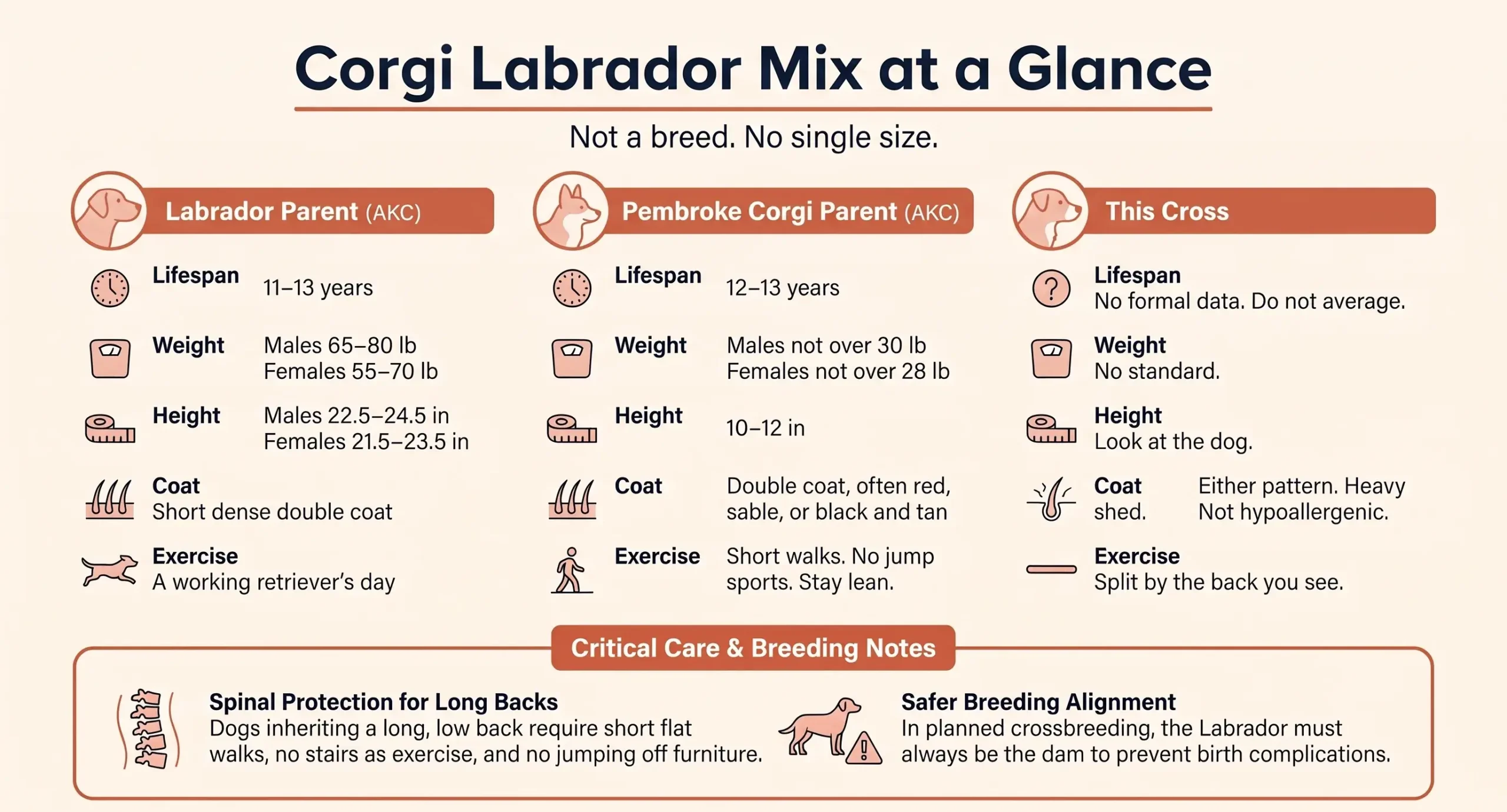
A corgi labrador mix has no set weight, from a Pembroke limit near 30 pounds to a Lab’s 55–80 pound range. The American Kennel Club lists Pembroke Welsh Corgis at 10–12 inches, with males not over 30 pounds and females not over 28. The Labrador standard runs from 55–70 pounds for females to 65–80 for males, and 21.5–24.5 inches at the shoulder.
Those figures belong to the parents. A short-leg photo is one possible puppy, not the whole litter. No formal data exists for how long a corgi labrador mix lives, so we will not average the parents into one lifespan.
Why Littermates Do Not Share One Size

A corgidor is a Labrador Retriever crossed with a Corgi. Most listings mean a Pembroke Welsh Corgi. A Cardigan Welsh Corgi is a different AKC breed, usually heavier, and it keeps a long tail. Ask which parent was used. The nickname is not a second breed.
A first-generation corgi labrador mix litter does not split down the middle. One can take the long back and the short legs. The next can look closer to a small Lab. A third lands in between, with a Lab head on a low body. Coat color does not set the size.
Use the parent ranges as a fence, not a target. If the Corgi parent is a small Pembroke and the Lab is a female, the puppy can stay compact. If the Lab parent is a male at 65–80 pounds, the puppy can grow well past 30 pounds. Shelter cards that say “corgi mix” are a guess about the parents, not a scale reading.
We do not publish one full-grown weight for a corgi labrador mix. No club has measured this cross. Look at the legs and the length of the back at six months, then again at a year. Chest and muscle can keep filling after the legs stop.
A corgidor is one of two long-backed builds in our full list of Labrador crosses. A labrador doxie mix is the other: a hound parent instead of a herder, the same rule that one photo is not the litter.
A chihuahua lab mix is the other small-parent cross on this site. The size gap is wider, and the Lab still has to be the dam.
Backs, Stairs, and Jumping
Intervertebral disc disease, or IVDD, is the issue that changes daily life with a long, low back. VCA Animal Hospitals notes that long backs and short legs wear discs down faster. That warning is written for dogs built like a Corgi or a Dachshund. It is not a measured rate for a corgi labrador mix.
If your dog has a long back and short legs, manage the spine the way a Corgi owner would until a vet has seen that dog. If the dog is leggy and the back is Lab-length, the strictest rules may be more than that dog needs. The vet has to see the spine. A breed label cannot.
Practical rules when the back is long:
- Use a ramp or carry the dog on stairs. Stairs are not a workout.
- Block the couch and the bed, or use a ramp. Jumping down is a common way discs fail.
- Lift with two hands, chest and hind end. Do not scoop by the front legs.
- Skip jump sports and ball launches that end in a hard stop.
- Keep the dog lean. Extra pounds load the discs.
Pain, a hunched back, crying when picked up, or wobbly hind legs need a vet the same day. A corgi labrador mix that looks mostly Lab can still carry a longer back than a pure Lab. “Mostly Lab” is not a free pass to hurl a ball down a hill.
Hips are the other parent question, on the Lab side.
Nipping Heels and Barking
Pembroke Corgis were bred to move cattle by nipping at heels. That habit shows up in a lot of these mixes. A running child, a bike, or the cat can get a heel nip. It is herding, not random aggression, and it still hurts.
Teach a settle and a place command before the dog decides the toddler is livestock.
School-age kids who can follow a stair rule do better than toddlers. We do not like a corgi labrador mix as a floor toy for a preschooler. A low dog gets stepped on. A heavier puppy that took after the Lab can bowl a small child.
Barking is the other Corgi habit. Many of these dogs alarm-bark at the door and at dogs they can hear but not see. A Lab parent does not cancel that. Plan on a dog that comments.
A corgi labrador mix is a poor bet for a quiet apartment unless you have already met the adult and heard it at rest. Size and noise do not travel together. A compact body can still carry a retriever’s voice and a Corgi’s opinions.
Food drive from the Lab side makes training easier if you are consistent. It also means counters and the trash. Feed meals. Pick up the bowl. Do not free-feed a dog whose back you are trying to protect.
Coat and the Year-Round Shed

Both parents shed. A Lab has a short dense double coat that blows twice a year. A Pembroke has a double coat with a thicker ruff that also blows. A corgi labrador mix can inherit either pattern, or a blend. You should plan on hair on the floor all year.
Neither parent is hypoallergenic, so the cross is not either. Brushing a few times a week keeps the loose coat in the brush instead of on the couch. During a blow, daily brushing is the honest schedule. Baths do not stop the shed.
Color in a corgi labrador mix is a lottery. Red, sable, black, and black-and-tan are common Pembroke colors. Black, yellow, and chocolate can come from the Lab. A rare-color fee is marketing. It does not change the back or the shed.
Why the Dam Should Be the Labrador
Ask which dog carried the litter. A Corgi carrying puppies sired by a Lab is a size mismatch at birth. The answer you want is that the Labrador was the dam, or that a vet managed the whelping. If the seller will not say which parent was the dam, that is the answer.
Ask the Lab parent’s breeder for hip and elbow scores. A clearance on the parent is not a guarantee for the puppy. It is the screen a careful litter should have. On the Corgi side, ask about backs in the line. How many close relatives ruptured a disc, and at what age?
We will not invent a disc rate or a birth-complication rate for a corgi labrador mix. We will say the long back is the daily-life issue, and the small dam is the breeding issue.
Skip any promise that the Lab “fixes” the Corgi. You can get the Corgi’s back and the Lab’s appetite in one dog.
A careful seller can show you the dam, the sire, and the vet records. A listing that only shows a short-leg puppy photo is not that. Ask to see the parents standing side by side. The size gap between them is the size gap inside a corgi labrador mix litter.
Exercise on a Long Back

Do not assign every corgi labrador mix a Lab hour of fetch. Match the work to the back you can see.
If the dog is long and low, think Corgi minutes, not retriever miles. Two or three short walks on flat ground are enough for many adults. Add a short training game in the house. Stop while the dog still looks loose through the spine. A limp or a roached back means you are done for the day.
If the dog is leggy and the topline looks closer to a Lab, it can handle a longer daily walk. It still should not spend the hour jumping or slamming on the brakes. Swimming can fit this build better than it fits a low dog, and only with a ramp out of the water.
Puppies of either build need less than adults. Short sessions. No forced miles. No stairs as practice. Growth plates and discs are both reasons to go easy before a year.
A corgi labrador mix that was sold as “apartment sized” can still need real outdoor time if it took the retriever engine. Meet the parents, or meet the adult, before you trust a listing line about energy.
Mental work counts on both builds. A five-minute place-and-stay tires a herding dog more fairly than another thrown ball. Roll a toy on flat ground if the Lab side wants a retrieve. Do not turn the hallway into a racetrack.
FAQ
Are corgi labrador mixes recognized?
No. A corgi labrador mix is a cross, not an AKC breed. Corgidor is a sales name for the same pairing. It does not get its own standard.
Do they shed?
Yes. Both parents shed, and the mix does too. Plan on year-round hair and a heavier blow once or twice a year. This cross is not hypoallergenic.
How long do they live?
No formal data exists for how long this cross lives. The AKC lists Pembroke Welsh Corgis at 12–13 years and Labradors at 11–13 years. We will not average those into one number for the cross. A lean dog with a sound back has a better shot than an overweight dog that jumps off furniture.
Are they good apartment dogs?
Some adults are, if the barking is mild and the shed is acceptable to the building. A dog that alarm-barks and took the Lab’s engine is a poor fit. Meet the dog at rest before you sign a lease around it.
What is a corgidor?
A corgidor is a corgi labrador mix. Same parents, same back rules, different sales name. Paying extra for the word buys nothing.
Think of a corgi labrador mix as a back-first dog. Buy or adopt for the spine you can see, not for a short-leg photo, and keep it lean, off the furniture, and on flat ground. The retriever parent’s traits matter too, because the Lab half brings the appetite and the engine. Neither half is the easy half.