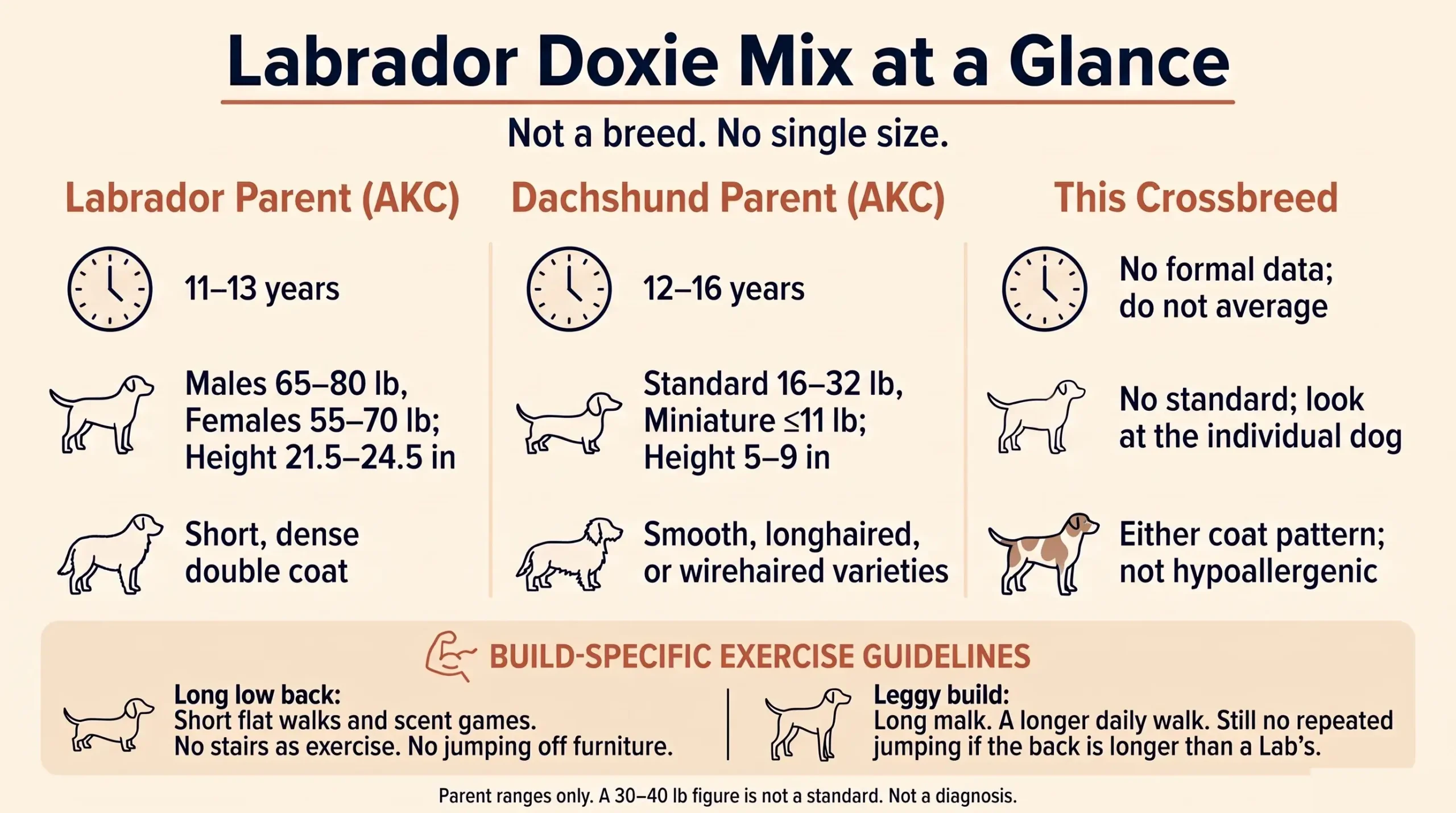
A labrador doxie mix has no set weight, from about 11 pounds to the Lab’s 55–80 pound range. The American Kennel Club lists miniature Dachshunds at 11 pounds and under, and standards at 16–32 pounds. Labrador males are 65–80 pounds, and females are 55–70 pounds.
Those figures belong to the parents, not to every labrador doxie mix.
Some care sites print one cute weight, often 30–40 pounds. That number is one site’s guess, not a standard.
A long, low back needs different work than a leggy retriever build. No formal data exists for how long a labrador doxie mix lives, so we will not invent a lifespan.
What a Dachsador Actually Is
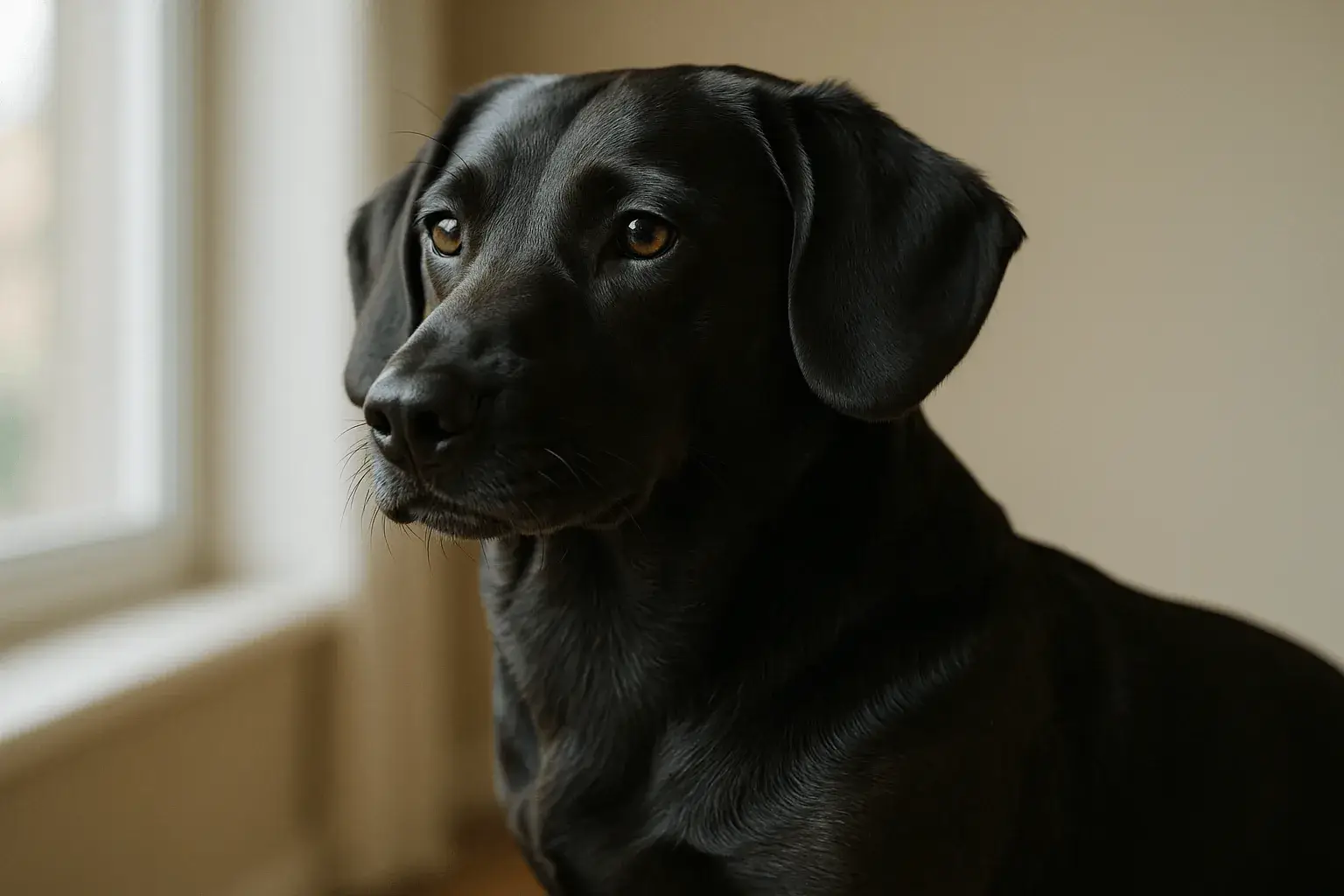
A dachsador is a Labrador Retriever crossed with a Dachshund. Weinerdor means the same cross. So does dachshund lab mix.
None of those names is an AKC breed.
The retriever parent is a sporting dog with a short double coat, a strong food drive, and a body built to swim. The Dachshund parent is a hound with a long back, short legs, and a nose built for quarry in a den.
First-generation puppies do not split down the middle. One puppy can take the long back and the short legs. The next can look closer to a small Lab.
A third can land somewhere awkward in between. Coat follows the same lottery. You may see a Lab’s short dense coat, or a smooth, long, or wire coat from the hound.
People shop a labrador doxie mix because the photos look compact and funny. Compact is not the same as easy. You still get a dog that can bark, dig, track scent, and beg for food.
A dachsador sits at the small end of the other Labrador crosses we cover, and it is one of only two with a long, low back.
A Chihuahua Lab mix is the smallest-parent cross we cover, with an even wider size gap between the parents.
A Corgi and Labrador cross follows the same long-back rules, with a herding parent instead of a hound.
This cross is not hypoallergenic. A Lab coat sheds. A wire or long hound coat still needs brushing.
No mix of these two parents gives you a shed-free house.
Why Littermates Do Not Share One Size
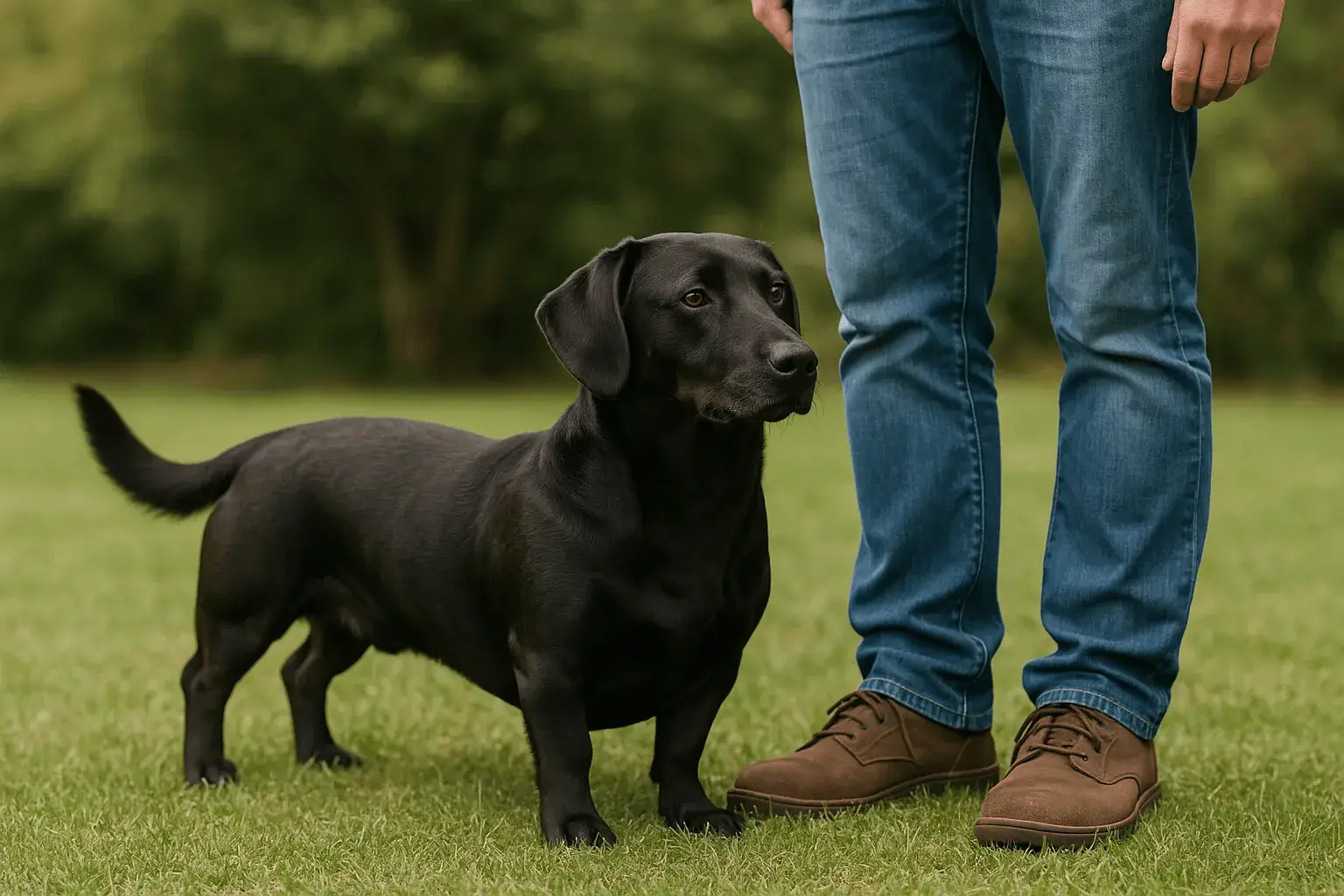
Ask for the parents’ weights before you trust a listing photo. A miniature Dachshund dam or sire pulls the litter down. A standard Dachshund and a full-size Lab pull it the other way.
English-type Labs run heavier than field-type Labs. That shifts a labrador doxie mix too.
Two puppies from one labrador doxie mix litter can miss each other by a lot of pounds. Shelter labels guess. “Doxie mix” on a kennel card is a guess about the parents, not a scale reading.
Use the parent ranges as a fence, not a target. If both parents are on the small side, an adult near the Dachshund’s 16–32 pounds is plausible. If the Lab parent is a male at the top of the AKC range, the puppy can grow well past a hound.
We do not publish one “full grown” weight, because no club has measured a labrador doxie mix.
Height is the same story. A Lab stands about 21.5–24.5 inches at the shoulder. A standard Dachshund stands about 8–9 inches.
Your dog will not be both.
Look at the legs and the length of the back at six months, then again at a year. Chest and muscle can keep filling after the legs stop.
Color does not set size. A black puppy is not a different breed from a chocolate or a dapple-pattern puppy. If a breeder sells “rare color” as a size promise, walk away.
Keep the dog lean either way. Extra pounds load a long back. They also hide the ribs you should be able to feel.
The Lab side will eat past that point if the bowl stays out all day.
Backs, Stairs, and a Long Spine
Intervertebral disc disease, or IVDD, is the health issue that changes how you live with a long-backed dog. VCA Animal Hospitals notes that long backs and short legs wear discs down faster. Dachshunds are in that group.
In those breeds, the sudden form often shows up in young adults, around 3–6 years. That is a Dachshund fact. It is not a measured rate for a labrador doxie mix.
No paper we can cite gives this cross its own disc risk. If your dog has a long back and short legs, manage the spine as a Dachshund owner would until your vet has examined that dog. If the dog is leggy and the back is Lab-length, the same strict rules may be more than that dog needs.
The vet has to see the spine. A breed label cannot.
The AKC Dachshund page is blunt about daily care. Keep the dog from getting overweight. Watch activity so the back does not take a bad hit.
We use those two rules for a low, long labrador doxie mix.
Practical rules when the back is long:
- Use a ramp or carry the dog on stairs. Stairs are not a workout.
- Block the couch and the bed, or use a ramp. Jumping down is a common way discs fail.
- Lift with two hands, chest and hind end. Do not scoop by the front legs.
- Skip jump sports, agility contacts, and ball launches that end in a hard stop.
- Keep nails short so the feet do not slip on wood floors.
Pain, a hunched back, crying when picked up, or wobbly hind legs need a vet the same day. Do not wait out a weekend. Time matters with a disc.
Even a labrador doxie mix that looks mostly Lab can carry a longer back than a pure Lab. “Mostly Lab” is not a free pass to hurl a ball down a hill.
Scent Work, Digging, and Barking
Dachshunds were bred to follow scent into a den and stay loud enough for the hunter to find them. That history shows up in a lot of these mixes. Your dog may lock onto a smell in the yard and ignore you.
Recall is harder than it is with a typical pet Lab.
Digging is the same instinct pointed at the ground. A bored dog will dig a bed, a couch cushion, or the fence line. Give the nose a job.
A snuffle mat or a short tracking game on grass does more for this dog. A second lap around the block does less.
Barking is the other hound habit. A labrador doxie mix will often alarm-bark at the door, the hallway, and dogs it can hear but not see. A Lab parent does not cancel that.
Plan on a dog that comments. If you need a quiet apartment dog, this is a poor bet unless you have already met the adult and heard it at rest.
Small pets are a separate question from barking. A nose bred for quarry can chase a cat, a rabbit, or a small dog. Early, calm introductions help.
They do not delete prey drive. Supervise. Do not leave a labrador doxie mix loose with a pocket pet.
Kids need the same honesty. A low dog gets stepped on in a busy kitchen. A heavier puppy that took after the Lab can bowl a toddler.
We like a labrador doxie mix with school-age kids who can follow a stair rule. We do not like it as a floor toy for a preschooler.
Food drive comes from the Lab side and makes training easier if you are consistent. It also means counters, trash, and the cat’s bowl.
Feed meals. Pick up the bowl. Do not free-feed a dog whose back you are trying to protect.
Exercise for a Low Dog Versus a Leggy Dog
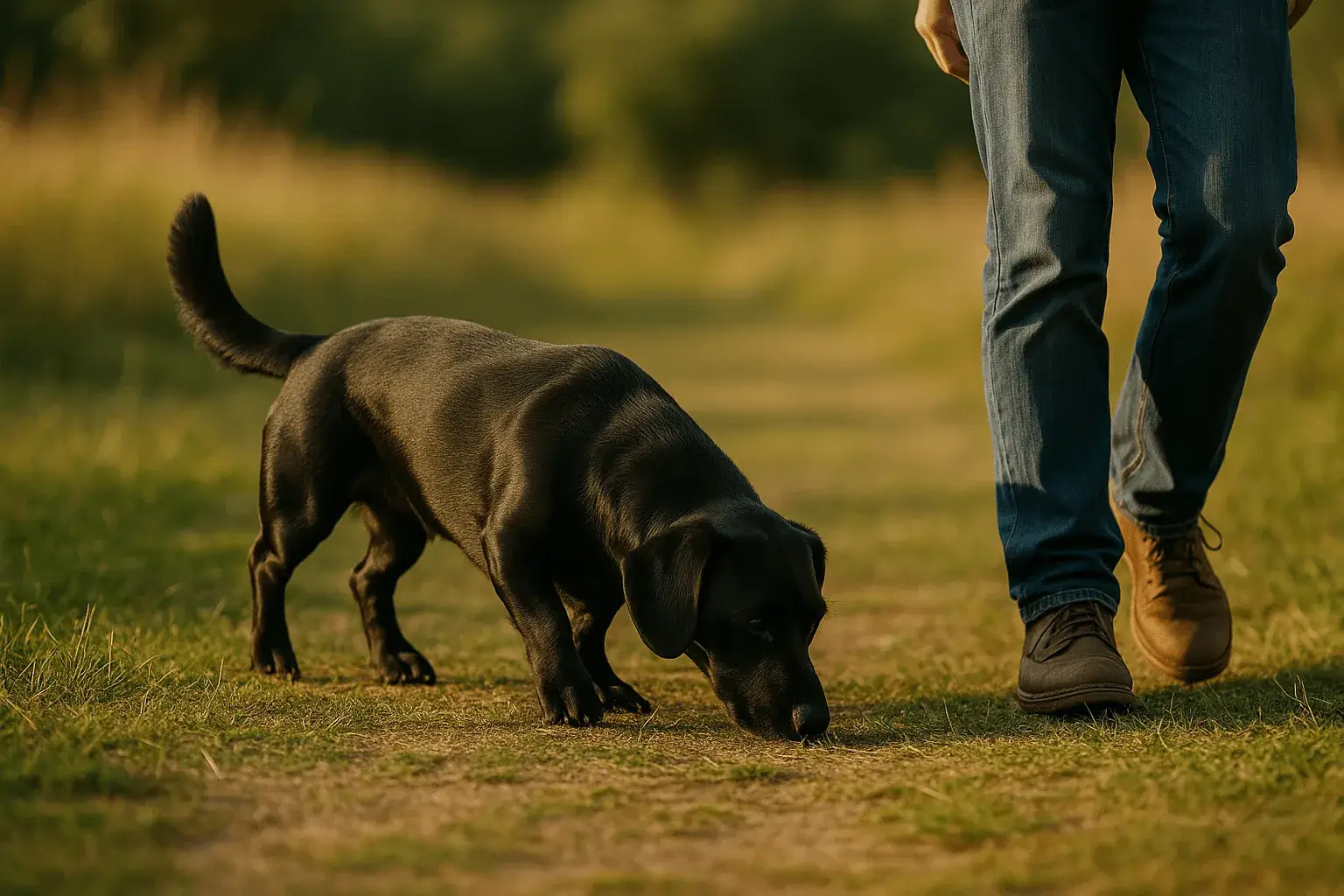
Do not assign every labrador doxie mix a Lab hour of fetch. Match the work to the back you can see.
If the dog is long and low, think Dachshund minutes, not retriever miles. Two or three short walks on flat ground are enough for many adults. Add scent games in the house or the yard.
Stop while the dog still looks loose through the spine. Heat and extra weight shorten that session further. A limp, a pause, or a roached back means you are done for the day.
If the dog is leggy and the topline looks closer to a Lab, it can handle a longer daily walk. It still should not spend the hour jumping, twisting, or slamming on the brakes.
Swimming can fit this build better than it fits a low dog, and only with an easy way out of the water. A pool without a ramp is a bad idea for a long back.
Puppies of either build need less than adults. Short sessions. No forced miles.
No stairs as practice. Growth plates and discs are both reasons to go easy before a year.
Mental work counts. A ten-minute scent search tires a hound-brained dog more fairly than a thrown ball. The Lab side will still want a retrieve.
Roll the ball on flat ground instead of launching it.
A labrador doxie mix that was sold as “apartment sized” can still need real outdoor time if it took the retriever engine.
Size and drive do not travel together. Meet the parents, or meet the adult dog, before you trust a listing line about energy.
Health Questions for Both Parents
Ask which dog was the dam. A Dachshund carrying puppies sired by a Lab is a size mismatch at birth. The question you want answered is that the Labrador was the dam, or that a vet managed the whelping.
If the seller will not say which parent carried the litter, that is the answer.
Hip dysplasia is common enough in Labradors that a parent clearance is a fair ask of any litter with a Lab parent.
Elbows are worth the same question. A clearance on the parent is not a guarantee for the puppy. It is the screen a careful litter should have.
On the Dachshund side, ask about backs in the line. How many close relatives ruptured a disc, and at what age? Ask what eye screening that parent had.
No study gives a labrador doxie mix its own eye-disease rate. A seller who screened the parents can name the test and the date.
Weight of the Dachshund parent matters too. The AKC split is 11 pounds and under for miniatures, and usually 16–32 pounds for standards. A parent between those bands is not a third official size.
Do not pay extra for a nickname.
Ears need a weekly look on a drop-eared dog. The AKC notes that Dachshunds can get ear infections when the ears stay dirty. A mix that inherited long hound ears has the same chore.
Smell, redness, or head shaking means a vet visit, not another wipe with a random cleaner.
Skip any promise that the Lab “fixes” the hound. You can get the hound’s back and the Lab’s appetite in one dog. That pairing is common enough in shelter mixes that we plan for it.
FAQ
Is a labrador doxie mix a real breed?
No. It is a cross, not an AKC breed. Dachsador, weinerdor, and dachshund lab mix are nicknames for the same pairing.
They are not three breeds and they do not get three websites.
Do they swim?
Some do, especially if the body took after the Lab. A long, low dog tires fast and needs a ramp out of the pool. A life jacket helps a dog that cannot keep its back level.
Do not throw a labrador doxie mix into deep water to test a listing claim.
Are they good with small pets?
They can be, and they can also chase. The Dachshund parent was bred to hunt quarry. Introduce cats and small dogs on purpose, and do not leave a labrador doxie mix alone with a rabbit or a hamster.
Supervision is the rule, not a hope.
How long do they live?
No formal data exists for a labrador doxie mix lifespan. The AKC lists Dachshunds at 12–16 years. We will not average that with a Labrador figure and print one number.
A lean dog with a sound back has a better shot than an overweight dog that jumps off furniture. Your vet can talk about the dog in front of you. A blog cannot.
What is a weinerdor?
A weinerdor is a labrador doxie mix. Same parents, same care, different sales name. A rare-breed price for the nickname buys nothing extra.
A labrador doxie mix is a size lottery with a spine you have to respect. Buy or adopt for the back you see, not for a single weight on a roundup. Keep the long-backed dogs lean, off the furniture, and on flat ground.
Read the parent breed in our Labrador Retriever breed guide before you decide the retriever half is the easy half. Every one of these dogs is judged on its own build after the first year.