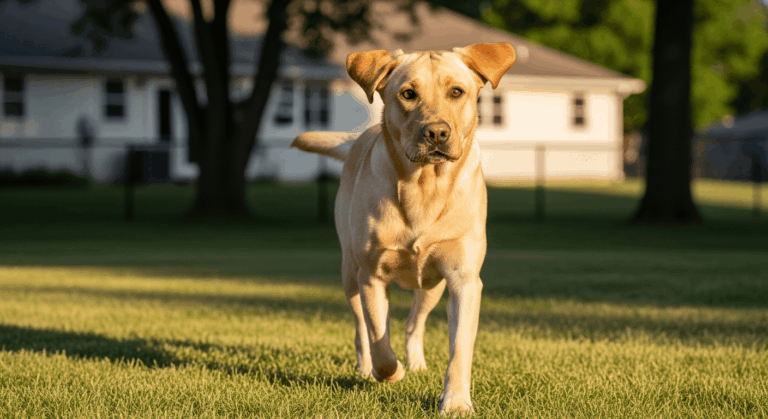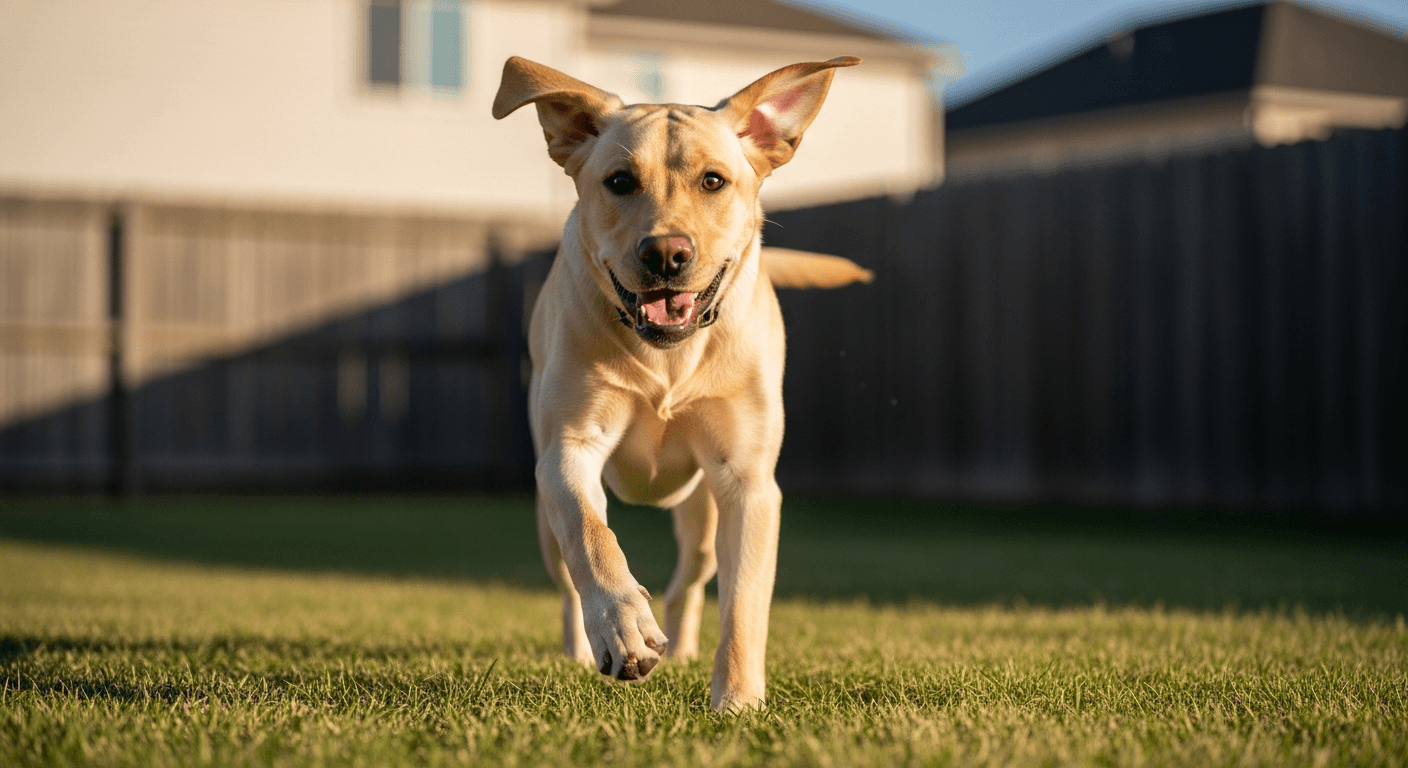
A 5 month old Labrador is finishing one hard phase and starting another. The adult teeth are nearly all through, so the worst of the destructive chewing is winding down. What is just beginning is adolescent independence — the selective hearing that will test your training for the next six months. Here is where your puppy stands, what’s normal, and what to lock in before adolescence peaks. The full first-year picture is in our Labrador puppy first-year guide.
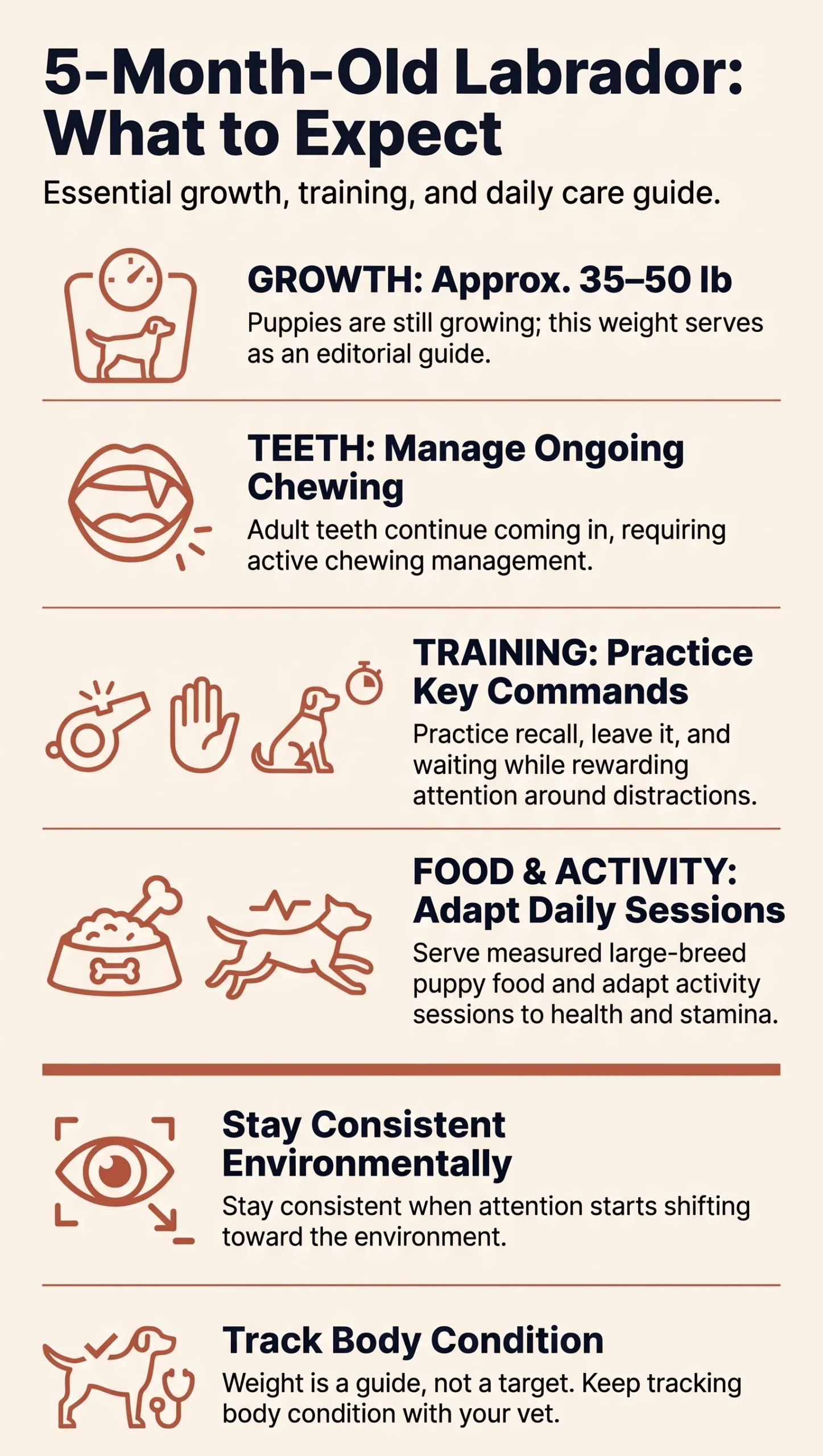
At 5 months, a Labrador puppy typically weighs 35 to 50 lbs. Males usually run 40 to 50 lbs and females 35 to 45 lbs, with gains of 1 to 2 lbs per week still normal. The build is leggy and athletic — adult height is closing in faster than adult bulk.
5-Month-Old Labrador Size & Weight
By 5 months, most Labs carry about 60% of their adult weight — males typically between 40 and 50 lbs, females between 35 and 45 lbs. Growth stays quick through month six, then gradually slows, with filling-out continuing until 12 to 18 months.
Expect the gangly phase in full force. Legs lengthen ahead of chest depth, so a 5-month-old Labrador looks borrowed from a taller dog — all limbs, no barrel. It resolves on its own as the chest and muscle come in over the next year.
Judge condition with your hands, not the food bowl theatrics. Most Labs carry the POMC gene variant that mutes fullness signals, so the begging never reflects need. Ribs should be easy to feel without firm pressing, and a waist should show from above. An overweight 5-month-old strongly predicts an overweight adult — portion guidance is in our guide to how much to feed a Labrador, and formula rules are in our Labrador puppy food guide.
5-Month-Old Lab Behavior: What’s Happening and Why
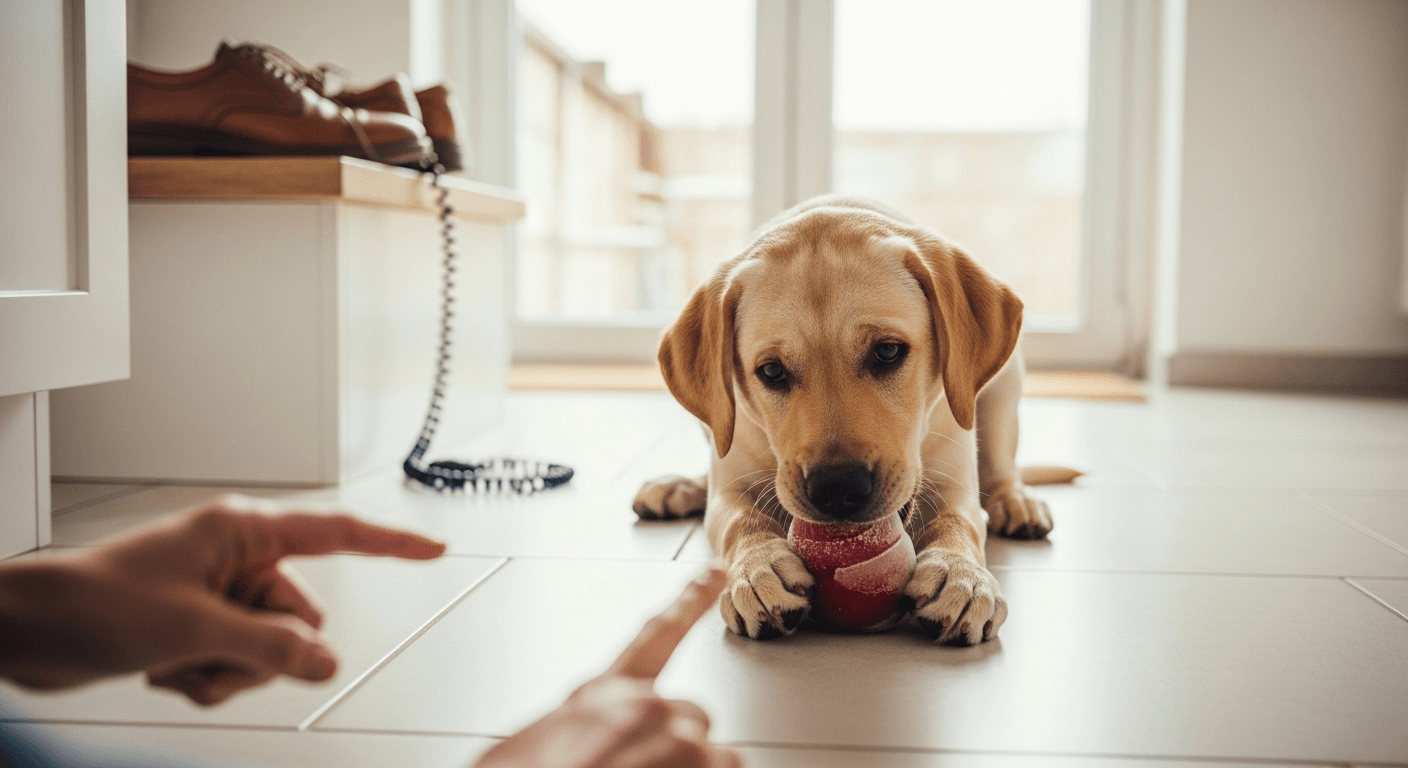
Still finding chewed shoes? You’re in the tail end of teething. Most adult teeth are through by 5 to 6 months, and chewing intensity starts easing after this month. Until it does, keep legal outlets in every room — frozen Kongs and bully sticks do the heavy lifting — and don’t leave the puppy unsupervised with cables and furniture it hasn’t earned.
The bigger shift is the first clear sign of adolescence: the recall that was bulletproof at 12 weeks now competes with every squirrel, scent, and stranger. This is biology, not regression. The independence drive is switching on, and the fix is better pay for right choices — not punishment. Our Labrador puppy training schedule covers the adolescent arc in detail.
There’s good news in the same package. A 5-month-old Lab can hold focus for 5 to 8 minute training sessions now, roughly double what it managed at three months. And sleep still runs 14 to 16 hours a day. For a breed with this much drive, hard napping after a walk and a training session is healthy recovery — lethargy without any exercise behind it is what earns a vet call.
Training a 5-Month-Old Labrador: What to Cement Before Adolescence
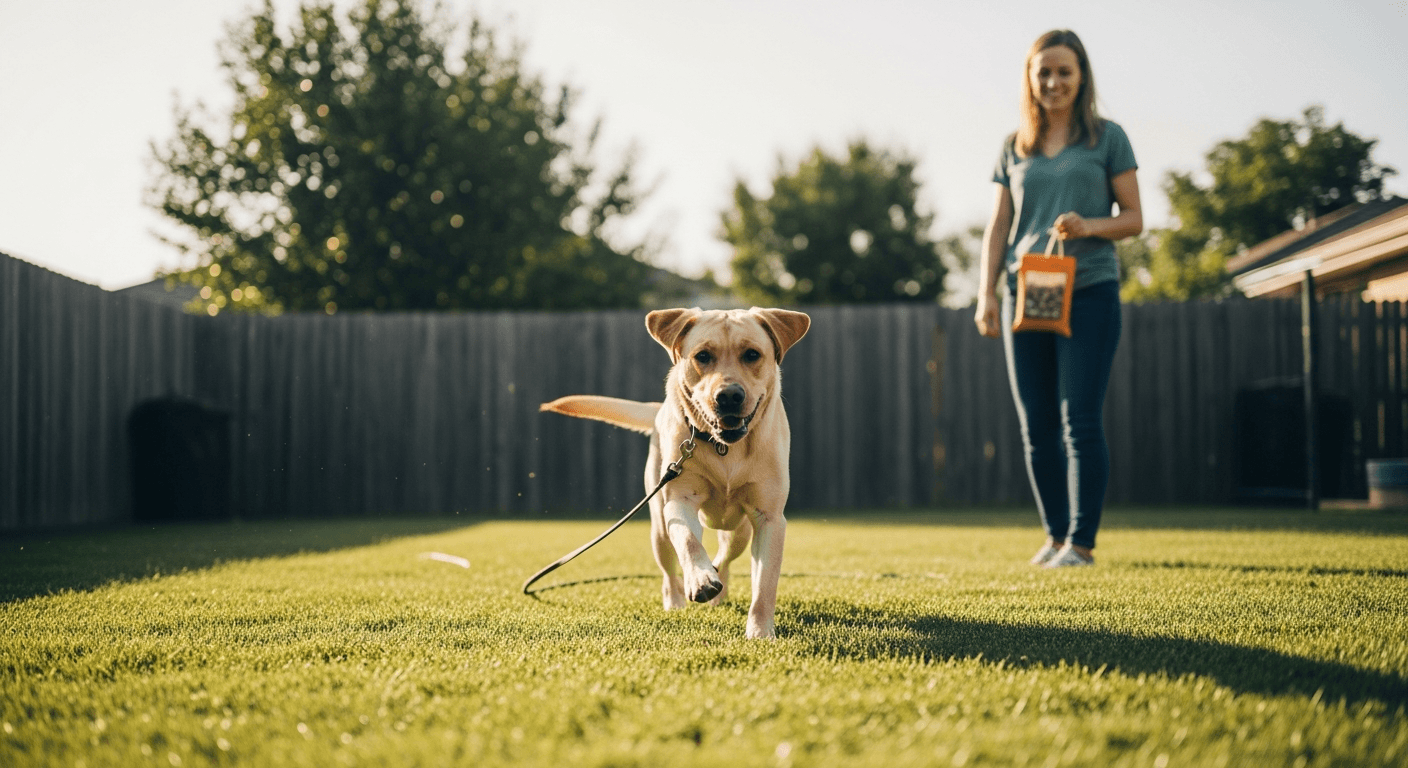
Recall is the highest-value work you can do with a 5 month old Labrador, and the clock matters. Between 6 and 10 months, adolescent Labs commonly blow through recalls that seemed finished. A recall practiced daily across at least 5 different settings — yard, park, quiet street, trailhead, a friend’s yard — before that window holds up; one built during it fights the tide. Use a long line for safety, pay every return with top-tier treats, and never call the puppy to end the fun.
Loose-leash walking is the second priority, for a mechanical reason: your puppy is big enough to practice daily but nowhere near adult pulling strength. Build the habit now — a working retriever bred to surge toward birds and water will happily build the opposite habit at 70 lbs.
Round out the month with three safety skills: “leave it” — non-negotiable for a breed that eats first and asks questions never — plus “wait” at doorways and food bowls, and “drop it” for the retrieving mouth. Full protocols live in our complete Labrador training guide.
One question surfaces at this age on schedule: “should we neuter at 6 months?” For Labs, the research says not yet. A 2020 UC Davis study found more joint disorders in males neutered before 6 months and in females spayed before their first birthday. AAHA advises large-breed males wait until growth stops, usually 9 to 15 months, and the AVMA’s spay/neuter guidance now emphasizes individualized timing. Raise it with your vet — ideally one familiar with the large-breed research.
Feeding & Exercise for a 5-Month-Old Labrador
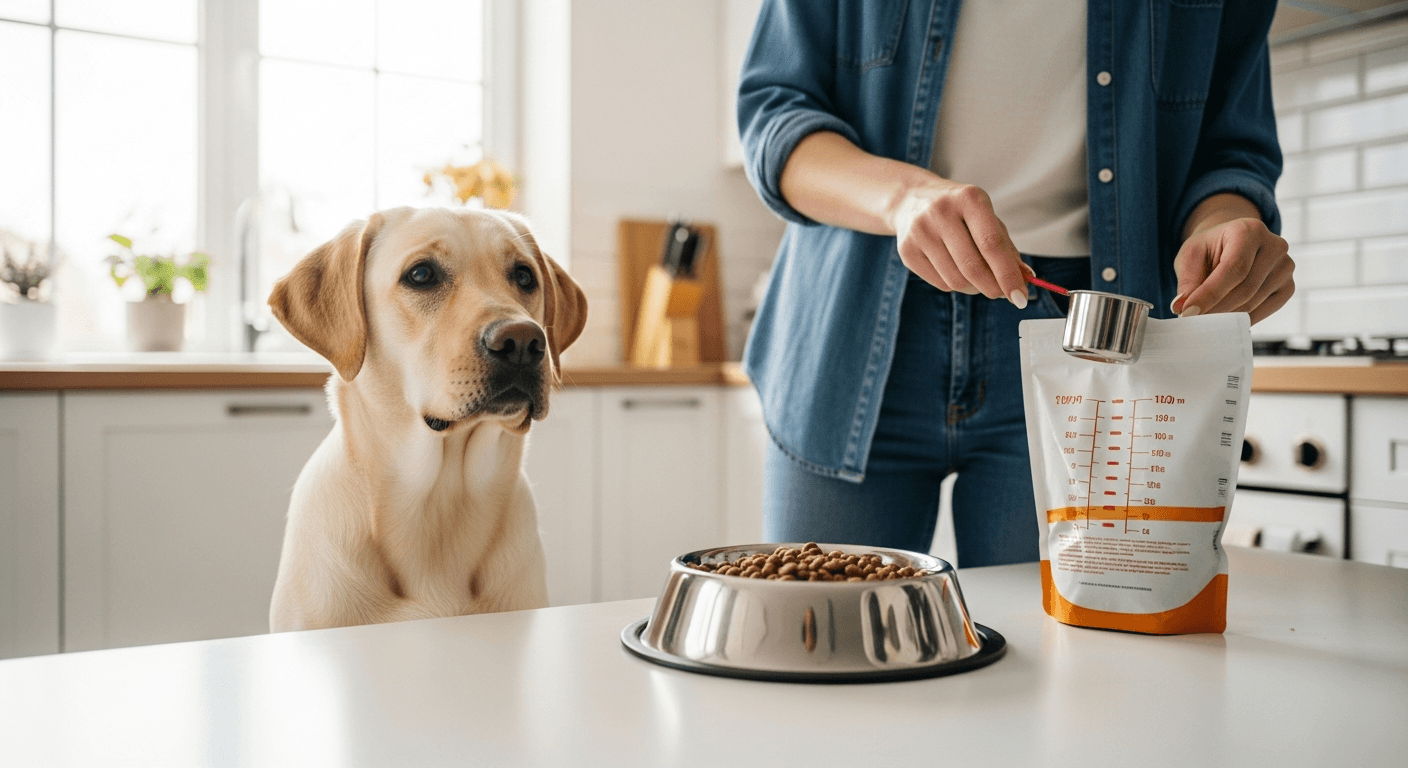
Stay on large-breed puppy formula — the adult-food switch doesn’t happen until 12 to 15 months. Most 5-month-olds eat about 2.5 to 3 cups per day across 3 meals, adjusted to the bag’s chart and the rib check rather than the puppy’s Oscar-worthy hunger performance.
Some owners drop to 2 meals around 5 to 6 months. That works if weight stays healthy, but be honest about the trade: a hungrier Lab between meals is a Lab with stronger counter-surfing and scavenging motivation. If those behaviors spike, go back to three.
Exercise follows the 5-minutes-per-month rule: up to 25 minutes of structured leash walking per session, twice a day. Free play at the puppy’s own pace stays unlimited. Keep avoiding repetitive impact — jump training, fetch sprints on pavement, daily stair marathons — because growth plates stay open until 12 to 18 months.
Introducing Swimming at 5 Months
Five months is a good age for a first proper swim. The paddling instinct is there, the body is coordinated enough, and a positive first experience now builds a lifelong outlet — swimming burns adolescent energy without loading growing joints.
Pick shallow, calm, warm water and walk in alongside your puppy rather than throwing a toy into the deep end. Let the dog choose to follow. One frightening dunk at this age can produce a Lab that avoids water for years — our guide to why Labradors love water covers safe introductions in detail. Rinse and dry the ears after every swim; trapped water is the fastest route to an ear infection in a floppy-eared breed.
Frequently Asked Questions
Why is my 5-month-old Labrador still chewing everything?
Because teething isn’t quite finished and the chewing habit is now well-practiced. Adult teeth complete around 5 to 6 months, and intensity drops after that — if legal outlets exist. Keep frozen Kongs and bully sticks in rotation, restrict unsupervised access to furniture, and treat every redirect as training, not failure.
How much should a 5 month old Labrador weigh?
Between 35 and 50 lbs for most puppies — males typically 40 to 50 lbs, females 35 to 45 lbs, roughly 60% of adult weight. The leggy, narrow look is normal at this age. Steady weekly gains and ribs you can feel without pressing matter more than the exact number.
How much exercise does a 5-month-old Labrador need?
Cap structured leash walks at about 25 minutes per session, up to twice daily, under the 5-minutes-per-month-of-age guideline. Free play at the puppy’s own pace is unrestricted. Skip repetitive jumping and hard-surface fetch marathons — growth plates remain open well past the first birthday.
Should I neuter my Labrador at 5 or 6 months?
The research argues for patience. A 2020 UC Davis study linked neutering males before 6 months, and spaying females before 1 year, to more hip dysplasia, elbow dysplasia, and cruciate tears. AAHA advises large-breed males wait until growth stops, usually 9 to 15 months. Put it on the agenda at your next visit.
Why does my 5-month-old Labrador suddenly ignore me?
Adolescent independence is switching on. Rising environmental awareness means squirrels, scents, and other dogs now outbid you — it looks like defiance but is normal development. Respond with higher-value rewards, a long line for management, and heavy recall reinforcement now, before the 6-to-10-month peak.
Can a 5-month-old Labrador sleep through the night?
Yes — by five months most Lab puppies manage 7 to 8 hours overnight without a potty break. If yours still wakes, move the last meal earlier, lift the water bowl an hour before bed, and make the final yard trip genuinely count. Overnight crying at this age is usually habit rather than need, provided the schedule is right.
Do I still need to socialize my 5-month-old Labrador?
Yes, but the job has changed. The critical window closed around sixteen weeks — now the work is maintenance. Keep meeting new people, dogs, and places every week so the confidence built earlier survives the teenage months. A well-socialized puppy that stops going anywhere can still turn wary by nine months.
How long can a 5-month-old Labrador stay home alone?
About four hours is the practical ceiling. The bladder can manage longer, but an under-stimulated adolescent Lab alone all day manufactures its own entertainment, and you will not like the results. Use a crate or puppy-proofed room, leave a frozen food toy, and build alone time up gradually rather than jumping straight to long absences.
Teething ends and adolescence begins in the same month — that’s the whole story of a 5 month old Labrador. The chewing fades on its own; the selective hearing only fades if you out-train it. The recall and leash work you bank now defines the 7-month-old Labrador you’ll be living with, so spend this month’s sessions there. For what that next stage looks like, see our guide to the 6-month-old Labrador.