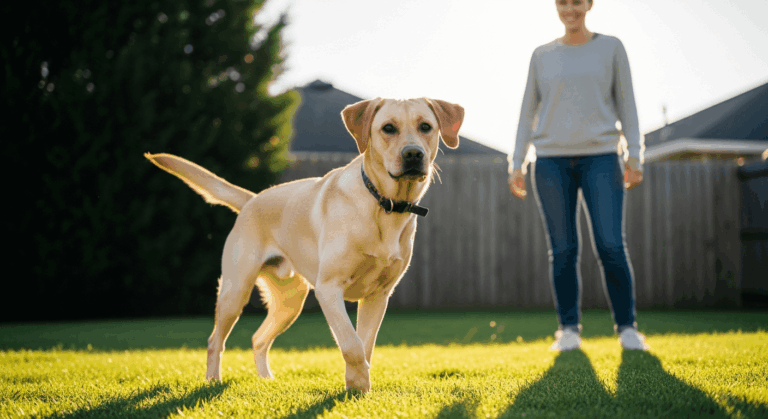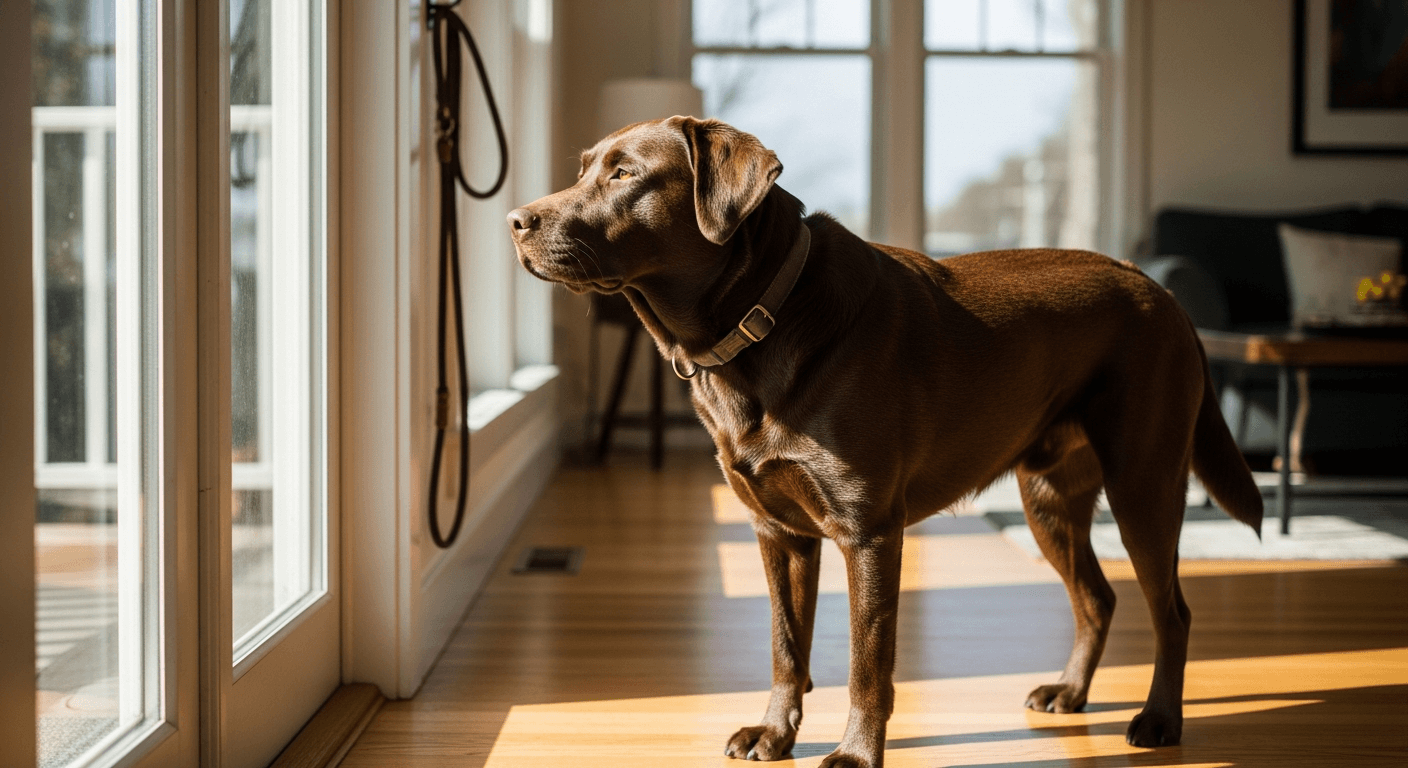
Labrador separation anxiety looks like bad behavior — shredded cushions, scratched door frames, excessive barking and howling through the neighbor’s wall — but it is a panic response, not defiance. Labs were bred to work in constant partnership with humans, which makes isolation genuinely difficult for many individuals. Understanding whether a Lab has true separation anxiety versus normal adjustment distress is where effective treatment starts, and this post gives owners the tools to tell the difference.
Yes — labrador separation anxiety is one of the most common behavior problems in the breed, driven by their strong human attachment and high social needs. Symptoms include destructive behavior near exits, sustained vocalization, pacing, and indoor elimination when alone. Severity ranges from mild distress — which typically resolves with graduated departure training over 4–8 weeks, consistent with behavioral modification protocols used by certified veterinary behaviorists — to a clinical anxiety disorder requiring veterinary medication.
Why Labradors Are Prone to Separation Anxiety
Labradors were selectively bred as retriever gun dogs from the early 19th century — originating in Newfoundland and later refined in England to retrieve game from water and field in close proximity to hunters. This history created dogs that actively seek human contact and stay highly attuned to human cues. According to the AKC, this bond with people is the breed’s most defining characteristic — and the same quality that makes isolation genuinely difficult for many individuals.
The POMC gene mutation common in Labs — present in approximately 25% of the breed — increases their drive to seek attention and food reinforcement. This deepens the human attachment that can tip into labrador separation anxiety when alone-time exposure is insufficient from puppyhood.
Specific risk factors for labrador separation anxiety in an individual dog: multiple rehomings, a significant routine change such as an owner returning to work after an extended period at home, no alone-time training during puppyhood, and highly emotionally charged departures and reunions. Early exposure work is protective — proper socialization reduces future separation anxiety.
Labs’ POMC-linked attention-seeking and high human-attachment wiring mean each of these factors produces a stronger response in the breed than in more independent dogs. Even a schedule shift that would barely register for a Basenji or Chow Chow can be enough to spark the anxiety spiral in a Lab.
A naturally anxious baseline temperament — visible as excessive startle response, clingy behavior from weaning age, or distress vocalizations lasting more than 10 minutes after separation from littermates at 7–8 weeks — increases the risk further.
The dog is not destroying things out of spite for an absent owner. In Labs specifically, this behavior is driven by panic — the breed’s deep human-attachment wiring amplifies this response in a way that genuinely surprises owners who expected a resilient, confident dog. Treating labrador separation anxiety as willful misbehavior makes it worse. Treating it as genuine distress makes it manageable.
Signs of Labrador Separation Anxiety in Dogs
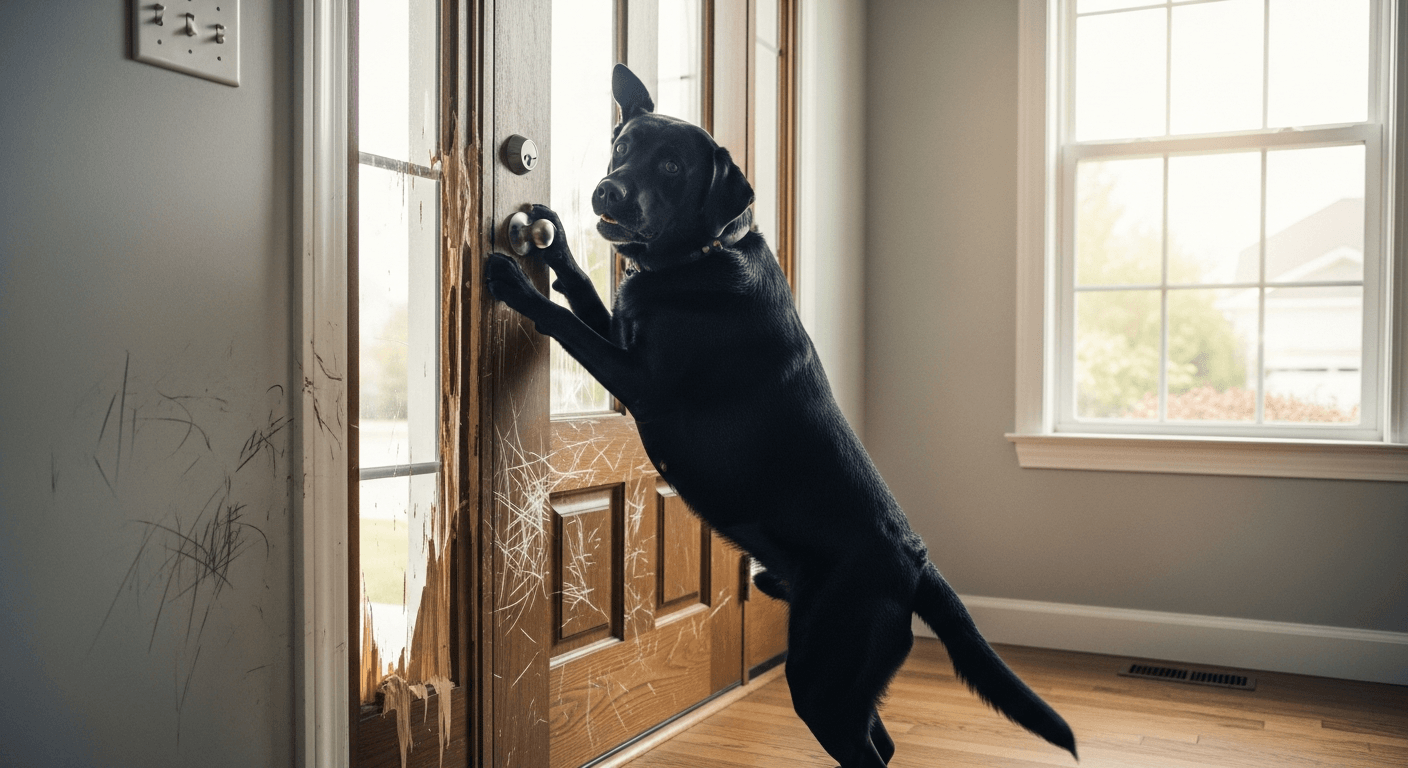
The critical distinction is the trigger: does the behavior happen only when the dog is alone?
Signs specific to labrador separation anxiety — these occur only during or immediately after owner departure, not when the owner is home. In Labs, the signs tend to be intense from the start: the breed’s elevated oral drive and high arousal baseline mean destruction typically begins within minutes, not hours.
- Destructive behavior focused near exits — Labs’ oral drive amplifies this; expect chewing damage to door frames, walls, and baseboards beyond the scratching typical of lower-drive breeds
- Vocalization (barking, howling, whining) that begins within minutes of departure and sustains
- Pacing or circling, inability to settle
- Indoor elimination despite the dog being reliably house-trained
- Not eating or drinking while alone — particularly notable in Labs, where the POMC gene mutation (present in roughly 25% of the breed) drives unusually strong food motivation; food refusal during absence is a strong anxiety signal specifically in this breed
- Self-directed anxious behavior — excessive licking or chewing of paws; Labs’ strong oral drive means this typically escalates faster in the breed than in lower-drive dogs
The trigger test: does the destruction happen when the owner is home too? A dog that chews furniture at 2pm whether the owner is present or not is bored or under-exercised — adult Labs need 60–90 minutes of vigorous daily exercise, and shortfalls show up as generalized destructiveness at any time, not absence-specific behavior. That is not labrador separation anxiety. A dog that only damages things during absence has an absence-specific problem. These require entirely different management.
The filming diagnostic: the most reliable way to confirm labrador separation anxiety is to film your dog for 30 minutes after you leave. A dog that settles within 20 minutes is showing normal adjustment. A dog still vocalizing, pacing, or attempting to escape at the 20-minute mark is in genuine distress.
A note on timing: most Labs with separation anxiety begin showing distress within 2–5 minutes of departure — well before you have reached the end of the street. Damage discovered hours later was often done in the first 15 minutes.
Normal adjustment versus labrador separation anxiety: a new dog — rehomed adult or young puppy — will often show distress for 1–2 weeks. Ongoing distress beyond 3 weeks of consistent establishment in the home is the signal to treat as a real separation anxiety pattern.
Mild vs Severe Labrador Separation Anxiety: Knowing Where Your Lab Falls
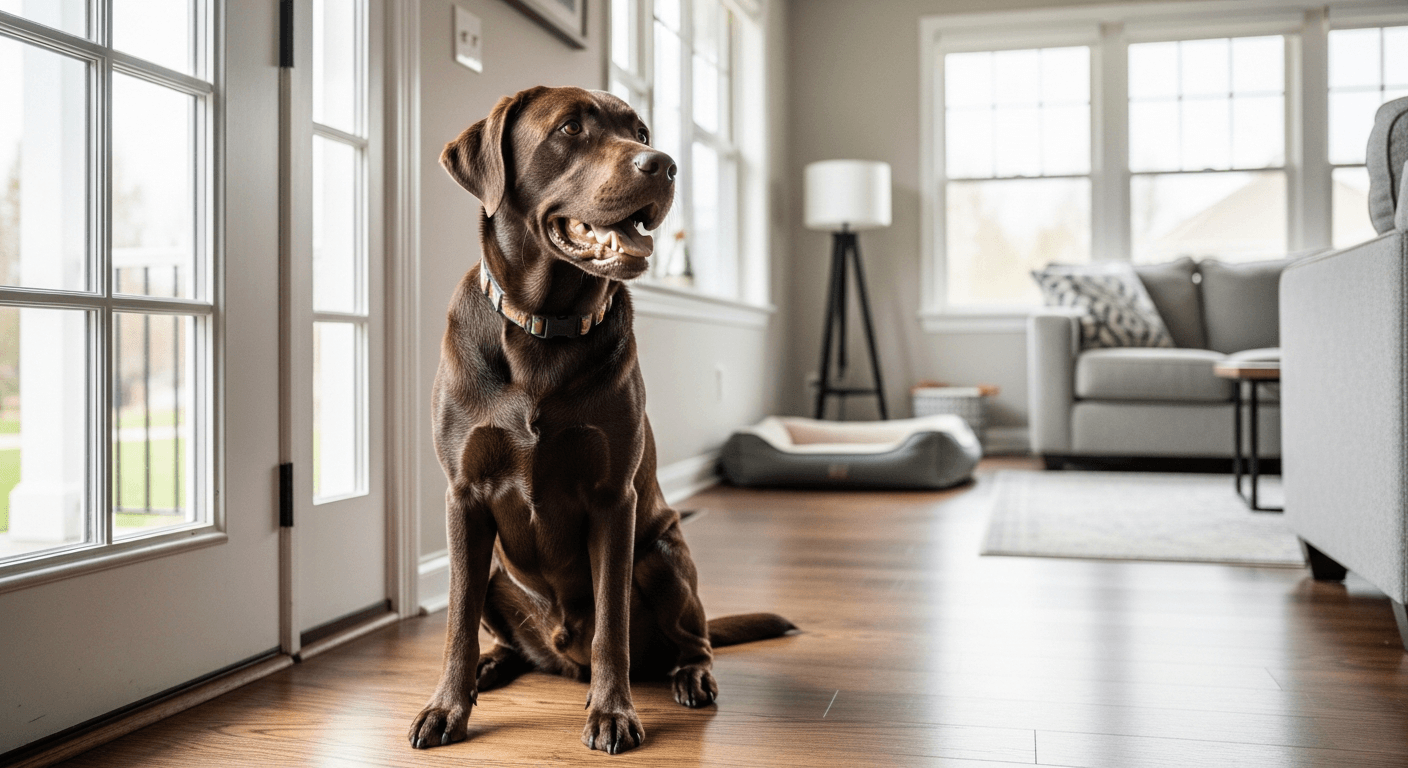
Severity determines whether self-management is appropriate or whether veterinary involvement is required. Most owners are dealing with mild-to-moderate labrador separation anxiety — and those cases respond well to behavioral training.
Mild SA: The dog shows distress signals — panting, pacing, some vocalization — for 10–20 minutes after departure, then settles and rests. There may be occasional minor destruction near exits. This level responds well to graduated departure training alone.
Moderate SA: The dog does not fully settle during any departure. Vocalization or low-level destruction occurs throughout most absences. The dog may not eat or drink while alone. Behavioral training works at this level but takes longer — short-term calming support such as Adaptil or Zylkene meaningfully speeds improvement when used alongside training.
Severe SA: The dog injures itself attempting to escape confinement — broken teeth on crate bars, bloody paws from scratching. The dog cannot be left alone for any duration without immediate acute distress. Apartment owners feel this hardest — our guide to Labradors in apartments covers alone-time setups for small spaces. Severe labrador separation anxiety of this kind has typically been ongoing for months or years without improvement. It requires veterinary assessment and almost always medication alongside behavioral modification — not instead of it.
Most Labs fall in the mild-to-moderate range. Severe cases are less common but occur more frequently in dogs with multiple rehoming experiences.
How to Treat Labrador Separation Anxiety: Desensitization & Graduated Departure Training
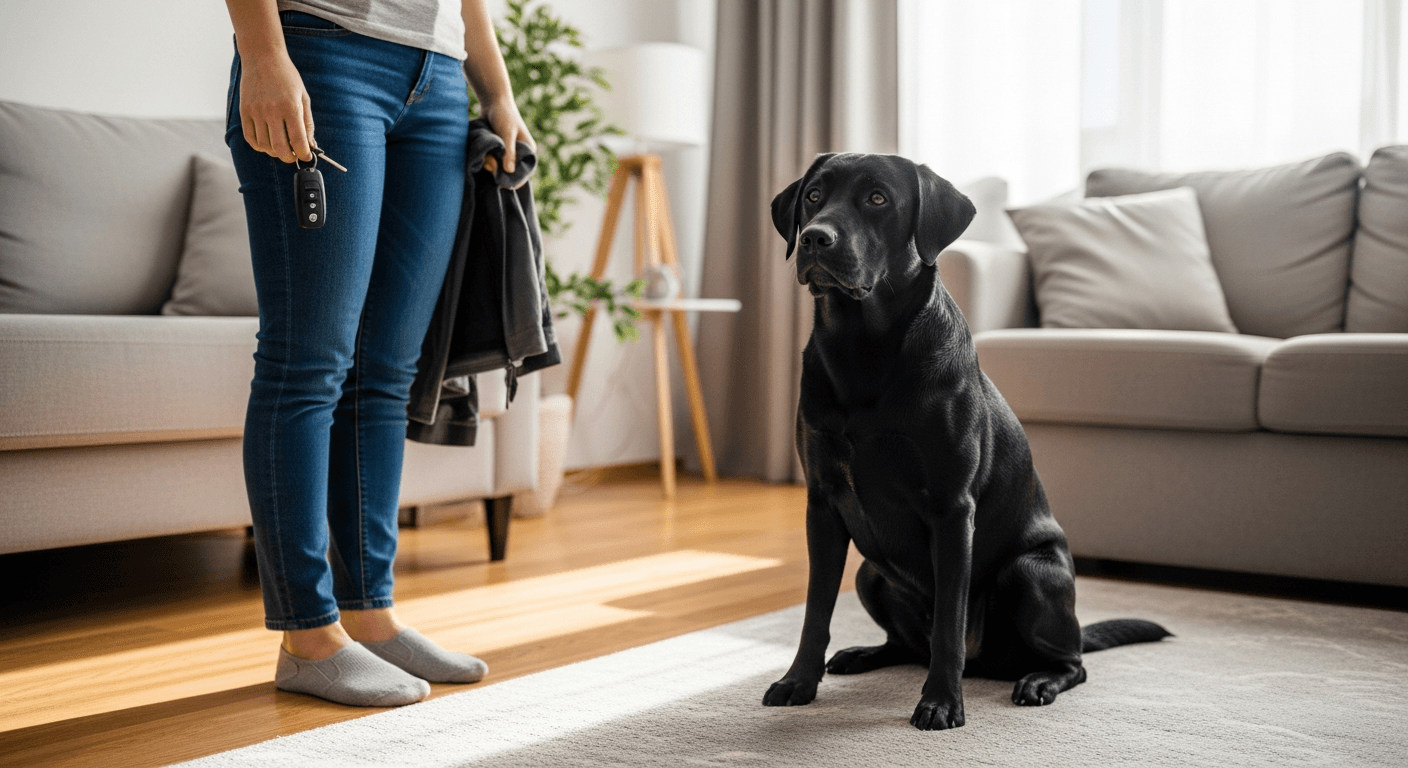
The foundation of all effective labrador separation anxiety treatment: the dog must never reach the anxiety threshold during training. If the dog begins to spiral at 5 minutes alone, every training departure must stay under 5 minutes. Exceeding the threshold during training reinforces the anxiety rather than reducing it. For a complete overview, see our How to Train a Labrador: Complete Training Guide for Puppies & Adults.
Pre-departure desensitization: Many Labs with separation anxiety begin to panic before the owner even leaves the house — because they have learned the pre-departure cues. Picking up keys, putting on shoes, picking up a bag each triggers the anticipatory anxiety spiral. Break these associations by practicing the cues without departing:
- Pick up keys, set them down, sit back on the sofa.
- Put on coat, take it off, make a cup of tea.
- Pick up bag, walk to door, turn around and sit down.
Repeat these sequences multiple times per day until the dog no longer reacts to them. This alone significantly reduces labrador separation anxiety symptoms during the early weeks of treatment.
The graduated departure protocol:
- Walk to the front door and return to the room — no departure. Repeat until the dog stays calm.
- Open the door, step outside, close it, and return in 5 seconds. If the dog is calm on return, reward calmly.
- Extend to 15 seconds, then 30 seconds, building in 30-second increments.
- If the dog shows anxiety at any duration — panting, whining, pawing at the door — return to the previous successful duration and hold there for several more sessions before extending again.
- Build over days and weeks toward the target departure length.
The Kong anchor: on every real departure, leave a frozen stuffed Kong at the door as you leave. The Kong lasts 15–30 minutes, provides a focused activity during the highest-anxiety window, and eventually becomes a positive predictor of departure — “Kong appearing means this is a short, safe absence.” We recommend a Kong Classic available on Chewy as the standard departure anchor for labrador separation anxiety training.
What not to do: prolonged emotional goodbyes increase anticipatory anxiety rather than providing comfort. Returning when the dog is vocalizing reinforces vocalization as an escape mechanism. Punishing anxiety behavior — coming home to find damage and responding with anger — worsens the labrador separation anxiety driving the behavior.
Calming Products That Help With Labrador Separation Anxiety
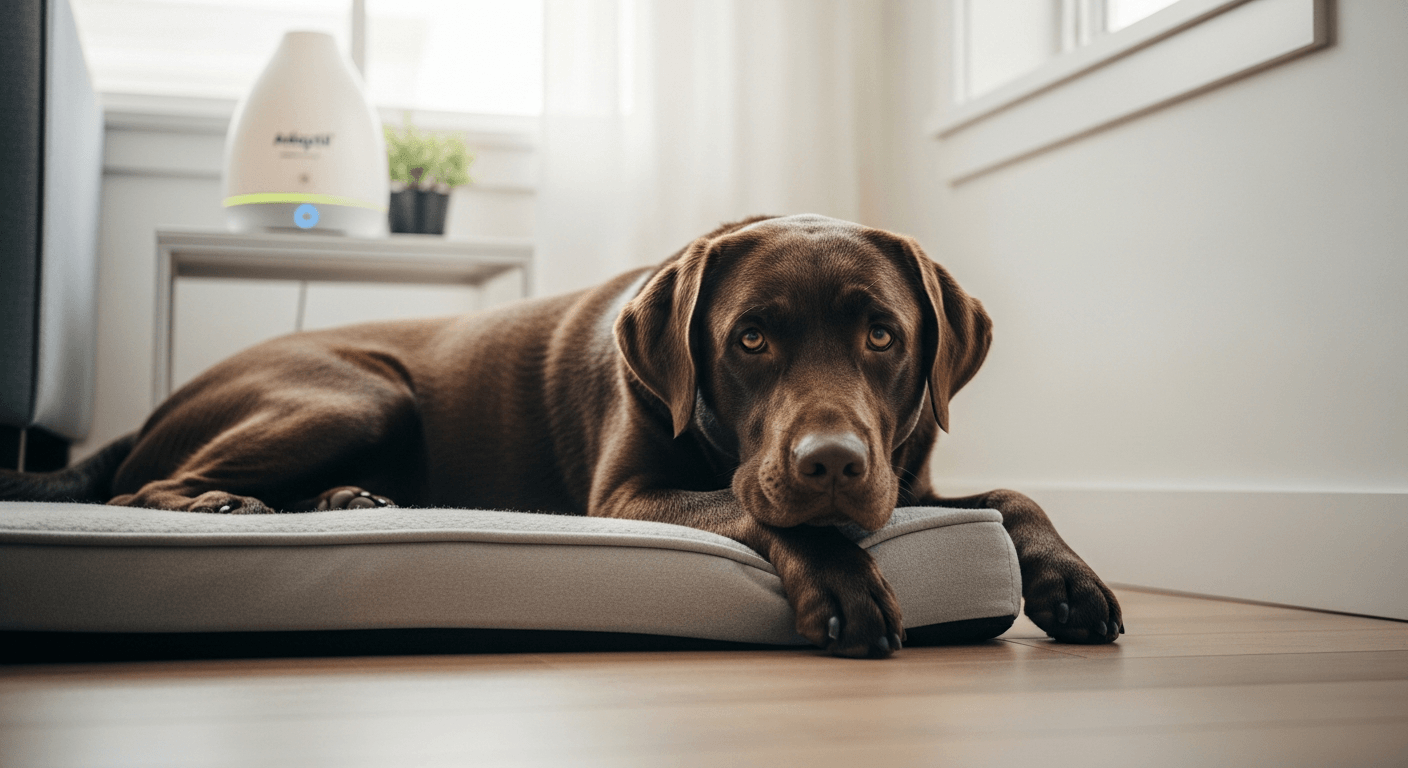
The right product, used alongside graduated departure training, meaningfully reduces the time to improvement. Used alone without training, no product fully resolves labrador separation anxiety — but the combination is substantially more effective than either alone.
Adaptil (DAP pheromone diffuser or collar) has the strongest evidence base of any non-prescription calming product for dogs. It mimics the calming pheromone produced by nursing dogs and reduces situational and separation anxiety in multiple clinical studies. A plug-in diffuser in the room where the dog spends departure time is the most effective delivery method. Must be used consistently — not just on high-stress days. Available on Chewy; refills are required every 4 weeks.
Zylkene (alpha-casozepine) is a dairy-derived supplement with genuine calming evidence in dogs. It is non-sedating, well-tolerated, and available over the counter. We recommend starting it 7–10 days before a planned high-stress period for best effect. It is a strong first supplement to trial for mild-to-moderate labrador separation anxiety alongside the training protocol.
L-theanine chews (Composure, Solliquin) have moderate evidence as an anxiolytic adjunct. Non-sedating and low risk. Useful as a supporting product alongside Adaptil and training — not as a standalone treatment.
Thundershirt applies constant gentle pressure to the dog’s torso on the principle of pressure-based calming. Results are variable — some Labs respond well and show clearly reduced anxiety; others show no measurable difference. Low risk and no side effects make it worth trialing.
Prescription medication (vet assessment required): VCA Animal Hospitals notes that Clomipramine (Clomicalm — the only FDA-approved medication specifically for canine separation anxiety), Fluoxetine (Reconcile — also FDA-approved), and Trazodone are all legitimate and often necessary components of treatment for moderate-to-severe cases. Medication works most effectively alongside behavioral training — it reduces the anxiety baseline to a level where learning can occur. Never administer human-prescription anxiety medications to a dog without veterinary direction.
When to Consult a Vet for Labrador Separation Anxiety
Some labrador separation anxiety cases are self-manageable with the protocol above. Others require professional help — and knowing which applies to your situation saves months of ineffective self-management.
See your vet when: the dog is self-harming in any way, symptoms are not improving after 6 consistent weeks of graduated departure training, the dog cannot tolerate any duration of absence without acute distress, or you want to discuss whether medication is appropriate.
See a veterinary behaviorist (DACVB) when: the labrador separation anxiety is severe and has not responded to initial veterinary medication, the dog has shown anxiety-related aggression, or previous treatment attempts have failed. A DACVB is a veterinarian with specialist behavior qualifications — not a dog trainer. They can assess, prescribe, and manage complex cases that general practice vets refer out.
A standard vet assessment for labrador separation anxiety involves a full history, ruling out medical contributions (thyroid dysfunction, chronic pain, hearing loss in older dogs), and a behavioral assessment. Most general practitioners are comfortable prescribing first-line medications for documented cases. More complex cases are referred to a specialist. According to the Merck Veterinary Manual, early intervention consistently produces better outcomes than treatment started after the condition has been established for over a year.
One practical note on timing: pet insurance policies that include behavioral treatment must be enrolled before the condition is documented in the medical record. If a Lab is showing early signs, enrolling before a formal diagnosis maximizes the chance of behavioral treatment being covered.
For a broader look at Labrador behavior problems beyond separation anxiety, see our full guide on Labrador behavior problems. For the complete training foundation your Lab needs, see the Complete Training Guide for Labrador Retrievers.
Frequently Asked Questions: Labrador Separation Anxiety
Do Labradors get separation anxiety more than other breeds?
Yes — labrador separation anxiety rates are higher than in many breeds. Their working history selected for constant proximity to a human partner, making solitude genuinely unnatural for many individuals. Labs with the POMC gene variant also seek human attention and reinforcement more intensively, deepening the attachment that can tip into dependence when alone-time exposure is insufficient early in life.
How do I know if my Labrador has separation anxiety or is just bored?
Film your dog for 30 minutes after you leave. Boredom shows a dog that settles within 20 minutes, then rests. Labrador separation anxiety shows sustained distress — pacing, vocalizing, attempting to escape — past the 20-minute mark. Also check the trigger: separation anxiety behavior occurs only during absence. Boredom-driven destruction happens at any time, whether you are home or not. Damage near exits is a strong indicator of separation anxiety specifically.
How long does it take to treat labrador separation anxiety?
For mild labrador separation anxiety, consistent graduated departure training over 4–6 weeks typically produces significant improvement. Moderate cases often take 8–12 weeks and benefit from calming supplements alongside training. Severe cases may require 3–6 months of combined behavioral and medical management. The most important variable is consistency — training must happen daily and every departure must stay below the anxiety threshold.
Should I crate my Labrador with separation anxiety?
It depends on severity. For mild cases in a dog that has been positively crate trained, a crate can provide a secure den during short absences. For moderate or severe labrador separation anxiety, a crate can become a panic amplifier — a dog self-harming to escape a crate is worse off than one in a dog-proofed room. Film to assess: if the dog is calmer in the crate than in the open room, use it. If more distressed, switch to a dog-proofed space.
Can I leave a Labrador with separation anxiety alone all day?
Not without a management plan in place. For a dog with active moderate-to-severe labrador separation anxiety, leaving alone all day causes repeated intense anxiety episodes that worsen the condition over time. Short-term options while treatment is underway: doggy daycare, a dog walker splitting the day into shorter absence blocks, or a trusted person checking in mid-day. Once the graduated departure protocol builds the dog up to the required duration, full-day absences become possible.
Most Labs with labrador separation anxiety improve significantly with consistent graduated departure training over 6–8 weeks. The key is keeping every practice session below the anxiety threshold — slow progress is still progress. If improvement has stalled after 8 weeks of consistent daily work, a vet conversation about medication is the right next step, not more of the same training at the same level.