How much should a Lab weigh? An adult male Labrador should weigh 65 to 80 pounds and a female 55 to 70 pounds, according to the AKC breed standard for Labs in working condition. The scale is only half the answer: you should also feel the ribs easily, see a waist from above, and see a tummy tuck from the side.
Labs are one of the easiest breeds to overfeed, and many owners miss the extra pounds. This guide covers the healthy range, the hands-on body check vets use, the line between overweight and obese, and how to bring a heavy Lab back into shape.
Healthy Adult Weight for Male and Female Labs
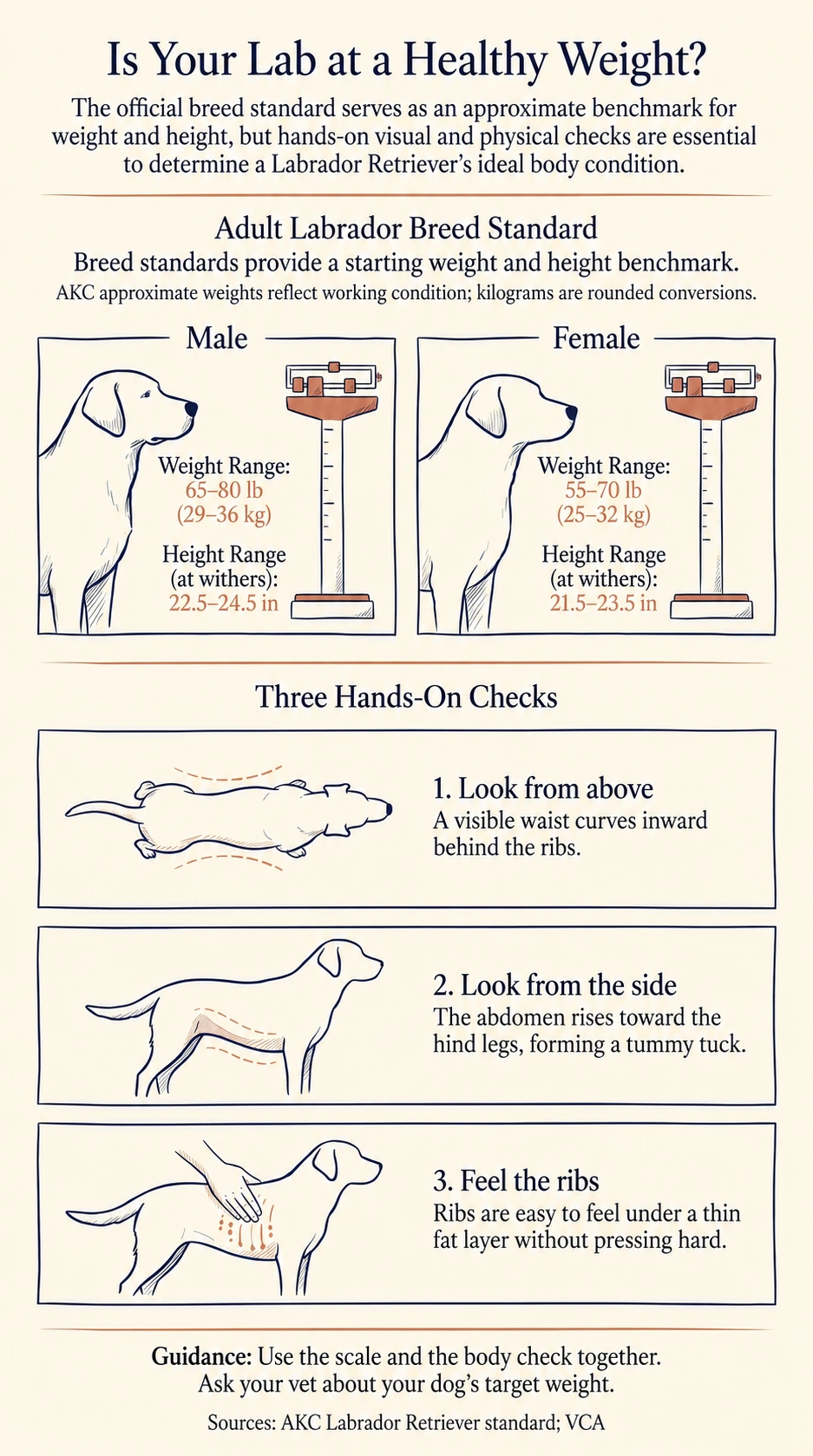
The AKC breed standard for the Labrador Retriever gives a starting point for the question, “How much should a Lab weigh?” It lists an approximate weight “in working condition” of 65 to 80 pounds for males and 55 to 70 pounds for females.
The same standard sets height at the withers, the top of the shoulders. Males stand 22.5 to 24.5 inches, and females 21.5 to 23.5 inches.
The kilogram figures are a straight conversion of the AKC pounds, for readers asking, “How much should a Lab weigh in metric?” They are not a separate standard.
How much should a female Lab weigh, then? Most healthy adult females land between 55 and 70 pounds, about 10 pounds lighter than males at both ends of the range. A small-framed female can sit near 55 pounds and be in perfect shape.
Notice the phrase “working condition.” The standard says Labs should be shown well-muscled and without excess fat. That describes a fit, active dog, not an average pet on the couch. So the range tells you how much should a Lab weigh when it is lean, not what most Labs actually weigh.
Why Two Healthy Labs Can Be 15 Pounds Apart
Two Labs of the same sex can differ by 15 pounds and both be at a healthy weight. The AKC range is wide on purpose.
Frame size matters most. A tall Lab with long legs and a deep chest carries more bone and muscle than a compact one, and that changes the answer to “How much should a Lab weigh?” for that dog. A dog at the top of the height range will usually sit near the top of the weight range too.
Sex sets the baseline. Males are taller and heavier on average, so how much should a Lab weigh depends first on whether it is male or female.
Field and show lines look different. Labs bred for field work are often leaner and lighter-boned, while show-bred Labs often look stockier.
The AKC standard still gives one weight range for both, and we don’t trust sites that invent a separate “English Lab” range. The body check below matters more than the line.
Muscle weighs more than fat. A Lab that swims, hikes, and retrieves every day can weigh more than a couch potato of the same size and still be leaner.
This is why “how much should a Lab weigh” has no single number for your dog. The range is a starting point. Your vet sets your Lab’s target weight, and your hands tell you if you are close.
The Hands-On Body Check

Vets judge weight with a body condition score (BCS), not just a scale. VCA’s body condition score guide describes two scales: a 5-point scale where 3 is ideal, and a 9-point scale where 4 to 5 is ideal. Always say which scale you mean, since a 5 is obese on one and ideal on the other.
You can answer how much should a Lab weigh for your own dog with a quick version at home in under a minute.
Look from above. Stand over your Lab while it stands. Whatever the scale says about how much should a Lab weigh, you should see a waist, a gentle inward curve behind the rib cage.
Look from the side. The belly should rise from the bottom of the chest toward the hind legs. That rise is the tummy tuck.
Feel the ribs. Run your flat hands along the sides of the chest. VCA says a dog at a healthy weight has a thin layer of fat with the ribs right underneath.
VCA uses your own hand as a guide. Make a fist and feel your knuckles: ribs that feel like that mean the dog is too thin. Lay your hand flat on a table and feel the knuckles: that is about right. Turn your hand over and feel the knuckles through your palm: that is overweight.
Do this check once a month. It answers how much should a Lab weigh far better than the bathroom scale, because it measures fat, not bone and muscle.
When a Lab Is Overweight, and When It Is Obese
The two words have real definitions. According to VCA’s guide to obesity in dogs, a dog is overweight at 10% to 20% above its ideal body weight, and obese at more than 20% above it.
For a male Lab whose vet sets an ideal weight of 70 pounds, that means:
- 77 to 84 pounds is overweight
- More than 84 pounds is obese
Those numbers are math, not a new standard. Only your vet can say how much should a Lab weigh in your dog’s case.
Extra weight is common. The Association for Pet Obesity Prevention’s 2022 survey classified 59% of dogs as overweight or obese. The same survey found that 36% of dog owners called their dog’s body condition normal when the vet scored it 6 to 9 out of 9, which means overweight or obese.
In plain terms, a fat Labrador often looks normal to its family. Owners who look up how much should a Lab weigh are often surprised, which is why the body check matters more than an opinion.
The extra weight costs the dog. VCA lists a higher risk of diabetes, osteoarthritis and faster joint wear, heart disease, high blood pressure, bladder stones, cancer, and complications under anesthesia. Joint problems, diabetes, and heart disease are among the common Labrador health problems owners deal with, and weight makes most of them worse.
The best Lab-specific evidence comes from a lifetime study by Kealy and colleagues, published in 2002. It followed 48 Labrador Retrievers in pairs, with one dog of each pair fed 25% less than its partner from 8 weeks of age. The leaner dogs had a longer median lifespan, and chronic disease showed up later in them. So how much should a Lab weigh is a lifespan question, not only a looks question.
Why Labs Put On Weight So Easily
Labs are famous for acting hungry, and there is a gene behind it in some dogs.
In 2016, Raffan and colleagues reported a 14-base-pair deletion in a gene called POMC in Labrador Retrievers. In the Labs they studied, the variant had an allele frequency of 12%. It was linked to higher body weight, more body fat, and stronger food motivation, and it was more common in Labs from assistance-dog programs.
Not every greedy Lab carries the gene, but some Labs do feel hungrier than others on the same meal.
Treats add up fast, and they are the hidden reason many owners miss how much should a Lab weigh. VCA says treats and snacks should be no more than 10% of a dog’s daily calories. Training sessions, dental chews, and table scraps all count toward that 10%.
Spaying and neutering play a part too. The AVMA notes that spayed or neutered dogs are more prone to weight gain, so portions often need trimming after surgery.
The fix starts with measuring. Use a real measuring cup or a kitchen scale, not a scoop or a guess, and check the feeding amount against your vet’s answer to how much should a Lab weigh. Our guide on how much to feed your Lab each day shows how to work out portions.
Getting an Overweight Lab Back in Shape
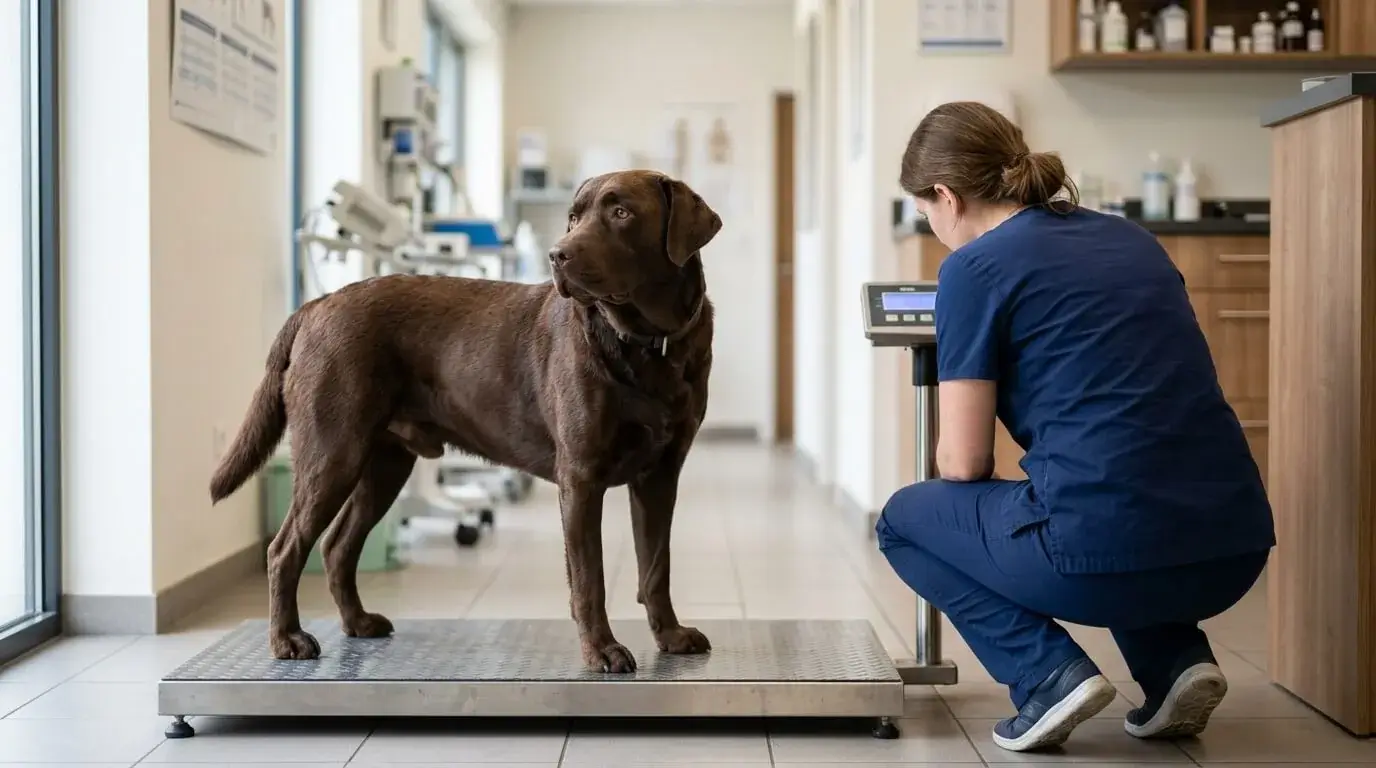
If the body check says your Lab is heavy, start with the vet. VCA says your veterinary team can calculate an ideal body weight to use as a target, and that is the number to work toward.
From there, a plan usually has four parts.
Measured meals. Feed a set amount, measured every time, split into two meals. Your vet may suggest a weight-loss diet, which lets the dog eat a normal-looking portion with fewer calories.
A treat budget. Keep treats under 10% of daily calories. Use pieces of the dog’s regular kibble as training rewards, or swap in low-calorie options your vet approves.
More movement. Add a longer walk, a second walk, or a swim. Build up slowly, especially for a heavy dog whose joints already carry extra load.
Regular weigh-ins. VCA calls monthly weigh-ins important, both to keep everyone accountable and to make sure the dog isn’t losing too fast or too slowly. Use the same scale each time, ideally the one at your clinic.
Expect it to take months, not weeks. Every family member has to follow the plan, because one person slipping extra treats can undo it.
Once your Lab reaches the target, how much should a Lab weigh becomes a maintenance job. Keep the portions measured. VCA warns that yo-yo weight loss and regain is no healthier for dogs than for people.
Weight Through Your Lab’s Life

If your Lab is still growing, the adult range does not apply yet. Our Labrador growth chart shows typical puppy weights month by month, and the body check works at any age.
Most Labs reach their adult height before they finish filling out. As growth slows, the food changes too, and our guide on when to switch to adult food covers the timing.
In the prime adult years, the answer to how much should a Lab weigh doesn’t move, so the job is to hold the weight steady. Weigh your Lab every few months, do the body check monthly, and adjust portions when activity changes, such as in winter or after an injury.
Around 7 years and up, many Labs slow down. Fewer calories burned on the same meal means slow weight gain, often a pound or two at a time. Watch the body check closely in these years and follow our tips on senior Lab care as your dog ages.
The answer to how much should a Lab weigh at 7 is the same as at 3: the range that keeps your dog lean. An older Lab does not need extra padding.
FAQ
How much should a Lab weigh in kg?
How much should a Lab weigh in kilograms? Converted from the AKC standard, an adult male should weigh about 29 to 36 kg and a female about 25 to 32 kg. These are the same ranges as 65 to 80 pounds and 55 to 70 pounds, just in metric. The body check still decides whether your Lab is at the right point in that range.
Can a Labrador weigh 100 pounds?
A Lab can reach 100 pounds, but that weight is well above the AKC range of 65 to 80 pounds for males. Very few Labs are tall enough to carry it as muscle. If your Lab weighs 100 pounds, do the body check and ask your vet. In most cases, the extra weight is fat.
Is a Lab a large or extra-large dog?
The AKC breed standard describes the Labrador Retriever as a medium-sized dog. Many owners and pet-product makers call Labs large because of their weight. Either way, a healthy adult Lab stays within the AKC range of 55 to 80 pounds, depending on sex, so how much should a Lab weigh doesn’t change with the label.
Is my Lab fat or just big-boned?
Use the body check. Bone adds weight, but it doesn’t hide the ribs or the waist. If you can’t feel the ribs without pressing, can’t see a waist from above, or the belly hangs instead of tucking up, your Lab is carrying fat, whatever its frame.
Do spayed or neutered Labs gain weight?
They can. According to the AVMA, spayed or neutered dogs are more prone to weight gain. That doesn’t make surgery the wrong choice. It means you should watch the body check after surgery and trim portions if the waist starts to disappear. Spaying also ends her heats; our Labrador heat guide covers the cycle.
So, how much should a Lab weigh? Use the AKC range of 65 to 80 pounds for males and 55 to 70 for females, then let the body check and your vet pick the exact target. Do the rib, waist, and tummy-tuck check once a month and adjust meals before a few extra pounds turn into a problem.