Exercise induced collapse labrador cases, known as EIC, come from an inherited nerve disorder caused by a mutation in the DNM1 gene. Affected dogs lose control of their hind legs after 5 to 20 minutes of intense, exciting exercise, stay alert, and usually recover within 5 to 25 minutes of rest. A DNA test confirms it.
Exercise-induced collapse, or EIC, can look terrifying the first time you see it. A happy, healthy Lab is retrieving at full speed one minute and dragging its back legs the next. The good news is that most affected dogs recover fully, and with the right exercise plan, they can live normal lives.
This exercise induced collapse labrador guide relies on the University of Saskatchewan’s veterinary team, which worked with the researchers who found the mutation, plus the OFA and the Merck Veterinary Manual. We don’t use owner anecdotes or unsourced numbers.
What EIC Is and Why Labs Carry It
EIC is caused by a mutation in the gene for dynamin-1 (DNM1), a protein found only in the brain and spinal cord. At low levels of activity, a dog doesn’t need much of it. Under heavy load, such as intense exercise combined with high excitement, DNM1 is essential for nerve signals to keep firing. Dogs with two copies of the mutation can’t keep up, and their nerves start to fail.
The mutation was identified in 2007, and it made exercise induced collapse labrador testing possible. It is autosomal recessive, which means a dog must inherit one copy from each parent to be affected. EIC is one of the inherited conditions Labs are screened for, alongside hip and elbow scoring and eye exams.
How common is it? The University of Saskatchewan’s EIC page reports that in tested populations, 5 to 15% of Labs have been affected and 35 to 40% have been carriers. Data from the first 45,000 Labs tested at the University of Minnesota showed nearly 40% carriers and about 6% affected.
These figures come from dogs whose owners or breeders chose to test, not from the whole breed. Still, the exercise induced collapse labrador numbers are high enough that every breeder should test. USask found carrier rates were no different between field trial, show, and pet Labs.
Exercise induced collapse labrador signs usually first appear between five months and three years of age, with an average of 14 months. The Merck Veterinary Manual gives a median of 12 months in dogs with two copies of the mutation.
What an Episode Looks Like

Dogs with EIC handle mild and moderate exercise without trouble. The problem starts with strenuous exercise plus excitement. USask describes five to 20 minutes of that combination bringing on weakness and then collapse.
A typical exercise induced collapse labrador episode follows a pattern:
- The back legs go first. The dog develops a wide, loose, long stride, then the hind legs weaken.
- The dog keeps trying. Many Labs keep running while dragging their back legs. In some dogs, the front legs weaken too.
- The muscles go limp. The legs are floppy, not stiff, and the dog doesn’t seem to be in pain.
- The dog stays alert. Affected dogs remain conscious and can still respond to commands.
One detail most owners don’t know: USask notes that symptoms commonly worsen for three to five minutes even after exercise stops. A dog that seems to get worse right after you stop has not necessarily had a second problem.
After an exercise induced collapse labrador episode, most dogs are back to normal within five to 25 minutes, with no lasting pain, weakness, or stiffness. The OFA describes episodes lasting 5 to 10 minutes, with complete recovery within 30 minutes.
What to Do the Moment Your Lab Starts to Wobble
USask is blunt about this: stop the exercise at the first hint of wobbliness or incoordination. Some affected dogs have died during collapse when their owners allowed or encouraged them to keep going.
If you see an exercise induced collapse labrador episode starting:
- Stop immediately. Put the ball or dummy away. Don’t throw “just one more.”
- Keep your dog calm and still. Excitement is part of the trigger, so speak quietly and keep other dogs away.
- Move to shade. Body temperature runs very high during intense retrieving in all Labs, with or without EIC.
- Offer water once your dog is steady enough to drink.
- Time the episode. Note when it started and when your dog was back to normal. Your vet will want to know.
Never let a dog with known or suspected EIC swim hard or retrieve in water unsupervised. USask reports that dogs have drowned when they collapsed in the water.
Call your vet for any first exercise induced collapse labrador episode, any episode that doesn’t resolve within about half an hour, or if your dog seems confused, in pain, or unable to stand afterward. A collapse always deserves a full exam, even if you suspect EIC.
EIC, Heatstroke, or Something Else?
EIC is the most common reason a healthy-looking Lab collapses during intense, exciting exercise, but it isn’t the only one. USask stresses that any Lab with exercise intolerance should get a complete veterinary evaluation.
Heatstroke is the big one to rule out in any exercise induced collapse labrador case. All Labs, affected or not, can heat up dramatically during hard retrieving. USask measured temperatures above 107°F (41.7°C) after 10 minutes of retrieving in both groups.
The difference is recovery. A Lab with EIC is usually normal within minutes; a dog with heatstroke stays sick and needs emergency care.
Other causes that USask lists for collapse or exercise intolerance include joint pain, heart disease and heart rhythm problems, anemia, laryngeal paralysis, lung disease, low blood sugar, low cortisol, cauda equina syndrome, myasthenia gravis, and muscle disease. Atypical seizures can also look similar.
USask notes some clues that point away from an exercise induced collapse labrador diagnosis: episodes that start suddenly instead of building, very short episodes of a minute or two, all four legs going at once, stiff rather than floppy muscles, confusion, or obvious pain.
A limp tail after a hard swim is a different problem again. That’s usually limber tail, one of several tail problems after swimming, and the back legs work normally.
DNA Testing: Clear, Carrier, Affected
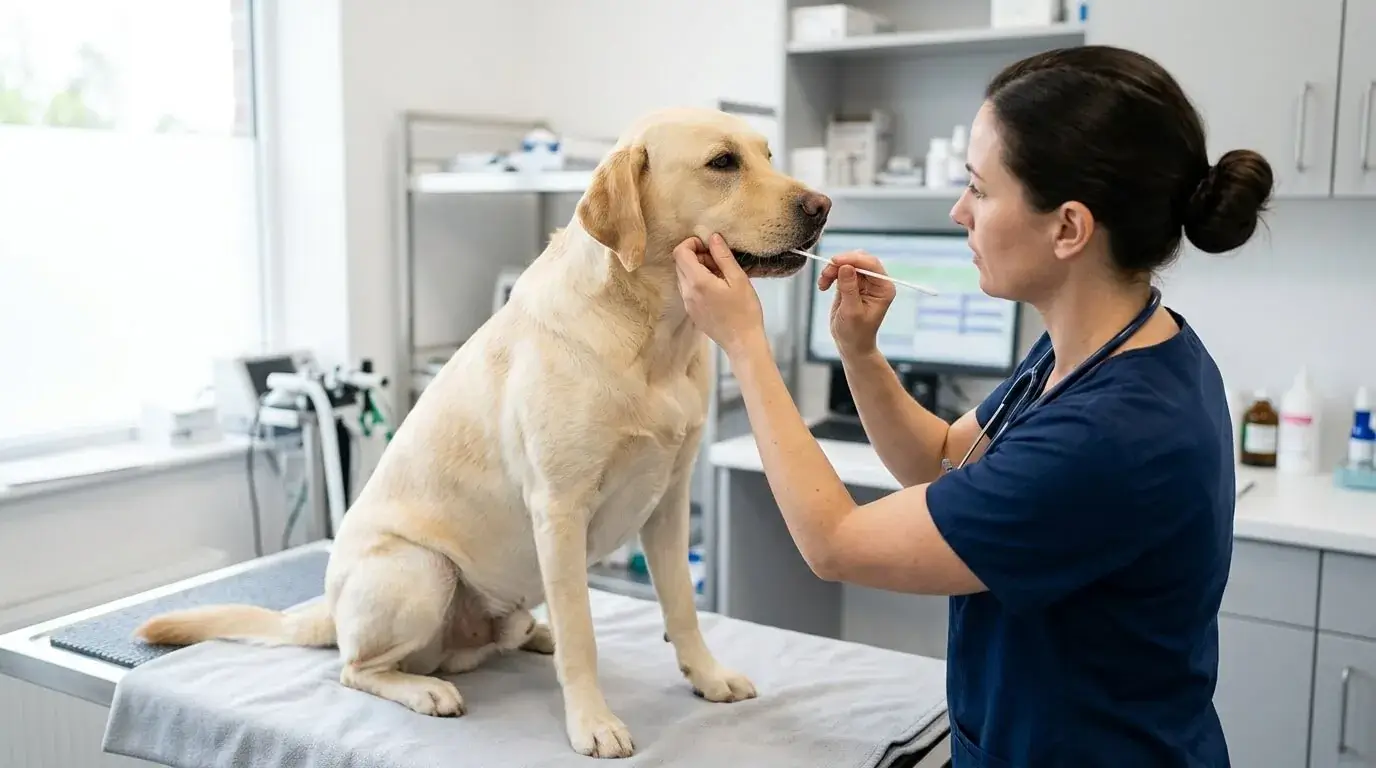
A simple exercise induced collapse labrador DNA test tells you a Lab’s EIC status. USask says testing can be done on cheek swabs, blood, or dewclaws from newborn puppies. The OFA’s EIC page offers a cheek swab kit, processed by the University of Missouri.
Results come in three forms:
- N/N (clear): no copies of the mutation. The dog won’t develop EIC and can’t pass it on.
- E/N (carrier): one copy. Carriers are clinically normal with no exercise intolerance, but they pass the mutation to about half of their puppies.
- E/E (affected): two copies. The dog is susceptible to collapse, though a few affected dogs never show it because they never hit the right mix of exercise and excitement.
For breeders, the pairing matters, because exercise induced collapse labrador genes pass on in a predictable way. USask gives these outcomes:
| Parents | Puppies |
|---|---|
| Affected × affected | All affected |
| Affected × carrier | 50% affected, 50% carriers |
| Affected × clear | All carriers |
| Carrier × carrier | About 25% clear, 50% carriers, 25% affected |
| Carrier × clear | No affected, 50% carriers |
If you’re buying a puppy, ask for both parents’ EIC results. It’s one of the most important questions to ask a Labrador breeder. As long as at least one parent is clear, no puppy in the litter will be affected.
Exercise for a Lab With EIC
There’s no cure, so exercise induced collapse labrador care is about management. Merck says affected dogs should avoid intense activities, and USask recommends avoiding known triggers, especially in hot weather. The upside: if trigger activities can be avoided, USask says dogs with EIC live normal lives.
USask names the activities most often linked to collapse:
| Higher risk for EIC dogs | Lower risk for EIC dogs |
|---|---|
| Repeated, excited “happy retrieves” | Routine jogging |
| Hunting, especially upland birds like pheasant | Hiking |
| Drills with e-collar pressure | Calm walks |
| Running alongside an ATV | Short, low-key play |
USask notes that routine jogging or hiking is not very likely to trigger an exercise induced collapse labrador episode. Steady, moderate exercise is the goal. For a sensible approach, see our steady running plan for adult Labs, and keep each session calm.
Hot days need extra care. Collapse is more likely when it’s warm, so exercise early or late, keep sessions short, and skip the ball on hot afternoons.
In its exercise induced collapse labrador research, USask also reports that a few affected males improved after neutering, and that phenobarbital seemed to help some dogs early in their research. The researchers suspect both may have worked simply by lowering the dog’s excitement level. Talk to your vet before trying either.
FAQ
How long does EIC last in dogs?
Most dogs recover within five to 25 minutes, according to USask. The OFA says complete recovery is seen within 30 minutes. Signs can get worse for three to five minutes after exercise stops before they improve.
What is the life expectancy of a dog with EIC?
There’s no formal lifespan data for exercise induced collapse labrador dogs. USask says dogs with EIC live normal lives if trigger activities can be avoided. A few dogs have died during or right after an episode, which is why stopping exercise at the first wobble matters.
Is EIC fatal?
Rarely. Most dogs recover fully from every episode. A few affected dogs have died during or right after collapse, and some have drowned when they collapsed in water.
Can an EIC carrier have symptoms?
No. USask says exercise induced collapse labrador carriers are clinically normal with no exercise intolerance. They can pass the mutation to their puppies, so carrier status matters for breeding.
How is EIC treated?
There’s no medicine that cures it. Treatment means managing exercise: avoid intense, highly exciting activities, especially in heat, and stop at the first sign of wobbliness. Your vet can help you plan safe exercise.
An exercise induced collapse labrador diagnosis isn’t the end of an active life. Test your Lab, learn the early signs, stop at the first wobble, and swap high-excitement retrieving for steady, calmer exercise. Most dogs with EIC go on to enjoy long, happy, normal lives.