Labrador potty training takes 4–6 months for most puppies — but how quickly you get there depends almost entirely on your schedule, not your dog. Labs are smart and motivated to please. The problem is never intelligence. It is always timing.
A Lab puppy can hold its bladder for roughly 1 hour per month of age. At 8 weeks that is 2 hours maximum. At 12 weeks it is 3 hours.
That window closes fast. If you are not watching closely and taking your puppy outside on a tight schedule, accidents are guaranteed — not because your puppy is stubborn, but because you missed the window.
This guide covers the exact schedule, the step-by-step method, what to do when accidents happen, and how to fix the most common labrador potty training problems.
Labrador potty training works best when you take your puppy outside every 1–2 hours, immediately after meals, naps, and play. The moment your Lab goes outside, reward within 3 seconds. Consistency and timing matter more than any tool or trick. Most Labs are reliably house trained by 4–6 months of age with a firm schedule.
How Long Does Labrador Potty Training Take?
Most Labs are reliably house trained between 4 and 6 months of age. Some fast learners get there by 3 months. Others — particularly puppies with inconsistent early schedules or multiple households — take closer to 8 months.
Labrador potty training tends to go faster than most owners expect. Labs were bred as working retrievers with a strong handler focus, which means food rewards trigger fast compliance — the same drive that made them exceptional gundogs also makes them responsive to a treat-and-timing approach to house training.
What matters more than breed, however, is when you start and how consistent you are. A puppy that starts house training at 8 weeks with a strict schedule will almost always beat a puppy that starts at 4 months with a loose one. For a complete overview, see our Labrador Puppy’s First Year: The Complete Development & Care Guide.
Adult Labs adopted from shelters are a separate case. They typically house train faster than puppies — within 2–4 weeks — because they have the bladder control puppies lack. The process is the same: consistent schedule, reward outside, manage the environment inside.
| Age | Max Bladder Hold | Outdoor Trips Per Day |
|---|---|---|
| 8 weeks | ~2 hours | 8–10 |
| 12 weeks | ~3 hours | 7–8 |
| 16 weeks | ~4 hours | 6–7 |
| 5–6 months | ~5 hours | 5–6 |
| Adult (1+ year) | 6–8 hours | 3–4 |
The Labrador Potty Training Schedule
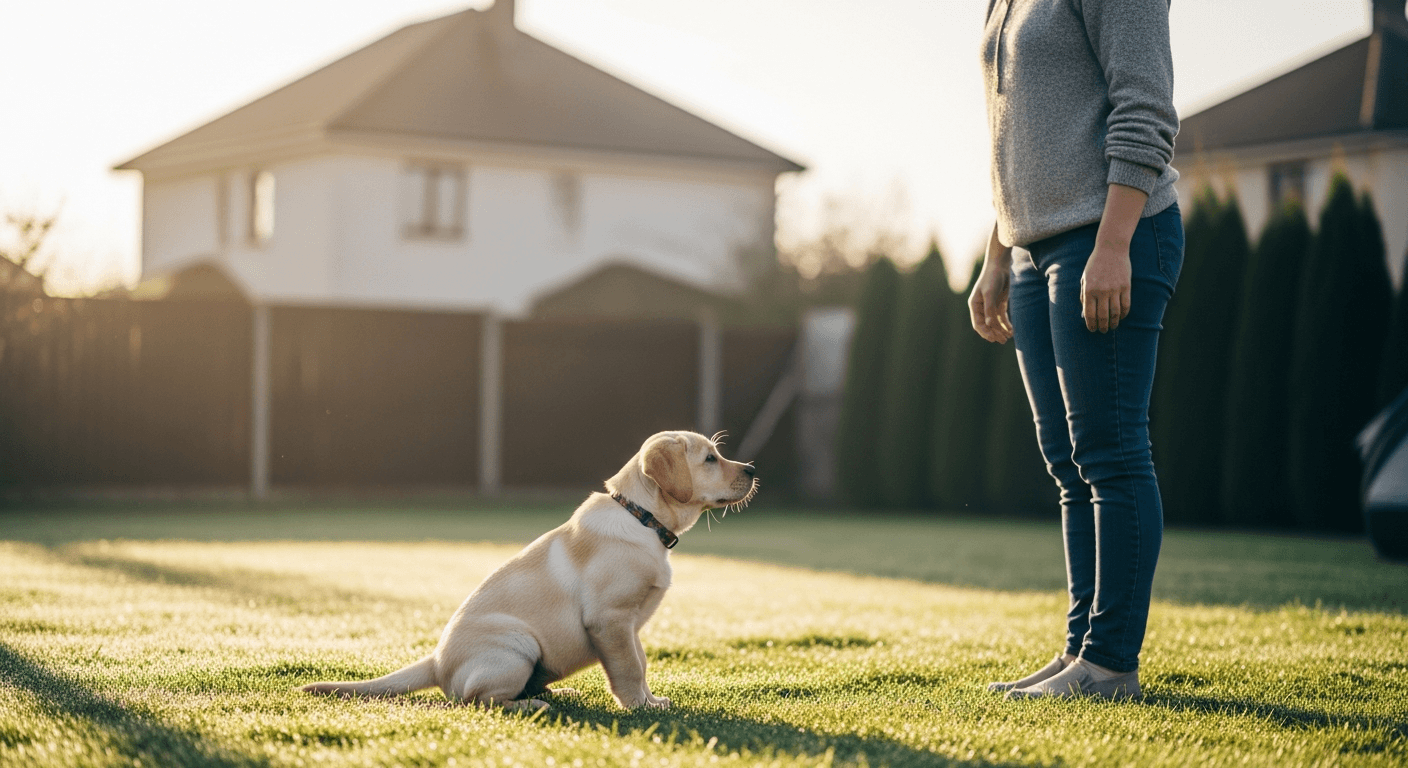
The single most important tool in labrador potty training is a consistent schedule. Labs in particular thrive on routine — their working-breed background makes them highly attuned to handler-set patterns. When outside time is predictable, elimination becomes predictable, and predictable is trainable.
Take your Lab puppy outside at these times, every single day:
- Immediately after waking up (morning and after every nap)
- Within 10 minutes of finishing a meal
- After every play session
- Every 1–2 hours during active daytime hours
- Just before bed
That adds up to 8–10 outdoor trips per day for an 8-week-old puppy. It is a lot. It is also temporary. By 16 weeks, the frequency drops to 6–7 times per day. By 6 months you are at a normal adult schedule.
Nighttime: Labrador puppies at 8 weeks have a bladder capacity of roughly 1–2 ounces — barely enough to make it 2 hours. Set an alarm for a 2–3 hour interval. Take your puppy out, say nothing except your cue word, wait for elimination, reward quietly, and return to sleep. No play. No conversation. Nighttime trips are purely functional.
By 4 months, Labs on a consistent daytime schedule and with a final outing at 11 p.m. can typically hold it through an 8-hour night.
IMAGE 1: daily potty schedule timeline infographic
How to Potty Train a Labrador Puppy: Step by Step
Step 1: Pick one outdoor toilet spot
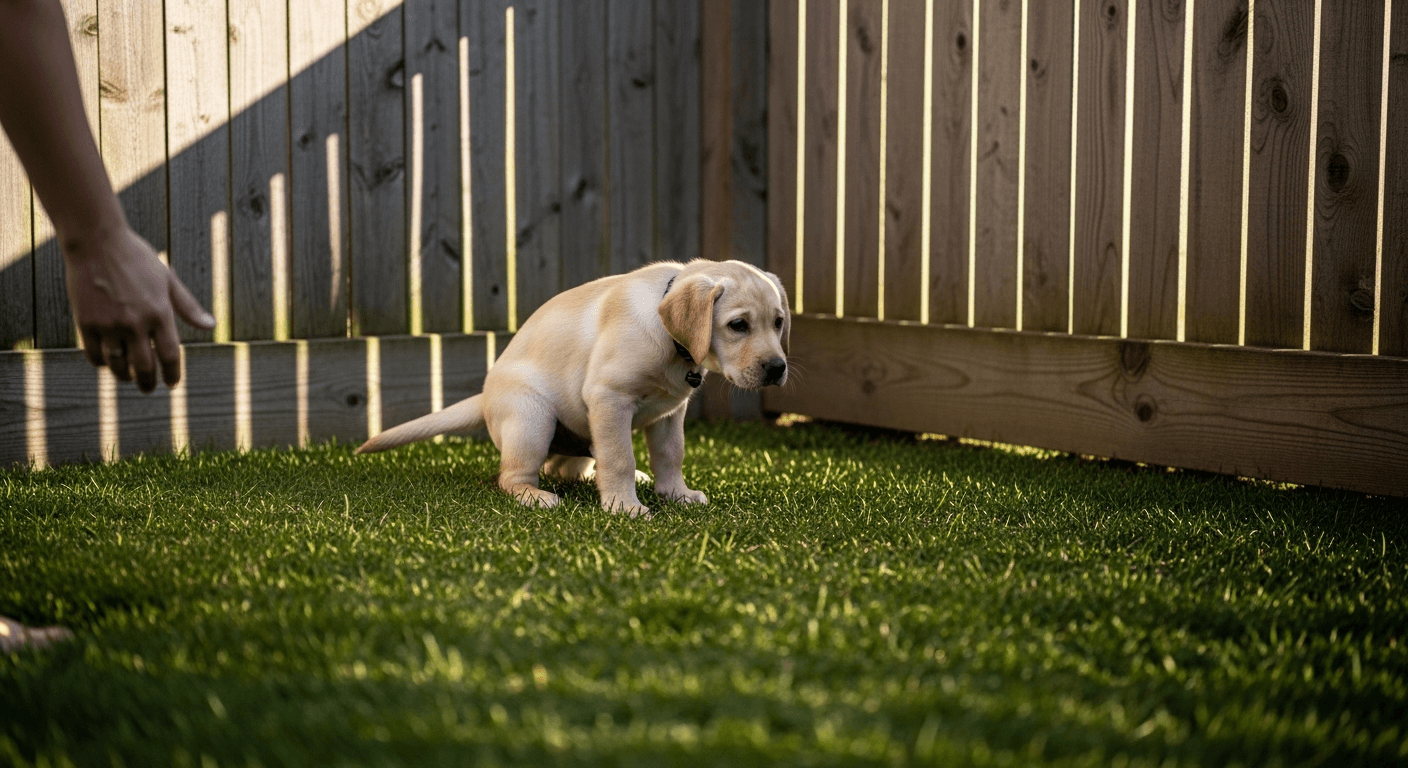
Always take your puppy to the same area of the yard or the same sidewalk patch. The scent of previous eliminations acts as a cue. Most puppies will sniff the spot and go within 2–3 minutes once the association is established.
Step 2: Add a cue word
As your puppy is actively eliminating, say your chosen cue word once in a calm, quiet voice — “go potty,” “hurry up,” or any phrase you will use consistently. After a few weeks, saying the cue word before the puppy goes will prompt the behavior. This is useful in bad weather or when you are in a hurry.
Step 3: Reward within 3 seconds
The reward must arrive within 3 seconds of the last squat or the last drop. Waiting until you are back inside breaks the connection. Carry a few small treats in your pocket for every outdoor trip. Mark the moment with a quiet “yes” or a click, then deliver the treat. According to the AKC’s puppy training guidelines, timing is the single most important variable in positive reinforcement — later rewards teach nothing.
Step 4: Learn the pre-potty signals
Labs typically circle, sniff the floor intently, lower their back end, or suddenly lose interest in play immediately before eliminating. If you see any of these signs indoors, move your puppy outside immediately and calmly — no scolding, no drama. Getting outside even one second before an accident counts as success.
Step 5: Use confinement between trips
When you cannot actively supervise your puppy, use a crate or a puppy-proofed area sized just large enough to stand, turn around, and lie down. Dogs naturally avoid soiling their sleeping area. Confinement is not punishment — it is a management tool that prevents accidents from becoming habits.
The crate and the potty schedule work together. A puppy that goes outside, comes back in, and is crated until the next outdoor trip will almost never have an indoor accident. That successful pattern builds into a reliable habit.
IMAGE 2: Lab puppy going outside in grass
What to Do When Your Lab Has an Accident
Accidents are part of the process. How you respond determines whether they slow training or not.
Do not punish. Rubbing a puppy’s nose in the mess or scolding after the fact does not work. Puppies cannot connect punishment to an event that happened more than a few seconds ago. What they do connect is your unpredictable anger — which erodes trust and makes your puppy afraid to eliminate in front of you, including outside.
Do not react at all if you did not catch it in the act. Clean it up and move on. What went wrong was your supervision, not your puppy’s behavior.
If you catch it mid-accident: A calm, low interruption (“outside”) and immediate movement to the toilet spot is the right response. If your puppy finishes outside, reward as normal.
Clean thoroughly. Dogs return to the same spots because of scent. Standard household cleaners do not break down the urine compounds that dogs can smell. Use an enzyme-based cleaner specifically formulated for pet urine. Spray, let it soak for the time listed on the product, and blot dry. Skipping this step often leads to repeated accidents in the same spot.
Bell Training for Labradors
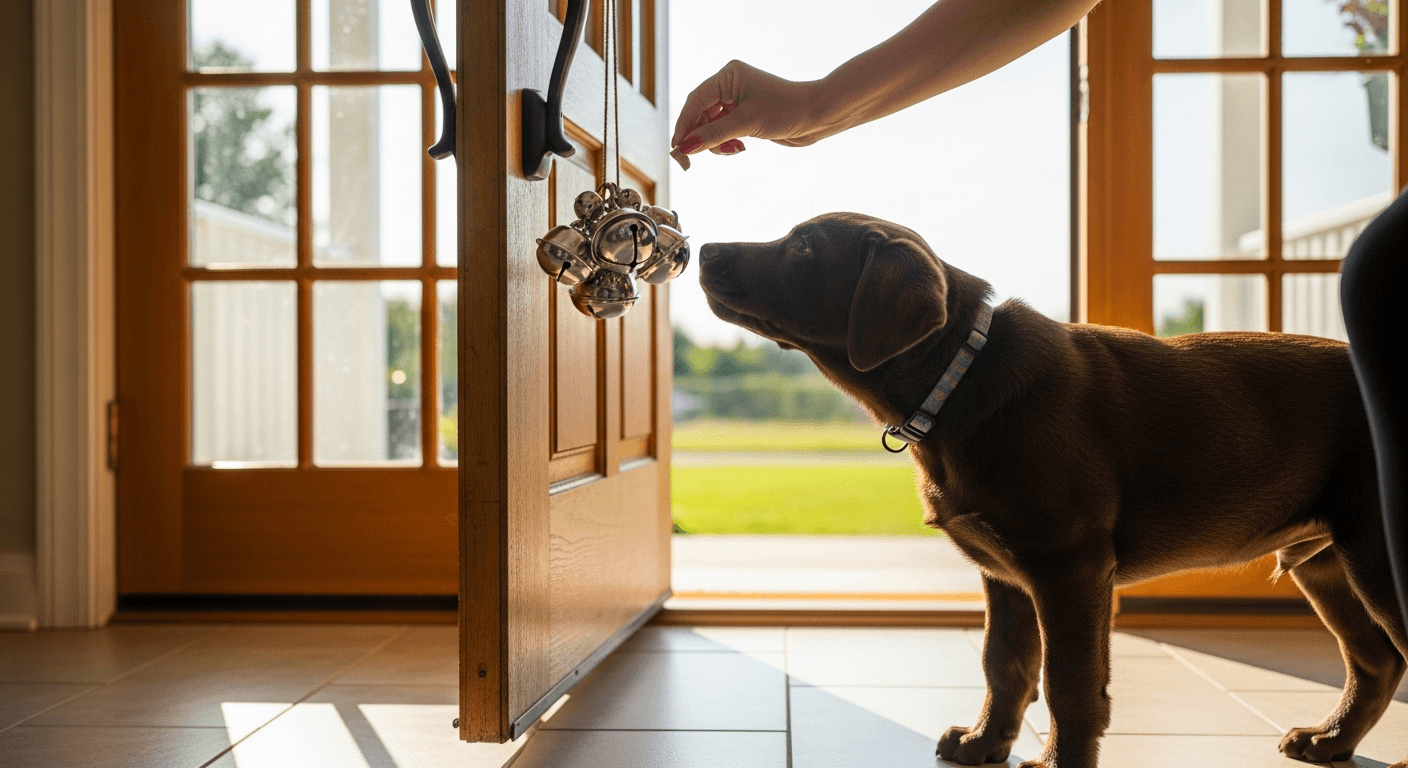
Bell training teaches your Lab to ring a set of jingle bells hanging from the door handle when it needs to go outside. It works because Labs are naturally good at making the connection between an action and a result — ring the bells, the door opens, I get to go outside.
How to teach it:
- Hang bells on the door handle at your puppy’s nose level.
- Every time you take your puppy outside, hold a treat behind the bells so your puppy noses them — the bells ring, you open the door, you go outside.
- After 10–20 repetitions across several days, your puppy will start ringing the bells on its own before outdoor trips.
- Gradually remove the treat prompt and rely only on the bells ringing → door opens sequence.
The one mistake to avoid: Labs are smart enough to figure out that ringing the bells produces door access — and then use it for outdoor playtime, not just elimination. If your Lab starts ringing the bells constantly without eliminating, respond only when elimination actually happens. If the trip produces no elimination within 3–5 minutes, come back inside without reward. The puppy learns quickly that bells are only effective when there is a real need.
IMAGE 3: Lab nosing jingle bells on a door
Common Labrador Potty Training Problems and Fixes
| Problem | Likely Cause | Fix |
|---|---|---|
| Frequent accidents despite going out regularly | Schedule gaps during transition times (after meals, naps) | Add an immediate post-meal trip within 10 minutes every time |
| Lab goes outside then has accident inside 10 minutes later | Puppy was distracted outside and did not fully eliminate | Stay outside until you see complete elimination before re-entering |
| Refuses to go outside in rain or cold | Discomfort with conditions | Use a cue word, stay outside with your Lab — do not shelter while they get wet |
| Was trained but suddenly regressing | Stress (new baby, move, new dog), UTI, or change in routine | Rule out UTI with vet; reset to the 8-week schedule temporarily |
| Goes in crate despite correct sizing | Puppy was left too long; or learned to eliminate in crate before you got them | Return to shorter crate intervals; clean crate with enzyme cleaner |
Regression is common at 4–5 months when puppies enter a hormonal adolescent phase. Do not take it as failure. Reset to the tighter schedule, be consistent for 2 weeks, and most Labs recover quickly. If accidents continue despite correct training and no schedule errors, have your vet check for a urinary tract infection — a common and easily missed cause of house training failure in puppies.
Frequently Asked Questions
How long does labrador potty training take?
Most Labs are reliably house trained by 4–6 months of age with a consistent schedule that starts at 8 weeks. Puppies with inconsistent early training, or those adopted later, may take 6–8 months. Adult Labs adopted from shelters typically house train within 2–4 weeks due to better bladder control.
How often should I take my Labrador puppy outside?
Every 1–2 hours during the day, plus immediately after waking, after every meal, and after play. An 8-week-old puppy needs 8–10 outdoor trips per day. That frequency drops as the puppy’s bladder develops — by 6 months, 5–6 trips is typically sufficient.
What age can a Labrador puppy sleep through the night without a potty trip?
Most Labs can hold it through the night by 4 months of age, provided they go out just before bed and immediately on waking. Before 4 months, set a 2–3 hour alarm for a quiet nighttime trip. No play, no conversation — just outside and back.
My Lab was potty trained but keeps having accidents again — what’s wrong?
First check for a urinary tract infection, which causes sudden urgency and frequent accidents even in trained dogs. If the vet clears that, look for a schedule disruption — a new person, a move, a change in routine. Temporarily return to the strict 8-week schedule for 2 weeks. Most regressions resolve quickly.
Is labrador potty training harder than other breeds?
No — Labs are considered one of the easier breeds to house train. Their food motivation makes positive reinforcement highly effective, and they are people-oriented enough to care about pleasing you. The challenge with Labs is their puppy energy: they get distracted outside and may not fully eliminate before wanting to play, which leads to accidents indoors soon after.
Labrador potty training comes down to one thing: taking your puppy outside before it needs to go, not after. Set the schedule today, commit to it for 6 weeks, and most of the work is done. For a broader foundation in teaching your Lab — commands, obedience, adolescence, and behavior — see our complete Labrador training guide.