
Labrador puppy health demands more decisions in the first year than in any other stretch of your dog’s life. Vaccinations at 8, 12, and 16 weeks, monthly parasite prevention, a spay or neuter decision, and the first joint checks all land inside 12 months. This guide lays out the full schedule — what happens when, what each step protects against, and which warning signs need a vet. It is the health companion to our Labrador puppy first-year guide.
A Labrador puppy needs three DA2PP doses at 8, 12, and 16 weeks, a rabies vaccine at 12 to 16 weeks, and adult boosters at 12 to 15 months. Non-core vaccines like Bordetella and leptospirosis depend on your puppy’s lifestyle.
| Age | Core Vaccines | Optional (Lifestyle-Based) |
|---|---|---|
| 8 weeks | DA2PP (distemper, adenovirus, parvovirus, parainfluenza) | Bordetella |
| 12 weeks | DA2PP booster | Leptospirosis, Lyme |
| 16 weeks | DA2PP booster + rabies | Bordetella booster |
| 12–15 months | DA2PP booster + rabies booster | As needed |
Labrador Puppy Vaccination Schedule: 8 Weeks to 12 Months
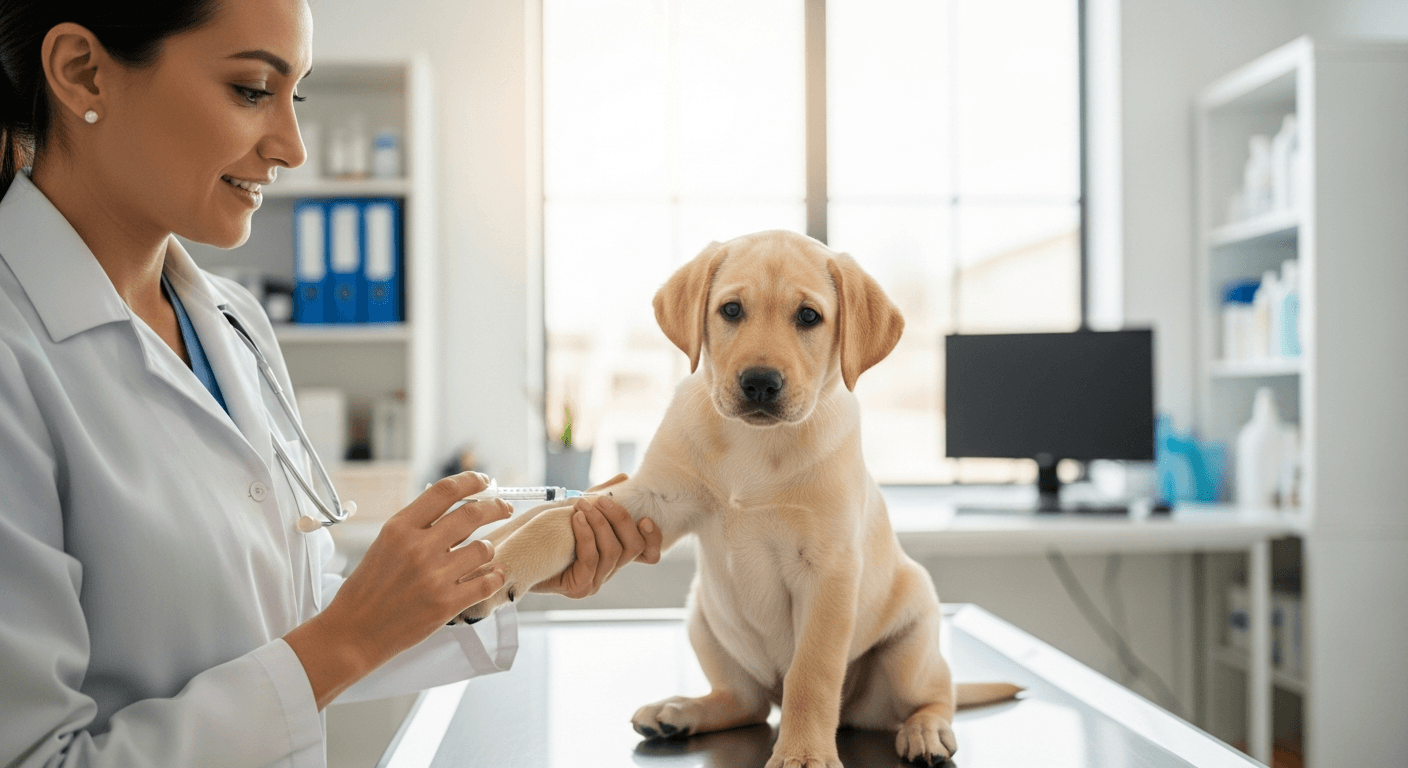
The core of every Labrador puppy vaccination schedule is DA2PP. One combination shot covers distemper, adenovirus (hepatitis), parvovirus, and parainfluenza. Your puppy gets it three times — at 8, 12, and 16 weeks.
Why three doses instead of one? Puppies inherit temporary immunity from their mother’s first milk. Those maternal antibodies fade at an unpredictable rate, and while they last, they can block a vaccine from working. The three-dose series exists to make sure at least one dose lands after the maternal protection wanes.
Parvovirus is the one to take most seriously. It spreads through contaminated soil and surfaces, hits puppies between 6 weeks and 6 months hardest, and is frequently fatal without hospital treatment. The AKC’s vaccination guide treats the parvo series as non-negotiable, and so do we.
Rabies is required by law for dogs in nearly every US state. Most Lab puppies receive it at 12 to 16 weeks — your vet will follow your state’s timing.
Non-core vaccines depend on lifestyle. Bordetella (kennel cough) makes sense if your puppy will attend daycare, boarding, or group puppy classes. Leptospirosis matters for Labs that will swim in ponds or lakes — which describes most Labs. Lyme vaccination is worth discussing if you live in a tick-heavy region.
The puppy series is not the finish line. A booster round at 12 to 15 months confirms immunity, and after that, adult boosters run on a 1-to-3-year cycle.
Your Labrador Puppy’s First Vet Visit: What to Expect at 8 Weeks
The first visit is mostly hands-on inspection, and it usually takes 30 to 45 minutes. The vet will weigh your puppy, take its temperature, listen to the heart and lungs, check eyes and ears, feel the abdomen, and examine the bite and limbs. Labs are checked for umbilical hernias, which veterinarians consider one of the more common congenital findings in the breed and often hereditary.
Bring a fresh stool sample in a sealed bag. Nearly every vet requests one at the first visit to screen for roundworm, hookworm, and giardia — all common in young puppies regardless of how careful the breeder was. Screening matters extra for this breed: Labs scavenge anything they can reach, which raises parasite exposure from day one.
Bring the breeder’s paperwork too. The vet needs to know which vaccines and deworming doses your puppy has already had, and what food it currently eats. Microchipping is usually offered at this visit or the next one. We recommend saying yes — a 2009 JAVMA study by Lord et al. found microchipped dogs were returned to owners more than twice as often as dogs without chips, and friendly, food-motivated Labs are exactly the breed that wanders off with a stranger.
Expect the first DA2PP dose before you leave, if the breeder hasn’t covered it. Mild lethargy or soreness at the injection site for 12 to 24 hours afterward is normal.
One last thing: this first visit starts a 10-to-12-year relationship. If the practice feels rushed or the answers feel dismissive, we think it is completely reasonable to try a different clinic for visit two.
Parasite Prevention for Lab Puppies: Fleas, Ticks, Heartworm & Worms
Heartworm prevention starts at 8 weeks and never stops. Most veterinarians recommend a monthly preventive year-round across the continental US, because heartworm disease is easy to prevent and risky to treat. Most monthly products are safe from 8 weeks of age.
Flea and tick control runs on the same monthly rhythm. Oral chews such as NexGard, Simparica, and Bravecto are highly effective and skip the skin-application issues some owners dislike with topicals. All are prescription products, so dosing gets set by your vet based on your puppy’s fast-changing weight.
Intestinal worms are usually handled before you ever meet your puppy — responsible breeders deworm at 2, 4, 6, and 8 weeks. Your vet confirms with the fecal test and prescribes another round if anything shows up. Giardia deserves a mention because Lab puppies love drinking from puddles. It causes persistent loose stools, shows up on the fecal test, and clears with a short course of medication.
One warning we repeat to every new Lab owner: never use an over-the-counter flea product that is not explicitly labeled for puppies. Some contain permethrin doses that are toxic to young dogs. When in doubt, buy prevention through your vet.
When to Spay or Neuter a Labrador Puppy: What the Research Shows
The old advice was simple: spay or neuter at 6 months. For large breeds like Labs, the research no longer supports that as a default.
A 2020 UC Davis study led by Dr. Benjamin Hart tracked joint disorders (hip dysplasia, elbow dysplasia, and cruciate ligament tears) in 1,933 Labs. In males, the rate doubled when they were neutered before 6 months. In females, it rose when they were spayed at any point before their first birthday. Sex hormones help regulate bone and joint development, and removing them early may disrupt that process in a fast-growing breed. Hip dysplasia already runs in Labrador lines, so this finding carries real weight — our Labrador hip dysplasia guide covers how the condition develops and what treatment costs.
The current direction of veterinary guidance reflects this shift. The AVMA’s spay/neuter resource emphasizes individualized timing over a universal age. The Hart study’s guideline is to neuter males after 6 months and spay females after 1 year. AAHA’s guidelines for dogs over 45 pounds say males should wait until growth stops, usually 9 to 15 months, and give females a 5-to-15-month window set by your vet. Our Lab neutering guide walks through both sexes.
Waiting has trade-offs. Intact males mark and roam more. Intact females cycle twice a year for about 3 weeks at a time. These are management challenges, not health crises.
Our recommendation: put the question on the agenda at your 6-month visit. Your vet knows your puppy’s growth curve and your household’s ability to manage an intact adolescent.
Labrador Puppy Health Problems: Early Warning Signs That Need a Vet
Most Labrador puppy health problems announce themselves early, and knowing the urgency level matters more than memorizing symptoms. We use a three-tier framework.
Emergency — go now. Not eating for more than 24 hours. Repeated vomiting or diarrhea, especially with blood. Extreme lethargy or inability to stand. Labored breathing. Crying, a hunched posture, or guarding a body part. Any suspected swallowing of a toxin or object — a real hazard with Labs, who eat first and think later.
Call the vet within 24 hours. Three or more loose stools in a row. Vomiting more than once. Eye or nasal discharge that persists. Sudden limping. Weight loss or a marked personality change.
Monitor at home. Mild loose stools in the first days after a food change. Occasional sneezing. Low energy for a day after vaccines.
A few flags are Lab-specific. Reluctance to climb stairs or jump at a young age can signal a joint problem worth raising early. Persistent eye discharge can point to entropion, an eyelid condition seen in the breed — our Labrador eye problems guide explains what to look for. And ear scratching that starts at 8 to 12 weeks is often the first sign of allergies, which Labs express through their ears — see our guide to Labrador ear infections.
The general rule from most veterinarians: when in doubt, call. A five-minute phone consult beats a night of anxious guessing. First-year emergencies are also the strongest argument for pricing pet insurance while your puppy is young and premiums are low.
Frequently Asked Questions
What vaccinations does a Labrador puppy need?
Every Lab puppy needs the DA2PP series at 8, 12, and 16 weeks, plus a rabies vaccine at 12 to 16 weeks. Boosters follow at 12 to 15 months. Bordetella, leptospirosis, and Lyme vaccines are optional add-ons based on daycare plans, swimming habits, and tick exposure in your area.
How much do Labrador puppy vaccinations cost?
Plan for roughly $75 to $100 per puppy visit at most US clinics, and $250 to $350 total for the first-year vaccine series including exam fees. Low-cost vaccine clinics and shelters often run the same core vaccines for significantly less. Rabies is sometimes subsidized by county programs.
When should a Labrador puppy first see the vet?
Within the first 72 hours of coming home, even if the breeder’s vaccines are current. The first visit establishes a baseline weight, screens a stool sample for parasites, and catches issues like umbilical hernias or heart murmurs early — while most purchase contracts still allow recourse.
What are the most common Labrador puppy health problems?
Digestive upsets lead the list — usually from food changes, scavenged objects, or giardia. Ear infections and early allergy signs follow close behind, since Labs are prone to both. Joint concerns like hip dysplasia typically show up later, but reluctance to jump or climb stairs is worth flagging at any age.
When should I neuter my Labrador puppy?
For males, not before 6 months. A 2020 UC Davis study of Labs found joint disorders doubled in males neutered earlier, and AAHA advises large-breed males wait until growth stops, usually 9 to 15 months. For females, the same study suggests spaying after 1 year. Settle the plan with your vet at the 6-month visit.
The first year sets the foundation for the next decade of Labrador puppy health. Three decisions carry the most weight: finishing the full vaccination series, starting parasite prevention at 8 weeks, and settling spay/neuter timing with your vet instead of defaulting to 6 months. For everything else happening in these same 12 months — feeding, training, growth stages — keep our Labrador puppy first-year guide close at hand.