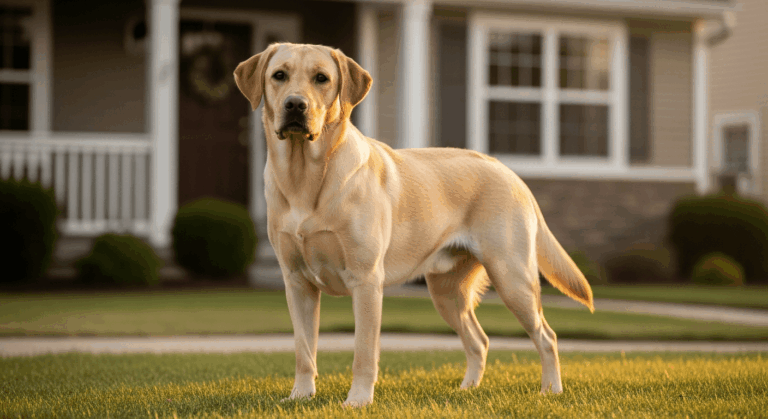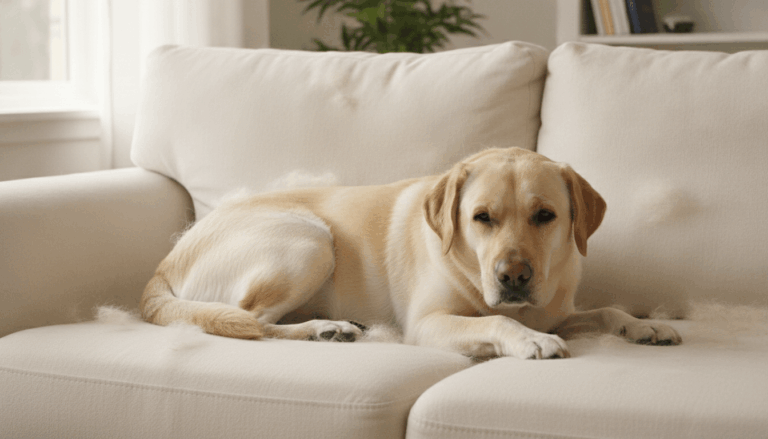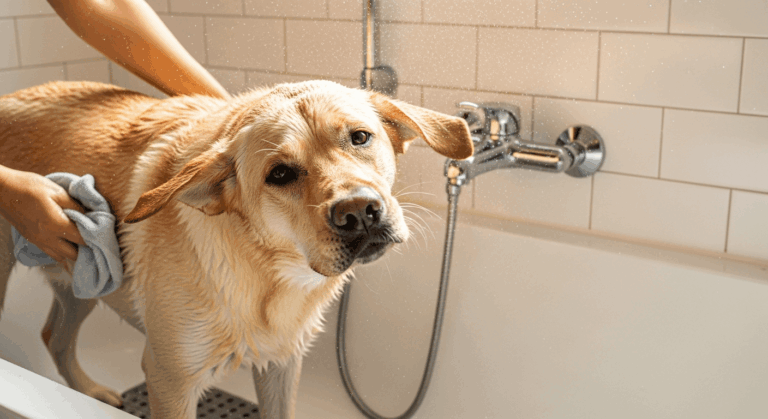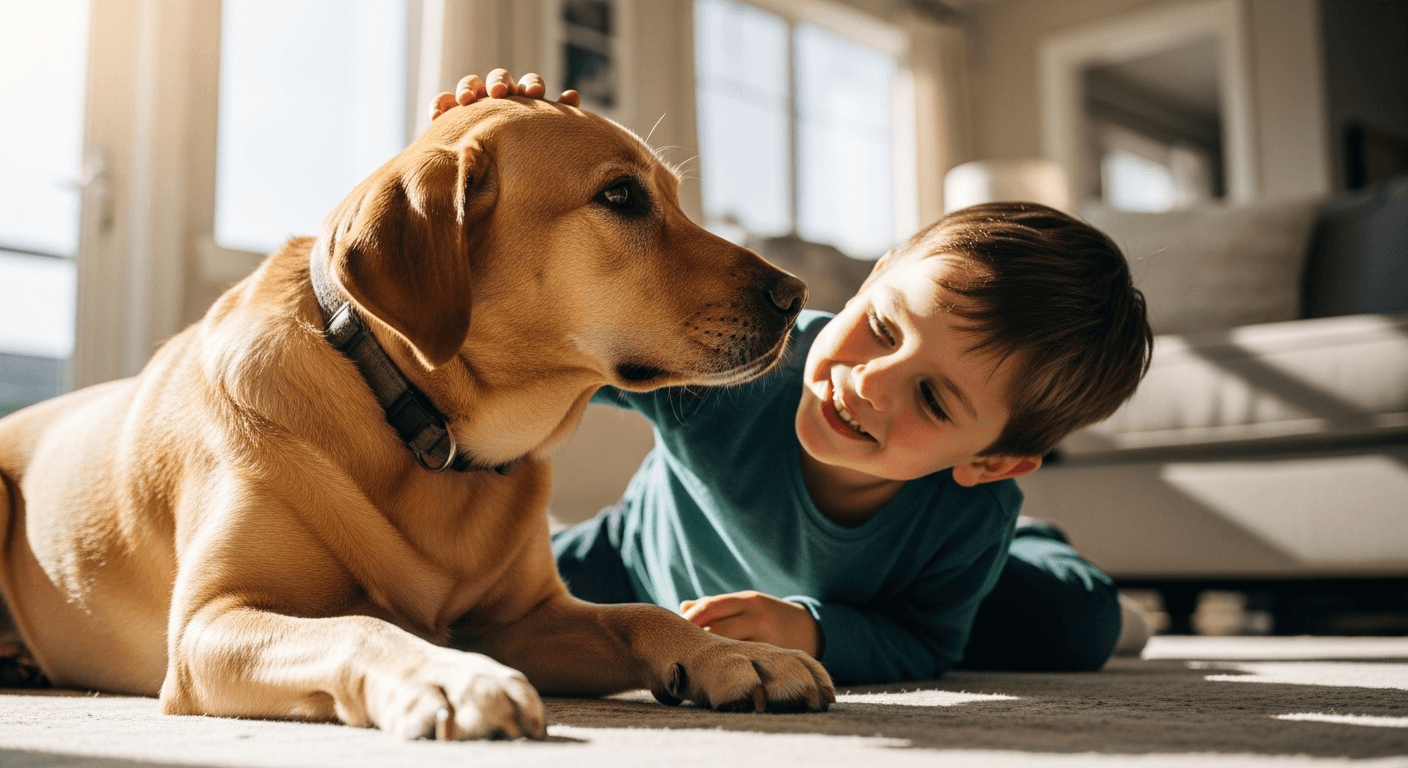
Are Labradors good with kids? Yes — and the reputation is earned. The temperament is genuinely suited to life with children. But “good with kids” isn’t the same as “automatically safe in any situation without thought.” A Lab that hasn’t been trained for family life is a large, enthusiastic dog that can knock over a toddler while trying to greet them. Understanding what makes Labs good with children — and what the relationship actually requires — is where good outcomes start.
Labrador Temperament: Why They’re Naturally Good with Kids
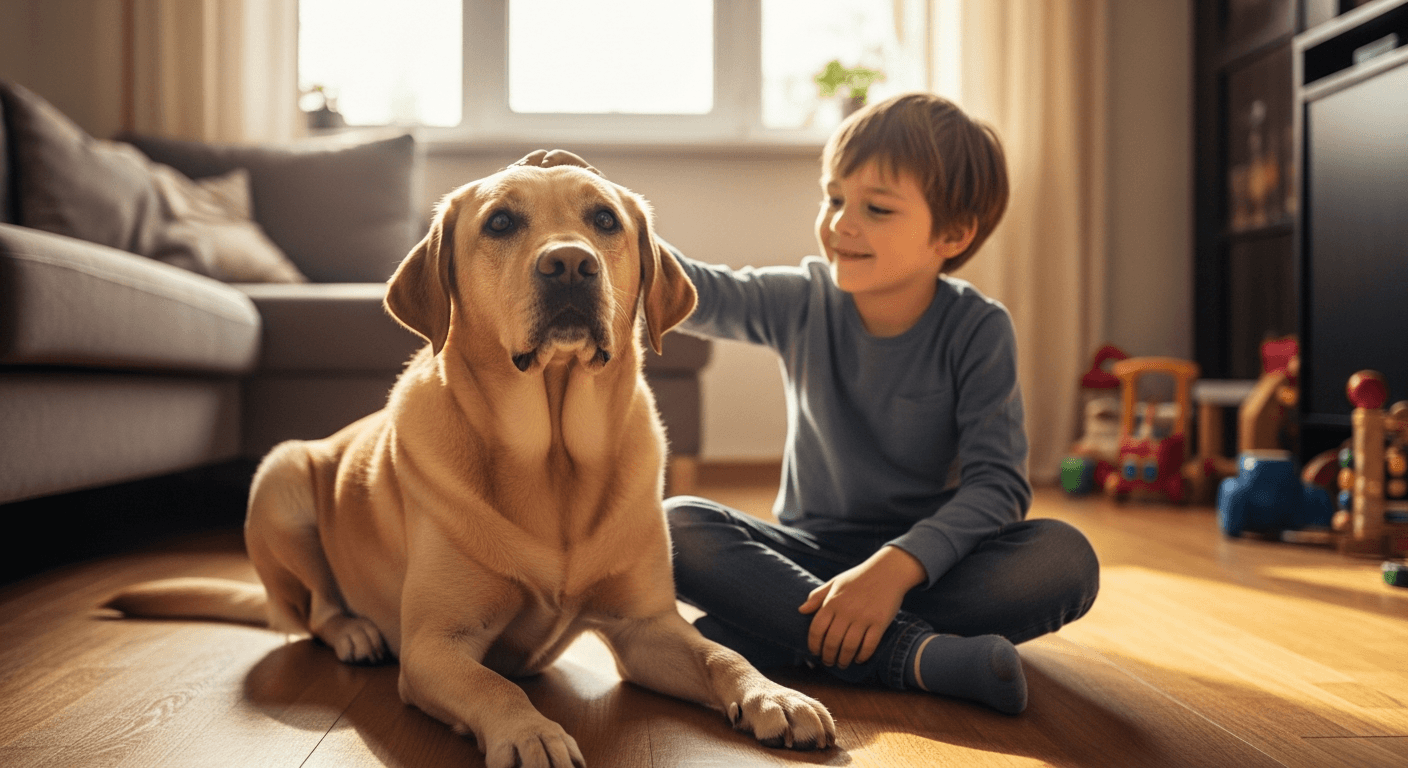
The Lab’s family-friendly reputation has a structural basis, not just a marketing one. Many parents also weigh the breed against its closest rival — see our Labrador vs Golden Retriever comparison for families.
Labs were bred to work in close physical partnership with humans — retrieving in high-stimulus environments while maintaining a calm, biddable disposition. The AKC breed standard calls explicitly for a gentle temperament. Non-aggression wasn’t an accident; it was selected for across generations of working dogs. The result is a breed with a genuinely high bite threshold. Unprovoked aggression is rare in a properly socialized Lab, and the dog is slow to bite even when pushed.
That high bite threshold matters specifically with children. Kids handle dogs clumsily — they approach from awkward angles, grab at ears and tails, make sudden movements, and create loud sounds at close range. These behaviors trigger fear or defensive responses in many breeds. Labs tolerate them more reliably than most. This isn’t unlimited patience — a dog in pain, or one with a history of mistreatment, can reach its limit in any situation — but the Lab’s baseline is more forgiving than the average family dog.
Energy match is the other factor that makes Labs work in family settings. They’re active enough to engage enthusiastically with children’s play — fetch, running, swimming — and calm enough to settle inside after exercise. A dog that can’t shift between those two modes is as difficult as one that won’t engage at all.
Socialization history matters more than sex. Males are often slightly more boisterous through adolescence; females can be marginally easier to train during the same period. But individual temperament and training history are the real variables. A Lab raised from puppyhood in a household with children will be more reliably calm around them than an adult rehomed from an adult-only home, regardless of sex. Still at the selection stage? Our guide to getting a Labrador puppy covers finding a breeder who raises family-ready puppies.
Age Matters: Labs with Toddlers, School-Age Children & Teenagers
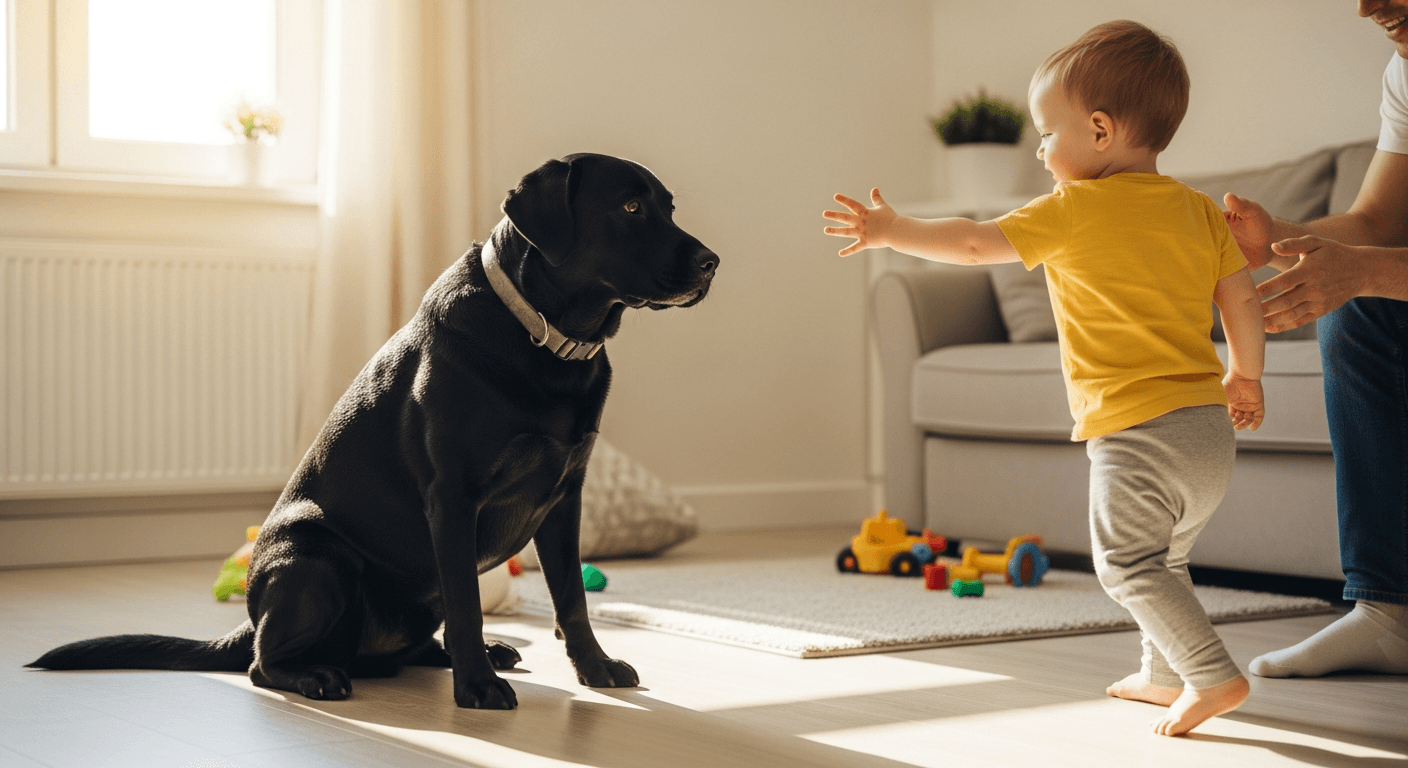
The Lab-and-child dynamic changes significantly depending on the child’s age. The same dog that is a natural companion for a nine-year-old needs active management around a two-year-old — not because the dog is dangerous, but because the interaction is completely different.
Toddlers (under 3): This combination requires the most supervision, and the most honest discussion. The risk with Labs and toddlers isn’t aggression. The risk is size and exuberance. A Lab’s wagging tail at child height can knock a toddler over. A Lab jumping in greeting can send a small child to the floor. Toddlers are also unpredictable in ways that startle even calm dogs — sudden screaming, erratic movement, grabbing at the dog’s face. No unsupervised interaction between a toddler and any dog, including a Lab, is the appropriate standard. This applies even to dogs with long, calm histories around children. Wondering about the flip side — whether a Lab will actively watch over your kids? See are Labradors protective.
Early school age (3–7): Children in this range start to follow basic interaction rules and can begin learning to read dog body language. Labs match well with this group — they have the energy for active play and the patience for quieter contact. Oversight is still required, but the interaction becomes more genuinely reciprocal as the child learns what the dog responds to.
School age (8–12): The best match for the Lab’s natural temperament and energy level. These children can learn proper interaction, handle the dog’s physical size, and participate meaningfully in training. Labs often form their deepest household bonds with children in this range. A child who participates in training sessions at age 10 builds a relationship with the dog that pays dividends for years.
Teenagers: Generally the easiest combination. Teenagers can manage the Lab’s size and match its energy outdoors. The main risk is inconsistent training reinforcement — a teenager who allows jumping or lets the dog steal food teaches the Lab that some household members are lower-status. Rules must be uniform across everyone in the home.
Toddler and puppy at the same time: Two of the most demanding, unpredictable household members simultaneously. Manageable with planning and structure, but it requires more sustained supervision than either scenario alone. If you’re in this situation, have a clear management plan before committing to a puppy.
Training Your Labrador for a Family Household
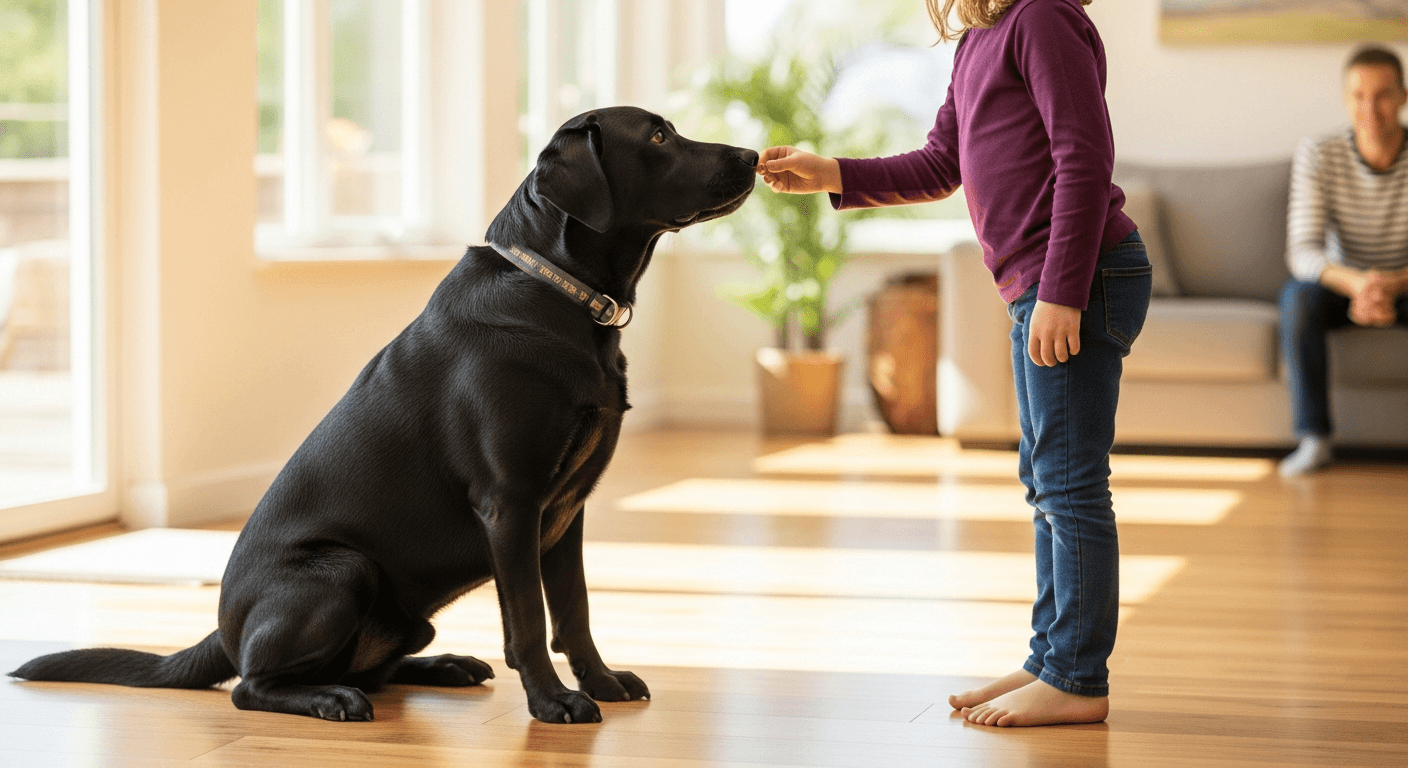
A good temperament is the starting point, not the whole answer. The bridge between a naturally gentle dog and a reliably safe family companion is deliberate training applied to the situations that actually arise in a house with children. Four behaviors matter most.
1. No jumping. A Lab that jumps on adults will jump on children — with more serious consequences given the size difference. Train this to reliability before a child is regularly in the environment. The method: complete disengagement when jumping occurs, reward only when four paws are on the floor. Everyone in the household must apply this consistently, every time, or it won’t hold.
2. Down-stay. The ability to settle in a designated spot on cue is the most useful daily safety behavior. A Lab in a reliable down-stay can’t simultaneously be underfoot during a toddler’s mealtime, charging at guests at the front door, or jumping at children coming home from school. Train it with the three D’s — Duration, Distance, Distraction — in that order.
3. Gentle take. Food and objects should never be grabbed forcefully. This matters when children hand treats to the dog, hold food near it, or interact around its bowl. Train a gentle take by closing your fist over the treat until the dog backs off and softens, then opening the palm.
4. Leave it. A reliable leave-it prevents resource conflicts between dog and child — a child’s toy on the floor, dropped food at the table, a snack in a small child’s hand. Leave-it is one of the simplest commands to train with high-value rewards and one of the most practically useful in a family home.
Consistency across all household members is non-negotiable. If one person enforces no jumping and another allows it, the Lab learns that some humans are exempt. Brief coaching of frequent visitors — grandparents, friends who visit weekly — preserves the training that took months to establish. For the full foundation training sequence, see our complete Labrador training guide.
Children should learn alongside the dog. Teach children not to approach the dog while it’s eating or sleeping, not to chase a dog that has walked away, and not to pull ears or tails. Give the dog an off-limits space — its crate or a raised bed — where children are not permitted to disturb it. This is a welfare requirement for the dog, and teaching children to respect it also teaches them a foundational rule about all dog interaction.
Supervision & Boundaries: Building a Safe Household
Training creates the conditions for safety. Daily supervision habits maintain it.
Active supervision means watching what’s actually happening between the dog and child — not just being in the same room with the television on. It means seeing the dog’s body language and the child’s behavior in real time, and intervening when either isn’t right.
The AVMA’s guidance is clear: no unsupervised dog-child interaction, regardless of the dog’s track record. A dog that has never shown any concerning behavior can still have a bad day — discomfort from an injury, a startle reaction, resource conflict over something unexpected. The cost of this rule is minimal; the upside is real.
The dog needs an exit. A crate or raised bed where children can’t follow gives the dog a space to remove itself from overwhelming interaction. A dog with no exit option eventually uses its only remaining tool. Labs almost never reach that point — but the escape route matters for the dog’s welfare regardless of how calm the dog is, and teaching children to respect it establishes the correct mental model for dog interaction.
Dog body language is learnable by children as young as five. Yawning, lip licking, turning away, whale eye (whites of the eyes visible around the iris), and stiff posture are discomfort signals that precede a growl. Teaching children to recognize these means they can disengage before the interaction escalates. Act immediately on any growling around children — even resource guarding around the food bowl. Growling is communication, not misbehavior. Suppressing it by punishing the growl removes the warning signal without addressing the underlying tension.
Puppy vs Adult Lab: Which Is Better for a Family?
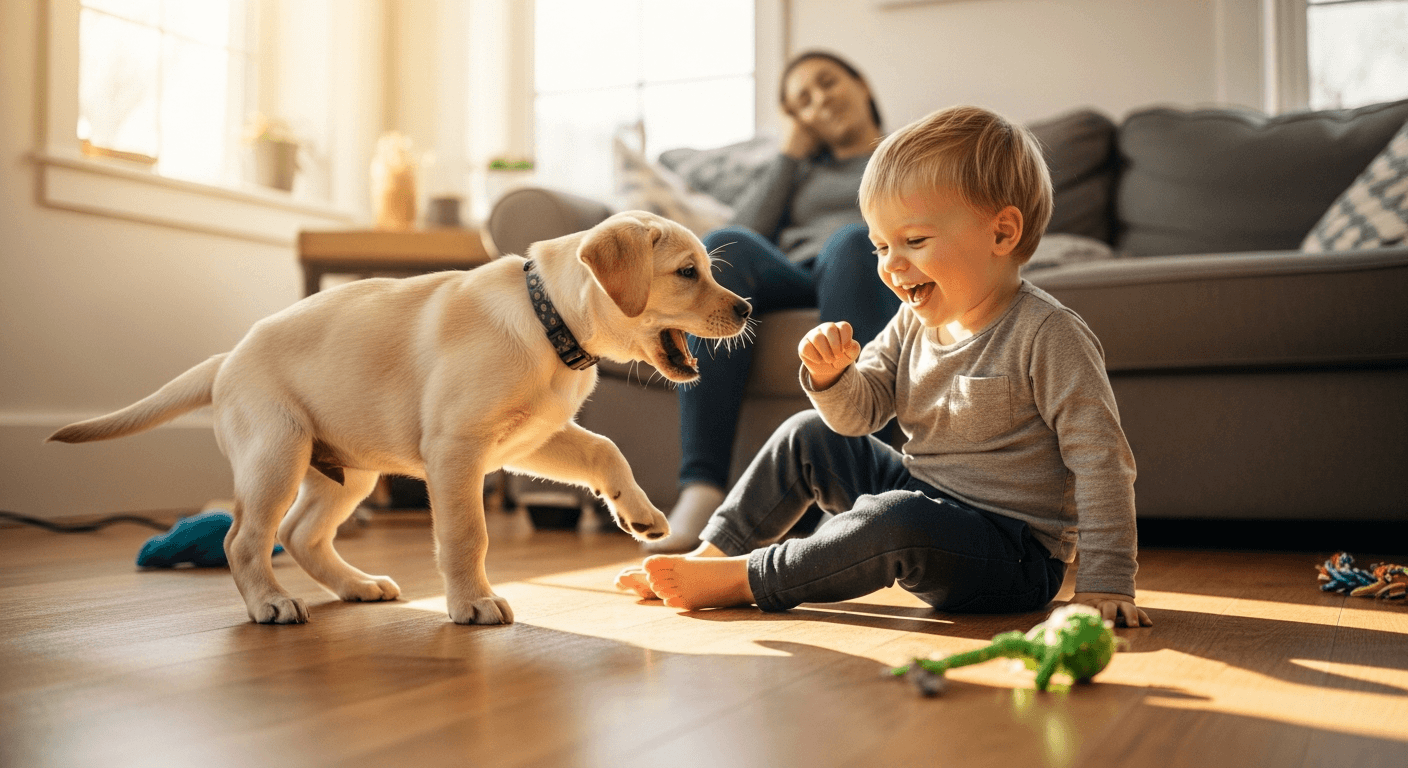
The default assumption is that families should get a puppy. For families with young children, that assumption is sometimes wrong.
The case for a puppy: socialized with your specific children from the start, you know the full history, and you can shape the dog’s early experience around your household. The downsides are real — Lab puppies are mouthy, energetic, and demanding. A 14-week-old Lab bouncing and nipping is a poor addition to a household with a toddler and a sleep-deprived parent. The first six months require significant daily investment.
The case for an adult Lab: what you see is what you get. A 2–4 year old Lab has an established temperament. A rescue organization that has assessed it as child-appropriate, and that has observed it in a home environment, gives you more certainty about actual behavior than any puppy can. Many adult Labs are relinquished for reasons entirely unrelated to behavior — owners returning to work, housing changes, family circumstances. A house-trained, calm 3-year-old Lab can be a better fit for a family with toddlers than a 10-week-old puppy.
The practical split: for families with children under 5, a calm adult Lab from a reputable rescue that has been specifically assessed around young children is often the lower-risk choice. For families with school-age children, either option works well — the puppy’s developmental period is easier to manage when children are old enough to participate in training rather than requiring simultaneous supervision.
Regardless of age: meet the dog before committing. With a puppy, ask to meet the dam — maternal temperament is the strongest single predictor of the puppy’s adult temperament. With an adult, ask specifically and in detail about prior history with children, and ask how the rescue assessed it. For the full guide to finding a reputable breeder or ethical rescue, see Getting a Labrador Puppy.
Health Screening: What to Check Before Bringing a Family Dog Home
Families focused on temperament often overlook health, but health and temperament interact directly in a family setting.
A Lab with untreated hip dysplasia experiences chronic pain as the condition progresses. A dog in chronic pain is more reactive to the unpredictable physical contact of children — being bumped, leaned on, climbed over — than a pain-free dog. Health clearances before purchasing a puppy aren’t overcaution; they’re due diligence for a dog that will be around children for 10–12 years.
For a puppy: ask for OFA or PennHIP hip screening on both parents, OFA elbow certification, EIC (exercise-induced collapse) DNA clearance, and eye health clearance (OFA/CAER). A responsible breeder has these documents and shows them without hesitation. A breeder who can’t provide them should not be on your list. For an adult rescue, request whatever veterinary records the organization holds and ask whether any physical issues were identified during their assessment.
Pet insurance, taken out before any health condition is documented, is a practical safety net for a family dog. A Lab that develops joint problems at six years without insurance in place puts the family in a difficult treatment decision. Insurance taken out at 8–10 weeks covers that scenario. For what hip dysplasia looks like as it progresses and how to manage it, see Labrador Hip Dysplasia.
Frequently Asked Questions: Labradors and Kids
Are Labradors safe around young children?
Labradors are among the safest breeds around children due to their high bite threshold and patient temperament. However, no dog is safe without supervision around toddlers. The most common risk with Labs and very young children isn’t aggression — it’s size and enthusiasm. A jumping Lab or wagging tail at child height can knock a small child over. Supervision and training remove this risk.
At what age is a Labrador best with children?
Labs are best matched with school-age children — roughly 8–12 years old. These children can handle the Lab’s physical size, participate in training, and build a genuine bond. Labs are manageable with younger children with appropriate supervision. Toddlers require the highest level of active supervision regardless of how well-trained the dog is.
Should I get a Lab puppy or adult dog for my family?
It depends on your children’s ages. Families with toddlers often do better with a calm, child-assessed adult Lab than with a mouthy, exuberant puppy that needs constant supervision simultaneously. Families with school-age children can manage either well. Meet the individual dog before committing — temperament varies regardless of age or breed.
What training does a family Lab need?
Four behaviors matter most in a family household: no jumping (essential around small children), down-stay (settle in place during busy moments), gentle take (no forceful grabbing of food or objects), and leave-it (prevents resource conflicts with children). All four require consistency from every person in the household to hold.
How do I introduce a Labrador to a baby or toddler?
Introduce calmly with the dog on a lead initially. Let the dog sniff from a distance before allowing closer contact. Keep the first interactions brief and reward calm behavior near the child. Never place a toddler on the floor with an unsupervised dog during early introductions. Gradually increase exposure over days and weeks as the dog demonstrates calm, settled behavior in the child’s presence.
Labradors are genuinely excellent family dogs — the reputation holds up in practice. What determines whether it works isn’t the breed but the habits: consistent training across all household members, active supervision that’s present rather than passive, and a household where both dog and children have clear expectations and an off-limits space to retreat to. For everything else about living with a Lab day-to-day, see our Complete Guide to Living with a Labrador.