Labrador eye problems are among the most carefully monitored health concerns in the breed — and for good reason. Labradors carry known genetic mutations affecting vision, which is why the Labrador Retriever Club recommends eye examinations for all breeding stock. If your Lab is showing eye changes, or you’re buying a puppy and want to know what health tests to ask about, here’s what matters.
Yes — Labradors have a hereditary predisposition to cataracts caused by specific gene mutations. Labs can also develop age-related cataracts as seniors. Hereditary cataracts typically appear in dogs under 5 years of age and progress faster than age-related ones. DNA testing identifies carriers before breeding.
Common Labrador Eye Problems: An Overview
Labrador eye problems fall into two broad categories: inherited conditions caused by specific gene mutations, and acquired conditions like infection or inflammation that can affect any dog.
The most significant inherited conditions in Labs are hereditary cataracts (HC) and progressive retinal atrophy (PRA). Both are caused by identifiable gene mutations and can be screened for through DNA testing. Entropion — an inward rolling of the eyelid — also appears in some Lab lines and requires veterinary correction.
Acquired conditions include conjunctivitis (eye inflammation), corneal ulcers, and routine eye discharge. These are generally treatable and less predictable than inherited conditions.
One important distinction that owners often miss: cloudiness in the lens is not always cataracts. Nuclear sclerosis is a normal hardening of the lens that occurs in most dogs from about 6 years onward — and in Labs this tends to appear on the earlier end of that range, often from 6–7 years, given their active lifestyle and early senescence pattern, producing a blue-grey haze that looks alarming but does not significantly affect vision. A vet exam is the only reliable way to tell the difference. According to VCA Animal Hospitals, nuclear sclerosis is one of the most common conditions misidentified as cataracts by owners.
Labrador Cataracts: Hereditary vs Age-Related
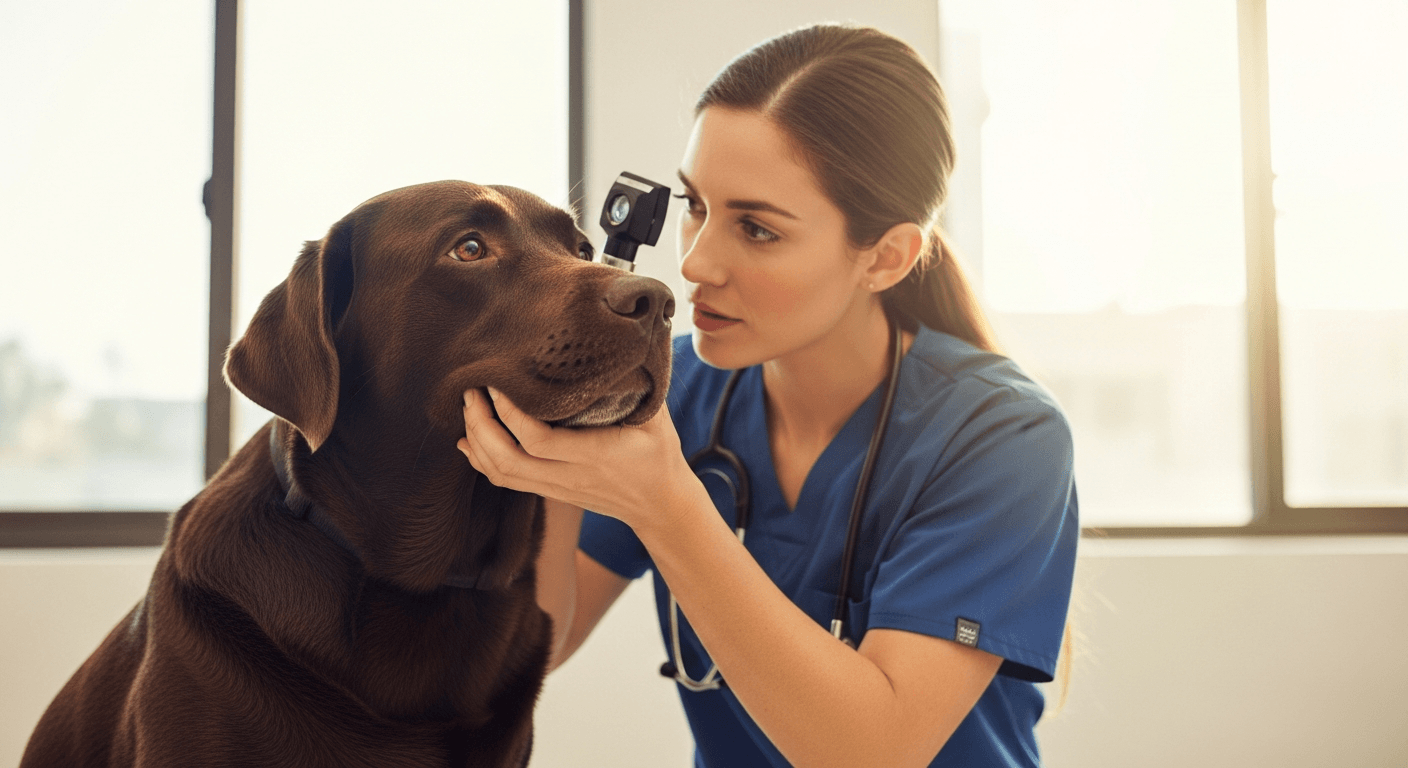
Labrador cataracts come in two distinct forms, and the distinction matters significantly for prognosis and treatment.
Hereditary cataracts are caused by specific gene mutations — in Labs, primarily the HC4 locus. A dog with two copies of the mutation (affected) will develop cataracts, often before 5 years of age. A dog with one copy (carrier) won’t develop cataracts itself but can pass the mutation to offspring. Hereditary cataracts progress faster and can cause significant vision impairment in affected dogs.
Age-related cataracts develop in most dogs eventually — typically from 8 years onward. Progression is slower than hereditary cataracts, and most senior Labs retain functional vision and quality of life with moderate age-related lens clouding, since the process is slow and Labs adapt well by relying on scent and hearing.
The signs are similar regardless of type: white or grey opacity in the lens (behind the pupil, not on the corneal surface), stumbling in low light, bumping into furniture, or hesitation on stairs. Diagnosis requires a specialist exam — a slit-lamp biomicroscopy by a veterinary ophthalmologist is the standard tool.
Treatment is surgical. Phacoemulsification — the same technique used in human cataract surgery — is effective and widely available for dogs. Not every cataract requires surgery; severity and rate of progression determine whether intervention improves quality of life. A DNA test (available through Embark or Optigen) identifies hereditary cataract carrier and affected status for Labs specifically.
Progressive Retinal Atrophy in Labradors: Genetics, Signs & Living with Vision Loss
Progressive retinal atrophy (PRA) is the most serious inherited eye disease in Labradors in terms of final outcome. It causes progressive degeneration of the retinal photoreceptors — first the rods (night vision), then the cones (daylight vision) — leading eventually to complete blindness. The process is painless.
The most common form in Labs is prcd-PRA (progressive rod-cone degeneration). A dog that is homozygous for the mutation — two copies — will develop PRA. Carriers (one copy) will not develop PRA themselves but can produce affected offspring when bred with another carrier. According to the Merck Veterinary Manual, prcd-PRA follows a straightforward autosomal recessive pattern that DNA testing can fully characterise.
Age of onset varies. Some Labs show signs at 3–5 years; others not until 7–10 years. Night blindness — difficulty navigating in low light — is typically the first sign. Day vision deteriorates later.
Labs adapt remarkably well to gradual vision loss. They compensate with smell and hearing. Keeping furniture placement consistent, removing trip hazards, and using scent markers at doorways all help. A blind Labrador can still run, swim, play, and live a full life. The diagnosis is harder on the owner than on the dog.
DNA testing for prcd-PRA identifies affected, carrier, and clear dogs. It’s the essential tool for breeders and also the most reliable diagnostic confirmation for an owner who suspects PRA in a Lab showing early signs.
Entropion, Conjunctivitis & Other Eye Conditions
Entropion is an inward rolling of the eyelid that causes the lid fur to rub against the cornea. Signs include excessive tearing, squinting, pawing at the eye, and corneal cloudiness at the lid margin. Left untreated, it causes corneal ulcers. The fix is a minor surgical eyelid correction with high success rates. Any Lab showing those symptoms should be examined promptly.
Conjunctivitis — inflammation of the pink tissue surrounding the eye — is the most common reason Labs visit a vet for eye labrador eye problems. Causes include bacterial infection, allergic reaction, or a foreign body. Signs: discharge (clear discharge suggests allergic or early infection; yellow or green indicates bacterial), redness, and squinting. Most bacterial conjunctivitis in Labs resolves with a short course of prescription antibiotic drops.
Eye discharge: a small amount of clear, watery discharge is normal — dogs produce the same “sleep” that humans do. Significant clear discharge, or any yellow or green discharge, warrants a vet visit. Discharge in young Labs alongside squinting or eye-rubbing may indicate early entropion.
Corneal ulcers can develop secondary to entropion, foreign bodies, or trauma. They are very painful — the dog will squint and paw at the eye persistently. Treat as urgent. Do not wait for a routine appointment if the eye is being continuously pawed at.
Eye Health Screening: What to Ask When Buying a Lab Puppy
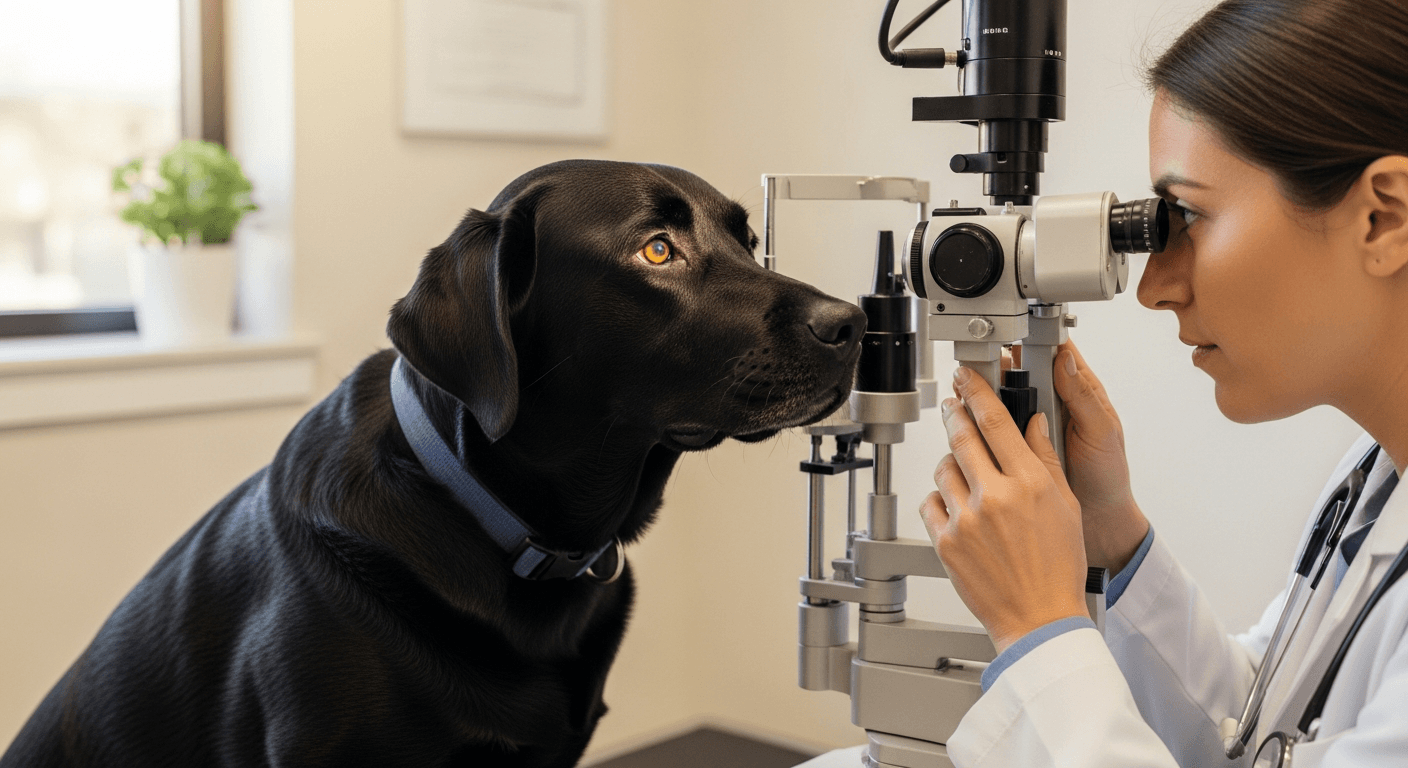
For prospective Lab buyers, labrador eye health screening is one of the most important parts of evaluating a litter. Two types of documentation are required.
CAER exam (Companion Animal Eye Registry) — previously CERF — is an annual ophthalmological examination by a board-certified veterinary ophthalmologist. It screens for a range of inherited and acquired eye conditions. Both parents should have a current CAER clearance, not just a note from a regular vet that their eyes “looked fine.” The OFA (Orthopedic Foundation for Animals) records CAER results and issues certificate numbers — ask for those certificates directly.
DNA testing for prcd-PRA and hereditary cataracts (HC4) is separate from the CAER exam. The DNA test identifies genetic status (clear, carrier, or affected) for each condition. Both Embark and Optigen offer these tests. A breeder who provides CAER clearances but no DNA tests has done half the job.
What to require as a buyer: current CAER clearance AND DNA clear or carrier status for both PRA and hereditary cataracts, for both parents. A carrier parent is acceptable only if the breeding partner is DNA clear — this prevents producing affected offspring. A reputable breeder provides this documentation without being asked.
For full guidance on evaluating a litter and what breeder health testing covers, see our guide to getting a Labrador puppy.
Frequently Asked Questions About Labrador Eye Problems
Do Labradors commonly get eye problems?
Yes. Labradors are among the dog breeds most carefully monitored for labrador eye problems because the breed carries known genetic mutations for hereditary cataracts and progressive retinal atrophy. Acquired conditions like conjunctivitis are also common. DNA testing and annual CAER exams are the primary preventive tools.
What does a cataract look like in a Labrador?
A cataract appears as a white or grey opacity inside the lens of the eye — behind the pupil. It is distinct from the blue-grey haze of nuclear sclerosis, which is a normal age-related lens change that doesn’t significantly affect vision. A vet exam is needed to distinguish between them.
Can a Labrador with PRA still have a good quality of life?
Yes. Dogs with progressive retinal atrophy adapt well to gradual vision loss, using smell and hearing to compensate. Keeping the home environment consistent — same furniture layout, no unexpected hazards — helps significantly. Many blind Labs remain active, playful, and engaged well into old age.
What is the CAER exam for Labradors?
CAER (Companion Animal Eye Registry) is an annual eye examination by a board-certified veterinary ophthalmologist that screens for inherited and acquired eye conditions. It is the breed-standard health test for Labrador eye health. Results are registered with the OFA. Both parents of a litter should have current CAER clearances.
Is eye discharge in Labradors normal?
A small amount of clear, watery discharge is normal. Significant clear discharge or any yellow or green discharge indicates infection or irritation and warrants a vet visit. Discharge in a young Lab accompanied by squinting or pawing at the eye should be evaluated promptly — it may indicate early entropion.
Most labrador eye problems are either manageable or preventable with the right testing. For hereditary cataracts and PRA, DNA testing gives the clearest picture — both for buyers screening a litter and for owners seeking a diagnosis for a Lab showing early signs. Annual CAER exams for breeding dogs are the breed standard for a reason. For a complete overview of health conditions to monitor across your Lab’s life, see our complete Labrador health guide.