The best harness for Labrador dogs fits the individual dog and gives you the leash attachments you need for everyday walks. Compare chest measurements, adjustment points, and buckle placement before choosing a size. A harness can help you manage a walk, but it does not teach loose-leash walking by itself.
We compare four specific versions below, from a padded front-and-back design to a buckle-neck option and two designs with tightening loops. The size examples describe the selected products; they are not a recommendation that every adult Lab needs Medium or Large.
By PuppDelight Editorial Team
We compared manufacturer specifications, product instructions, and U.S. retailer listings. We have not hands-on tested these products.
Product photos come from the selected Amazon listings; the walking and fitting scenes are generated generic illustrations.
At a glance
Amazon U.S. prices checked Nov 8, 2026 · USD
Padded everyday walks
$59.99
Opening neck buckle; six adjustments
$45.95
Bundle; back tightening loop
$45.96
Lower-priced; chest tightening loop
$22.99
Our top pick: Ruffwear Front Range
For Labs comfortable with an overhead harness: padding, four adjustments, and front/back attachments. Choose Blue-9 if an opening neck buckle matters more.
Prices may change. USD before tax and shipping; confirm the selected offer.
Four attachment and adjustment designs
OUR TOP PICK · EVERYDAY WALKS
01 · PADDED FRONT AND BACK
Ruffwear Front Range
Standard · Medium · 27–32-inch girth · Blue Pool
$59.99 at Amazon
USD · Price checked Nov 8, 2026
Consider this for
Everyday walks when padding and both attachment locations matter
What makes it different
Four adjustments; foam-padded chest and belly
Check before buying
Overhead opening; standard version, not Front Range Flex
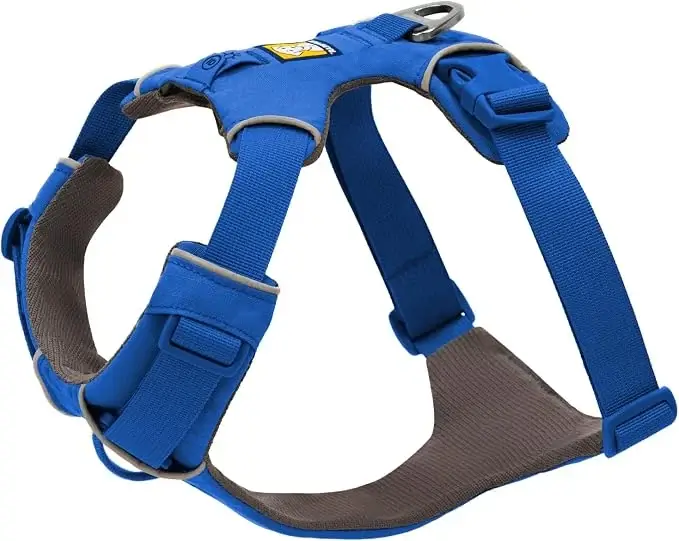
The standard Front Range has a back aluminum V-ring and reinforced webbing at the chest. Ruffwear lists four adjustment points and foam padding. Its Medium chart covers a 27–32-inch measurement around the widest ribcage; larger Labs may need another size.
We favor this combination as a starting point because it lets you compare front and back handling without changing harnesses. Padding is another clear difference from the Blue-9’s exposed webbing. Neither feature tells us how an individual Labrador will move in it, so assess the fitted harness before committing to longer walks.
The main buying limitation is the overhead opening. If your dog backs away when a loop approaches its head, compare the Balance’s opening neck buckle. Do not assume that an Amazon listing for Front Range Flex describes this standard version. Ruffwear’s care directions for the standard model specify hand washing, mild detergent, and air drying.
OUR PICK · BUCKLE-NECK ADJUSTMENT
02 · BUCKLE-NECK WEBBING
Blue-9 Balance Buckle-Neck Harness
Black · M/L · 24–35.5-inch ribcage range
$45.95 at Amazon
USD · Price checked Nov 8, 2026
Consider this for
A dog that dislikes an overhead opening
What makes it different
Six adjustments; neck buckle; front and back rings
Check before buying
Unpadded webbing requires individual strap-position checks
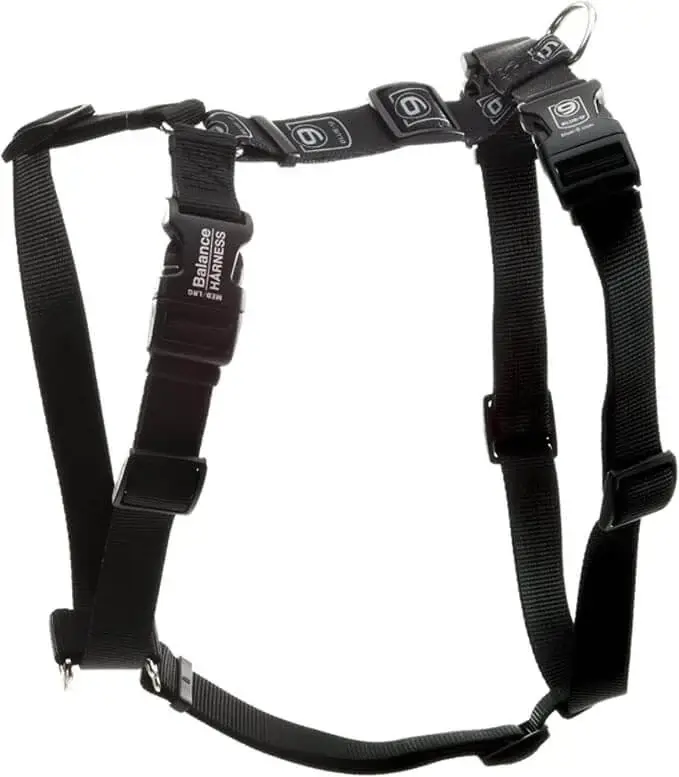
The Balance Buckle-Neck Harness opens at the neck, so the loop can be fastened around your dog. Blue-9 lists six adjustment points and front and back leash rings. Our selected Amazon version is Black M/L, labeled for a 24–35.5-inch ribcage measurement.
We would compare it first when getting a harness on calmly is the main difficulty, or when separate strap adjustments matter to the fit. That wider advertised adjustment range is not proof that it fits more Labradors than the Front Range. The neck, chest, and ribcage straps still need to sit correctly together.
Its main limitation is the unpadded webbing layout. The manufacturer’s fitting guide shows the girth strap around the ribcage, clear of both the underarm and soft abdomen. Check that position while your Lab stands and moves. Additional adjustment points do not establish an escape-proof fit or guarantee against rubbing. We retain one retailer link because the alternative Chewy candidate was not fully resolved in the research.
OUR HARNESS-AND-LEASH BUNDLE OPTION
03 · HARNESS AND LEASH BUNDLE
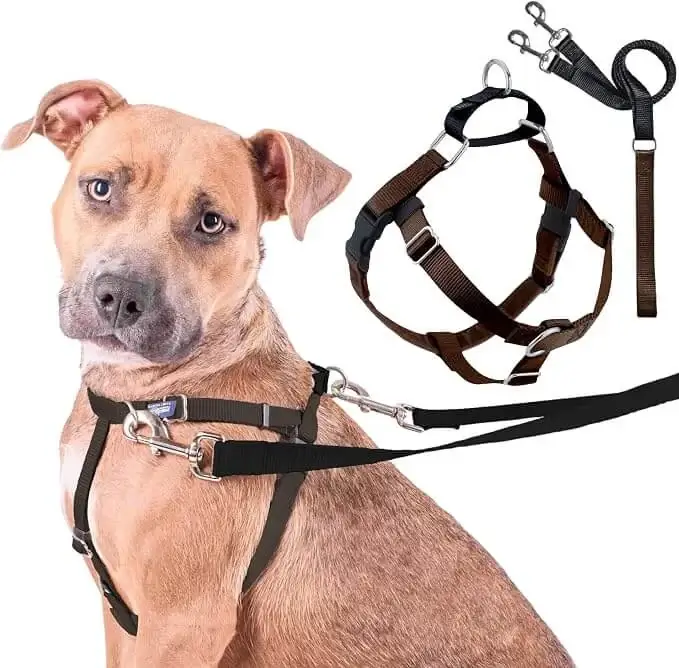
2 Hounds Design Freedom No-Pull Harness and Leash
Brown · Large · 1-inch straps · 28–32-inch chest · Leash included
$45.96 at Amazon
USD · Price checked Nov 8, 2026
Consider this for
An owner comparing a harness with an included leash
What makes it different
Front and back connections; four adjustments; lined strap
Check before buying
Back martingale loop tightens under tension
The selected Freedom bundle includes the Brown harness and a leash. Its Large size has 1-inch straps and a 28–32-inch chest range. The selected listing describes four adjustment points and velvet lining; the manufacturer explains the front and back connection options.
This is the bundle to compare if you want both pieces in one purchase. A double-connection setup lets the handler use the front and back points together, following the manufacturer’s instructions. Check the included leash rather than assuming that every Freedom listing contains the same set: harness-only versions are also sold.
The back connection sits on a martingale loop that tightens with tension. We do not recommend using that action to deliver leash corrections, or treating the name No-Pull as a training outcome. Choose the fixed-layout alternatives first if you want to avoid a tightening mechanism. The lining is a documented feature; it does not establish that this harness cannot rub your dog. Fit and handling still decide whether the setup is appropriate.
LOWER-PRICED FRONT-CLIP OPTION
04 · FRONT-CLIP STRAP DESIGN
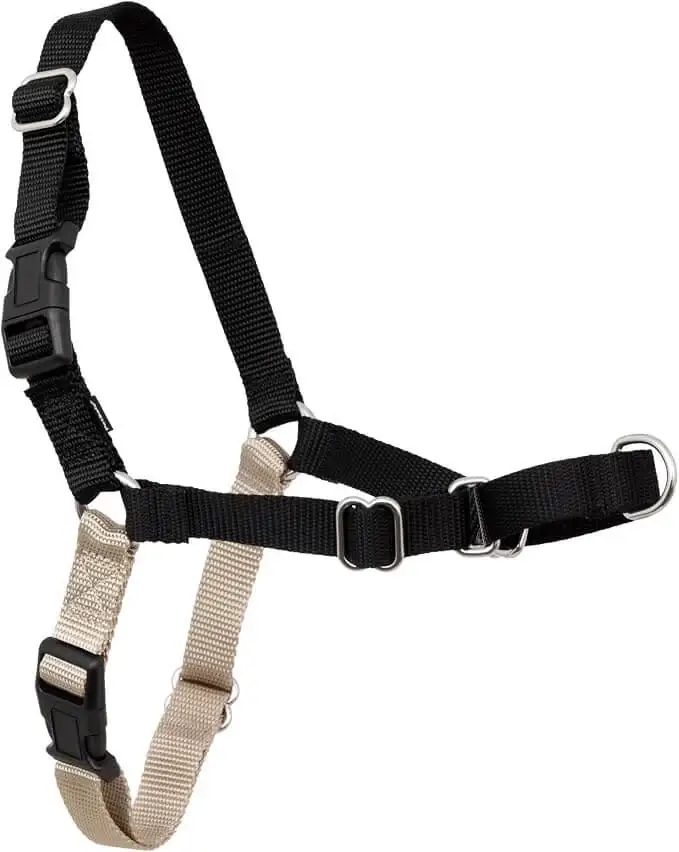
PetSafe Easy Walk
Standard · Large · Black
$22.99 at Amazon
USD · Price checked Nov 8, 2026
Consider this for
Comparing a lower-priced front-attachment layout
What makes it different
Four adjustments; front martingale loop
Check before buying
Cross-chest strap and tightening action differ from fixed-layout alternatives
The standard Easy Walk uses nylon straps, four adjustments, and a leash connection at the chest. PetSafe’s Large chart gives two measurements: 16–21 inches for chest width and 27–40 inches for girth. Those measurements describe different paths on the dog; check both.
It had the lowest Amazon price among these four selected offers when checked. That makes it a useful price comparison, but its construction is a separate decision. Unlike the padded Front Range or adjustable neck-loop Balance, it has a strap running across the chest and a martingale loop at the front.
PetSafe describes that loop tightening when the dog pulls. Assess the chest strap’s position and your Lab’s movement rather than buying from the no-pull label alone. We would compare a different layout if it sits against the shoulder or affects the dog’s stride. This selection is the standard Easy Walk, not Comfort or Deluxe. A familiar brand name does not make those versions interchangeable.
Measure the chest and check movement
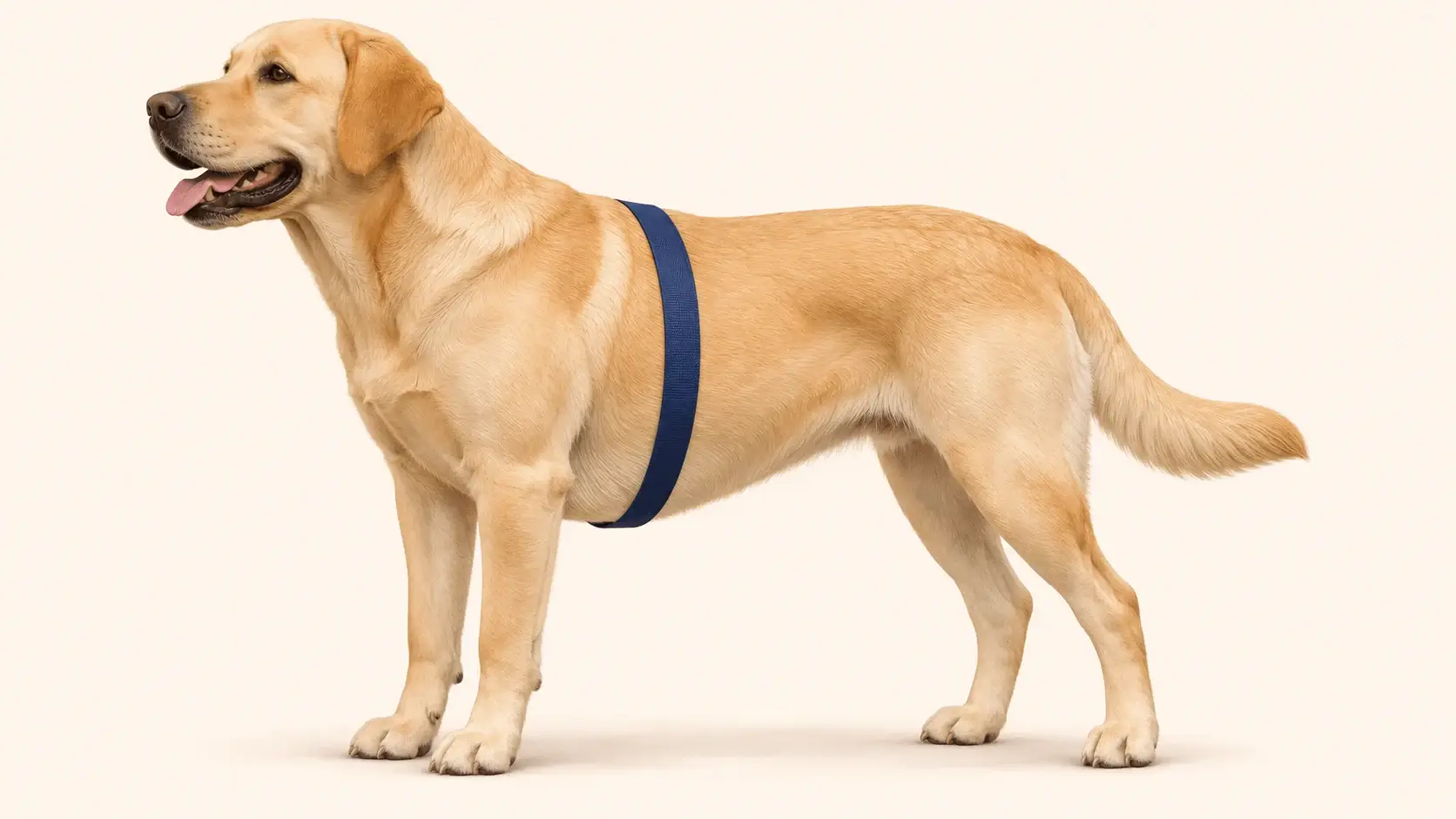
Measure your Labrador while it stands naturally, using the selected brand’s diagram. For a girth measurement, follow the tape around the widest ribcage behind the front legs. Keep the tape level and record the result before opening a size selector. A breed label or approximate body weight is not enough.
The selected examples show why size names do not transfer between brands. Ruffwear’s Medium covers 27–32 inches around the ribcage. Freedom’s selected Large covers 28–32 inches around the chest. PetSafe asks for a separate chest-width measurement as well as girth. Use its diagram instead of interpreting chest width as another circumference.
Read boundary instructions, too. Ruffwear advises choosing the larger size between sizes. The Freedom fitting text favors the smallest size that fits, including its Medium example at an exact 28-inch measurement. Ask the manufacturer if your dog falls on a boundary and the straps do not settle correctly.
After fastening the harness, check the actual strap paths. The Blue-9 guide illustrates how a girth strap can sit too near the underarm or too far back toward the abdomen. Watch the front panel or straps while your Lab walks and lowers its head to sniff. A matching number on a chart is only the beginning of the fit check.
VCA Animal Hospitals’ equipment guidance emphasizes a harness that avoids chafing and leaves shoulder movement clear. Stop to reassess a strap pressing into the shoulder, rubbing skin, or shifting enough that the dog may slip out. A photograph of a harness on another dog cannot establish that fit for yours.
Match the attachment to your walking plan
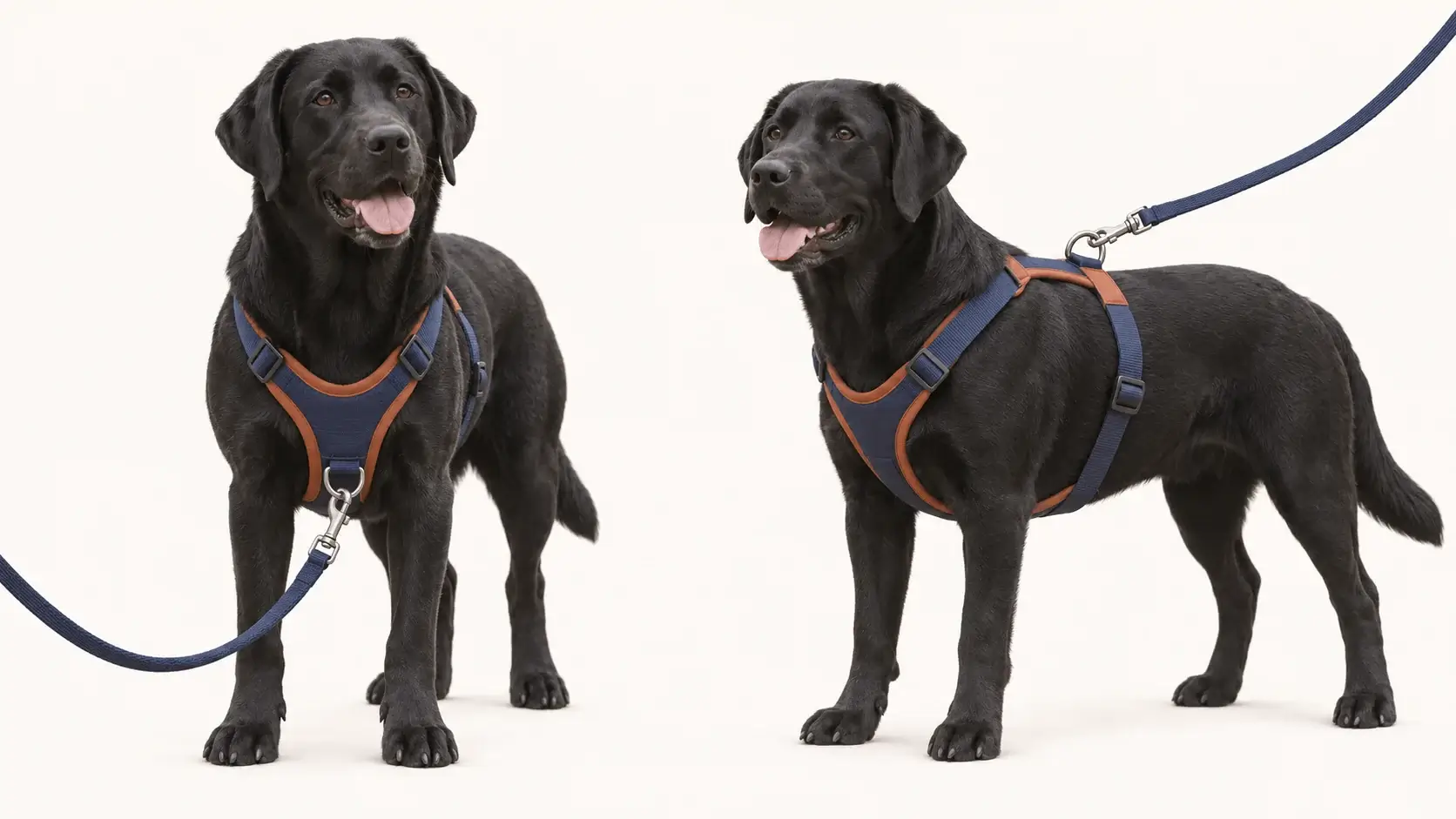
A back attachment places the leash connection over the torso. A front attachment places it at the chest and changes where leash tension acts. Ruffwear, Balance, and Freedom give you both locations; the selected Easy Walk is a front-attachment design. Choose a setup you can fit and handle according to its instructions.
With a front connection, check where the leash runs when your Lab turns or sniffs. With two connections, learn the handling arrangement before heading into a busy area. Extra rings and a matched leash do not remove the need to practice calmly with your dog.
The American Veterinary Society of Animal Behavior recommends reward-based training and advises against leash corrections. Use rewards to practice basic obedience cues alongside the equipment. If this is your first puppy, introduce training to a young Labrador in short, manageable sessions.
If a walk includes lunging, distress, or attempts to escape, understand the behavior behind a difficult walk and get individual help. Buying a more restrictive harness is not a behavior assessment.
Keep vehicle use separate. We have not established crash-test certification for any of these selected walking harnesses. A strong leash ring, vehicle accessory, or word such as secure does not establish crash protection. Check a restraint intended for that use and its exact instructions before car travel.
How we compared the harnesses
We reviewed manufacturer product pages and fit guidance, then rechecked the selected U.S. retailer listings on November 8, 2026. We compared measurements, attachments, adjustments, padding, how the harness goes on, and whether the selected offer includes a leash. Amazon checks used a New York 10001 delivery destination; that is not a guarantee of delivery to every U.S. address.
Our recommendations are editorial judgments from those documented differences. We have not fitted these harnesses to our own dogs, measured shoulder movement, or tested escape resistance, chafing, durability, or crash performance. We do not give them test scores.
The selected listings matter: standard Front Range is separate from Flex; Freedom is a Brown harness-and-leash bundle; Easy Walk is the standard Black model. Chewy is included only for the matching Ruffwear variant. A retailer’s promise that a harness stops pulling is not adopted as evidence that it trains your Labrador.
Frequently Asked Questions
Can a harness stop my Labrador from pulling without training?
A harness provides an attachment and handling arrangement; it does not teach the dog which walking behavior earns rewards. A front connection may change how you manage the leash, but training still needs to accompany it. We would choose the fit and construction first, then practice calm walking through a reward-based plan.
Is an overhead or buckle-neck design better for my dog?
Watch how your dog responds when equipment is introduced. An overhead design may suit a dog that accepts a loop passing over its head. A buckle-neck model opens that loop, which offers another way to put it on. Either design needs an individual fit check; additional buckles do not prove comfort or security.
Can I use the walking harness as a car restraint?
We have not verified any of these selected walking harnesses as crash-tested car restraints. Their leash attachments and walking features do not establish that purpose. Check a restraint made for vehicle use, including its size, installation instructions, and evidence for the exact version. Do not infer certification from an accessory clip or a retailer’s broad safety language.
Should a Labrador puppy keep wearing the same size?
Recheck the puppy’s measurements and fitted strap positions as it grows. More adjustment room does not guarantee that the same harness remains appropriate. Change sizes when the current model no longer follows its fit guidance. Do not buy an oversized harness for growth if it leaves the puppy able to slip out during current walks.
What if my dog backs out of a correctly adjusted harness?
Treat the escape as evidence that the current setup is not containing that dog reliably, even if you followed the chart. Stop relying on it for ordinary walks and ask the manufacturer or a qualified reward-based professional to reassess the fit and design. Avoid trying to solve the problem simply by tightening every strap further.
Recheck the fit during early walks
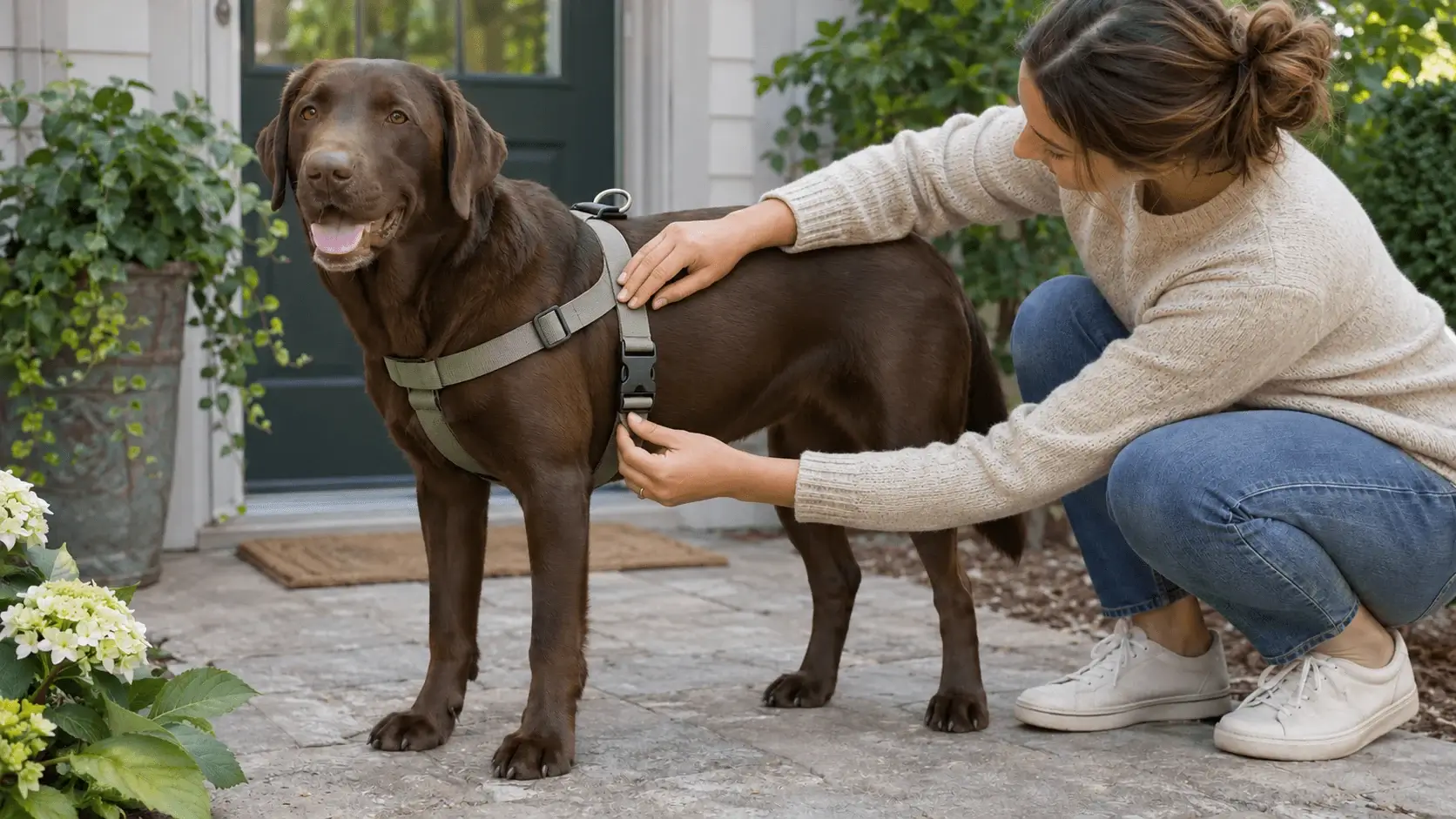
Start somewhere quiet where you can observe the harness while your Lab moves. Inspect straps, stitching, rings, and buckles before use, and look for rubbing or changed strap positions afterward. Recheck measurements when the fit changes. Continue with our guide to build your Labrador training foundation as you practice with the selected harness.