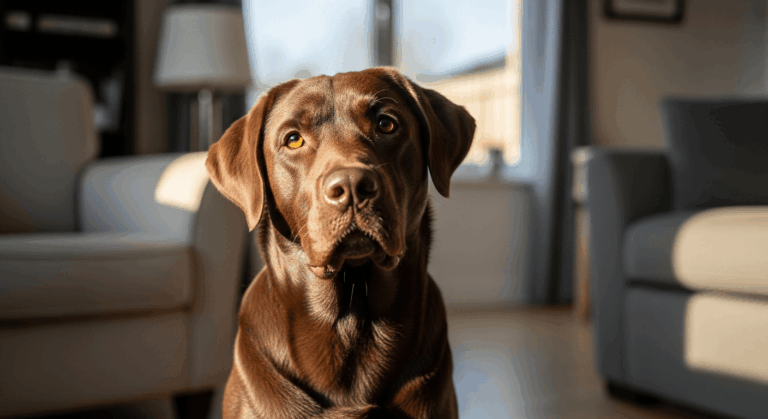
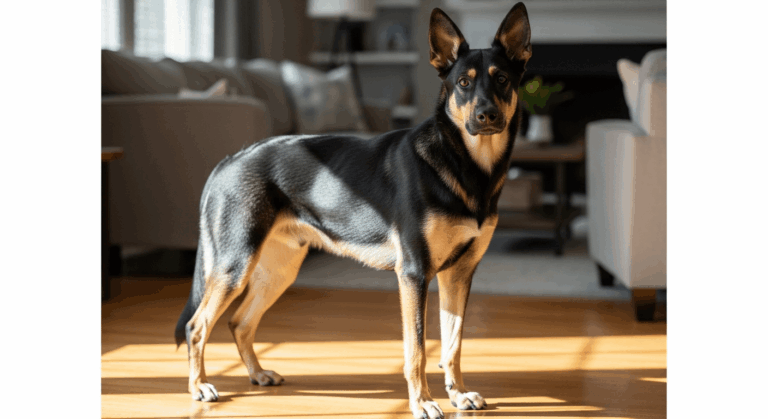
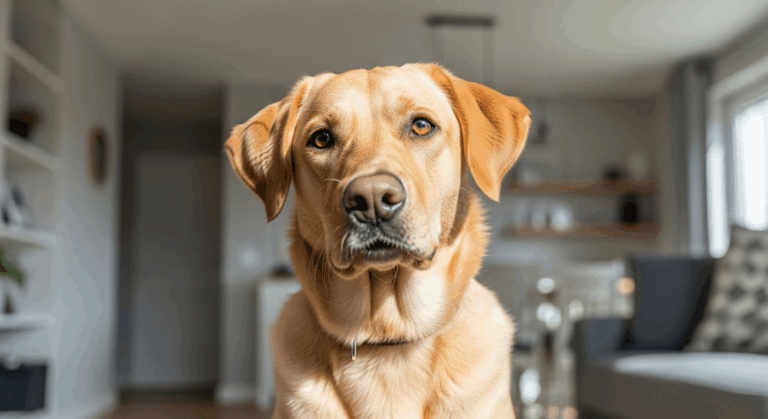
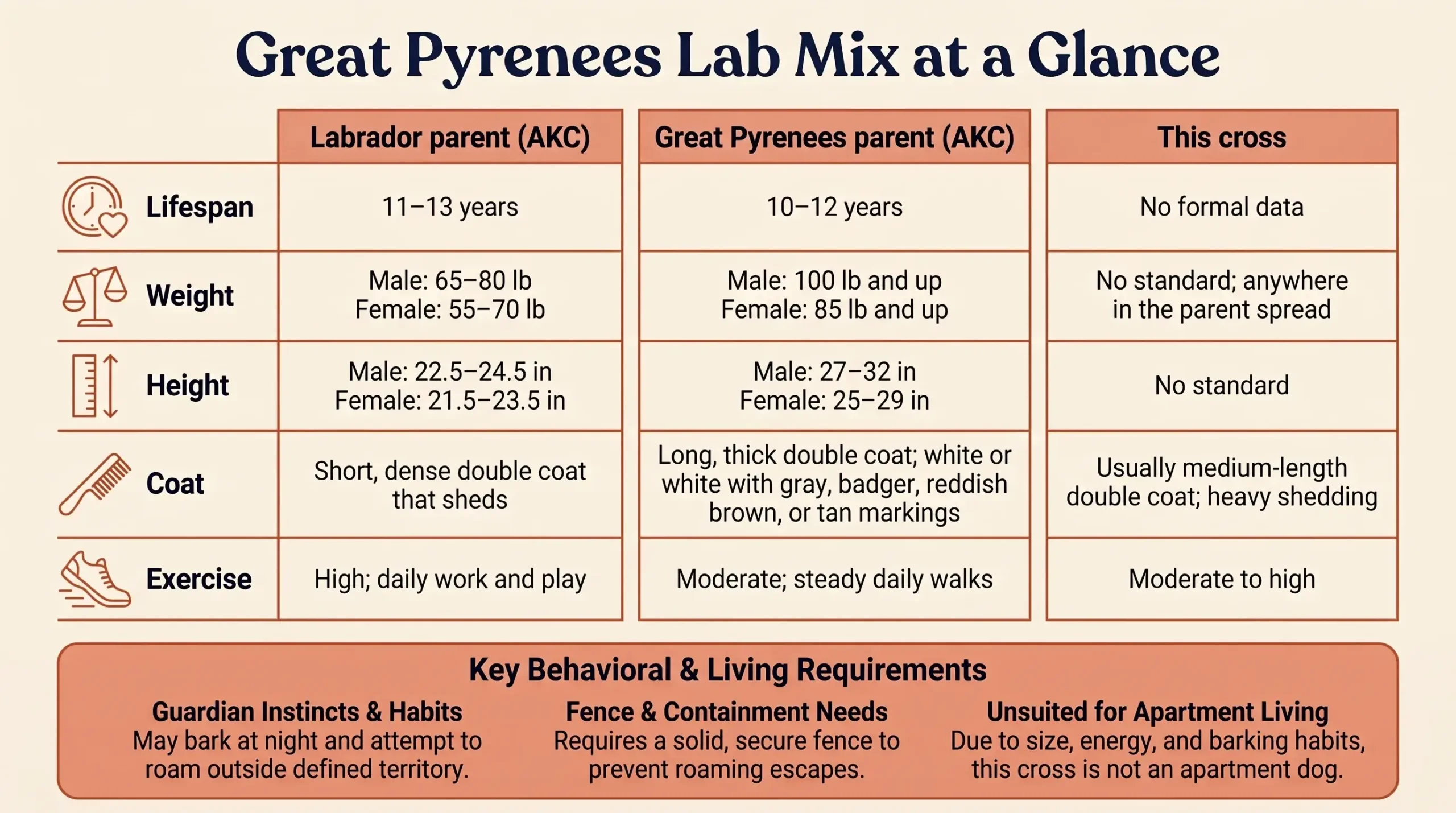
A great pyrenees lab mix is a large dog, often between a big Lab’s 80 pounds and a Pyrenees’ 100-plus. The American Kennel Club lists Great Pyrenees males at 100 pounds and up and females at 85 pounds and up. Labrador males are 65–80 pounds, and females are 55–70.
Those numbers belong to the parents, not to every great pyrenees lab mix. Pyrador and pyrelab are nicknames for the same cross. Neither is an AKC breed, and no club publishes a standard for it.
Pyrador Size
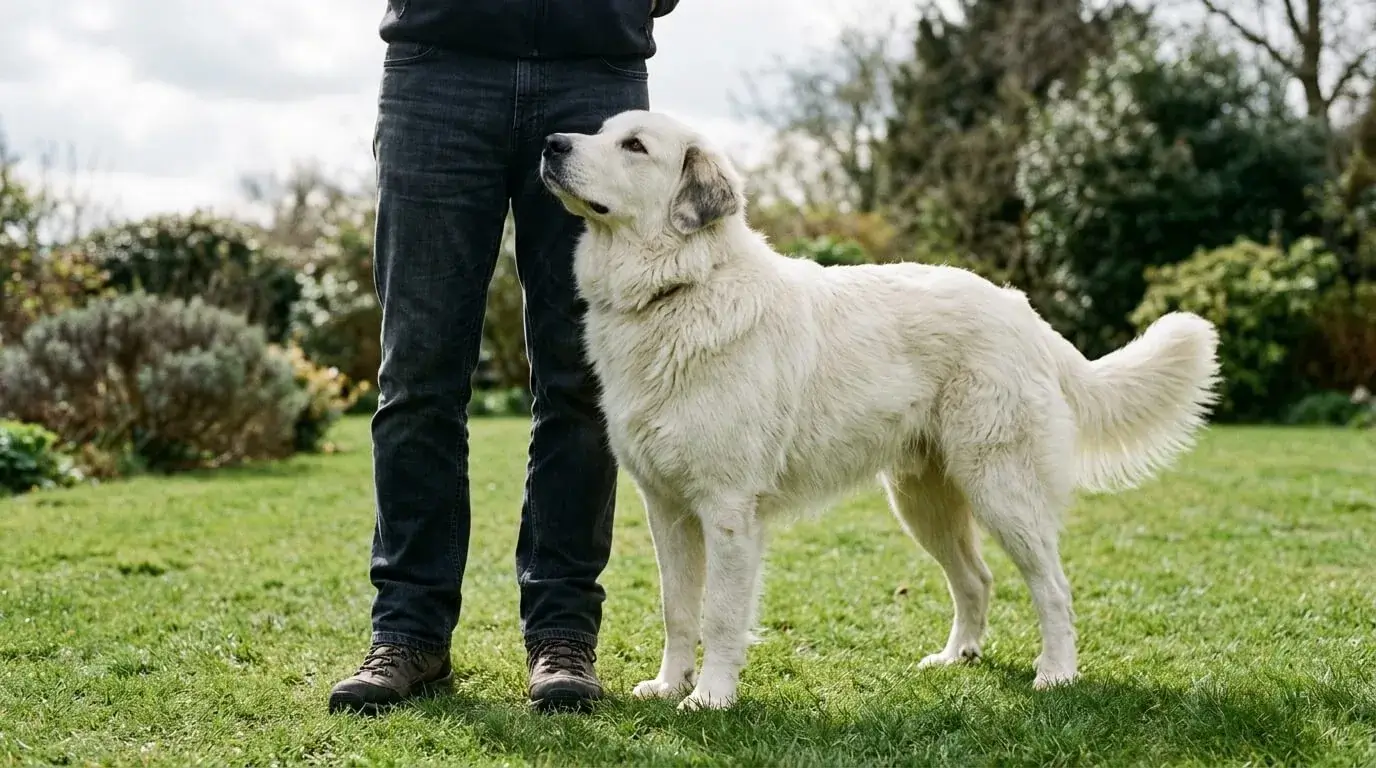
We do not publish one adult weight for a pyrador. One breed-info site prints 70–120 pounds and 23–28 inches. That is their figure, not a club standard. It is a fair picture of how wide the spread can be, and that is all it is.
Here is what the AKC does print. Great Pyrenees males stand 27–32 inches at the shoulder. Females stand 25–29 inches.
Labrador males stand 22.5–24.5 inches, and females 21.5–23.5 inches. Your great pyrenees lab mix can land near either end, or in the middle.
Littermates do not match. One puppy takes the Lab’s shorter coat and tighter frame. The next grows Pyrenees bone and a broad chest.
Look at both parents if you can. Look again at 18 months. Large dogs keep filling out after they stop getting taller.
Plan for the big end. That means a crate for a 100-pound dog, a car that fits one, and a vet who is fine lifting one onto a table. It also means a counter the dog can reach with its chin, flat-footed.
A great pyrenees lab mix is not an apartment dog. The size alone makes stairs and elevators hard. The barking we cover next makes shared walls harder. A house with a fenced yard is the honest baseline.
Some Pyrenees carry double dewclaws on the hind legs. The breed standard calls for them. Any great pyrenees lab mix may inherit them. Ask your vet to show you how to trim those nails, because they do not touch the ground and can grow into a curl.
Barking at Night
The part most care pages skip is the job. A Great Pyrenees was bred to guard sheep from wolves on mountain pastures, often at night, often without a person nearby.
A Lab was bred to fetch birds for a hunter and wait for the next cue. Those are opposite work styles. Your puppy can land anywhere between them.
A livestock guardian barks to warn predators off before they come close. Much of that work happens after dark. That is the Pyrenees half doing its job, not a training failure.
A Lab barks at the door, at a squirrel, and when it is bored. It usually settles once the thing passes. With strong guardian genes, a great pyrenees lab mix may keep going, especially at night, at noises you cannot hear.
This is the single biggest reason these dogs end up in shelters. Neighbors complain. Owners lose sleep. Nobody warned them the cute white puppy was a night-shift guard.
What helps:
- Bring the dog inside at night. A guardian left alone in a yard will patrol and bark.
- Block the window view of the street or field. Less to see means less to announce.
- Reward quiet after one or two alert barks. Thank the dog, then call it away.
- Give the day a real walk and a sniff. A tired dog barks less, though it still barks.
What does not help: yelling, spray collars, or shock collars. A guardian that learns the house is unsafe gets more alert, not less. For stubborn cases, a certified trainer or a veterinary behaviorist is the next step.
If you live close to neighbors and need a quiet dog, choose a different cross. That is a fair decision, not a failure.
Strangers: The Lab Greets, the Pyrenees Decides
Labs tend to meet strangers as friends. A Great Pyrenees tends to watch first and decide later. In a great pyrenees lab mix you can get either, and many do both in the same week.
Expect a great pyrenees lab mix to be gentle with its own family and cautious at the gate. It may stand between a child and a visitor. It may bark at a delivery driver it saw yesterday. That is guardian behavior, and it can scale up if nobody shapes it.
Socialization is the fix, and it starts early. Between about 8 and 16 weeks, let the puppy meet calm people of many ages, hats, beards, and umbrellas. Reward calm. Do not force greetings.
Keep going past puppyhood, because guardian caution often grows in the second year.
Our piece on how protective Labradors really are covers the retriever side. The short version: a Lab alerts and then often wants to be friends. The Pyrenees half may not.
Do not buy a great pyrenees lab mix as a trained guard dog. It is not one. It is a family dog that may take guarding seriously on its own terms. That needs management, not encouragement.
With other dogs, most do fine with dogs they were raised with. Some Pyrenees get firm with strange dogs on their turf. Introduce new dogs on neutral ground, on leash, and watch for stiff posture.
Training uses food and patience. The Lab half is usually eager. The Pyrenees half was bred to think for itself in a field with no shepherd in sight.
Expect a dog that knows sit and chooses when to do it. Short sessions, high-value rewards, and many repetitions work better than force.
Coat, Blow Season, and Shedding
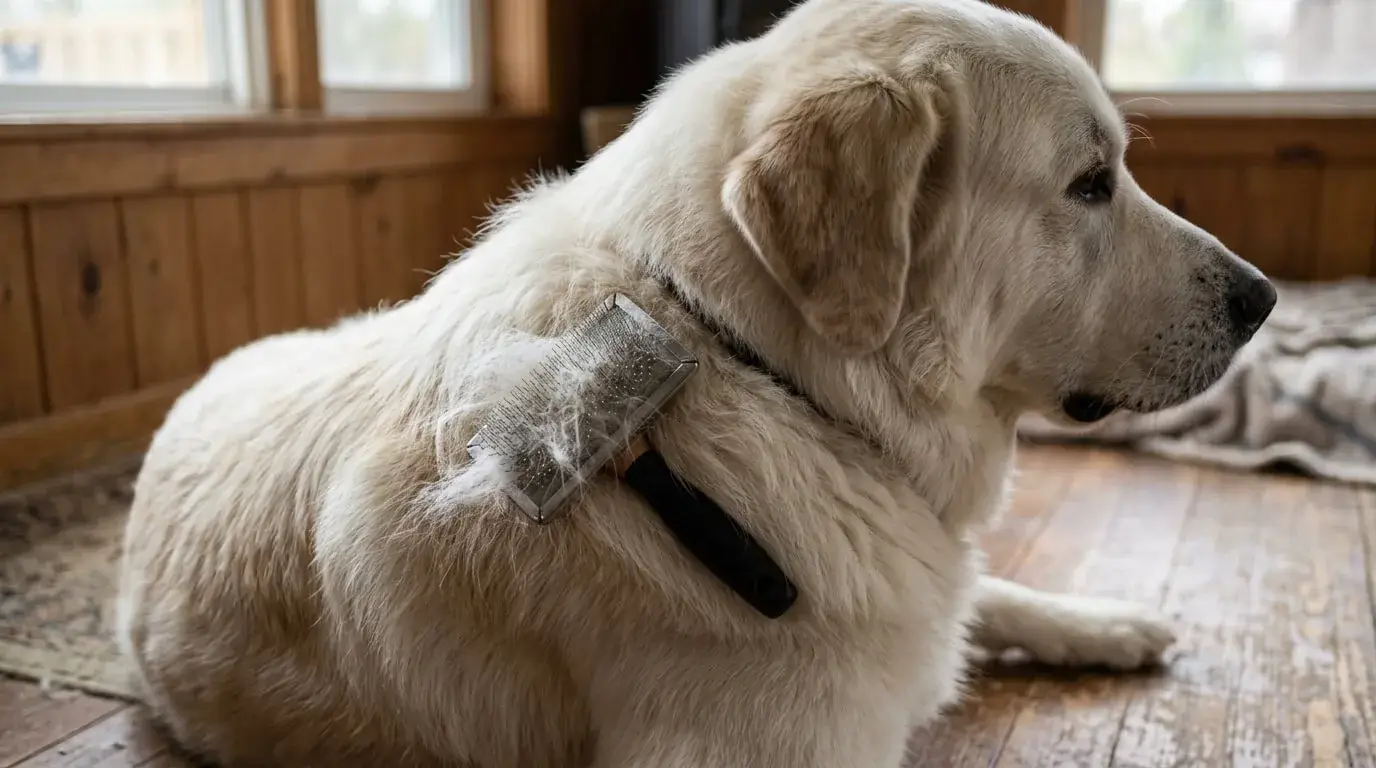
Both parents have a double coat. The Pyrenees coat is long, thick, and weather-resistant. The AKC lists it as white, or white with markings of gray, badger, reddish brown, or tan.
The Lab coat is short and dense. Most of the time, the great pyrenees lab mix lands at medium length and sheds a lot.
No great pyrenees lab mix is hypoallergenic. A pale coat shows less on a white couch and more on dark pants. It is on both.
Expect two heavy blows a year, often spring and fall, plus steady shedding in between. During a blow, brush daily. The rest of the year, two or three times a week keeps mats away.
Mats start behind the ears, under the collar, in the “pants” on the back legs, and in the armpits. Work them out with a comb while they are small. If you cannot see skin under a knot, a groomer is safer than scissors.
Do not shave the coat for summer. A double coat protects the skin from sun and helps regulate heat. A shaved coat can grow back patchy. Keep the dog cool with shade, water, and walks in the cool hours instead.
Baths are occasional, not weekly. A thick coat takes a long time to dry. A damp undercoat against the skin can cause hot spots. Use a high-velocity dryer or a lot of towels, and brush once the coat is dry.
Fences, Space, and Roam
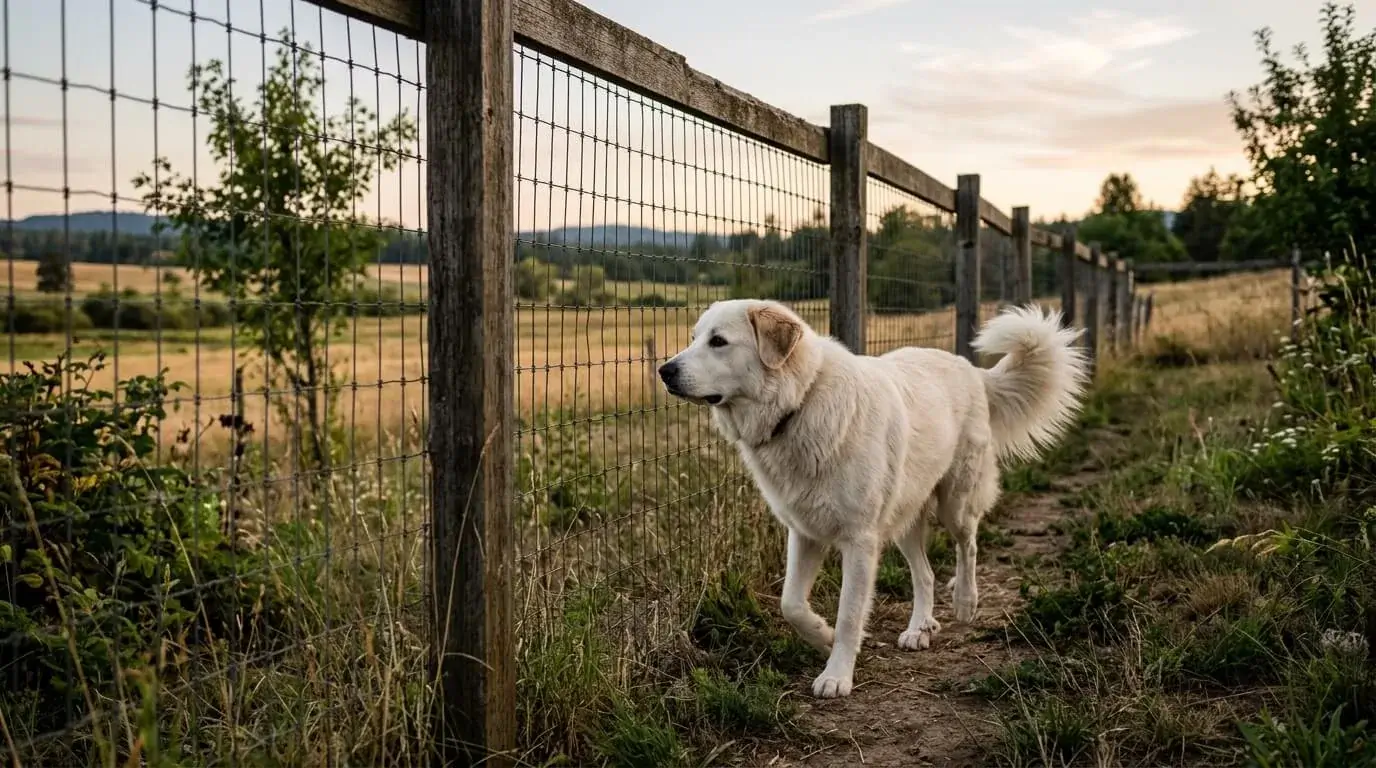
Guardian dogs patrol. A Great Pyrenees treats the pasture edge as its territory and may push that edge out if nobody stops it. That is why Pyrenees owners often say the breed should not be off leash in open land.
A Lab has a strong recall when trained, and a strong nose that can override it. Put those together and a great pyrenees lab mix may wander to check a noise half a mile away. It is not running away. It is working.
What that means for you:
- A solid fence, usually five feet or more, with no gaps at the bottom. Some Pyrenees dig under.
- No invisible fence as the only barrier. A guardian on patrol may take the shock to reach the threat, then not come back through.
- Leash walks in unfenced areas. Always.
- Microchip and an ID tag with a phone number.
Exercise for a great pyrenees lab mix is moderate, not extreme. The Pyrenees parent is steady rather than fast. The Lab parent wants more.
A fair adult day is a long walk, a sniff-heavy outing, and some training or play. Many of these dogs are calm in the house once that is done.
Puppies get less. No forced running or long jogs while growth plates are open. Large breeds grow for a long time. Short walks and free play on soft ground protect the joints.
Heat matters for a great pyrenees lab mix. A thick coat and a Lab engine can overheat on a warm day. Walk at dawn and dusk in summer. Carry water.
Hips, Bloat, and Eyes as Parent Questions
No formal data exists for how long a great pyrenees lab mix lives. The AKC lists Great Pyrenees at 10–12 years and Labs at 11–13. Those ranges overlap. We will not blend them into one number for the mix.
Hips and elbows are the large-dog question on both sides. Ask the breeder for hip and elbow scores on both parents. A clearance is a screen, not a guarantee. Keep the dog lean, because extra weight loads growing joints.
Bloat is the emergency to know. Large, deep-chested dogs are at higher risk of gastric dilatation-volvulus, where the stomach fills with gas and can twist. VCA Animal Hospitals lists retching without bringing anything up, a swollen belly, and restlessness among the signs. That is a same-hour vet visit. Ask your vet about feeding smaller meals and whether a preventive gastropexy makes sense for your dog.
Eyes are a Lab-line question. Many Lab breeders test for inherited eye disease and have the parents examined by a veterinary ophthalmologist. Ask whether that was done.
Ask the Pyrenees side too. What did the parents and grandparents live to? What did they die of? A breeder who does not know is giving you an answer.
Weight hides under a thick coat. Use your hands on the ribs every week. You should feel them under a thin layer without pressing hard.
The Lab half will eat everything you offer. Measure meals.
FAQ
Are they good guard dogs?
Many are watchful, and some are protective. That is not training, and it is not guaranteed. Think of a great pyrenees lab mix as a family dog with possible guardian instincts, which need socialization and management rather than encouragement.
Do they bark a lot?
Often, yes, and often at night. The Pyrenees half was bred to bark predators away in the dark. Keep the dog inside at night, block window views, and reward quiet. If you share walls with neighbors, pick a quieter dog.
How big is a great pyrenees lab mix?
There is no standard. The AKC lists Great Pyrenees females at 85 pounds and up, males at 100 pounds and up, and 25–32 inches tall by sex. Labs are 55–80 pounds and 21.5–24.5 inches. A great pyrenees lab mix can land anywhere in that spread.
Plan for the large end.
Are they good with kids?
Usually gentle with their own family, and heavy. Older kids who can follow house rules do better than toddlers. Supervise every greeting, and teach kids not to climb or hug the dog. Watch for guarding around children’s friends who visit.
A great pyrenees lab mix is a big, gentle family dog that may bark all night and patrol the fence. If you have space, a solid fence, and patient neighbors, it can be a loyal companion.
The bernese mountain dog labrador mix is the closer large-coated sibling. Our Labrador mix hub covers the rest. Read the retriever parent in our guide to the Labrador Retriever before you count on the Lab half to quiet the guardian.