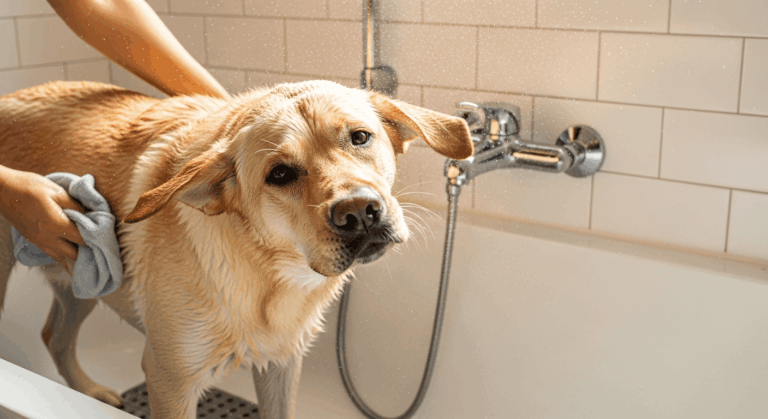
The best toys for Labs fit the activity your dog enjoys, their mouth size, and the supervision you can provide. A stuffable rubber toy gives a dog something to work on between throws. A ball or flying disc makes sense when the game is retrieving, and a puzzle board gives a food-motivated dog a different job.
We compare four specific options for adult Labradors. Choose one for a game you can supervise, then inspect the toy after play. If your dog starts tearing at it or trying to swallow parts, end the session and reconsider the toy.
By PuppDelight Editorial Team
Our comparison is based on manufacturer specifications, product instructions, and U.S. retailer listings. The picks reflect that documentation and our editorial judgment.
Amazon prices were checked November 23, 2026, for delivery to New York 10001. Prices are in USD before tax and shipping. Check the selected size, seller, and current total before ordering.
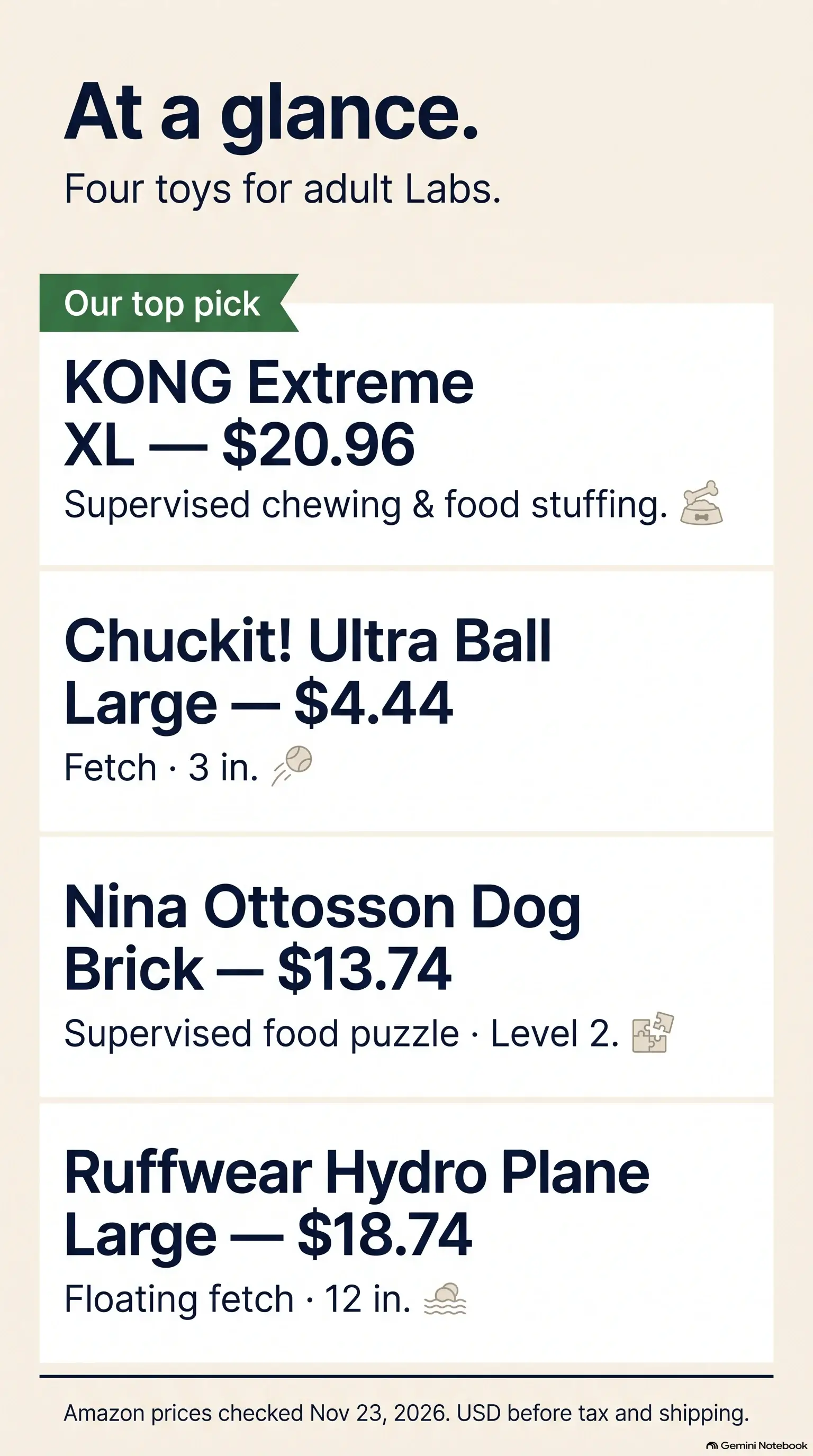
Four options for chewing, fetch, puzzles, and floating play
Start with what happens after your Lab picks up the toy. For a dog that brings it back, a ball or disc gives you a way to repeat the game. A dog that wants to stay put and chew may be better served by the KONG.
A dog that enjoys searching for food may take to the Dog Brick once you show them how to open an easy compartment. Whatever you choose, balance games with your Labrador’s activity needs and allow rest between sessions.
OUR TOP PICK · SUPERVISED CHEWING
01 · STUFFABLE RUBBER
KONG Extreme
X-Large · Black · 1 count
$20.96 at Amazon
USD · Price checked Nov 23, 2026 · Pattern Products
Consider this for
A Lab that settles with a food toy.
What makes it different
The hollow center holds part of a meal.
Check before buying
Check mouth fit and remove the toy if damaged.
Our top pick for supervised chewing and food stuffing. The hollow center lets you use some of the same kibble you already feed. We would try this first for an adult Lab that settles with a food toy and can carry the selected size comfortably.
KONG’s Extreme product instructions identify the black material as natural rubber and give 60–90 pounds as the X-Large weight range. KONG also advises that the widest part of the toy should exceed the width of the back of the dog’s mouth. Its guidance says to size up when fit is uncertain, especially for a dog that chews persistently.
The food goes into one cavity, so you can start with a loose fill and observe how your dog gets it out. Try that before making the food harder to reach. A dog that loses interest with tightly packed food may still enjoy a toy that releases a few pieces when moved.
Main limitation. The rubber can wear or tear. Take the toy away if you see a split, a missing piece, or damage around the opening. Reassess the size if the widest part can slip behind your dog’s teeth.
FOR SUPERVISED FETCH
02 · FLOATING RUBBER BALL
Chuckit! Ultra Ball
Large · 3-inch diameter · Orange and blue · 1 count
$4.44 at Amazon
USD · Price checked Nov 23, 2026 · Amazon.com
Consider this for
A Lab that brings a ball back.
What makes it different
A 3-inch ball with a thick rubber core.
Check before buying
Confirm fit and put the ball away when the game ends.
Consider it for supervised fetch. The selected Amazon listing identifies the ball as Large and 3 inches across. Petmate’s Ultra Ball documentation describes a thick rubber core, a floating design, and compatibility with matching launchers.
A round ball is useful for a dog that watches for a bounce and brings the toy back to your hand. Try gentle rolls or low throws first so you can watch the pickup. The bright surface can help you keep track of the ball on grass, and its buoyancy gives you the option of retrieving it near the water when conditions are suitable.
Main limitation. Save this ball for the game. A suitable size is easy for your dog to carry and too large to fit entirely inside their mouth. If the ball disappears into the mouth, stop and choose a different size.
When your Lab begins lying down to gnaw, trade for the ball and put it away. Petmate also advises replacing toys with rips, tears, or cuts. Check for Large, one ball on the retailer page because the family includes other diameters and pack sizes.
FOR SUPERVISED FOOD SEARCHES
03 · LEVEL 2 PUZZLE BOARD
Nina Ottosson Dog Brick
Outward Hound · Level 2 · Standard blue-and-red board · 1 count
$13.74 at Amazon
USD · Price checked Nov 23, 2026 · Amazon.com
Consider this for
A food-motivated Lab that can work the covers gently.
What makes it different
Flip, slide, and lift covers to uncover food.
Check before buying
Watch the removable parts and store the board after play.
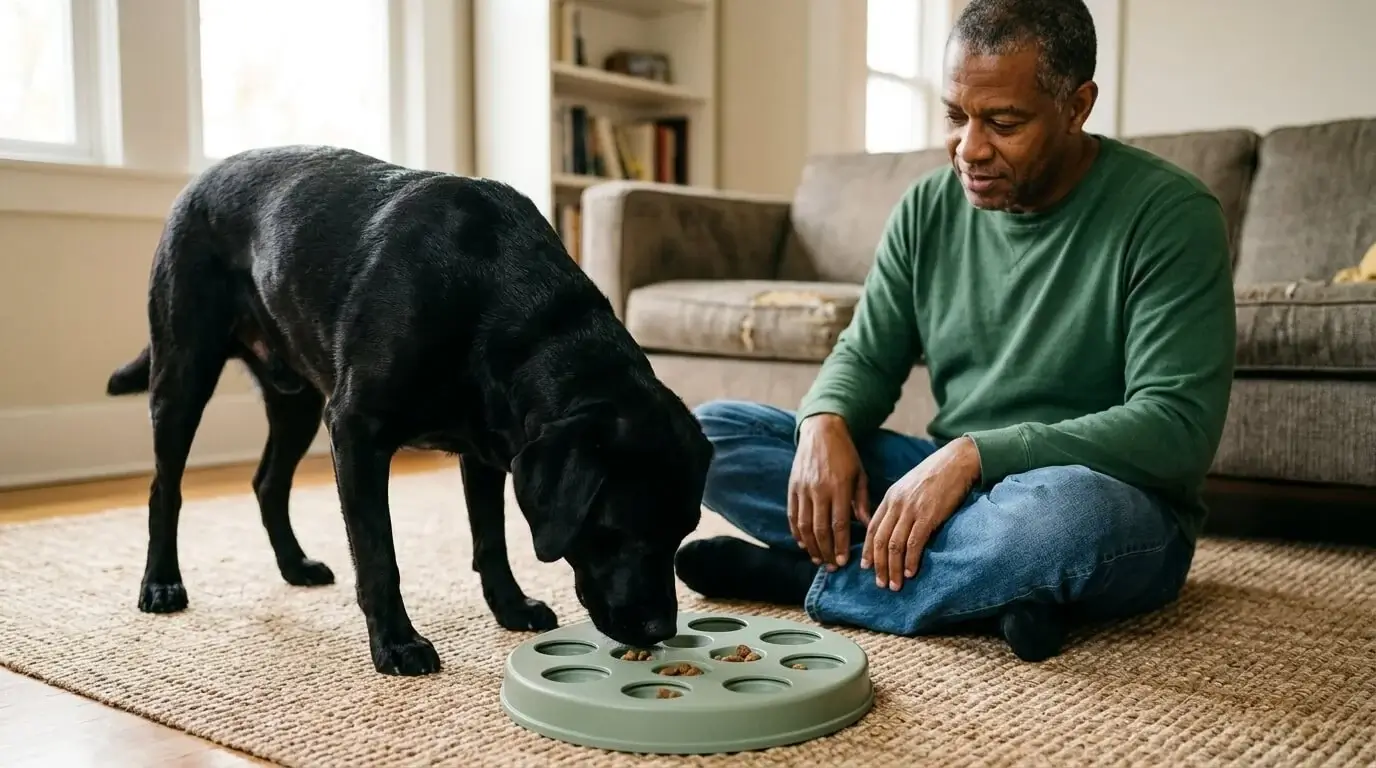
Consider it for supervised food searches. Outward Hound’s Dog Brick instructions show three ways to reach food. Your dog can flip a lid, slide a compartment, or lift a removable white cover. The plastic board and pieces wash by hand with soap and water.
Set the board on a stable surface and give your dog an easy first search. Leave one lid partly open, with a piece of their regular kibble in view. Once your Lab understands how the lid moves, try one closed compartment.
Main limitation. The removable pieces require close supervision. End the session if your dog chews a cover, tries to swallow a piece, or bites the edge of the board. Check that every piece is present and intact before putting it away.
If your dog keeps switching from searching to chewing, offer an easier food activity with equipment suited to that behavior. Count the kibble or treats you load into the board as part of that day’s food.
FOR FLOATING FETCH
04 · FLOATING FABRIC DISC
Ruffwear Hydro Plane
Large · 12-inch diameter · Biolumin Blue
$18.74 at Amazon
USD · Price checked Nov 23, 2026 · Ruffwear, Inc.
Consider this for
A Lab that carries a disc by its rim.
What makes it different
Buoyant foam under a fabric shell.
Check before buying
Put it away if your dog starts chewing the fabric.
Consider it for retrieving a floating disc. Ruffwear’s Hydro Plane specifications list a 12-inch diameter for Large, a polyethylene foam rim and body, and a fabric shell that includes nylon. The foam provides buoyancy. The wide rim gives a dog a different shape to pick up from the grass or water than a round ball.
Start on dry ground with a low throw or place the toy a short distance away. Watch whether your Lab can pick up and return the rim without repeatedly stepping on it or dropping it. A dog that finds the Large awkward may do better with a different size or shape.
Reserve water play for places where your dog can enter and get out easily. Choose distance and conditions based on your dog’s swimming ability.
Main limitation. The disc works for interactive retrieves. If your dog starts chewing the fabric between throws, trade for the disc and put it away. Ruffwear recommends discarding it if a part loosens or detaches.
The manufacturer calls for hand washing with mild detergent and air drying. After water play, let it dry thoroughly before storing it with other gear.
Choose size and materials for your dog
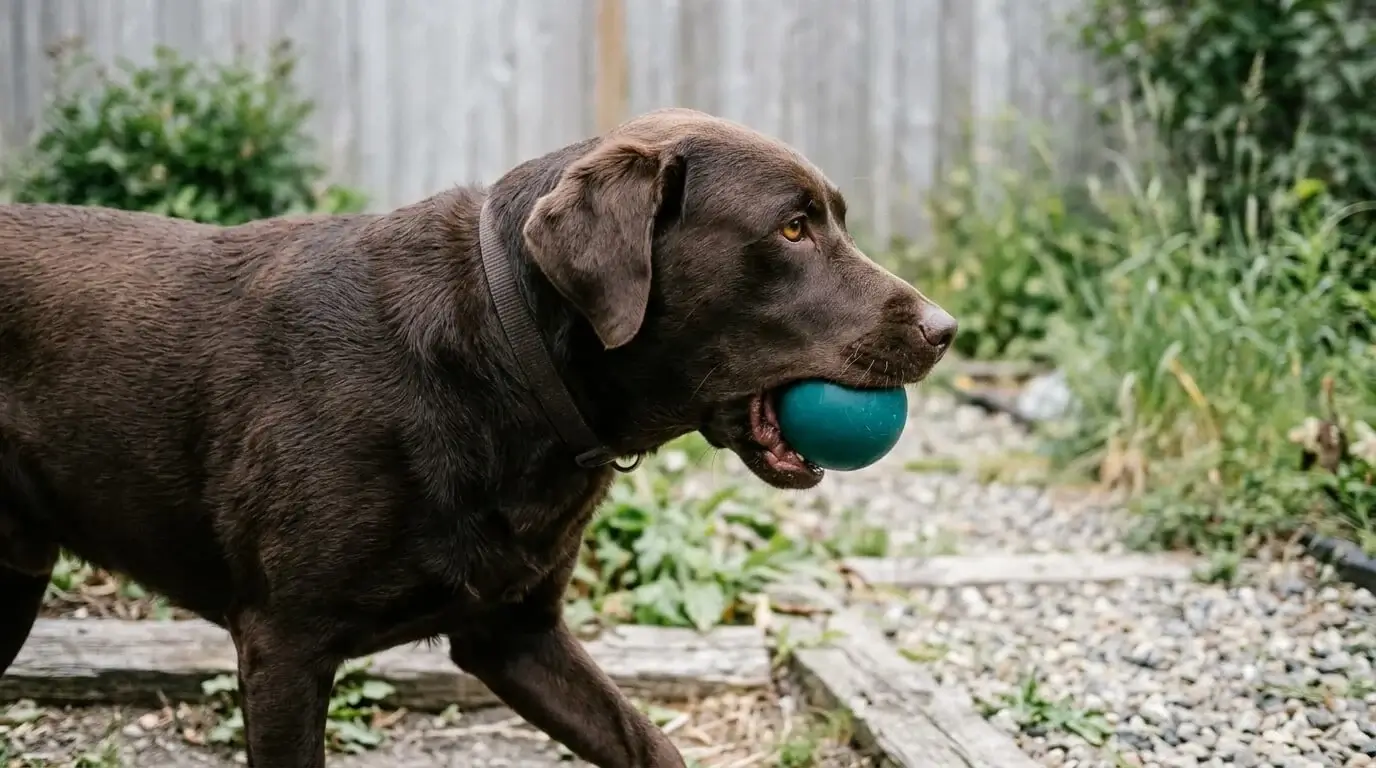
A Labrador who carries a toy gently and a Labrador who bears down on it may need different choices. Watch how your dog handles an intact toy during play. Look for whether they use their front teeth to tug at edges, press down with their back teeth, or repeatedly try to move the whole item deeper into their mouth. That behavior tells you more about fit and supervision than the word “Large” on a listing.
For the ball, check whether your dog can pick it up and release it easily while the ball stays too large to go entirely inside their mouth. For the KONG, use the widest point and the manufacturer’s mouth-fit guidance in addition to the weight range. A ball’s diameter and a KONG’s size label describe different shapes. Compare each one against the dog in front of you.
Choose the material for the task. The KONG’s firm rubber can hold food and is designed for supervised chewing. The Ultra Ball’s rubber construction serves a throwing game. The disc needs to stay intact around its rim and seams, and the Dog Brick’s moving plastic pieces make sense only while you can watch the dog work them.
This guide covers adult Labs. A growing puppy has different mouth dimensions and may handle an item differently as their teeth change. Check the current size and the manufacturer’s age guidance whenever you move a toy from one dog to another or reuse one your dog had when younger.
VCA Animal Hospitals’ guidance on activity toys recommends choosing a size your dog cannot accidentally swallow and watching how the dog interacts with it. For a food toy, VCA also advises starting at a difficulty your pet can manage. If your dog becomes frustrated, make the food easier to reach and see whether they return to searching.
Supervise, inspect, clean, and rotate
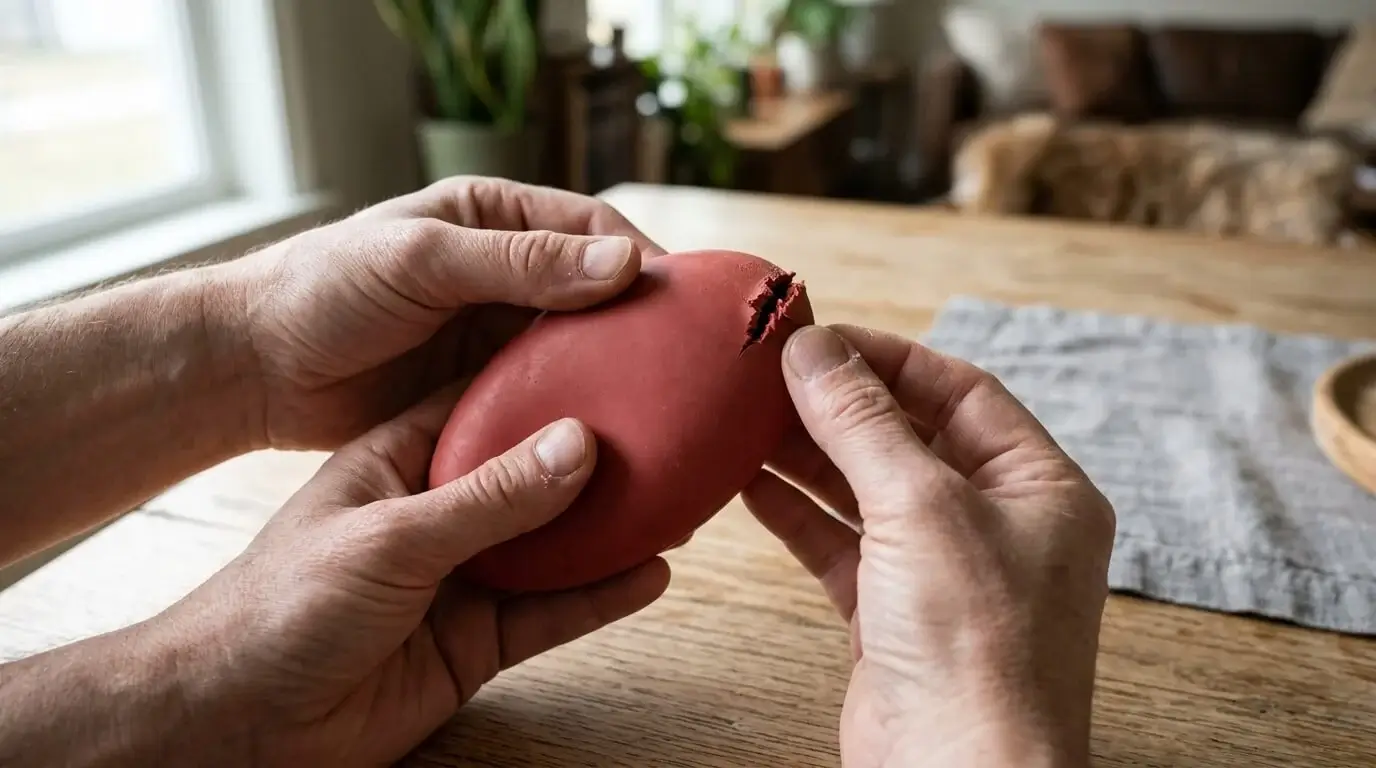
Stay close enough to see what your dog is doing. Step in if play turns into pulling pieces off, trying to swallow a component, or fighting over the toy. Keep dog toys separate from children’s belongings and supervise a Labrador around children. In a busy room, set up the food game in a quiet space where an adult can watch.
Inspect the parts most likely to show damage after each session. Look around the KONG opening, turn the ball to check its surface, count the puzzle pieces, and check the disc’s seams. Remove an item with cracks, sharp edges, missing pieces, or an open seam.
As you plan for replacement gear costs, use each toy’s condition and your dog’s habits to decide what needs replacing.
For the KONG, follow the manufacturer’s cleaning directions and scrub out food residue with warm water, dish soap, and a small brush. KONG also allows the upper dishwasher rack for its rubber toys, with heated drying switched off. Wash the Dog Brick by hand and clean under the moving covers. Rinse dirt off the fetch ball, and follow Ruffwear’s hand-wash instructions for the disc.
Set aside the puzzle portion before filling the food toy. If you use part of dinner, serve that much less in the bowl. Include extra treats in the day’s food allowance, especially if you use a stuffed KONG and a puzzle on the same day.
Store toys by use so the right one is available. A dry fetch ball can go with your outdoor gear, while a clean puzzle can stay near the food bin. Rotate according to what your dog actually plays with. A food search adds variety alongside walks and training.
How we compared these toys
We chose four models with distinct jobs and checked the manufacturer’s stated purpose, size, materials, cleaning directions, and restrictions. The comparison uses the exact variants offered for a U.S. delivery address on November 23, 2026.
We matched the selected size and pack before recording the main Amazon offer. For KONG and Chuckit, the linked Chewy listings show the same sizes.
Published specifications explain features such as a food cavity, a floating foam rim, and removable puzzle parts. We picked each option for a game that uses its design. A ball at $4.44 is useful if your Lab brings it back. A food board earns its space if your dog can search without chewing the pieces.
Frequently Asked Questions
What is a Labrador’s favorite type of toy?
It depends on the dog. A Lab that brings objects back may enjoy a ball or disc, while a dog that likes working for food may prefer a stuffable toy or puzzle. Watch which game your dog returns to after a short break.
Can my Labrador chew a fetch ball between games?
Put the fetch ball away when the retrieving game ends. If your Lab switches to sustained gnawing, trade for the ball and choose a suitably sized toy intended for supervised chewing. Replace a fetch ball that is torn, split, or otherwise damaged.
Can a puzzle board be left with my dog when I go out?
The Dog Brick is for close supervision. Stay with your dog while they use it, check that the pieces are intact, and store the board after play. Take it away if your dog starts chewing a cover or the board itself.
Do tough rubber toys last forever?
Tough rubber can wear or tear. Check the surface and opening after use, especially if your dog works one spot repeatedly. Discard a damaged toy and reassess the size or design if your dog is able to remove pieces.
Do food toys replace walks or training?
Food toys provide a separate activity. Keep walks and training in your routine, and use some of your dog’s daily food to make an easy search or stuffing game. Count everything you put inside toward the day’s food allowance.
Start with the activity your dog enjoys
Pick the game your dog already asks to play. Check the fit, supervise the first session closely, and put the toy away as soon as the game ends. Use the activity your dog keeps coming back to as one part of how you plan your Lab’s home routines.